


I arrived on Dalyan’s waterfront just after nine, when the light was still soft on the river and the first boats were warming their engines. The air smelled of brackish water, sunscreen and strong Turkish tea, and across the channel the rock-cut tombs of ancient Kaunos were already catching the sun. I had come for a single, linked experience: to follow the Dalyan river-delta system by boat, out past the reeds to İztuzu turtle beach on the Mediterranean, then work my way back via the ruins of Kaunos, tying together landscape, history and conservation in one long day.
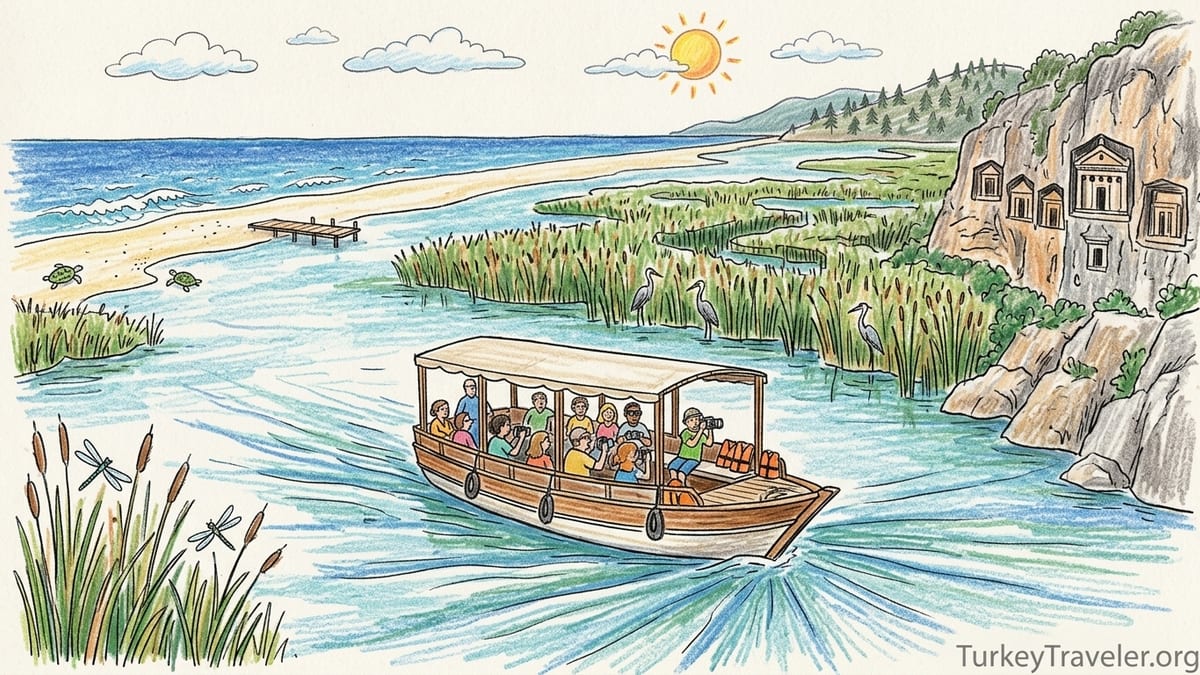
Boarding at Dalyan’s Waterfront
Dalyan’s riverside is a working waterfront, not a stage set. When I walked down from Maraş Caddesi to the main quay, men were loading crates of water and bread onto narrow, low-slung riverboats, while a few early visitors compared prices at the chalkboards by the gangplanks. Each board listed routes to İztuzu Beach, some only to the sea and back, others bundled into full-day cruises with mud baths or a run across Köyceğiz Lake. I wanted the most direct feeling of the river itself, so I skipped the big day-trip boats and headed to the line of public “dolmuş” riverboats that shuttle between Dalyan and İztuzu.
The system is straightforward once you know to look for the small booth by the main jetty. There, I bought a Dalyan–İztuzu return ticket, which in late 2025 was posted at between 175 and 350 lira depending on the operator and season. The woman in the booth stamped a small card for me and pointed to a boat that was already half full. These public riverboats are long and open-sided, with wooden benches around the edges and a simple canvas roof stretched overhead. They are not luxurious, but the seating is padded, and on a warm morning with a breeze pushing up the channel it felt entirely comfortable.
As we waited for the last passengers, the captain moved along the outside of the boat, untying thick ropes from the cleats. The engine coughed into life, loud and slightly rough at idle, then settled into a deep, insistent thrum. That motor noise would be our constant companion for the next 40 to 45 minutes. It was not deafening, but you needed to lean close to hold a conversation. On the plus side, the low speed of the boat and the open structure made it easy to look out and photograph the banks without having to stand on tiptoe or elbow for space.
We slid away from the quay, the town dropping behind us in a line of pensions, restaurants and small jetties. Immediately to our right, carved into the sheer rock face above the far bank, were the Lycian-style tombs usually called the “Kings’ Tombs.” Their facades, with their columns and triangular pediments, looked like miniature temples in the cliff. The captain throttled back for a minute so we could all take them in: this was my first close encounter that day with Kaunos, although the city itself lay hidden beyond the ridge, out of sight from the river.
Through the Reed Labyrinth of the Dalyan Delta
Once past the tombs the channel widened, then narrowed again, twisting into a maze of reeds that seemed to swallow the town behind us. The Köyceğiz–Dalyan Special Environmental Protection Area stretches around this whole lagoon system, and from the boat it feels like true wetland, not simply a pretty backdrop. Tall reed beds hem in the channel, sometimes so close that you can see individual dragonflies on the stalks. The water here is still predominantly fresh, fed by the lake and by small streams higher in the basin, and the surface held a slight brown-green tint from silt and vegetation.
The engine maintained a slow but steady pace, maybe 6 or 7 knots at most. The ride felt surprisingly gentle given the mechanical noise. Ripples fanned out behind us, but there was very little wake to slap the banks, a small reassurance when you remember how fragile these wetlands are. Our captain cut power completely in one or two especially narrow sections, drifting while another boat coming the other way slid past in near silence, passengers traded glances and cameras between us.
Wildlife was present, but subtle. I saw grey herons standing motionless in the shallows, and once a flash of electric blue as a kingfisher shot low across the bow to disappear into another wall of reeds. This area is known among birdwatchers for marsh terns, glossy ibis and various waders, but on a late-summer morning with a chatty group aboard, the birds kept a polite distance. I did not see any Nile soft-shelled turtles, which are occasionally spotted near the mud bath area upriver, and I was careful not to talk myself into imagining one. This is the kind of landscape that encourages wishful sightings, but it felt important to be honest with myself about what I actually saw and what I simply hoped was there.
As we progressed, the water slowly lost its river-brown tint and shifted toward a clearer green. The captain pointed ahead where the channel began to open out, explaining in Turkish and simple English that just beyond lay the back side of İztuzu, the long spit of sand that separates this inland lagoon system from the open Mediterranean. It was a geographic turning point as much as a visual one: we were about to leave the realm of reeds and sluggish freshwater and meet the waves, wind and salt of the sea.
Arriving at İztuzu: A Barrier Between River and Sea
İztuzu Beach itself is a narrow ribbon, about 4.5 kilometres long, running roughly east to west. It forms the natural barrier between the Dalyan delta and the Mediterranean, which on maps looks almost like a stitched seam where brown-green lagoon water and deep blue sea try to meet but never quite merge. Our riverboat pulled into the western end of the beach, the side only accessible by water. The captain nosed the bow against a wooden pier, and we all stepped down onto sun-bleached planks already warming in the late morning sun.
From this end, the sand forms a low, slightly curved arc, backed by brackish shallows and patches of reeds. The sea on my left rolled in with small, regular waves, breaking in long, foamy lines along the shore. Under my feet the sand felt fine and compact near the water, gradually becoming softer and more powdery as I walked away from the tide line. There were organized rows of sunbeds and umbrellas here, but only in designated sections, backed by simple wooden cabins that served as snack bars, showers and toilets.
The facilities at the boat end of İztuzu are basic but adequate. There are public toilets and freshwater showers, which in 2025 charged a modest fee payable in lira or coins dropped into a box. Simple beach cafes serve gözleme, chips, packaged ice creams and cold drinks. Prices were higher than in Dalyan itself, which is normal for a captive beach, but plainly posted at the counters. There is no high-rise development, no hotel backing directly onto the sand. The whole setup felt temporary and light on the land, as if it could be removed between seasons.
I had several hours before my planned return boat, so I walked a little way along the shore. It is only when you begin to cover the distance on foot that the shape of İztuzu really becomes clear. To reach the opposite, road-accessible end would have taken well over an hour of steady walking in full sun, and that is before you consider the heat radiating off the sand. Somewhere down that way, near the low hills, lay the small complex of buildings associated with the turtle conservation center and the dolmuş stop where minibuses arrive from Dalyan and Ortaca. The fact that riverboats and road access arrive at opposite ends of the beach has practical consequences, which I would only fully appreciate later when I tried to coordinate onward travel to Kaunos.
Turtle Protection and Ordinary Beach Life
Even in the middle of the day, when İztuzu functions mostly like any other family beach, reminders of its role as a prime nesting site for loggerhead turtles are everywhere. Signs in Turkish and English mark off the dune line and back-beach zones where walking is discouraged, explaining that nests are buried beneath the sand. Wooden stakes and light fencing demarcate specific stretches where sunbeds and umbrellas are not permitted at all. In these sections, people simply lay their towels on the open sand between the stake lines and the water.
One board outlined the basic rules: during the main nesting season, from 1 May to 31 October, the beach is closed to the public between 20:00 and 08:00. That means all ordinary beach use, including swimming, walking with flashlights, barbecues and any form of camping, is prohibited on the sand during those hours. The idea is to give adult females and later hatchlings a quiet, dark window to emerge and orient themselves without being disoriented by artificial light or disturbed by people. I noticed that there were no tall floodlights or loud beachfront venues. The sunbeds all sat in front of the stake lines, and the few permanent structures were single-story and set back.
As a visitor, it changes how you behave. The temptation on any clean, gentle-shelving beach is to wander wherever the sand looks nicest, or to drag a sunbed closer to the water. Here, staff and lifeguards politely but firmly redirect people who stray into marked nesting areas or try to shift equipment. Even the placement of umbrellas is controlled. I watched a beach worker carefully reposition a parasol that someone had moved onto a taped-off patch of sand, quietly explaining why that particular spot might conceal a nest. There was no drama, just steady insistence that the rules matter.
I swam several times during my stay. The water at İztuzu was warm and slightly turbid near the shore, with a gradual drop-off that felt safe even for families with children. Small waves made for fun, low-key body-surfing, and beyond the first breakers the sea settled into a calmer, deeper blue. I kept scanning the surface out of pure hope that a turtle’s head might break through, but nothing appeared, and that was fine. Conservation work here, as the signs made clear, is about giving turtles space, not orchestrating close encounters for tourists. The loudest sounds were shouts of children in the shallows and, faintly, the rumble of a generator somewhere behind the cafes.
Later in the afternoon I walked toward the inland side, where shallow lagoon water laps at the sand. You can wade in, but most visitors stick to the seaward edge. Here the contrast between freshwater and salt, between flat, sheltered lagoon and energetic open sea, really comes into focus. It underscored the idea that İztuzu is not simply a pretty strip of sand, but a functioning barrier between two different ecosystems, crucial for both birdlife and sea turtles.
DEKAMER, Conservation Work and the Other End of the Beach
I did not have time to walk the full length of the beach, but later in the season I returned by road specifically to visit the area near DEKAMER, the Sea Turtle Research, Rescue and Rehabilitation Center that operates close to the eastern, dolmuş-accessible end of İztuzu. From Dalyan, minibuses depart from the stop opposite a central restaurant and follow a winding road past Sülüngür Lake, reaching the beach in roughly 20 to 25 minutes under normal traffic. Fares change with inflation, but in 2025 a two-ride local card showed a price in the high double digits of lira, cheaper than the boat if you are travelling solo and do not mind the road.
The atmosphere at this end of the beach felt slightly busier. There is a larger car park, a more substantial snack bar complex and clearer signage pointing to the turtle center. DEKAMER itself is not an entertainment attraction; it is a working facility where injured turtles are treated and where researchers monitor nesting activity and collect data. Public access, when allowed, typically involves brief, structured visits to small information areas, sometimes with views of recovering turtles in pools. During my visit, a staff member stressed that touching, feeding or posing closely with the turtles was strictly off limits. Their emphasis was on education and scientific work, not photo opportunities.
That distinction matters in a region where boat operators and informal guides sometimes market “turtle watching” in ways that blur the line between respectful observation and harassment. At İztuzu, all the official messaging I saw was aimed at reducing human impact: keep umbrellas out of marked zones, leave no litter, do not stay on the beach after nightfall, avoid shining lights on the sand. No one promised guaranteed turtle sightings, and I did not witness any hatchlings making their way to the sea. Any story that pretended otherwise would feel dishonest, and would undercut the very conservation messages the place tries to convey.
Logistically, the split between the riverboat end and the road end can be a little confusing. If you arrive by public boat, you land at the west, with a simple pier, cafes and sunbeds. If you arrive by dolmuş, you reach the east, near the car park and the DEKAMER facilities. There is no regular transport running along the sand itself, for obvious environmental reasons. Anyone who wants to experience both ends in a single visit either walks the length of the beach or combines different modes of arrival and departure, for example taking the boat downriver in the morning and returning to Dalyan by minibus later.
Back to the River and Onward to Kaunos
By mid-afternoon the sun had deepened and the sand was almost too hot to cross barefoot. I rinsed the salt from my skin at one of the freshwater showers, changed into dry clothes in a basic cabin and boarded a returning riverboat for Dalyan. The ride back followed the same 40–45-minute route but felt subtly different in late-afternoon light. Shadows from the reeds stretched longer across the water, and the rock tombs were now front-lit, glowing amber against a deepening sky as we approached town.
Instead of lingering at a riverside café, I stepped straight off the İztuzu boat and walked ten minutes downstream to the small ferry landing used for the Kaunos crossing. There are actually two options to reach the opposite bank near the ruins: tiny rowed or motorized boats that act as pedestrian ferries, and a slightly larger car ferry a bit further along which can take both vehicles and walkers. I chose the small passenger boat, which was tied to a rough wooden dock shaded by a single tree.
The crossing took less than five minutes. The man piloting the boat collected a modest fare in cash, quoted in euros and lira on a hand-painted sign. The amount was the rough equivalent of a few euros, small enough that I did not begrudge paying a bit more than a local might. As we slid across, the tombs loomed overhead in the cliff, appearing even higher and more imposing from directly beneath them. It was a useful reminder that these rock-cut monuments, while closely associated with Kaunos, are physically separate from the main body of the ancient city. You cannot reach them by continuing on from the ruins; they occupy their own ledge in the cliff face, accessible only from specific paths below or best appreciated from the water.
On the far side, a dusty track led away from the jetty between olive and fig trees. Depending on your pace, the walk to the Kaunos ticket booth takes 10 to 20 minutes. In the heat of a late-summer afternoon, and with almost no shade, it felt longer. I glanced back once or twice at the river, half-wondering if I should have allowed more flex in my schedule. Regular ferries are not timetabled with the precision of urban transport, and missing the last or finding a long gap at the end of the day can add an unwanted scramble to what should be an unhurried visit.
Among the Ruins of Kaunos
Kaunos itself sits on a low hill above what used to be a harbor, long since silted up by the same processes that created the Dalyan delta and İztuzu Beach. At the entrance, a small booth sells tickets, priced in 2026 at around 3 euros for foreign visitors over a certain age, according to the official museum tariff. The Museum Pass for the Aegean region is valid here, and Turkish citizens can use their national Müzekart. I bought a single ticket in cash, stepped through the turnstile and found myself in an open landscape of stone and scrub, with only a scattering of trees to break the sunlight.
The first structure to truly grip my attention was the theater. Set into the hillside, its broad seating curve looks out toward the river mouth and the lagoon. Climbing up the worn steps to the upper tiers was hard work under the sun, but the view from the top tied the whole day together: below, the line of the old harbor, further off the reeds and channels of the delta, and, beyond them, just visible as a pale line, İztuzu Beach forming the sandy edge of it all. It felt less like moving between separate attractions and more like reading different chapters of the same story in one sitting.
Scattered beyond the theater are remains of Roman baths, a basilica, stretches of city wall and the slopes that once held temples and houses. Excavations are ongoing in places, with some fenced-off zones where archaeologists still work. There are informational boards, but fewer than in more commercialized sites; without some prior reading or a guide, you are left to interpret a good deal yourself. I spent about an hour and a half wandering the main paths, careful to ration the water in my bottle because there is limited shade and no drinking fountains inside the site.
It is here that the relationship between the rock-cut tombs and the ruins of Kaunos becomes clear. The tombs, visible from Dalyan and the river, are part of the broader Kaunos necropolis but they are not located within the main urban excavation area. They occupy a separate rock face across from the modern town, cut in the 4th century BC and reused in Roman times. Standing in the ancient city, you cannot simply walk up to them; at most you glimpse their outlines in the distance. To approach them more closely, you have to return to the modern road system or view them again from a boat on the river. Separating those realities in my mind helped dispel some of the myths I had heard in Dalyan about secret tunnels between city and tombs or dramatic ceremonial processions carved directly into the cliff. The truth is fascinating enough without embellishment.
By the time I turned back toward the exit, the sun was low enough to cast long, golden streaks between the stones. The walk back to the ferry felt shorter, perhaps because the air was cooling. Still, I was grateful when the small boat appeared again, sparing me any anxiety about its evening schedule. Had it been later in the shoulder season, I might have checked ferry times in Dalyan beforehand, or even arranged with a private boatman to collect me at a set hour, as some higher-end tours do.
Independent Journey vs Packaged Dalyan Cruises
Spending the day this way, stitching together public riverboats, small ferries and walking paths, gave me a layered sense of the Dalyan system, but it also came with little frictions. The biggest was time management. The public boat to İztuzu runs regularly during the main season, yet departures are loosely tied to demand. Boats often wait until they have enough passengers, and although return times are posted, they can shift. The Kaunos ferry, too, runs frequently during daylight but does not operate on a rigid, published timetable. If you are someone who dislikes uncertainty, this can be mildly stressful.
The upside is flexibility. Travelling independently, I could choose to spend longer on the beach, to detour to the DEKAMER end on another day, or to linger at the top of the Kaunos theater until I felt ready to move on. I was not bound to a group schedule or herded back onto a boat just as I found my favorite view. Costs also stacked up more gently: a round-trip boat ticket to İztuzu, the short Kaunos ferry fare and the site entrance fee together came to significantly less than many organized full-day cruises, particularly if you skip extras like lunch packages or long detours to mud baths.
The organized day trips, however, have their own strengths. Many local agencies in Dalyan advertise full-day cruises that combine a slow ride down the river past the tombs, swimming stops in clear coves, a run across Köyceğiz Lake, time at the famous mud baths and an afternoon or sunset at İztuzu. Lunch is often cooked on board, and you simply step aboard in the morning and step off, pleasantly tired, at dusk. For families or groups wanting a sociable, low-effort day where logistics are entirely someone else’s problem, these cruises can be excellent value.
The trade-off is depth. On a busy multi-stop cruise, İztuzu may be limited to an hour or less, slotted between lunch and a mud bath visit, with only the broadest explanation of turtle protection rules. Likewise, Kaunos may feature only as a distant backdrop behind the tombs, with no time allocated to actually crossing and visiting the ruins. If your priority is to experience conservation work at close quarters, to understand the delta as an ecosystem or to stand inside the ancient city and grasp its topography, independent travel or a very small, focused tour is the better fit.
In my case, I was glad to have skipped the mud baths and lake swims for another day. The narrower focus allowed me to perceive the through-line that connects freshwater reeds, turtle nesting sand and stone-built theater. Yet I could easily imagine returning with friends and choosing a lazy lake-and-mud-bath cruise instead, knowing that the heart of the river journey would still be there even in a more social, less introspective format.
The Takeaway
By the time I walked back along Dalyan’s riverfront, the last light was draining from the sky and the tombs across the water were only silhouettes. The day had started with the mechanical cough of a riverboat engine and the sight of those same tombs catching the morning sun. Since then I had floated through reed beds, felt warm Mediterranean waves on my skin, read about nesting turtles on beachside boards and stood at the top of an ancient theater looking down on the entire system spread out below me.
If I had to choose the single strongest element of the day, it would be the river journey itself: that slow, transitional passage from town to reeds to sea. It is along the water that you feel most clearly how the landscapes connect, and where the contrast between freshwater labyrinth and open Mediterranean becomes visceral. The beach added its own, more immediate pleasures and a sober awareness of human impact on sea turtles, while Kaunos grounded everything in time, reminding me that people have been adapting to and reshaping this delta for millennia.
Yet it is the combination that stays with me. Experiencing İztuzu only as a beach, without the context of the delta behind it or the ruins above, would flatten it into just another beautiful strip of sand. Visiting Kaunos without having sensed the slow work of silt and reeds on the journey downriver would make its abandoned harbor more abstract. Taking the boat without understanding the nesting rules at the mouth of the system might reduce the whole ride to a picturesque commute.
Travelling this route independently involves a little more planning and a willingness to accept small inconveniences. Boats may not depart exactly when you hope, shade can be scarce at Kaunos, and coordinating river return times with ferry crossings requires some attention. But for me, those minor frustrations were a fair price for a day in which history, ecology and simple pleasure in sun and water wove together into a single, coherent story.
FAQ
Q1. How long does the Dalyan to İztuzu public boat trip take?
The public “dolmuş” riverboats from Dalyan’s main quay to İztuzu typically take about 40 to 45 minutes each way, depending on river traffic and how often the captain slows to pass other boats in the reed channels.
Q2. How much does the Dalyan–İztuzu boat cost, and can I buy a return ticket?
Recent price boards at Dalyan’s waterfront show return fares in the ballpark of 175 to 350 Turkish lira per person, varying by season and operator. Tickets are usually sold as returns at a small booth by the jetty, and the same card is presented when you board the boat back from İztuzu.
Q3. What are the main turtle protection rules on İztuzu Beach?
During the nesting season, roughly 1 May to 31 October, İztuzu is closed to the public between 20:00 and 08:00. In marked nesting areas you cannot place sunbeds or umbrellas, camp, build fires or use strong artificial lighting. Visitors are asked to stay in front of stake lines near the water and to keep the dune and back-beach zones free of disturbance.
Q4. Can I see turtles or hatchlings on the beach?
It is possible to see adult turtles offshore or, more rarely, hatchlings at the right time of season, but there are no guarantees and there are no official tours timed to ensure sightings. Any encounter should happen at a respectful distance, without touching, feeding or using bright lights. On my visit I did not see any turtles, and I considered that a normal outcome rather than a disappointment.
Q5. How do I get to the DEKAMER turtle center, and is it like an aquarium?
DEKAMER is near the road-accessible, eastern end of İztuzu. Minibuses from Dalyan and Ortaca follow the coastal road and stop close to the car park there. The center is a research, rescue and rehabilitation facility, not an entertainment park. Public access, when allowed, usually involves short educational visits, and direct contact with turtles is not permitted.
Q6. What is the difference between the rock-cut tombs and the ruins of Kaunos?
The famous tombs carved into the cliff opposite Dalyan belong to the wider Kaunos necropolis but sit on a separate rock face above the river. The main ruins of Kaunos, including the theater, baths and city walls, are located inland on a low hill reached by a short boat crossing and a walk. You cannot walk from the theater directly up to the cliff tombs; they are best viewed from Dalyan’s waterfront or from the river.
Q7. How do I reach Kaunos from Dalyan without a tour?
From Dalyan’s riverfront, you walk to the small ferry landing and take a short boat ride across the channel, which takes just a few minutes and costs the equivalent of a few euros. From the opposite bank it is a 10 to 20-minute walk along a country track to the Kaunos ticket booth, followed by more walking inside the site. Allow at least a couple of hours for the crossing, the walk and a basic visit.
Q8. Are there facilities like shade, toilets and cafes at Kaunos?
At the entrance there is usually a small kiosk or café and toilets. Inside the archaeological area itself, shade is limited and there are no regular refreshment stands, so you should bring water, a hat and comfortable footwear. The terrain includes uneven stone steps and some moderate slopes, especially if you climb to the upper theater rows.
Q9. What are the pros and cons of taking an organized Dalyan river cruise?
Organized cruises typically include the river journey past the tombs, time at İztuzu, stops at mud baths and sometimes a run onto Köyceğiz Lake, with lunch on board. They remove all logistical hassle and can be excellent value for a relaxed, social day. The downside is less control over timing at each stop and, in many cases, no visit to the Kaunos ruins beyond viewing the tombs from the water.
Q10. Is it realistic to visit İztuzu Beach and Kaunos in the same day?
Yes, it is feasible to combine both, especially in longer summer days. A common pattern is to take a morning boat from Dalyan to İztuzu, spend several hours on the beach, return by mid-afternoon, then cross to Kaunos for a late-day visit when the sun is lower. It requires attention to boat and ferry timings, and you should be prepared for a fair amount of walking and limited shade.