


Family holidays in “Antalya” can be confusing before you even hit the sand. Antalya is both a compact Mediterranean city and a large province that stretches for more than 600 kilometers of coastline. A hotel marketed simply as being in “Antalya” might actually sit in Lara, Belek, Side, Alanya, Kemer or even smaller resorts farther west. That matters for families, because each stretch of coast has different beach surfaces, water depth, facilities, transport options and airport transfer times. This guide walks you through the most important family beaches from Antalya city eastwards, comparing what they are really like with children in tow.
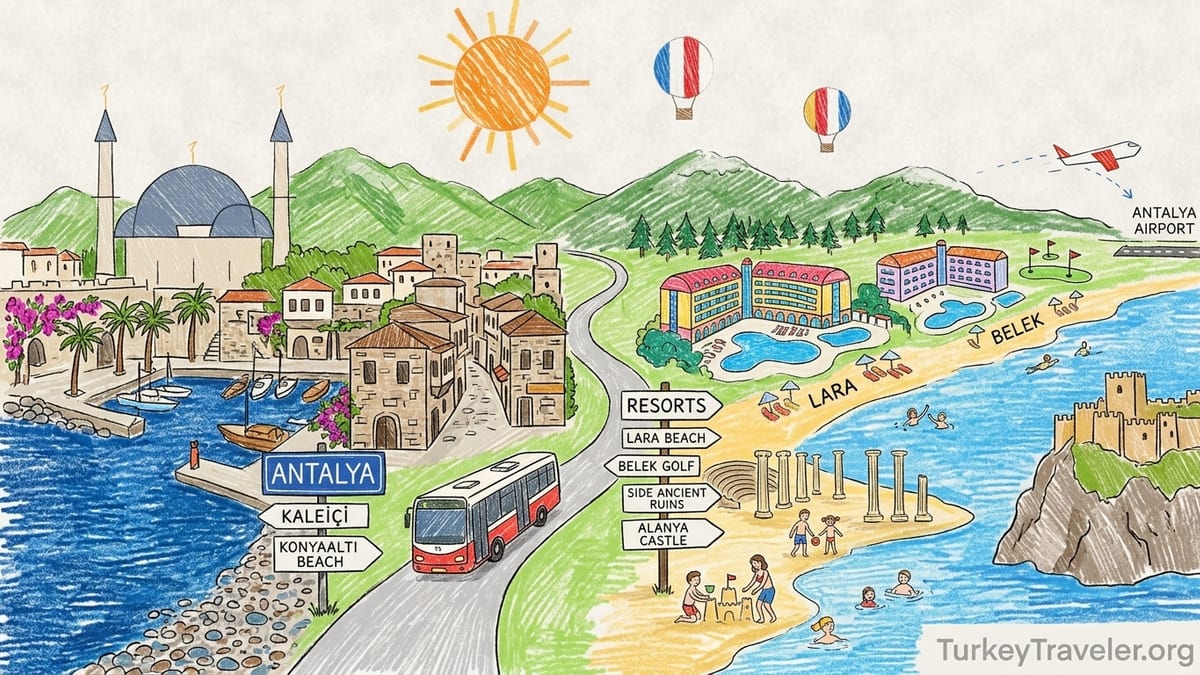
Antalya City vs Antalya Province: Why Location Labels Matter
When you see a package holiday labeled “Antalya,” it usually refers to Antalya Airport as the gateway, not to staying in the central city itself. The airport sits east of downtown, closer to Lara and the Belek resort strip than to the historic Kaleiçi old town. Transfers from the airport to different parts of the province range from about 20 minutes to over 2 hours by road, which has a direct impact on how easy your arrival and departure days feel with tired children and luggage.
Central Antalya city has two main coastal zones that work well for day visits: Konyaaltı to the west and Lara to the east. Both are technically within Antalya’s urban area and can be reached on city buses and trams. By contrast, Belek and Kadriye belong to the Serik district, Side and its satellite resorts sit in the Manavgat district, and Alanya and İncekum are separate municipalities further along the coast. Manavgat’s Side belt alone includes smaller strips such as Evrenseki, Çolaklı and Sorgun, each marketed slightly differently despite sharing one long, sandy shoreline.
For families, this administrative detail translates into real differences. A hotel in Konyaaltı gives you a genuine city-plus-beach experience, with supermarkets and local parks right behind the promenade. A hotel in Lara or Belek is usually in a self-contained resort zone with limited independent dining nearby but large all-inclusive properties and more on-site entertainment. Side and Alanya often combine long sandy beaches with busy promenades and dense mid-range hotel strips. Knowing which coastal area you are actually booking avoids unpleasant surprises such as a two-hour night transfer or a pebbly shoreline when you imagined soft sand for a toddler.
Türkiye’s shore law makes all beaches public, but in practice resorts can control direct access through their grounds while still leaving public corridors and separate municipal beaches. Families who like variety may prefer bases such as Konyaaltı, Side or Alanya, where dedicated public sections with lifeguards, showers and toilets sit between or in front of private beach clubs and hotel decks, making it easier to mix free days with the occasional paid lounger.
Konyaaltı: Long Pebbly City Beach With Strong Public Facilities
Konyaaltı Beach runs for roughly 7 kilometers west of Antalya’s old town, backed by parks, playgrounds and a wide promenade. The surface is mostly coarse pebbles and shingle, sometimes mixed with rough sand. The sea here tends to deepen more quickly than on the sandy resort coasts, which suits confident swimmers but means toddlers and early swimmers need closer supervision and usually water shoes to protect their feet on the stones. Families who like clear water often prefer Konyaaltı, as the pebbles keep the seabed from becoming cloudy.
Konyaaltı is one of Turkey’s most heavily serviced public beaches. Recent municipal information lists several dozen lifeguard towers across the managed section, along with tens of changing cabins and showers spread along the coast, plus long stretches of wooden boardwalks behind the shingle for easier movement with strollers. Accessible sections with adapted facilities and floating wheelchairs are available at selected lifeguard points, which can be a major advantage for families traveling with a disabled relative. Around the beach park area near the aquarium and Boğaçayı there are shaded playgrounds, grassy lawns, snack kiosks, cafes and rental sunbeds under umbrellas.
Water entry along Konyaaltı varies. In the eastern zones near the old port the drop-off can be relatively quick, while toward the western end closer to Boğaçayı Bridge some sections feel a bit more gradual, though still not as shallow as Side or İncekum. Waves are usually moderate in summer, but the open exposure means choppier days are not rare. Lifeguards generally operate daytime hours from late morning until early evening in high season, and red, yellow or green flags are hoisted depending on conditions. Families should plan that young children will mostly paddle at the edge or swim under adult support, rather than wade far out alone.
Konyaaltı is excellent for car-free travelers. The T1 tram runs from the bus station and city center towards the western end, and several city bus routes connect the beach with neighborhoods and the airport transfer hubs. Airport taxi or shuttle time is usually about 30 to 40 minutes depending on traffic. Parking exists along the back streets and in paid lots behind the promenade, and families report that municipal sections do not typically charge to leave a car beyond normal city parking fees. For a practical cost example in summer 2026, a family of four could spend a nearly free beach day here by bringing their own towels and shade tent, paying only for bus tickets and snacks, or choose to rent two sunbeds and one umbrella from a municipal operator for a moderate fee that remains lower than most private beach clubs.
Lara: Sandier Shore, Hotter Underfoot and More Resort Driven
Lara lies east of the city center and closer to Antalya Airport, making it a favorite for short breaks and package holidays. The coastline here is sandier than Konyaaltı, though still with some coarse grains and occasional pebbly patches depending on the exact section. The seabed usually slopes more gently than in Konyaaltı, so children can walk out a bit farther before the water reaches their shoulders, but the sand compacts under the feet and waves can pick up size on windy afternoons.
Families need to distinguish between the publicly run sections of Lara and the hotel-controlled beach fronts. The Ministry of Culture and Tourism and local authorities manage official public beaches sometimes labeled “Lara 1” and “Lara 2,” which offer free entry, lifeguards during the main season, basic changing cabins, public toilets and showers, and municipal sunbed and umbrella rentals for a set daily price. Close to these sections you will find kiosks selling simple meals, ice creams and soft drinks at regulated or clearly signed prices. Outside the public areas, many stretches of Lara’s coast are effectively extensions of large all-inclusive resorts, where non-guests may face high prices for day access or may not be admitted to facilities at all.
Lara’s sand has advantages and drawbacks for families. It is softer underfoot and more comfortable for sandcastles than Konyaaltı’s stones, but in July and August the dark, compacted surface becomes extremely hot by midday. Small children should wear water shoes or sandals from their hotel to the sea’s edge, and parents often set up closer to the waterline where the saturated sand is cooler. Umbrella shade is important here; either rent a set near a public beach café or invest in a pop-up beach tent, which also helps with occasional gusty winds. During high summer the combination of air temperature often above 34°C and reflected heat can limit safe playtime to mornings and late afternoons.
Lara is one of the fastest beaches to reach for new arrivals. Taxis and private transfers from Antalya Airport to the main public beaches and resort strip commonly take about 20 to 25 minutes depending on hotel location. Public buses run from the city center and some routes pass near the airport road, but most families prefer a transfer on arrival and then use city buses or ride-hailing to reach downtown on sightseeing days. Prices for food, drinks and sunbeds are usually higher than in Konyaaltı, reflecting Lara’s more resort-oriented audience, but families can still manage costs by alternating between full-service beach days and simpler visits using only public facilities.
Belek and Kadriye: Finding Public Sand Among the Golf Resorts
East of Lara, the coastline shifts into the Belek and Kadriye resort zone, known for golf courses and large all-inclusive hotels with wide private-looking beachfronts. Legally the shoreline is public, yet in practice direct access is dominated by resort gardens and security gates. For families staying outside the biggest hotels or day-tripping from Antalya or Side, the key is to aim for Kadriye’s public beach park and designated municipal beach sections in Belek, where access corridors and facilities are clearly signed.
Kadriye’s official beach park lies roughly 20 to 30 kilometers from Antalya Airport, with road transfer times of about 35 to 45 minutes depending on traffic. The surface here is mostly sand with some coarser grains near the high-water mark and occasional shingle pockets, and the entry into the water is usually more gradual than Konyaaltı, though often a little steeper than Side’s shallow western beaches. Facilities at the public areas include lifeguard presence in the main season, showers, toilets, simple changing cabins and snack kiosks. Sunbeds and umbrellas are available for daily rental, but because so many nearby visitors are all-inclusive guests, these public services can be less crowded during weekdays than you might expect.
In Belek itself, public access often takes the form of narrow tracks between hotels leading to beach strips where independent operators rent loungers and umbrellas. Some sections feel like small village beaches sandwiched between long resort decks. This works best for families who either have a car or are staying nearby, since signage from the main highway can be inconsistent. Public buses and dolmuş vehicles run between Antalya and Serik, and from there toward Belek and Kadriye, but most families find that juggling children, beach bags and transfers is more effort than arranging a direct hotel shuttle or taxi at least for the outward journey.
From a cost perspective, Belek and Kadriye are shaped by package-resort economics. A family of four on an all-inclusive deal may find that almost all beach-related expenses are already covered via the hotel’s private section, aside from extras like water sports. A different family staying in a small guesthouse in Antalya city and visiting Kadriye public beach for a day would instead factor in a return taxi or rental car fuel, a modest sum for four municipal sunbeds and two umbrellas, and beach café meals that are usually slightly above inland restaurant prices. These areas reward planners who either commit fully to resort life or visit as an occasional excursion rather than a daily base.
Side, Evrenseki, Çolaklı and Sorgun: Shallow Sands for Younger Children
Side and the surrounding Manavgat coastline form one of Türkiye’s classic family belts, and the beach geography explains why. West of Side’s ancient peninsula, the coastline opens into a long, wide sandy beach that continues through Kumköy, Evrenseki and Çolaklı. The sand is fine to medium-grained and usually light in color, and the seabed slopes very gently, allowing adults to walk quite far out with water only up to their waist. This makes the western Side area one of the most forgiving for toddlers and cautious swimmers, provided adults remain attentive to waves and crowds.
West Beach, including the stretches around Evrenseki and Çolaklı, hosts a mix of hotel-front sections and public strips. Independent reviews in 2026 describe several clean, sandy public segments branded as Evrenseki Public Beach or similar, with municipal or local operators providing sunbeds, umbrellas, simple showers and toilets. Lifeguards are present at main access points in the summer season, and many of the beach paths include wooden walkways that help stroller users cross the sand. Waves in summer tend to be gentle, though choppier conditions can occur after storms or on windy afternoons.
On the opposite side of the peninsula, East Beach historically had more uneven infrastructure, but recent local reorganizations have created at least one designated public area with toilets, showers, rentable sunbeds and food and beverage stands. The sand on the eastern side is generally fine but the seabed can be slightly steeper and the atmosphere quieter and less built up, with some sections backed by dunes or low vegetation. Continuing east, Sorgun combines sandy stretches with pine forest backdrops, creating a cooler, more natural ambiance that appeals to families seeking shade and calmer surroundings. Access points into Sorgun’s beach belt may lack the dense facilities of West Beach, so families often bring extra water and snacks or choose one of the better-equipped public sections highlighted by local tourism offices and hotels.
Side sits about 65 kilometers from Antalya Airport, with typical road transfers of roughly 1 to 1.5 hours depending on hotel location and traffic. Large shared shuttle coaches can take longer when dropping at multiple resorts along the west beach, Evrenseki and Çolaklı; private transfers and taxis are faster but costlier. Public buses and dolmuş services link Antalya’s bus station with Manavgat, and from there minibuses fan out to Side and the coastal hotels, but this route involves changes and is less practical when heavily loaded with beach gear and small children.
Cost-wise, Side’s public beaches make it easy to blend budget-friendly days and little splurges. A family based in a mid-range Side hotel without its own beach can walk or ride a dolmuş to a public section, paying for four sunbeds and umbrellas while using free public showers and toilets, then eat in one of the many promenade restaurants a short walk away. Another family staying at a large west-beach resort might choose to spend most of their time on the hotel’s facilities but still set aside a day to take older children on the short local bus ride to quieter Sorgun, combining beach time with a walk among the pines.
Alanya, İncekum and Cleopatra: From Soft Sand to Urban Buzz
Further east, Alanya marks the outer edge of what many visitors casually call “Antalya.” In reality Alanya is its own district, roughly 120 to 135 kilometers from Antalya Airport depending on hotel location. Transfers for package holidays usually take around 2 to 2.5 hours by coach, which can feel long with younger children after a flight. Some families offset that effort with the promise of very sandy beaches and a lively urban setting around the castle-topped headland.
West of Alanya, İncekum is particularly popular with families seeking soft sand and gently shelving water. The name İncekum roughly means “fine sand,” and the shoreline here tends to match the reputation, with smooth, golden sand and a relatively shallow seabed that deepens slowly for several meters. Municipal and independent public beach sections provide lifeguards in high season, simple changing cabins, showers and toilets, plus sunbed and umbrella rentals. Entries into the water are usually easy barefoot, though jellyfish sightings can occasionally occur in warmer periods, so parents should keep an eye on local notices and flags.
Inside Alanya itself, Cleopatra Beach runs beneath the western cliffs of the castle hill. The sand here is slightly coarser than İncekum’s but still comfortable, and the setting feels distinctly urban, with hotels, cafes and small supermarkets just across the road from the promenade. The seabed slopes faster than Side’s but not as abruptly as some parts of Konyaaltı. Certain numbered beach sections around the central stretches are known for a quicker drop-off just a few meters from shore, while others offer slightly more gradual depth; families often choose a section favored by locals with children, who know the friendlier entries. Lifeguards and flag systems are standard in the main season, and jet skis and parasailing near some access points create a livelier atmosphere.
Alanya’s beaches suit families with older children and teenagers who appreciate more entertainment and independence. Free public areas backed by sports courts, beach volleyball nets and casual snack bars make it easy for teens to play while adults relax nearby. Local buses and dolmuş lines serve the entire urban coast, so car-free families can base themselves near Cleopatra Beach and reach other parts of town easily for cable car rides, harbor walks and markets. For day visitors coming from Side or Manavgat, local tour agencies run inexpensive day trips that combine several hours on Cleopatra or nearby beaches with short sightseeing stops.
Costs in Alanya’s public beach zones are broadly similar to Side’s, with municipal sunbeds typically cheaper than those at branded private clubs. A family of four could expect to pay a moderate combined fee for two loungers, two deckchairs and an umbrella at a municipal section, then supplement with supermarket drinks and sandwiches bought across the street, keeping the total far lower than an all-inclusive daily rate while still enjoying showers, toilets and lifeguard coverage.
Kemer and Moonlight Beach: Clear Water, Pebbles and Mountain Views
West of Antalya city, the coast toward Kemer feels different again. Forested slopes of the Taurus Mountains drop steeply to the sea, creating coves that are often pebbly rather than sandy. Kemer’s Moonlight Beach, set in a sheltered bay just south of the marina, is the standout option for families who value clear turquoise water, dramatic scenery and a compact, well-serviced environment.
The surface at Moonlight Beach is mostly small pebbles to coarse sand, with some sections smoothed by years of use and others still requiring water shoes, especially at the waterline. The seabed tends to deepen faster than in Side or İncekum but generally more gently than at the steepest sections of Konyaaltı. The bay’s shape protects it from the highest waves, creating relatively calm water on many summer days, although wake from passing boats and occasional swells still occur. The clarity of the water is a major draw for families who like snorkeling close to shore.
Facilities around Moonlight Beach include lifeguard coverage in season, changing cabins, toilets and showers, children’s play areas and a variety of beach clubs and municipal sections offering sunbed and umbrella rentals. Shaded lawns and pine trees behind some parts of the beach give parents cooler spots to retreat during midday heat. Kemer’s compact town center sits just behind the beach zone, so cafes, ice cream shops and small supermarkets are easy to reach without crossing large roads. This makes Moonlight Beach particularly manageable for families who prefer to walk everywhere rather than use buses or taxis during their stay.
Kemer lies around 60 kilometers southwest of Antalya Airport, with transfer times typically about 1 to 1.5 hours depending on traffic and hotel location. Buses and dolmuş services link Antalya’s main bus station with Kemer, but most package guests arrive by prearranged coach or private transfer. Compared with Lara and Belek, Kemer’s beach experience feels more compact and nature-oriented, though still busy in high season. For cost planning, a family choosing a small hotel in Kemer center and spending most days at Moonlight Beach would budget for daily sunbed and umbrella rentals plus meals in local cafes, generally finding prices similar to or slightly lower than those on central parts of Konyaaltı.
Heat, Jellyfish and the Myth of the Automatic “Family Beach”
From June to early September, daytime highs along the Antalya coast often reach the low to mid 30s Celsius, sometimes higher in heatwaves. On still days, the combined effect of hot air, reflected sun from the water, and radiant heat from sand or pebbles can be intense, especially in Lara, Side and Alanya where sandy surfaces bake in direct sun. Families are wise to structure beach time around early mornings and late afternoons, using indoor hotel pools or shaded parks during peak midday hours. Lightweight UV-protective clothing, broad-brimmed hats and frequent water breaks are just as important as sunscreen.
On sandy beaches such as Lara, Side and İncekum, the surface itself can become too hot for bare feet, even near the shoreline. Water shoes or sandals are essential for small children, and parents often test the sand with their own feet before allowing kids to play unshod. Pebbly beaches like Konyaaltı and parts of Kemer have their own challenges, with uneven stones that can hurt sensitive feet and make quick dashes to the water more awkward without footwear. In all areas, families should watch for warning flags and municipal announcements about jellyfish, which tend to appear in patches rather than continuously. Local lifeguards and cafe staff usually know if a particular section has seen more stings in recent days.
The label “family resort” on a hotel brochure does not automatically guarantee a child-friendly public beach. Many Antalya-area resorts offer excellent kids’ clubs, water slides and shaded pools but sit on shorelines where the sea deepens quickly, the bottom is rocky or the public access outside the hotel is limited. Parents focused on safe sea play should look beyond marketing terms to check three practical factors: the beach surface, the slope of the seabed and the presence of lifeguards at the nearest public access. Where details are unclear, contacting the hotel to ask about distance to the nearest public beach and how deep the water is a few meters from shore can save disappointment.
Families should also understand the difference between public-beach days and resort-package days in terms of cost. A four-person family staying in an all-inclusive hotel in Side, for example, might pay a fixed nightly rate that includes unlimited use of the hotel’s beach section, meals and many drinks. The same family staying in a city apartment in Antalya and using Konyaaltı public beach would instead budget separately for groceries, restaurant dinners, occasional sunbed rentals and transport. On many summer dates, a week in a mid-range Side resort for two adults and two children may total more than the combined cost of a simple city base plus a mix of public beach visits and a couple of paid excursions, but the resort removes daily decision-making and small cash outlays while the city approach offers more flexibility and access to multiple beach types.
The Takeaway
Choosing the best Antalya-area beach for your family starts with matching your children’s ages and swimming confidence to the coastline. Konyaaltı’s long pebbly strip offers excellent public infrastructure, accessible facilities and a real city backdrop but is better for swimmers comfortable with quicker depth and stonier entry. Lara’s sandier environment and short airport transfer suit families wanting easy all-inclusive weeks, provided they are ready for hot sand, slightly higher prices and a mostly resort-focused setting.
Eastward, Belek and Kadriye work best when you commit to resort life, using the hotel’s controlled beachfront while dipping into public beach parks for variety. Side’s western sands, Evrenseki and Çolaklı are among the most forgiving for small children, with shallow entry and wide, sandy shorelines, while Sorgun offers a quieter, pine-backed alternative for families who prioritize shade and calm. Alanya and İncekum reward those who accept the longer transfer with some of the softest sand and, at Cleopatra Beach, an energetic urban beach scene ideal for teenagers.
Toddlers and very young children are usually happiest on the gentle slopes of Side’s west beach, Evrenseki, Çolaklı and İncekum, where adults can stand waist-deep while little ones splash nearby. Teenagers may prefer the buzz and independent options of Cleopatra Beach in Alanya or the sportier sections of Konyaaltı. Families who want sandy swimming underfoot but a shorter journey from the airport often gravitate to Lara or the closer sections of Side, while those traveling car-free will find Konyaaltı, central Side and Alanya’s urban beaches easiest thanks to frequent buses, trams and promenades directly behind the sand. For quieter holidays with striking scenery and clear water, Kemer’s Moonlight Beach and Sorgun’s more natural stretches stand out.
No single area is perfect for every family. The smartest strategy is to decide first whether you want a city-plus-beach mix or a resort corridor, then choose between pebbly clarity and sandy shallows. Once you know whether Konyaaltı’s promenade, Lara’s resort strip, Side’s family sands, Alanya’s vibrant arc or Kemer’s mountain-framed coves fit your style, you can compare specific hotels and public access points, confident that the coastline itself matches what your children need.
FAQ
Q1. Is Konyaaltı or Lara better for families with small children?
Konyaaltı has excellent public facilities but a pebbly bottom and quicker depth, while Lara offers softer sand and gentler slopes. For toddlers who will mostly play at the edge and build sandcastles, Lara is usually easier. For confident swimmers or mixed-age families who value a city setting and promenades, Konyaaltı works well.
Q2. How long does it take to reach Side and Alanya from Antalya Airport?
On typical summer days, shared coach transfers to Side take around 1 to 1.5 hours, depending on hotel stops along the west and east beaches. Reaching Alanya and nearby İncekum usually takes about 2 to 2.5 hours by road from the airport, so families should factor this into arrival and departure plans with younger children.
Q3. Are the beaches in Belek and Kadriye really public if they are full of resorts?
By law the shoreline is public, but resorts line most of Belek and Kadriye, so practical access concentrates at public beach parks and municipal corridors. Families can use these public sections, which usually offer lifeguards, showers, toilets and rentable loungers, even if much of the coast behind them is occupied by resort grounds.
Q4. Which Antalya-area beaches have the shallowest water for young kids?
Side’s west beach and the adjoining sands around Evrenseki and Çolaklı are known for very gentle slopes and shallow water stretching far from shore. İncekum near Alanya also offers soft sand and gradual depth. These areas are often favored by families with toddlers and early swimmers who want to stand comfortably while supervising children.
Q5. Can I manage a family holiday here without renting a car?
Yes, especially if you base yourselves in Konyaaltı, central Side, Alanya town or Kemer, where beaches, shops and restaurants sit close together and are linked by buses, trams or dolmuş services. Car-free travel is harder in Belek’s resort belt and some isolated hotel zones, where most movement relies on hotel shuttles, taxis or longer walks along busy roads.
Q6. How expensive are sunbeds and umbrellas on public beaches?
Municipal or regulated public sections typically charge a modest flat fee per sunbed and umbrella, which for a family of four usually results in a reasonable total for two loungers, two additional chairs or mats and one or two umbrellas. Private beach clubs and hotel day passes are more expensive, so budget-conscious families often alternate between paid lounger days and simple towel-on-the-sand visits.
Q7. Are lifeguards present on all Antalya beaches?
Lifeguards operate at most main public beaches and in front of larger resorts during the core summer season, usually between set daytime hours. However, not every small cove or undeveloped stretch has coverage. Families should always look for lifeguard towers and colored flags indicating conditions, and avoid swimming on unsupervised sections during rough seas.
Q8. What about jellyfish and sea life hazards for children?
Jellyfish appear occasionally along the Antalya coast, especially in warmer periods, but most stings are minor and local warnings are issued when presence increases. Parents should check flags and notice boards and ask lifeguards if they have concerns. Sea urchins and sharp rocks are more common on stony or rocky entries, so water shoes are a useful precaution on pebbly sections.
Q9. When is the best time of year for a family beach holiday in Antalya?
For most families, late May to mid-June and late September to early October offer warm sea temperatures, plenty of sunshine and more manageable daytime highs. July and August bring very hot weather and busier beaches, especially on sandy coasts like Lara, Side and Alanya, which may suit older children who enjoy longer water time but can be challenging with toddlers.
Q10. How should I compare public-beach days to all-inclusive resort packages?
Think in terms of fixed versus flexible costs. All-inclusive resorts near Lara, Belek or Side roll beach access, meals and many drinks into a single nightly rate, reducing daily spending decisions but limiting variety. Building your own trip using city hotels or apartments near Konyaaltı, central Side or Alanya means paying separately for transport, sunbeds, food and drinks, yet often results in a lower total bill and access to multiple beach types across your stay.