


By the time a beach attendant in Türkbükü quietly mentioned a “two hundred and thirty euro minimum spend” for the privilege of using a sunbed, I realised my simple plan for a morning swim on the Bodrum peninsula had collided with one of the most aggressive luxury beach economies in the Mediterranean. What followed, over several days of walking piers, comparing menus and hunting for municipal sand, was less a holiday and more a field investigation into how expensive it has become to reach the Aegean, and how blurred the line now is between paying for premium service and simply accessing the shoreline itself.
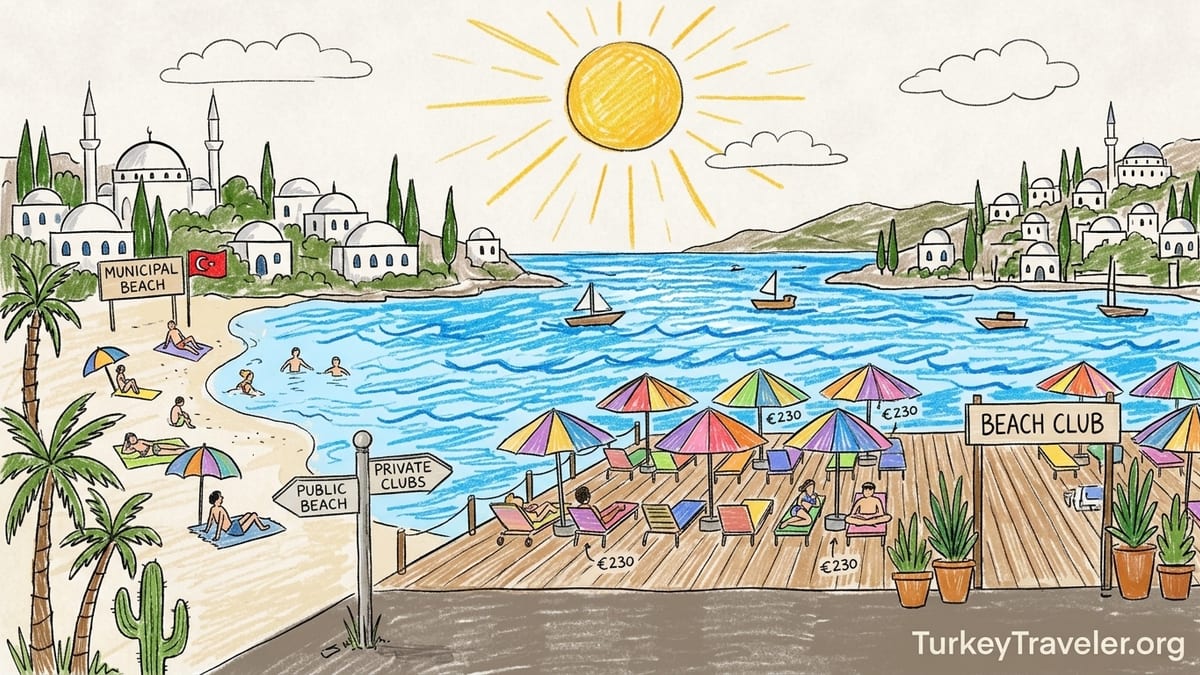
Starting in Türkbükü: Looking for the Sea Behind the Sunbeds
I began in Göltürkbükü, on the Türkbükü side, because that is where Bodrum’s beach club mythology concentrates. The bay is visually stunning, a natural amphitheatre of hills and white houses wrapped around water so flat it could be lacquer. Yet almost every metre of the central waterfront is lined with wooden decks, private piers and restaurant-branded loungers pressed shoulder to shoulder. Walking the promenade in peak summer, it was surprisingly hard to answer a basic question: where, exactly, is the public beach.
In front of Maçakızı, arguably Türkbükü’s most famous deck, there was no sign announcing a day price on the roadside, no simple board that said “sunbed X lira, towel Y lira.” The branding and entrance felt like a hotel, and a discreet host stood at a podium. Only after asking directly about “just swimming” did a staff member mention that for non‑hotel guests the beach operates on a minimum spend system rather than a fixed entrance fee. Independent 2026 beach guides that survey the area place that minimum at around 230 euros per person for the day, a figure that the venue encourages you to confirm when reserving because it can shift with season and section of the deck. ([bodrumguru.com](https://bodrumguru.com/en/bodrum-beaches-guide/?utm_source=openai))
This lack of clear pricing at street level was not unique. Along the same stretch, several clubs displayed elegant cocktail menus or photos of sunset parties, but not the actual minimum food and drink spend that controlled access to their decks. Some required reservations via WhatsApp before they would even discuss prices. From the pavement, the message was visual rather than verbal: if you have to ask, you probably should keep walking. For an ordinary visitor who simply wants to swim before lunch, that can be disorienting. It also raises a deeper issue about transparency in a town where the shoreline itself is, by law, supposed to be shared.
Only at the very ends of the bay did Türkbükü begin to look recognisably public. There, small strips of coarse sand and concrete platforms sat between the last hotel and the rocks, with locals arriving in flip‑flops carrying plastic bags instead of designer beach totes. No one asked them for a minimum spend. The water, of course, was the same.
Two Bodrums: Luxury Clubs and Accessible Bays
Talking to residents and cross‑checking several current Bodrum beach reports, a pattern emerges that is crucial for travellers to understand: Bodrum does not have a single beach economy but several, layered on top of the same coastline. Türkbükü and parts of neighbouring Gölköy have become shorthand for ultra‑premium decks such as Maçakızı and high‑spend hotel beaches at Cennet Koyu and Tilkicik bays, where 2026 minimums often run in euros and start in the low hundreds per person. ([bodrumguru.com](https://bodrumguru.com/en/bodrum-beaches-guide/?utm_source=openai))
By contrast, other parts of the peninsula still operate on a more traditional, lira‑based model. Bitez and Ortakent‑Yahşi, for instance, remain dotted with small pensions, family‑run cafes and beach fronts where using a sunbed might cost a modest fixed fee or simply require ordering a drink or two. Independent guides that compare the peninsula emphasise that while Bitez has a handful of trendier spots, its seafront includes stretches with no entrance fee at all, only pay‑as‑you‑go food and drinks, and crucially, visible municipal sections operated by the local authority. ([bodrumguru.com](https://bodrumguru.com/bodrum-plajlari-rehberi/?utm_source=openai))
Further out, Akyarlar and several coves toward Turgutreis skew even more local. Here the archetype is a short pier, a few rows of mismatched loungers and a grill turning sardines, rather than a champagne trolley and imported sand. Meanwhile, Bodrum municipality itself, under national guidelines that encourage accessible coasts, runs a growing number of free‑entry Blue Flag public beaches around the peninsula, including İçmeler near the town and a municipal facility at Türkbükü. These offer showers, lifeguards and basic amenities with either low‑cost or free sunbeds, showing that another model of seaside infrastructure is both possible and already present. ([bodrum.bel.tr](https://www.bodrum.bel.tr/en/halk_plajlari.php?utm_source=openai))
In other words, the idea that “Bodrum” now universally means 200‑euro sunbeds is inaccurate. Yet in the areas where global media and social networks focus their attention, the numbers are undeniably eye‑watering, and the way they are communicated often leaves visitors guessing until they are already seated.
Decoding 2026 Prices: Maçakızı, Flamm and Coze
Because third‑party blogs and older newspaper pieces often conflict about Bodrum beach club charges, any serious attempt to report on 2026 prices needs to cross‑check several recent sources and distinguish hearsay from patterns. For Maçakızı, multiple 2026 beach‑club roundups that compile current season data converge on a minimum spend figure in the 200 to 230 euro range per adult for the deck, with no separate entrance fee listed. Bodrum‑focused guides that tabulate clubs in euros specifically name a 230 euro minimum for Maçakızı in 2026, although they still advise confirming the exact amount when booking, because it can vary by date and section. ([bodrumguru.com](https://bodrumguru.com/en/bodrum-beaches-guide/?utm_source=openai))
For Flamm, another well‑known Türkbükü property with its own narrow waterfront and deck, 2026 beach‑club reports written for Turkish readers indicate that the property uses a minimum spend model in Turkish lira, typically collected via pre‑authorisation at booking. One widely cited lifestyle magazine report notes that Flamm allows cancellations up to four hours before the reservation without penalty, after which the pre‑authorised amount can be charged if guests fail to show, but it does not publish a universal, season‑long minimum spend figure in the way that some competitors do. ([saatolog.com.tr](https://saatolog.com.tr/seyahat/bodrum-beach-club-rehberi-2026/?utm_source=openai))
Coze in Bitez presents a slightly clearer case. Several 2026 Bodrum beach‑club roundups, including one that lists minimum spends in lira for non‑hotel clubs, cite Coze’s current minimum spend for a sunbed as approximately 3,500 to 4,000 Turkish lira per person for the main summer season, with no additional entrance fee. These reports describe Coze as attracting a younger clientele with sushi and cocktail‑heavy menus, functioning as a “middle ground” between village taverna and ultra‑luxury deck. ([mudavim.net](https://mudavim.net/bodrum-beach-clublar/?utm_source=openai))
Across venues, one theme repeats. Prices are influenced by section, time of day and whether you are a hotel guest. Ocean‑front cabanas cost more than second‑row loungers. Weekend and peak August days sit at the top of the range, shoulder season days closer to the bottom. Some clubs quote the minimum spend per person, others per lounger, others per cabana that seats a couple or small group. Without standard language, the onus falls on visitors to interrogate the numbers and ask: Is this a deposit, a minimum consumption requirement or an entrance fee on top of what I eat and drink.
Entrance Fees, Minimum Spends and What You Actually Pay
Part of the confusion in Bodrum comes from the mix of pricing mechanisms operating side by side. An entrance fee is a flat amount you pay to access a property for the day, regardless of what you consume. A minimum spend, by contrast, is a threshold you must reach in food and drink or services. In some clubs the two are combined, with a smaller entrance fee plus an additional minimum consumption, while others apply only the minimum. Tucked into the small print there may also be service charges, towel fees or mandatory cabana upgrades.
For example, among the Bodrum clubs that price in euros, independent 2026 guides document variations. Mandarin Oriental at Cennet Koyu is reported as charging an entrance fee of around 100 euros for external guests without an explicit additional minimum, whereas Maçakızı operates as a minimum‑spend‑only deck. Lucca Beach in Gölköy is cited with a 100 euro entrance. F&B‑focused venues in town like Folie Bodrum combine a moderate entrance fee with a smaller additional required spend, while some international branded hotel clubs add required food and drink on top for non‑residents. ([bodrumguru.com](https://bodrumguru.com/en/bodrum-beaches-guide/?utm_source=openai))
In lira‑priced clubs, the figures can look more approachable at first glance but still mount quickly in context. A daybed with a 3,500 or 4,000 lira minimum spend for one person at Coze, if fully used on lunch and drinks, might cover one shared mezze platter, two main dishes and several cocktails at 2026 menu prices. Add 10 to 15 percent service, which many clubs include automatically, and the total creeps higher. At the very top end of the peninsula, reports of 5,000 lira minimums per person at select Türkbükü decks for front‑row loungers in peak August are no longer outliers, but part of a new normal that Turkish media itself has started to criticise. ([isthaberler.com](https://isthaberler.com/bodrumda-plaj-fiyatlari-2026-bodrum-beach-club-giris-ucretleri-sezlong-fiyatlari-maca-kizi-ve-buddha-bar-fiyatlari/?utm_source=openai))
What almost none of these menus make immediately obvious is that the sea beyond the deck is not private. You are paying for the lounger, the towel, the platform and the choreography of service. Yet, psychologically, the pricing language often feels as if you are being charged to access the water itself.
What a “Simple Swim” Really Costs for a Couple
To understand how these mechanisms translate into a real bill, imagine a couple booking a 2026 high‑season day at a euro‑priced deck such as Maçakızı, and then compare it with a day at a lira‑priced club like Coze and a municipal Blue Flag beach like Bodrum İçmeler.
At a club operating around a 230 euro minimum per person, a couple is looking at approximately 460 euros of required food and drink spend for the day, not counting transport. Arrive by taxi from central Bodrum and you might add the equivalent of 20 to 30 euros return, depending on traffic. Order two coffees in the morning, a shared lunch of two starters and two mains, a bottle of mid‑range wine or several cocktails and a round of soft drinks and water, and you will almost certainly reach or exceed the minimum. An automatic service charge of around 10 to 15 percent, common at high‑end Turkish venues, adds perhaps another 40 to 60 euros. Parking, where applicable, can add a smaller but noticeable extra for those arriving by rental car.
At Coze in Bitez, using the approximate 3,500 to 4,000 lira minimum per person seen in 2026 reports, a couple might face a required spend in the region of 7,000 to 8,000 lira. Converted at mid‑2026 exchange rates, that is still significantly less than the 460 euros required at the ultra‑luxury decks but far from negligible. There may be no formal towel fee and no entrance charge beyond the minimum, but once you add a service charge and perhaps a taxi or rideshare, the realistic cost of “a simple swim” and lunch can sit comfortably above 9,000 lira for two people on a busy weekend. ([mudavim.net](https://mudavim.net/bodrum-beach-clublar/?utm_source=openai))
Contrast this with a day at Bodrum municipality’s İçmeler public beach, which has Blue Flag status and clearly posted rules. Here entrance is free. Sunbeds and umbrellas, where operated by the municipality, are typically rented at modest fixed fees, with prices that local media describe as kept intentionally accessible relative to private clubs. You will still pay for water, snacks and perhaps a simple lunch at the on‑site cafe, but no one is tracking a minimum spend per person. A couple can swim, shower and sit on the sand all day for a fraction of the cost of Türkbükü’s most famous decks, without feeling monitored by a running tab. ([bodrum.bel.tr](https://www.bodrum.bel.tr/en/halk_plajlari.php?utm_source=openai))
In this light, the question becomes not whether Bodrum is expensive in some corners, but whether the premium being charged in specific locations accurately reflects service and product, or whether visitors are sometimes paying simply to resolve the anxiety of not knowing how to access the sea any other way.
Law vs Reality: Public Coasts and Private Infrastructure
Legally, Türkiye’s framework for coastal access is clear in principle. The national Coastal Law and associated planning regulations stress that the coastline is a public resource and that access to the sea should remain free and equal. Municipalities and the Ministry of Environment and urban agencies highlight this principle in their own publications when discussing beach management and Blue Flag sites. ([webdosya.csb.gov.tr](https://webdosya.csb.gov.tr/db/ced/icerikler/tc-dr_2020_-ng-l-zce-20210430143751.pdf?utm_source=openai))
In practice, however, the law distinguishes between the public status of the shore and the private status of the commercial infrastructure that sits on or next to it. A restaurant, hotel or beach club is permitted to charge for the use of its loungers, toilets, showers, towels and service staff, even if those facilities are built very close to the water. The law does not entitle a passer‑by to occupy a business’s sunbed or use its restrooms simply because the sea itself is a shared resource. Nor does it require an operator to act as unpaid caretaker for the general public.
Where tension arises is in the grey space between theory and enforcement. Along some parts of Bodrum’s coast, particularly in highly commercialised stretches of Türkbükü and Yalıkavak, the density of decks and restaurant platforms is so great that the public’s physical ability to reach the water without crossing a commercial boundary becomes limited. Locals and visitors occasionally report feeling discouraged from using narrow slivers of sand between structures, or being told that certain ladders and steps are “for customers” even when they descend from quasi‑public promenades. These experiences vary, and without formal complaints and investigations it would be irresponsible to accuse individual named venues of illegal blocking of access. Yet the overall impression, especially for first‑time visitors, can be that the shore has been effectively privatised even when the law says otherwise. ([en.wikipedia.org](https://en.wikipedia.org/wiki/K%C3%BCd%C3%BCr_Peninsula?utm_source=openai))
Bodrum’s response has been to expand the number and quality of municipal beaches, particularly those with Blue Flag status, and to demolish unlicensed structures on sensitive peninsulas, as seen in recent clearances around Küdür. These actions underline that the state recognises the risk of allowing unregulated decks to dominate the shoreline. But they do not remove the need for better on‑the‑ground communication about where the public can walk, spread a towel or enter the sea without committing to a day‑long consumption contract.
Five Frictions in Bodrum’s Luxury Beach Culture
After days of walking bays and cross‑checking reports with actual bills, at least five recurring criticisms of Bodrum’s luxury beach economy stand out.
First is compulsory spending disguised as choice. A club that technically has no entrance fee but requires a 200‑plus euro minimum per person for a sunbed has in effect imposed a paywall on its deck, yet the language of “minimum consumption” often makes it sound voluntary, as if a frugal guest might realistically spend less. In peak season, staff may also gently suggest that guests who do not plan to reach the minimum should consider a different area or not reserve at all.
Second is inconsistent price communication. Some venues publish 2026 minimum spends in press interviews and lifestyle features, but not on their own on‑site boards or English‑language menus. Others allow third‑party blogs and hearsay to set expectations while reserving the right to quote different numbers by phone for the same date. For an international visitor, that makes budgeting opaque and can lead to awkward conversations with staff while already seated in swimwear.
Third is unclear public access along contiguous decks. In places like Türkbükü’s central strip or parts of Yalıkavak, almost continuous lines of loungers and low tables give the impression that every metre of shoreline belongs to a specific establishment. There may in fact be narrow public passages or municipal jetties between them, but without signage or markings, only locals know where they are. Tourists, wary of confrontation, tend to default to the club model and pay.
Fourth is the physical saturation of the waterfront. Photos from Bodrum’s high‑end bays in late July show sunbeds pushed right to the edge of the water, with barely a metre between the last cushion and the drop into the sea. This maximises revenue per square metre for operators but reduces the feeling of being at the seaside and increases noise, with DJ booths, speakers and table service competing for sonic space. Visitors expecting a tranquil swim in nature can feel misled when they find themselves pressed into what resembles a floating cocktail bar.
Fifth is the mismatch between marketing and reality for travellers who just want to swim. Social media posts and word‑of‑mouth sometimes frame Bodrum’s famous decks as obligatory pilgrimages, implying that you have not “seen” Bodrum unless you have spent a day at its most expensive clubs. The resulting fear of missing out can push budget‑conscious couples into experiences that do not align with their idea of a seaside holiday, only to leave them staring at a four‑figure bill for what was, at its core, a few hours on a mattress over the water.
When Paying for a Premium Club Makes Sense
None of this is to say that Bodrum’s luxury beach clubs have no place. For travellers who value a certain style of day, paying the premium can make sense. At their best, these venues offer fine dining that rivals urban restaurants, strong cocktail programmes, attentive multilingual staff and carefully designed decks where every detail from towel quality to background music is curated. Some provide changing cabins, fresh‑water pools, water sports, security and concierge‑style assistance that extends to yacht tenders and onward dinner reservations.
For a group celebrating a milestone birthday, a couple who genuinely plan to treat the deck as their main gastronomic event for the day, or travellers for whom time is more valuable than money, a 230 euro minimum that includes a long, multi‑course lunch, drinks and a front‑row position in a beautiful bay may feel proportionate. Those who are already staying in the associated hotel may also experience a different cost structure or added benefits that soften the blow. ([bodrumguru.com](https://bodrumguru.com/en/bodrum-beaches-guide/?utm_source=openai))
Where disappointment tends to arise is when guests arrive with the wrong objective. If your main goal is to read under an umbrella, swim in clear water and hear the sound of waves, there is little that a 200‑euro DJ and branded towels can add that a quieter municipal or mid‑range setup cannot. If you do decide to pay for premium, it is wise to treat it not as a ticket to the sea but as a bundled package of dining, entertainment and convenience, and to choose a venue whose strengths match your interests, whether that is music, gastronomy or people‑watching.
In practical terms, anyone considering a high‑end Bodrum club should contact the venue directly, ask for the current season’s minimum spend per person, clarify whether this is per lounger or per head, confirm service charge rates and cancellation terms, and request a sample menu with indicative prices. That may feel formal for a beach day, but in a market where lunch for two can rival a hotel night, it is a reasonable level of due diligence.
How to Enjoy Bodrum’s Sea Without Buying Into the Hype
The good news is that enjoying Bodrum’s coastline does not require signing up for its most expensive decks. One strategy is to base yourself in a bay with a strong municipal or mid‑range presence. Bitez and Ortakent‑Yahşi, for example, still allow you to step from a small hotel onto a promenade where public sections, modestly priced sunbeds and simple cafes exist side by side. In Akyarlar, the combination of local fish restaurants and small guesthouses adjacent to genuine sand beaches provides a taste of the old Aegean at prices more in line with domestic tourism. ([bodrumguru.com](https://bodrumguru.com/bodrum-plajlari-rehberi/?utm_source=openai))
Another approach is to make Bodrum’s Blue Flag public beaches your daily base and visit one high‑end club only once, if at all. Facilities like İçmeler offer showers, lifeguards and accessible infrastructure within a public framework, and they sit on the same coastline and under the same sun as their private neighbours. Combining municipal days with a single planned splurge can deliver variety without breaking the budget.
For the determined independent swimmer, studying satellite images and municipality maps before travelling can reveal coves and rocky entries that are effectively public, even if they require a little walk from the road. Places like Küdür Peninsula, where authorities have moved to remove unauthorised structures, illustrate the state’s willingness to preserve certain stretches of coast from over‑commercialisation. Arriving early in the day also helps, as public parking near municipal beaches fills quickly and latecomers can find themselves nudged toward paid valet systems at adjacent clubs. ([en.wikipedia.org](https://en.wikipedia.org/wiki/K%C3%BCd%C3%BCr_Peninsula?utm_source=openai))
Perhaps most importantly, visitors can adjust their expectations. Bodrum is no longer a uniformly bohemian fishing town, but neither is it a gated resort where every swim must be mediated by a hostess and a minimum spend. Knowing that several parallel beach economies exist, and that you can opt into or out of each one, gives you back the freedom that the sight of endless sunbeds can momentarily take away.
The Takeaway
My days tracing the waterfront from Türkbükü to Bitez left me with mixed feelings. On one hand, Bodrum’s luxury beach clubs represent a sophisticated, globally connected hospitality scene that has every right to charge what the market will bear for finely tuned service in an undeniably beautiful setting. On the other, the way prices are framed, and the way physical access to the sea is structured around private decks, can make travellers feel as though the Aegean itself has been placed behind a velvet rope.
In the end, what troubled me was not that a multi‑course lunch with champagne at a famous deck costs hundreds of euros. It was that someone arriving in flip‑flops, hoping only to float for half an hour in clear water, might not realise that alternatives exist. Bodrum’s own municipal beaches, its family‑run pensions in Bitez and Ortakent, its low‑key coves near Akyarlar and its public Blue Flag facilities show that you can still meet the sea on more equal terms. The key is refusing to equate the shoreline with the most expensive mattress on it.
If Bodrum is to balance its role as a playground for the global jet set with its identity as a coastal town in Türkiye, better price transparency and clearer public access routes would be a start. Until then, visitors can protect both their wallets and their enjoyment by asking precise questions before committing to a club, embracing municipal and mid‑range options, and remembering that the Aegean is legally, if not always visibly, shared by all.
FAQ
Q1. Is it true that you have to pay hundreds of euros just to swim in Bodrum?
Not everywhere. Ultra‑luxury decks in places like Türkbükü may require minimum spends in the 200 to 230 euro range per person, but municipal beaches and mid‑range bays such as Bitez, Ortakent‑Yahşi and Akyarlar remain much more affordable, often with free entrance and modest charges only for sunbeds and food.
Q2. How can I tell if a beach area in Bodrum is public or belongs to a beach club?
In practice it can be difficult, because private decks and restaurant loungers often sit directly on the shoreline. Look for municipal signage, Blue Flag flags, and unbranded sunbeds or open sand without waiter service. When in doubt, ask locals or your hotel which nearby sections are operated by the municipality.
Q3. What is the difference between an entrance fee and a minimum spend at a Bodrum beach club?
An entrance fee is a flat charge to access the venue for the day, regardless of what you consume. A minimum spend is a required amount you must reach in food, drinks or services. Some Bodrum clubs use only a minimum spend, others combine a smaller entrance fee with a consumption requirement, so it is important to ask which applies.
Q4. Are Maçakızı, Flamm and Coze breaking the law by charging high minimum spends?
High prices are not illegal by themselves. Türkiye’s Coastal Law protects public access to the sea but does not prevent private businesses from charging for their loungers, decks, toilets or service infrastructure. Without clear evidence of physical blocking of public access, it would be inaccurate to say that specific named clubs are acting unlawfully.
Q5. How much should a couple realistically budget for a day at a high‑end Bodrum beach club?
At a top‑tier euro‑priced deck with a minimum of around 230 euros per person, a couple can expect to commit roughly 460 euros to food and drinks, plus service charges and transport. At lira‑priced clubs like those in Bitez, a couple might spend the equivalent of several thousand lira including minimums, tips and taxis, especially in peak season.
Q6. Are there genuinely free or low‑cost beaches with facilities in Bodrum?
Yes. Bodrum municipality operates several free‑entry public beaches, including Blue Flag sites such as İçmeler and a municipal beach at Türkbükü. These offer lifeguards, showers and basic amenities, with either free or modestly priced sunbeds and umbrellas, and no minimum spend per person.
Q7. Can I walk along the shoreline in front of beach clubs without paying?
Legally, the coastline is a public resource, but in practice continuous decks, piers and restaurant platforms can make shoreline walking difficult in some bays. You are not entitled to cross private seating areas or use club facilities without permission, so it is often easier to use promenades, municipal beach entrances and marked public paths to reach the sea.
Q8. How can I avoid surprise bills at Bodrum beach clubs?
Before sitting down, ask staff to explain the minimum spend per person, whether there is a separate entrance fee, how service charges are applied and whether towels or cabanas cost extra. Request to see a full menu with prices and confirm whether the minimum is per lounger or per guest. Clarifying these points at the outset greatly reduces the risk of unpleasant surprises.
Q9. Which Bodrum areas are best if I want a relaxed, affordable seaside holiday?
Areas such as Bitez, Ortakent‑Yahşi, some parts of Gölköy away from the most famous decks, and bays around Akyarlar generally offer a calmer, more local feel with lower prices. Staying near a municipal Blue Flag beach, like İçmeler, is also a good strategy if you prioritise swimming and basic facilities over club culture.
Q10. Is it still worth visiting a famous Bodrum beach club for a day?
It can be, if you see it as paying for a complete experience that includes high‑level dining, service and atmosphere, not just access to the water. For travellers who enjoy that style and budget for it in advance, a single day at a renowned deck can be memorable. For those mainly seeking quiet swims and simple meals, Bodrum’s public and mid‑range options often deliver better value.