


The Aegean coast west of İzmir offers a dense cluster of very different beaches within a couple of hours of the city. Around Çeşme, Alaçatı, Karaburun, Urla, Seferihisar and Foça, you can find shallow family coves, cold clear bays, and world-famous windsurf and kitesurf lagoons, often within a short drive of each other. Understanding how wind direction, bay orientation and water temperature interact with sand, pebble and rock makes it much easier to choose the right spot for your style of swimming or wind sports.
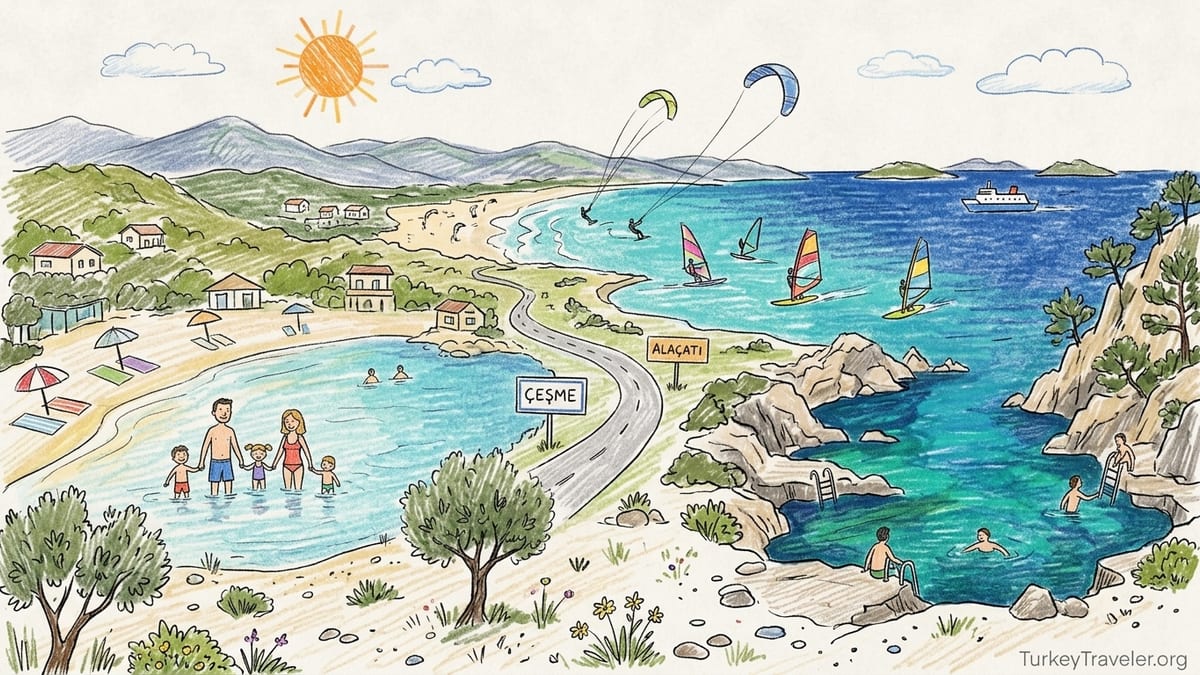
How Wind, Orientation and Water Temperature Shape Aegean Beach Days
On paper, many beaches near İzmir look similar: a sweep of coastline on the Çeşme Peninsula or Karaburun, a line of umbrellas, some tavern-style restaurants and summer houses behind them. In practice, a few very local factors change your day completely. The first is wind. In high summer, the north and northwest Meltemi wind often picks up by late morning. A north-facing bay like much of Çeşme’s outer coast can be choppy and whitecapped by mid-afternoon, while a cove tilted slightly east or south stays much calmer.
Orientation to open sea is just as critical. A beach that faces west or northwest into open Aegean, such as parts of Karaburun and Altınkum near Çeşme, usually has clearer, cooler water because it is more directly flushed by offshore currents. Bays tucked deeper into the peninsula, like Ilıca and parts of Alaçatı’s inner lagoon, tend to be a little warmer and shallower. Rocky coves like Kuyucak or Akvaryum around Karaburun stay transparent and deep, better suited to confident swimmers than toddlers who need a sandy, waist-deep shelf.
Sea temperature is the third variable visitors often underestimate. Along this stretch of coast, you can drive 30 minutes and feel a difference of several degrees in the water. Open-bay beaches labeled Altınkum, for example, regularly report water readings a few degrees cooler than more enclosed sandy coves. On top of this natural pattern, Ilıca is warmed by geothermal springs rising through the seabed, so its shallows can feel noticeably warmer than the same day’s reading in nearby Çeşme town.
Finally, the type of shoreline changes not only comfort but safety. Fine sand like Ilıca or Ardıç in Mordoğan is forgiving for families and anyone who wants to wade far out. Pebbly entries in parts of Foça or Karaburun demand water shoes and more sure-footed swimmers. Rocky shelves and ladders in Akvaryum or some Urla coves give superb clarity and snorkeling but little space for playing in the shallows. Keeping these patterns in mind helps decode the very different characters of the beaches described below.
Çeşme Peninsula: Comparing Ilıca, Boyalık and Altınkum
Ilıca Beach is Çeşme’s classic family shoreline. It stretches for around 2 kilometers in a gentle crescent of pale sand, with a wide public section plus several private beach clubs run by hotels and day venues. The bay is shallow for a long distance, often only knee- to waist-deep tens of meters out, which makes it easy for children and non-confident swimmers. Geothermal springs rise through the seabed close to shore, so in high season and even into October the water in parts of the shallows can feel almost bath-like compared with more exposed bays nearby.
The trade-off at Ilıca is exposure to northerly and northwesterly winds. On days when the Meltemi builds, this broad, open-facing bay can become choppy with wind waves, and light inflatables drift quickly offshore. Lifeguards are usually present in summer and the beach is publicly accessible along its length, but parents often choose early morning or late afternoon when winds are calmer. There is regular minibus (dolmuş) service from Çeşme and Alaçatı, and parking ranges from paid hotel and municipality car parks along the waterfront to side-street spaces behind the promenade.
Just west of Çeşme center, Boyalık Beach offers another long ribbon of sand with a slightly different feel. Parts of Boyalık are fronted by large resort hotels with their own jetties and paid sunbed areas, while in between you will find free public patches where you can simply spread a towel. The seabed is mostly sandy with occasional pebbly sections, and the water deepens a bit faster than Ilıca, which some swimmers prefer for doing lengths parallel to the shore. Thanks to the curve of the bay, sections closer to Çeşme town can feel a bit more sheltered from north winds than the most exposed parts of Ilıca.
Altınkum, at the western tip of the Çeşme Peninsula near Çiftlikköy, looks like an idyllic postcard with pale sand and open views toward the horizon. The name means “golden sand,” but what locals talk about first is the water temperature. Open to the north and northwest and flushed more directly by offshore currents, it is consistently colder than Çeşme’s more enclosed coves, especially noticeable in June and September. On hot August days this is exactly what some swimmers seek, and many İzmir residents drive specifically to Altınkum for its cold, clear water. Minibuses from Çeşme run in season, and parking is often an informal mix of small paid lots and roadside spaces. Facilities range from simple public areas to beach clubs that charge an entrance fee covering a sunbed and parasol.
Wind and Waves: Pırlanta, Çark, Aya Yorgi, Kocakarı and Paşalimanı
Pırlanta Beach lies south of Altınkum on the outer edge of the peninsula and combines fine sand with strong wind exposure. It takes its name from the diamond-like sparkle of the sand grains. Despite looking from shore like a long, gentle bay, Pırlanta functions primarily as a kitesurfing spot. The municipality highlights a dedicated kitesurf center here that is certified by an international kitesurf organization and staffed with qualified instructors. Parts of the bay are specifically zoned for kitesurf training and launch areas, and on windy afternoons the sky can fill with large kites arcing back and forth just offshore.
For swimmers, this means two things. First, even though the sand is soft and the entry gradual, parts of the water are often chopped up by board traffic and crossing lines, so families usually stick to clearly marked swimming zones closer to shore or away from the busiest launch corridors. Second, safety boats and instructors watch their own students, not free swimmers, so it is not advisable to drift or snorkel inside kite lanes. On quieter mornings, however, Pırlanta can still be an enjoyable place for a dip, with a wild, open-sea feel and a mixture of basic public sections and simple facilities that cater to both watersports visitors and day trippers.
Across the peninsula near Alaçatı, Çark Beach fronts the famous windsurfing lagoon. A wide, shallow bay south of the village is lined with windsurf schools and rental centers, which operate from late spring into autumn. Studies on Alaçatı’s tourism and current school listings describe extensive beginner-friendly standing-depth areas and steady cross-onshore winds, making it a training ground for all levels of windsurfers. The shoreline at Çark is a mix of sand and compacted shell grit, with a long, knee-deep entry that suits first-time learners getting used to boards and rigs.
Because of its strong association with windsurfing schools, Çark is not the ideal spot for a relaxed linear swim. Large parts of the bay are structured into slalom tracks and teaching lanes, and windsurf boards regularly cross close inshore. There is a small public beach area plus a line of paid sunbed sections attached to the surf centers and a few beach clubs. Minibuses from Alaçatı and Çeşme typically stop near the Port Alaçatı side, from where it is a short walk to the water. Casual visitors who want to watch rather than join can still enjoy the spectacle of dozens of sails planing across turquoise water on breezy days.
Aya Yorgi, northeast of Çeşme town, sits in a narrow, well-sheltered inlet that feels more like a fjord than an open bay. High, green slopes wrap around the cove, cutting off much of the Meltemi and leaving the water calmer than more exposed beaches even on windy afternoons. The coastline here is mostly rocky terraces and platforms, with ladders into deep, clear water rather than a gentle sandy slope. Over the past decade, Aya Yorgi has become closely identified with beach clubs that charge daily entrance fees, provide decks, cushions and DJs, and largely control access to the shoreline.
For travelers primarily interested in swimming, Aya Yorgi’s plus points are flat water and depth that suits confident swimmers and snorkelers, along with excellent clarity. The trade-offs are cost and atmosphere: public access is limited, music can be loud, and many clubs expect a minimum spend in peak season. Parking is typically in paid lots behind the bay or via taxi from Çeşme. Those seeking a quieter, family-friendly cove may be more comfortable in neighboring Paşalimanı or Kocakarı, both of which retain more of a village-beach character.
Kocakarı Beach, on the Dalyanköy side of Çeşme, is a compact but much-loved local bay. It has a sandy to fine-pebble shoreline and usually clearer, slightly cooler water than Ilıca, because it faces more toward the open Aegean. The beach is publicly accessible, with a few small cafes and fish restaurants just behind the sand. Parking tends to be informal on nearby streets, and space on the beach itself can be limited in midsummer, so many residents arrive early. The relatively quick drop-off after a few meters satisfies stronger swimmers, while the narrow strip of shallows near shore is still manageable for children if supervised.
Paşalimanı sits a little further along the same coast and offers a longer arc of beach backed by holiday homes and low-key pensions. The entry here is mostly sandy with some scattered pebbles, and the water is usually calm in the morning, with moderate chop when afternoon winds rise. There are public stretches where you can bring your own umbrella, as well as small, simple beach businesses that rent loungers at modest day rates compared with the clubs at Aya Yorgi. Dolmuş services often run from Çeşme and Alaçatı in summer, dropping passengers a short walk from the shoreline.
Karaburun Peninsula and Mordoğan: Rocky Coves and Clear Water
North of Çeşme, the Karaburun Peninsula forms a narrower finger of land between the Aegean and the Gulf of İzmir. Compared with Çeşme, Karaburun remains far less developed, with a lower rate of urbanization and many coves that feel relatively untouched. Mordoğan, an important settlement on the eastern coast of the peninsula, is the main access point if you are arriving from İzmir and looking for beaches without long transfers. The coastal road from İzmir passes through Mordoğan before continuing to Karaburun town, with regular buses in season and intercity coaches that stop near the village center.
Ardıç Beach near Mordoğan stands out as one of Karaburun’s main sandy options. Municipal information and Blue Flag listings describe it as a public beach with a broad sandy shoreline, clear water and environmental standards monitored through the Blue Flag program in recent years. The bay faces more toward open water than enclosed coves like Ilıca, so the sea here tends to be fresh and transparent, with gentle swell on windier days. Visitors find a typical mix of basic facilities like showers and changing cabins in summer, and public access is straightforward, without compulsory club fees. For families wanting a sand-underfoot experience on Karaburun without committing to very remote coves, Ardıç is a logical starting point.
Further from the main road, smaller coves like Kuyucak and Akvaryum appeal to experienced swimmers and those who prioritize water clarity over easy entry. These bays are often framed by rocky shorelines where you step directly into deeper water, sometimes from small pebble wedges, sometimes from flat rocks. The seabed tends to drop off sooner, which suits snorkeling and longer swims along the coast but offers little of the waist-deep shelf small children enjoy for splashing. Facilities are generally minimal, sometimes limited to a seasonal kiosk or one small beach cafe, and you should not assume lifeguards or extensive safety infrastructure.
Because many Karaburun coves are open to north and northwest winds, conditions can change quickly through the day. On calm mornings, the sea can resemble a pool, with almost glassy surfaces and visibility into several meters of depth. By mid-afternoon, whitecaps can appear, especially along the outer western coast. Drivers should also plan ahead for parking; in tight coves the few flat areas near the shore fill fast in July and August, and roadside parking on steep approaches may require careful maneuvering. Public minibuses connect İzmir and Karaburun via Mordoğan, but reaching scattered small bays often requires a second local bus or a walk of varying length.
Closer-to-İzmir Options: Urla, Seferihisar–Sığacık and Foça
Not every visitor wants to base in Çeşme itself. For shorter breaks or days when you want to swim without a long drive, nearby Urla offers a string of coves and small beaches within roughly 40 to 50 minutes of İzmir by car, depending on traffic. The coastline here alternates between small sandy pockets and rocky shelves, with several areas that have become known for clear water and modest-scale beach businesses. Some coves are fronted by seasonal cafes or beach clubs that charge day-use fees, while others remain open public spaces favored by locals who bring their own umbrellas and coolers.
Most Urla spots are more sheltered than the fully exposed west side of Çeşme but still feel open enough to catch breeze on the hottest days. Because the coastline is indented, you can often drive or walk a short distance to find a cove facing a slightly different direction if the surface is choppy where you first arrive. Public transport from İzmir’s Üçkuyular bus terminal runs regularly to Urla town, from where local buses and taxis reach the seafront districts. Exact conditions vary cove by cove, so it is worth asking your guesthouse or host which bay is most suitable for children or non-swimmers on a given day.
Further south, Seferihisar and Sığacık stand at the mouth of a broad inlet where the Aegean begins to narrow toward the Gulf. Akarca and Akkum are the main named beaches widely used by residents of İzmir and Seferihisar. These are more conventional municipal-style beaches than wild coves: expect a mix of sand and fine pebbles, promenades backed by summer apartments, and seasonal cafes and restaurants. The water is generally calmer than outer-peninsula beaches like Altınkum, though wind and boat traffic can still create afternoon chop.
Akkum in particular has a defined sandy area and shallow nearshore zone that suits families, plus a denser ring of facilities such as sunbed rentals, showers and toilets in summer. Public buses and minibuses link İzmir, Seferihisar and Sığacık regularly, and parking is straightforward except on peak holiday weekends. Prices for a pair of loungers and an umbrella at municipality-run sections are usually lower than private beach clubs in Çeşme, which makes this a popular choice for budget-conscious day trippers.
North of İzmir, Foça and Yeni Foça line a more indented, rocky coastline that faces the open Aegean but is softened by headlands and islands offshore. The old town of Foça has several small town beaches within walking distance of pensions and boutique hotels, generally narrow strips of sand or fine pebble with ladders and pontoons. The water is known for being cooler and often very clear, influenced by open-sea currents. Yeni Foça, a little further up the road, offers slightly longer beaches and summer housing developments with public access points between them. In both towns, municipal beaches provide basic facilities and free entry, sometimes with optional low-cost lounger rentals.
Windsurfing vs Kitesurfing: What Swimmers Need to Know
The stretch of coast between Alaçatı and Çeşme has become one of Turkey’s major centers for windsurfing and, more recently, kitesurfing. While both activities share boards and wind power, they use different equipment and occupy the water in distinct ways that matter to ordinary swimmers. Windsurfing, long established around Alaçatı, uses a board with a mast and sail fixed at the base. Riders stand on the board and hold the sail on a boom, steering by tilting the rig. This setup tends to keep the power source and lines relatively compact above the board, with the rider and sail downwind of where they are heading.
Kitesurfing, which is prominent at Pırlanta and in designated parts of the Alaçatı bay, separates the power source from the board. A large inflatable kite flies several meters up in the air, connected to the rider’s harness by long lines. When a kitesurfer loses control or needs to relaunch, these lines can sweep down across the water surface. For this reason, kite areas are usually zoned away from main swimming zones, and schools are careful to launch and land kites in specific corridors. The combination of stronger pull and longer lines also means kitesurfers need more space than windsurfers to operate safely.
For ordinary swimmers and families, the simplest rule is to avoid training and riding zones whenever you see clustered sails or kites. At Çark in Alaçatı, most centers clearly mark their sectors with flags and buoys, and there is usually a separate flagged area for casual bathers. At Pırlanta, look for signs set up by the kitesurf center and municipality that indicate launch zones and board lanes. Swimming inside these lanes can put you in the path of learners who may not yet have full control in gusty wind.
If you would like to try the sports yourself, Alaçatı and Çeşme offer a range of licensed schools providing short beginner courses that include all equipment, safety briefings and often accident insurance. While specific prices change from season to season, many centers advertise multi-hour beginner windsurf packages and slightly higher-priced kitesurf discovery lessons. The important point is to book with established operators that prioritize safety protocols and respect agreed zoning, which helps keep the mix of swimmers and riders workable for everyone in shared bays.
Staying in Çeşme Town vs Alaçatı and Beach Costs
Accommodation choices around the peninsula strongly shape how you experience these beaches. Çeşme town itself, clustered around the marina and castle, is the main hub for buses and ferries and has a wide range of mid-range hotels, small city pensions and some upscale properties. Staying here makes it easy to reach Ilıca, Boyalık, Kocakarı, Paşalimanı, Aya Yorgi and the western beaches like Altınkum and Pırlanta using a combination of dolmuş and short taxi rides. The town also has more year-round services, including supermarkets and clinics, making it a practical base for families.
Alaçatı village, by contrast, is inland from the coast and known for its stone houses, boutique guesthouses and evening restaurant scene. Accommodation here skews toward smaller design hotels and restored townhouses, often at higher nightly rates in July and August than basic hotels in Çeşme center. From Alaçatı you are closer to Çark and the windsurf lagoon, as well as some coves toward Ilıca and Ovacık, but you will still need a vehicle, taxi or seasonal shuttle to reach most beaches. For travelers focused on wind sports or seeking a village nightlife atmosphere after the beach, Alaçatı is often the preferred choice.
Across both bases, the cost of accessing the sea varies sharply depending on whether you use public sections or commercial beach clubs. In Ilıca, Boyalık, Kocakarı, Paşalimanı, Ardıç and many parts of Urla, Seferihisar and Foça, long stretches of shoreline remain free to enter, with optional low-priced rentals of sunbeds and umbrellas at municipality-run kiosks. In high summer a pair of loungers and an umbrella on these municipal or simple private sections is often priced to be accessible to local families.
Beach clubs in Aya Yorgi, sections of Ilıca and Boyalık, and some coves around Alaçatı typically charge a per-person entrance fee that may or may not include a sunbed. These clubs sometimes also set minimum spending levels on food and drink during the busiest weeks. For example, visitors might find that a day at a popular Aya Yorgi club, including entrance, a sunbed, a couple of drinks and a snack, adds up to a significantly higher per-person cost than a day at a public section of Kocakarı or Akarca. When planning, it helps to decide how many “club days” versus “public beach days” you want, and budget accommodation and transport accordingly.
Which Beach for What: A Practical Matrix
Choosing between these beaches becomes easier if you match them to specific priorities. For calm swimming on typical summer mornings, Ilıca’s shallow bay, Paşalimanı’s more protected arc and the inner parts of Boyalık often work well, as do Akarca and Akkum near Seferihisar and some municipal beaches in Foça when wind is light. For children who need sand underfoot and gradual depth, Ilıca and Ardıç stand out, along with suitable sections of Akkum and several small sandy bays around Urla. In all of these, supervision is still essential, especially in the afternoon when waves can pick up even in apparently sheltered coves.
Travelers actively seeking cold and clear water gravitate toward Altınkum near Çeşme, many Karaburun bays, Foça and Yeni Foça, and rocky coves like Kuyucak and Akvaryum where the seabed drops quickly. These locations are excellent for invigorating dips in high heat and for snorkeling, but some are not ideal for very young children or anyone unsteady on pebbles and rocks. Water shoes and a mask can make a big difference in comfort and safety in such coves.
For wind sports, the primary addresses remain Çark in Alaçatı for windsurfing and Pırlanta for kitesurfing, with additional windsurfing activity at some other Çeşme bays when conditions allow. Ordinary swimmers using these beaches should keep to designated bather zones and treat the rest of the water as working space for boards and kites. Snorkelers tend to be happier in relatively undeveloped coves on Karaburun or in the rockier sections of Urla and Foça, where boat and board traffic is lighter and underwater visibility is often excellent.
If your main goal is to find relatively undeveloped coves, the Karaburun Peninsula, parts of Urla’s outer coastline and some stretches around Yeni Foça still feel far from mass tourism compared with Çeşme’s marquee beaches. These areas reward travelers willing to trade extensive facilities and easy parking for quieter settings, basic seafront cafes rather than full-service clubs, and the need to check local bus schedules or arrange their own transport. Combining a stay in Çeşme or Alaçatı with a day trip to Karaburun or Foça gives a good sense of the spectrum of Aegean beach experiences available within striking distance of İzmir.
The Takeaway
The region around İzmir, Çeşme, Alaçatı and Karaburun offers far more variety than a simple list of “best beaches” suggests. Ilıca’s shallow, thermally warmed sand shelf, Altınkum’s open and bracingly cold water, Pırlanta’s energetic kitesurf scene, Çark’s regimented windsurf tracks, Aya Yorgi’s club-lined calm inlet, and the clear rocky coves of Karaburun each deliver a distinct style of day by the sea. Wind direction, bay orientation and water temperature shape these experiences just as much as whether the shoreline is sand, pebble or rock.
By thinking in terms of what you want to do in the water and how much development you are comfortable with on shore, you can match beaches to your own priorities. Families generally do best mixing a base near Ilıca, Boyalık or Seferihisar’s sandy bays with carefully chosen excursions to cooler coves once everyone is confident in deeper water. Wind sports enthusiasts can anchor themselves around Alaçatı and Pırlanta while still enjoying calmer swims in Paşalimanı or Foça on lower-wind days. Travelers seeking peace and clear water above all will find it rewarding to look north to Karaburun and Foça or south toward quieter Urla coves.
Public transport, from İzmir’s main terminals to Çeşme, Alaçatı, Urla, Seferihisar, Karaburun and Foça, makes it realistic to explore even without a car, especially in summer when dolmuş frequencies increase. For more remote Karaburun bays and scattered Urla coves, however, a rental car opens up many more options and lets you respond quickly to changes in wind and crowd levels. Whatever your choice of base, factoring in wind, orientation and water temperature will help you read the coastline and find your own ideal corner of the Aegean.
FAQ
Q1. Is Ilıca Beach suitable for young children and non-swimmers?
Ilıca is one of the most child-friendly beaches on the Çeşme Peninsula, with a long, shallow sandy entry and usually warm water, but it can become choppy on windy afternoons, so early and late hours are safest for non-swimmers.
Q2. Why is the water at Altınkum near Çeşme colder than other nearby beaches?
Altınkum faces more directly into the open Aegean and is less sheltered by headlands, so offshore currents and wind exposure keep the water noticeably cooler and clearer than more enclosed bays like Ilıca.
Q3. Can I swim anywhere I like at Pırlanta, or are there restricted kitesurfing zones?
At Pırlanta, parts of the bay are zoned specifically for kitesurfing lessons and riding, with launch corridors and board lanes, so swimmers should stay within clearly marked bather areas and avoid kite traffic.
Q4. Is Çark Beach in Alaçatı a good choice if I just want a peaceful swim?
Çark is primarily a windsurfing lagoon with many schools and training lanes, so large sections of the bay are busy with boards; swimmers wanting a quiet dip are usually happier in nearby coves or in more conventional bathing beaches.
Q5. Are Karaburun’s rocky coves safe for families with small children?
Many Karaburun coves like Kuyucak and Akvaryum have rocky or pebbly entries and deepen quickly, which is excellent for strong swimmers and snorkeling but less suitable for toddlers who need shallow sand and lifeguarded areas.
Q6. How easy is it to reach these beaches from İzmir without a car?
Regular buses and minibuses connect İzmir with Çeşme, Alaçatı, Urla, Seferihisar, Karaburun and Foça, and local dolmuş services link towns with main beaches, though reaching the most secluded Karaburun and Urla coves typically still requires a car or a walk.
Q7. What is the difference between windsurfing and kitesurfing for someone new to both?
Windsurfing uses a sail fixed to a board and keeps power and lines compact around the rider, while kitesurfing uses a large kite on long lines flying above, which needs more space and has separate launch and riding zones that swimmers should avoid.
Q8. Are beach clubs in Çeşme and Aya Yorgi worth the higher cost compared with public beaches?
Beach clubs offer extras like deck platforms, music, service to your sunbed and often a more controlled environment, but they charge entrance and may have minimum spends, so travelers on tighter budgets often prefer public sections in Ilıca, Kocakarı, Paşalimanı or Seferihisar.
Q9. Where should I go if I want cold, clear water and good snorkeling near İzmir?
Altınkum on the Çeşme Peninsula, many Karaburun coves including Kuyucak and Akvaryum, and rocky areas around Foça and Yeni Foça are known for relatively cold, transparent water and interesting underwater scenery.
Q10. Which area is better to stay in, Çeşme town or Alaçatı village?
Çeşme town suits travelers wanting central transport links, easier access to a wide range of beaches and more practical services, while Alaçatı appeals to those prioritizing boutique accommodation, village atmosphere and immediate proximity to the main windsurfing lagoon.