

I turned off the D400 on a hot September afternoon, leaving behind Antalya’s concrete hotel corridors for a narrow road signed for Çıralı. Within a few minutes the highway hum faded and the landscape tightened around me. The asphalt climbed briefly through pine forest, then began to snake downhill in tight curves. Every bend opened a new view of steep, scrubby slopes and a flat green fan of citrus orchards spilling toward the sea. By the time I reached the valley floor, the air smelled faintly of orange blossom and wood smoke, and the only buildings in sight were low stone-and-wood pensions hidden behind garden walls. It felt less like arriving at a resort and more like driving into a village that happens to end at a remarkable beach.
Descending from the Highway into a Different World
The contrast with Antalya begins the moment you leave the D400. On the city’s Lara and Konyaaltı coasts, multi storey all inclusive resorts stand shoulder to shoulder, their glass fronts and pool terraces lit late into the night. The Çıralı turnoff, by comparison, is easy to miss. The road drops roughly 7 kilometers from the highway toward the sea, a narrow strip of tarmac clinging to the side of the valley. There are no big hotel signs, only the occasional wooden board for a pansiyon or bungalow tucked far below among the trees.
As I drove, the landscape shifted from pine forest to rows of citrus and pomegranate trees. Greenhouses appeared here and there, then small fields with chickens and beehives. When the road finally straightened out, it delivered me into a flat grid of lanes lined with oleander, vines and bougainvillea. Accommodation was scattered, not stacked. Most places consisted of a main house plus a handful of wooden bungalows in deep gardens. My guesthouse, Lemon Garden Lodge on a quiet side lane, had perhaps a dozen rooms, all hidden among lemon and orange trees with hammocks slung between them.
Prices in Çıralı reflect this small scale. In autumn 2026, simple pensions with breakfast typically charge the equivalent of about 70 to 110 US dollars per night for a double, depending on season and facilities, with bungalows and boutique options a little higher. That is often comparable in price to Antalya’s mid range resorts, but the feel could not be more different. There were no wristbands, no buffet wristwatch queues, no DJ thumping over the water. Instead I checked in at a small desk in a shaded courtyard, where the owner’s family served tea while we filled in the registration form by hand.
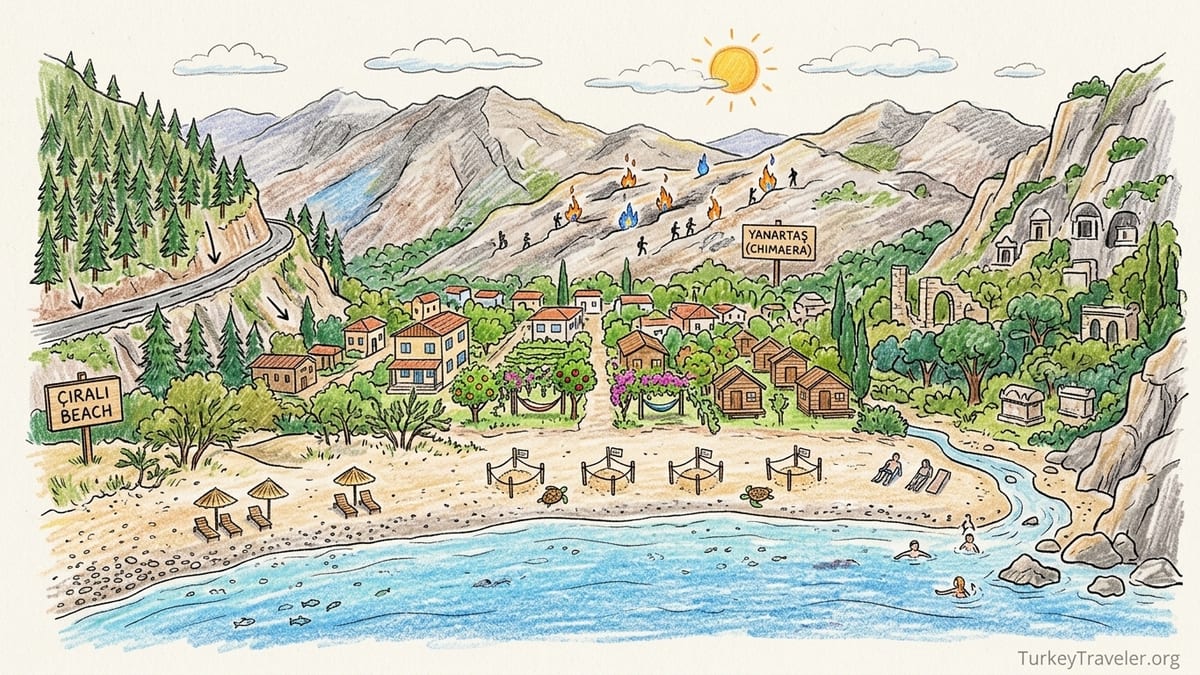
Because Çıralı is within the Beydağları Coastal National Park and part of an important sea turtle nesting area, building regulations have kept structures low and relatively dispersed. Walking toward the beach, I passed only one storey or occasionally two storey houses, many with chickens in the yard and tomato plants climbing up poles. The sea did not announce itself with a line of towers. It simply appeared at the end of the lane as a wide, pale band of shingle and blue water backed by mountains.
Day One: Getting to Know Çıralı Beach
My first full day belonged entirely to the sea. From my guesthouse it was a flat 8 or 9 minute walk down a sandy lane to Çıralı Beach. Where Antalya’s city beaches are lined with promenades, playgrounds and high level lighting, Çıralı’s seafront is mostly a low dune fringed by tamarisk trees. A few small wooden beach cafes sit slightly back from the sand, each with its own cluster of sunbeds and umbrellas, but large parts of the shore are left completely open.
The beach surface underfoot is a mix of coarse sand and smooth pebbles, the exact balance shifting along its roughly 3 kilometer length. In front of the central section near the village lanes, the upper beach is mostly small stones that crunch pleasantly as you walk. Closer to the water, the pebbles give way to darker, compacted sand with scattered rounded rocks. Entry into the sea is straightforward but not as soft as a fine sand bay. I found that simple plastic sea shoes made the first few steps more comfortable, especially where slightly larger stones collect along the waterline.
Once in, the seabed drops away at a moderate angle. In the morning the water was exceptionally clear, with visibility of several meters; I could see fish darting between stones below. On a calm September day there was a gentle swell but no strong undertow. Families with small children tended to settle near the cafe zones where the slope felt slightly gentler, while couples and solo travelers spread towels in the unserviced stretches. Even in late season I noticed that the loudest sound was usually the waves. The national park status keeps motorized watersports at a minimum, and there are no permanent concrete jetties or large beach clubs lining the shore.
Shade at Çıralı comes from a combination of rented umbrellas and natural tree cover. In front of some pensions, wooden platforms hold pairs of sunbeds under straw parasols or canvas awnings. Elsewhere, people tuck themselves under the few tamarisk and pine trees at the back of the beach. Because of Çıralı’s protection as a nesting area for loggerhead turtles, permanent bright lighting right on the sand is avoided and large enclosed beach bars are absent. During the day I could buy a Turkish coffee or a gözleme pancake at a simple open sided café, but I never felt enclosed by commercial frontage.
Sharing the Shore with Sea Turtles
Walking along the high tide line, I began to notice small roped off circles of sand with wooden stakes and numbered tags. These were sea turtle nests, each one recorded and protected by local volunteers and conservation groups. Çıralı’s beach is a significant nesting ground for loggerhead turtles, and conservation rules shape much of how visitors are expected to behave. Signs at the accesses explain that from May to October the beach is an active nesting and hatching zone and that disturbances after dark can disorient turtles.
Practical rules are straightforward but important. Open fires and barbecues on the beach are prohibited year round. Campsites are set back from the sand, and free tent camping directly on the nesting areas is restricted or forbidden during the season, with local notices explaining that tents and associated lights can both crush nests and confuse hatchlings emerging at night. Beachfront cafes switch off or reduce visible lighting toward the sea after late evening, and larger accommodations are expected to keep seaward facing lights low and shielded. That means the shoreline at night is darker than many Mediterranean resorts, which can surprise first time visitors but is essential for turtle survival.
As visitors we share responsibility. In practice this meant that after sunset I avoided using my phone torch directly on the sand, and I never walked close to the roped off nests. If you happen to see a nesting turtle or hatchlings, local advice is to stay back, keep quiet, and certainly not to handle or photograph them with flash. During my September stay I did not see turtles in person, but the density of marked nests made it very clear that the beach belongs to them as much as to swimmers. It is a different experience from the brightly lit promenades of Antalya, but one that feels more appropriate to a protected coastline.
There are also subtler consequences. Because vehicle access on the beach is restricted, there are no cars or quad bikes buzzing along the sand. Rubbish bins are spaced but not intrusive, and several pensions remind guests to remove beach furniture at night so that turtles have a clear path. For a weekend visitor this amounts to small adjustments: carrying a torch that can be dimmed and pointed down, leaving large items on the terrace instead of the sand after dark, and accepting that a natural coastline is a little wilder and darker in exchange for remaining alive for more than just human enjoyment.
Comparing Çıralı and Olympos Beaches
Although Çıralı and Olympos beaches share the same curving bay, they feel like cousins rather than twins. Standing on the sand in Çıralı and looking south, you can see where dark cliffs begin to rise, pinching the shoreline into the narrow river valley where ancient Olympos sits. On foot, it is possible to walk along the water’s edge from one to the other in roughly 45 minutes to an hour, depending on how much you stop to swim. This uninterrupted coastal walk reinforces that it is one natural unit. Yet, in practical terms, each end has its own access, its own small world.
From the Olympos side, visitors typically drive down a separate valley road, park near the archaeological entrance, then walk through the ruins to reach the sea. Cars cannot be taken to the beach itself. Simple tree house style hostels, backpacker pensions and bars cluster in the valley, creating a youthful, sociable atmosphere. Nights there often include live music and open air bar terraces among the trees. By contrast, Çıralı’s accommodations are spread along several flat lanes back from the dune. Most establishments are family run pensions or bungalows in gardens, with a quieter, more village like tempo once dinner is over.
The beach experience reflects this split. On the Çıralı side, sunbeds are modest in number and mostly associated with guesthouses that lease sections from the municipality. Music, where it exists, is low and localized to a handful of cafes. On the Olympos end, many swimmers use the beach as an extension of their archaeological visit. Towels spread between fragments of worn masonry at the back of the sand, and day trippers carrying small coolers join hostel guests for an afternoon swim after seeing the ruins. Both sections share the same sand and shingle mix and the same clean, quickly deepening sea, but Çıralı feels more like a low key seaside village, while Olympos leans toward a backpacker enclave threaded through antiquity.
For my own stay, I chose to sleep in Çıralı and treat Olympos as a daytime excursion. That decision proved practical. In the evenings, Çıralı’s beachfront restaurants serve fresh fish, meze and grilled vegetables at reasonable prices, often 12 to 18 US dollars for a main course of grilled sea bream or calamari, with cold meze plates charged separately. The atmosphere is sociable but subdued. Nearby Olympos, a short drive or a longer beachfront walk away, offers livelier bars and occasional parties for those who seek them, but returning to the citrus shaded quiet of my pension in Çıralı suited the slower rhythm of this particular weekend.
Walking Through Ancient Olympos to the Sea
I devoted the heart of my first afternoon to Olympos, which lies only a few kilometers south of Çıralı by road. From my guesthouse, it took about 10 minutes to drive to the signed entrance, where a small parking area marks the end of vehicle access. From there, the visit becomes a walk. After buying my ticket at the gate, I followed the main path into the gorge, the sound of cicadas joining the trickle of water in the riverbed beside me.
As of late 2026, foreign visitors pay the equivalent of roughly 10 euros for entrance, with the national Museum Pass also valid. The ticket is checked both at the archaeological gate and again closer to the beach, because the shore here is classed as part of the ancient site. From the entrance to the sea, the distance is about 1.5 kilometers. Walking at a relaxed pace with short stops for photographs and shaded pauses, I covered it in approximately 25 minutes. The surface is mostly compacted earth and stones, with occasional roots and broken masonry, so trainers or solid sandals are more comfortable than flip flops, especially if you plan to explore side paths.
The ruins themselves are not monumental in the way of Ephesus or Pergamon, but they are deeply atmospheric. Olympos was one of the important cities of the Lycian League and enjoyed a strategic position at the mouth of a sheltered valley. It prospered through trade and maritime connections through the Hellenistic and Roman periods, later declining under changing trade routes and natural disasters. As you walk, the river splits the site in two. On one side stand the remains of a bath complex and Byzantine basilica, their walls softened by fig roots and creepers. On the other, a path climbs gently to rock cut Lycian style tombs, their facades carved into the hillside, and free standing sarcophagi with long, weathered inscriptions.
Interpretive panels in Turkish and English are spaced through the site, explaining which period each structure belongs to and how archaeologists interpret its function. One stop describes the agora area and its role as a commercial and civic center, another outlines the bathhouse with its sequence of cold and hot rooms. In a clearing near the river, the outline of a small Roman theatre can be traced, partly hidden by vegetation but still suggesting the scale of gatherings that once filled the valley with voices. None of this relies on romantic pirate legend; instead, it speaks of an urban community integrated into wider Lycian maritime networks and later the Roman world, positioned on a coast that offered harbors, fertile hinterland and access to inland routes.
Reaching the seaward end of the gorge, the ruins thin out and the path opens suddenly onto a narrow strip of pale shingle and extraordinarily clear water. Here the river slips underground before meeting the sea, so the beach feels framed by cliffs and forest rather than a visible stream. Swimmers scatter across the gentle curve, some climbing onto low rocks to sun themselves between dips. Behind them, masonry walls and arches crumble into the undergrowth. It is one of the few places where you can walk from an archaeological site straight into the sea with a single ticket, and the walk itself, more than any single structure, is the essence of Olympos.
Day Two: Climbing to Yanartaş, the Flaming Rocks
On my second morning I saved my energy for Yanartaş, also known as the Chimaera. The site lies in the hills above Çıralı, roughly 3 kilometers inland, and is reachable either by car or on foot. I opted to borrow a bicycle from my guesthouse for the mostly flat approach road and then lock it at the base, where a small cluster of tea houses and ticket booths mark the entrance. In 2024 and 2025, local information boards and lodge notices list the entry fee as around 100 to 120 Turkish lira per adult, payable in cash or by local card, although visitors should check on arrival for current prices as Turkey’s inflation means figures change.
From the gate, a stone and earth path climbs to the main cluster of flames. Signs suggest allowing about 20 to 30 minutes for the ascent. I set a timer out of curiosity and reached the first flames in 19 minutes at a steady, unhurried pace. The trail is short but not trivial. It gains a noticeable amount of height, and large stones make some sections feel like uneven steps. In the heat of late morning, I was grateful for wearing trainers and carrying water. Flip flops would be possible for the surefooted, but I saw several people wobble on the polished rocks. During the day the path is shaded in parts by trees, but the air still feels close, especially in midsummer.
The fires themselves are smaller and more scattered than the famous photographs might suggest. Dozens of blue orange flames burn directly from cracks in the bare rock across a sloping terrace, some only the size of a hand, others perhaps as large as a campfire. They are fed by natural gas seeping continuously from the subsurface rocks, a mixture of methane and other gases linked to the region’s complex geology and serpentinized rocks. Scientists have studied the site as an example of long lived natural gas seepage, and ancient writers likely drew on it for myths of a fire breathing creature, but standing there today it reads more as a geological curiosity than a spectacle.
Because the flames draw people both by day and after dark, it is worth adjusting expectations. In daylight, the fires are smaller than many people imagine, but they sit in a lovely high clearing with views back toward the sea, and the surrounding slopes are scented with pine and herbs. After sunset, the flames stand out more sharply against the dark, and many visitors time their climb to arrive at dusk. In that case a headlamp or strong hand torch and good footwear cease to be optional. The stones that were merely uneven in daylight become potential ankle traps in darkness, and while some people still try the ascent in sandals, my own experience suggests enclosed shoes are a safer choice, particularly on the descent.
At the site there are rough stone benches and blackened patches where people once roasted marshmallows and boiled tea, but officials and conservation minded locals now discourage open fires and cooking. Given the dry forest around and the presence of sea turtle nesting areas further down the valley, avoiding additional flames feels like common sense. I spent roughly 40 minutes at the top, moving quietly between the clusters of fire, watching small groups take photos and sit silently. Then I walked back down in about 17 minutes, passing others on their way up with picnic bags and phone flashlights. The total outing from Çıralı, including cycling to the base and back, buying a tea before starting, and the hike itself, took around three hours.
Practicalities: Heat, Insects, Meals and Money
Spending two days in Çıralı and Olympos in late summer brought a predictable mix of heat, insects and simple practicalities. Daytime temperatures often reach into the low to mid thirties Celsius, and even in September the sun on the beach can feel fierce. A hat, high factor sunscreen and plenty of drinking water are essentials both for the archaeological walk in Olympos and for the climb to Yanartaş. Shade is available in the ruins and along parts of the Chimaera trail, but not continuously. I found that planning Olympos for late afternoon and Yanartaş for a morning or just before sunset made the heat manageable.
Insects were noticeable but not oppressive. Çıralı sits in a green, watered valley, and standing water in irrigation channels attracts mosquitoes at dusk. Pensions usually fit simple mesh screens on windows, but a small bottle of repellent made evenings more comfortable, especially during outdoor dinners. On the beach, insects were fewer thanks to sea breezes. Stray cats are plentiful around cafes and pensions, a familiar sight along the Turkish coast. Most are used to people, and staff often set out bowls of water and leftovers, but it is still sensible to avoid feeding them directly at your table.
Food was one of the weekend’s pleasures. My first evening meal in Çıralı was at a beachfront restaurant with low tables on a wooden deck and soft lighting directed inward rather than toward the sea, in keeping with turtle friendly practices. A grilled sea bass with salad and bread cost the equivalent of about 16 US dollars, while a plate of mixed cold meze shared between two came to around 10 dollars. A large bottle of local beer added roughly 4 to 5 dollars. Inland on the village lanes, simpler lokanta style eateries served stews, beans and rice at lower prices, more like 5 to 8 dollars for a satisfying plate. Breakfasts at my pension were included in the room rate and generous enough to make lunch optional: sliced tomatoes and cucumbers, olives, cheese, eggs, fresh bread, honey and homemade jams.
Transport costs for the weekend were modest once in Çıralı. I had already rented a small car in Antalya, where daily rates in 2026 hover around 30 to 50 dollars depending on season and provider. The drive from Antalya city to Çıralı took about an hour and a half, following the D400 past Kemer and then turning inland at the signed junction. Fuel for the round trip plus local drives to Olympos and back was under 30 dollars at current prices. Entrance fees added up as follows: roughly 10 euros for Olympos, around 100 to 120 lira for Yanartaş, and a few modest parking charges of one or two euros at most. For two nights, including accommodation, meals, fuel, and site entries, I spent in the region of 260 to 320 US dollars. Travelers on tighter budgets could reduce that by choosing simpler pensions and eating more often at village lokantas rather than beachfront restaurants.
Quiet Gardens or Nightlife in the Trees
One of the recurring choices for visitors is whether to stay in Çıralı or in the Olympos valley. They are so close geographically that you can walk along the beach between them in under an hour, yet the evening experiences differ. In Çıralı, nights are dominated by the sound of waves and the occasional clink of cutlery from small restaurants. After about 11 pm, the village lanes fall quiet. Garden lamps are subdued, and many pensions dim or angle seaward lights to respect turtle regulations. I slept with my window open under a mosquito screen, hearing little more than crickets and the soft murmur of guests talking on balconies.
Olympos, by contrast, has a long established reputation as a hangout for younger, sociable travelers. Its tree house hostels and backpacker camps surround central courtyards where music and conversation run later. Bars often stay open past midnight, and there is more of a communal party feel. For some visitors this is exactly the appeal: evenings spent swapping stories over cheap drinks among ruins and pines, then strolling back along forest paths to a basic cabin. Others find the soundtrack less appealing after a day of heat and exploration.
My own choice of Çıralı reflected a preference for quiet nights and early mornings on the beach. From that base, I could still dip into Olympos’ livelier scene by driving or walking there one evening, then retreat to my citrus garden room. Families with children, couples seeking rest and older travelers often gravitate to Çıralı for this reason. Solo travelers looking to meet others and enjoy spontaneous gatherings may find Olympos more stimulating. Both ends share access to the same sea, the same archaeological wonder and the same national park. The decision comes down to how you want your evenings to sound.
In terms of accommodation character, Çıralı’s pensions feel more integrated into a working village, with orchards, vegetable plots and long term residents. Olympos accommodations feel more like seasonal enclaves nested in forest, oriented strongly toward tourism. Neither is inherently better, but over a focused two night stay, the quieter base made it easier for me to wake early, walk the beach at first light, and pay more deliberate attention to the fragile nesting sites under my feet.
The Takeaway
Looking back on this short trip, the strength of Çıralı lies in its combination of elements that elsewhere might be spread along an entire coast. Within a compact area you can swim from a wide, relatively undeveloped turtle nesting beach, walk through the remains of a once important Lycian port city, and then climb to a hillside where natural fires have burned for centuries. None of these experiences alone would necessarily justify travel from afar, but together they create a textured weekend that feels quite different from a standard resort stay in Antalya.
The key is to embrace what Çıralı is not. It does not have rows of waterslides, club music echoing from beach bars long after midnight, or aggressive neon lighting along the promenade. Instead, it offers low rise pensions in gardens where breakfast is served under fruit trees, a beach where sections are deliberately left dark and unbuilt for the sake of turtles, and an archaeological site where the walk is as important as the stones. For those used to all inclusive packages, the quieter rhythm may feel unfamiliar at first. For others, it will feel like a relief.
Did the combination of beach, archaeology and flames genuinely justify two nights? For me, the answer is yes. Two full days allowed enough time to swim on both Çıralı and Olympos beaches, to walk the entire 1.5 kilometer gorge through the ruins without rushing, and to climb to Yanartaş without cramming it into the midday heat. It also gave space simply to sit: on a shaded pension terrace listening to chickens in the next yard, on a darkened beach watching stars over a protected shoreline, on a stone step in Olympos with my feet in the river. A single day trip from Antalya would have ticked the sights but missed that cumulative quiet.
For travelers weighing destinations along Turkey’s southern coast, Çıralı will not replace the buzz and amenities of larger centers. What it offers instead is a small scale alternative that still feels physically and emotionally connected to the landscape and its non human residents. If swimming where turtles nest, walking an ancient maritime valley to the sea, and sitting beside modest but real eternal flames appeal more than pool games and nightclub lineups, then a weekend in Çıralı, anchored by two nights in a garden pension, is time well spent.
FAQ
Q1. Is Çıralı suitable for a short two night stay from Antalya?
Yes. Çıralı is about a 1.5 hour drive from Antalya, which makes two nights practical. You can comfortably fit in beach time, a visit to Olympos ruins and a hike to Yanartaş without rushing.
Q2. How difficult is the walk through ancient Olympos to the beach?
From the entrance gate to the sea is roughly 1.5 kilometers each way on uneven paths. Most reasonably fit visitors manage it in 20 to 30 minutes one way, but sturdy footwear and water are recommended.
Q3. What are the current entrance fees for Olympos and Yanartaş?
In late 2026, Olympos charges foreign visitors the equivalent of about 10 euros, while Yanartaş costs around 100 to 120 Turkish lira per adult. Prices in Turkey change frequently, so confirm at the gate on arrival.
Q4. Can I camp directly on Çıralı Beach?
No. Because the beach is a protected sea turtle nesting area, free camping on the sand is restricted or prohibited, especially between May and October. Designated camp areas and pensions set back from the shore are the appropriate options.
Q5. Is it better to stay in Çıralı or in Olympos?
Stay in Çıralı if you prefer quiet evenings, garden pensions and darker, turtle friendly beachfront. Choose Olympos if you want livelier hostels, later night socializing and a more backpacker focused atmosphere.
Q6. Do I need special equipment to visit Yanartaş at night?
Good closed shoes and a reliable torch or headlamp are highly recommended after dark. The path is short but rocky, and there is limited lighting. Carry water and avoid open flames or cooking near the natural gas vents.
Q7. How pebbly is Çıralı Beach and do I need sea shoes?
Çıralı is a mix of coarse sand and pebbles, with smoother stones concentrated along the waterline. Many visitors swim barefoot, but simple sea shoes make entry and exit more comfortable, especially where larger stones collect.
Q8. Are there facilities like showers, toilets and cafes on Çıralı Beach?
Yes. Several small beachfront cafes provide sunbeds, basic showers and toilets for customers, and there are public access points along the beach. Facilities are modest compared with big resorts but adequate for a comfortable day.
Q9. What should I do if I see a turtle or hatchlings on the beach?
Keep your distance, stay quiet, do not use flash photography or bright lights, and never touch turtles or nests. If you see people disturbing a nest or animal, notify local authorities or your guesthouse, who can contact conservation volunteers.
Q10. How much should I budget for a two night visit to Çıralı?
For mid range travelers, a rough budget might be 140 to 220 US dollars for two nights in a pension with breakfast, 80 to 120 dollars for meals, 10 euros for Olympos, local lira for Yanartaş and around 30 dollars for fuel and parking if arriving by car.