


I arrived at the lower gate of Ephesus with the kind of hushed expectation you reserve for world wonders. This was the city of the Library of Celsus and the roaring Great Theatre, the place where the Temple of Artemis once outshone every shrine in the ancient Mediterranean. I had swallowed the brochures and cruise-ship hype whole. What I had not fully grasped was how sharply the modern reality of ticketing, crowds, heat and logistics would clash with that dream, or how quickly forty euros at the gate would become fifty-five before I had even seen my first column up close.
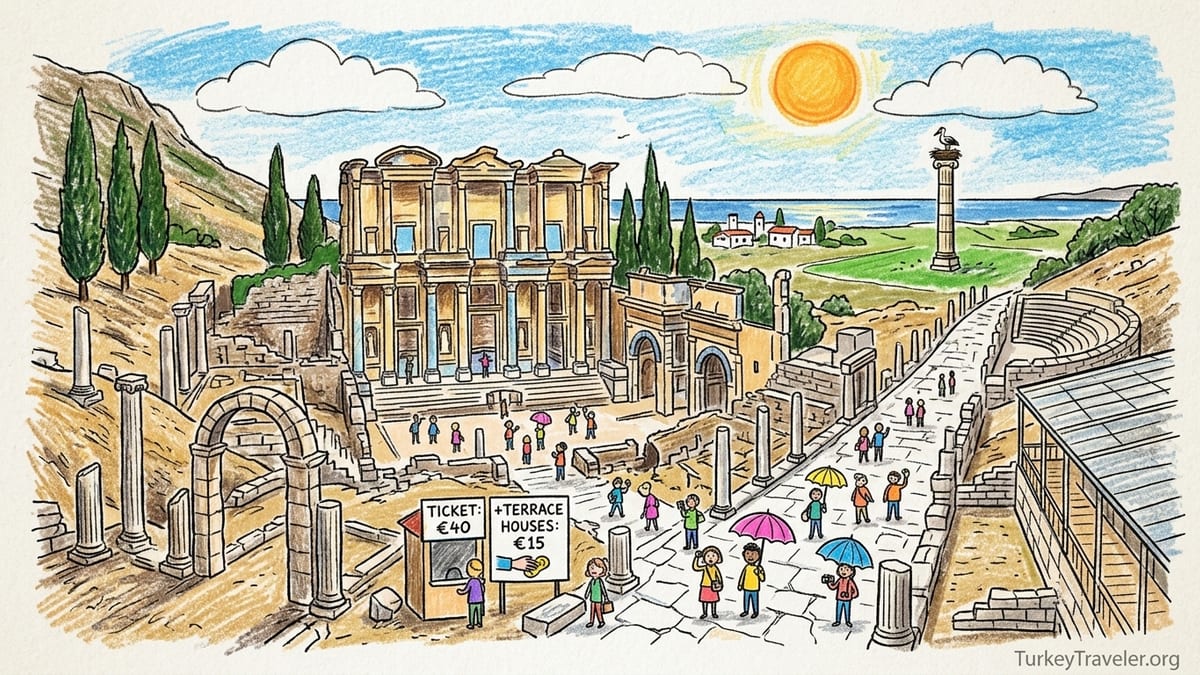
First Impressions: Two Gates, One Long Marble Funnel
Most independent visitors first meet Ephesus at one of two points: the upper Magnesia Gate high above the site, or the lower Harbour Gate closer to modern Selçuk and the tour-bus parking. I started at the lower gate, the same point used by a steady stream of coaches coming up from Kuşadası. Within minutes, the “ancient city” feeling had to compete with souvenir stalls, ice-cream freezers and guides raising colored umbrellas to rally their groups. The stone-paved processional way may be Roman, but the choreography at the entrance is modern mass tourism.
Entering at one gate and exiting at the other is, in theory, a clever way to save your legs. The site is built on a slope and the one-way downhill walk from the upper gate to the lower can be kinder in the heat than trudging up and back again. In practice, the decision creates a planning problem. If you arrive by rental car and park at the lower gate but let gravity carry you out at the upper, you either backtrack on foot in the sun or haggle for a shuttle or taxi. If you let your hotel in Selçuk drop you at the upper gate but want to linger at the end of the day, you must coordinate a pickup at the lower bus park or negotiate with drivers who know perfectly well you have few options.
On my visit, a driver at the upper car park quoted a firm price to take solo visitors back around the perimeter road to the lower gate, a trip of only a few minutes. The fee was not extortionate, but it illustrated a subtle point: the physical layout of Ephesus nudges you either into a loop of extra walking on uneven marble or into a chain of small, unbudgeted payments in a place where you thought the ticket was the main hurdle.
Starting at the lower gate has its advantages. The monumental arch and the long, straight Harbour Street deliver you almost immediately to the Library of Celsus and the Great Theatre, two of the site’s great set pieces. The downside is that you hit the densest crowds instantly, then fight your way uphill through the cruise-ship tide toward the upper exit. Beginning at the upper gate spreads out the build-up. You descend gradually past the State Agora and the Odeon, then follow Curetes Street down toward the library along the same axis that made ancient Ephesus a show city. Either way, the site’s topography funnels almost everyone through the same choked corridor of marble.
The €40 Ticket: Sticker Shock Before the First Column
The first real jolt of the day came not from a collapsed temple, but from the price board at the ticket window. For foreign adults in late 2026 the official tariff for the main Ephesus site is set at the equivalent of around €40, using a Euro-based schedule that the Ministry of Culture and Tourism now publishes for international visitors. That single ticket includes both the archaeological site and the Ephesus Experience Museum, the digital, immersive attraction built into the complex.
The forty euros are paid in Turkish lira at the gate, converted at the previous business day’s official exchange rate. Card payment is accepted, but euro cash is not. In abstract, it sounds reasonable to pay forty euros for one of the Mediterranean’s great ruined cities. The problem is what happens next. To enter the “Terrace Houses” section, where the best-preserved domestic interiors of Roman Ephesus are protected under a modern roof, foreign visitors currently surrender a further fifteen euros or its lira equivalent. In other words, if you want to see the city’s grand public spaces and its elite homes in a single visit, you are paying the ticket office fifty-five euros per person before transport, guide or lunch.
The pricing model is not unique to Ephesus. Major sites from the Colosseum in Rome to Knossos in Crete have layered ticket structures or charge separately for premium areas. What makes Ephesus sting is the combination of a high headline fee, a mandatory digital attraction folded into the main ticket, and a separate surcharge for exactly the part of the ruins that most deeply rewards careful visitors. It feels less like paying for added depth than being asked to buy back access to the city’s lived-in spaces that ought to be central to the story.
There are genuine ways to blunt the financial hit. The Museum Pass Aegean, a regional version of Türkiye’s national museum pass, covers Ephesus, the Terrace Houses, the Ephesus Archaeological Museum in Selçuk, the Basilica of St John and major regional sites from Aphrodisias to Pamukkale. As of autumn 2026, the pass is priced at the equivalent of roughly ninety to one hundred euros for seven days. For a traveler intending to combine Ephesus with Pamukkale, Hierapolis, Laodicea or the stadium at Aphrodisias, this can bring the effective cost of Ephesus down. But that is cold comfort to the day-tripper who sees only one site and pays full price, especially from a cruise ship where port calls are short and add-ons multiply.
The Terrace Houses: Essential Treasure or Overpriced Add-On?
The terrace houses are the place where Ephesus stops being a stone backdrop and becomes a city with carpets, kitchenware and graffiti. A steel and glass covering protects a cluster of Roman townhouses stacked up the slope beside Curetes Street, complete with mosaic floors, painted wall panels in deep reds and blues, marble-lined reception rooms and private latrines. Climate control keeps the humidity steady. Elevated walkways thread you over the archaeologists’ grid of trenches and conservation scaffolding.
On my visit in high season, I watched a steady stream of tour groups walk past the entrance without stopping. When I asked one guide why none of his twenty-strong group had tickets for the terrace houses, he was blunt: “For a family of four that is sixty euros more. Most think they are already paying enough.” Inside the enclosure, the density of visitors dropped dramatically. Where Curetes Street outside was shoulder to shoulder, here there were only a few dozen people spread over multi-level catwalks. The difference in atmosphere and interpretive depth was striking.
Skipping this area is, in my view, one of the biggest mistakes a visitor can make. The layout of the houses makes sense of the public facades outside. You suddenly understand who might have walked into the shops and offices along the street, up what staircases they climbed, and under which frescoes they received their guests. Without the terrace houses, Ephesus risks being perceived as an endless parade of broken columns and reconstructed fronts. With them, it becomes legible as a city where people argued at dinner, prayed in small household shrines and commissioned portraits of themselves for their reception rooms.
The question is whether that insight is worth a fifteen euro surcharge on top of an already expensive baseline. For solo travelers and couples on short trips, I would still say yes. The per-person cost is painful, but the time inside is calm and unusually informative compared to the jostle outside. For larger families on a tight budget the calculation gets harsher. In those cases, at least one adult should consider going in, photographing and filming generously, then sharing those images with children who might already be melting in the sun. It is an unsatisfying workaround, but it respects both budget limits and the fact that this is where Ephesus’s richest domestic story is told.
The Ephesus Experience Museum: Meaningful Context or Expensive Sideshow?
The second part of the mandatory package is the Ephesus Experience Museum, an immersive digital installation that uses projection, sound and reconstructed scenes to evoke ancient life. Since a combined ticket for the archaeological site and experience museum is now standard for foreign visitors, the real question is not whether it is worth buying, but whether it feels like good value relative to the ruins outside.
Inside, visitors move from room to room through a sequence of dark, climate-controlled spaces. Frescoed walls light up with projected banquets. Ships sail across a digital harbor. Voices in multiple languages tell the story of Artemis, the Roman colony and the early Christian community. It is polished and, at moments, affecting. For travelers who struggle to imagine columns as functioning buildings, there is real value in seeing interiors, crowds and furnishings animated, even virtually. For children, the show can be the most accessible part of the entire complex.
Yet there is an uneasy tension in building a high-tech entertainment environment inside an archaeological landscape already under pressure from more than two and a half million annual visitors. According to figures released by the Culture and Tourism Ministry, Ephesus was Türkiye’s single most visited cultural site in 2025, drawing around 2.55 million people. The decision to make the digital attraction part of the standard ticket has provoked legal challenges from parts of the travel industry, concerned that a Euro-based, bundled ticket regime pushes prices up without clear consent from visitors.
As a researcher, I found the experience museum least convincing where spectacle edged out explanation. A room where the floor vibrates and lights flare to simulate a minor earthquake feels more like a theme-park effect than an interpretive tool. The basic facts about the city’s long history under Greek, Roman, Byzantine and Seljuk rule are conveyed clearly enough, but much of the same information is available on standard panels on site or in any half-decent guidebook. Compared with Istanbul’s Archaeology Museums or the quietly superb Ephesus Archaeological Museum down in Selçuk, the digital show felt heavy on mood and light on objects. It may earn its place as a gateway for visitors unfamiliar with ancient history, but it also quietly absorbs a significant slice of that forty euro ticket.
Crowds on Marble: What 2.5 Million Visitors Feel Like on the Ground
Ephesus’s headline visitor figure looks abstract on paper. On the marble of Curetes Street at 10.30 on an August morning, it feels very concrete. The classic spine of the site, running from the upper gate down to the Library of Celsus, narrows into a stone canyon hemmed in by shop colonnades. Every ten or fifteen metres a guide stops, raises a flag or closed umbrella, and begins a speech in English, German, Italian or Korean. Their groups spread across the width of the street. Solo travelers and small parties weave between them, pausing for the same photo of the library framed by columns.
The density is not uniform. Early in the morning, for the first hour after opening, the upper section around the Odeon and the State Agora can feel almost peaceful, especially outside the peak cruise months. The lower agora and the Great Theatre, by contrast, are magnets for the largest tour groups arriving from Kuşadası by mid-morning. When two or three large groups converge on the short stretch between the library and the theatre, staircases and viewpoints back up quickly. On my visit, a family with a stroller took several minutes to navigate just fifty metres of steps because every landing was already occupied by people posing for photographs.
It would be misleading to claim that Ephesus is equally crowded every day of the year. In winter and on days when few cruise ships call at Kuşadası, the atmosphere is calmer. Advisory notes published by the culture ministry acknowledge seasonal differences, and locals in Selçuk speak of January afternoons when you can stand in the theatre and hear little but the wind. Yet for most travelers, especially those visiting between late April and October, the reality is closer to a managed bottleneck. The stone-paved streets of the ancient city were not designed to accommodate today’s volume of visitors.
Interestingly, crowding drops sharply as soon as you step off the main axis. The side street up toward the Varius Baths or the rougher path out toward the Vedius Gymnasium can feel almost empty even while the library is ringed two or three people deep. That contrast points to a larger disappointment. Ephesus does contain quieter corners where you can absorb the scale and landscape. The problem is that the ticket price and international reputation are driven by exactly those high-traffic postcard views most saturated with bodies.
Heat, Shade, Water and Broken Stone: The Physical Toll of a Visit
Ephesus sits in a basin just inland from the Aegean, and in high season the heat pools between the surrounding hills. On a July afternoon the stone underfoot can radiate warmth like a storage heater. Shade is limited, particularly along Curetes Street and the open plaza in front of the library. A few scattered trees and some awnings near the entrances offer brief relief, but most of the central site is unprotected. Visitors in sandals and light sneakers pick their way over polished marble slabs, many of them bowed or cracked. The remains look beautiful in photographs, but they make for treacherous footing.
There are drinking water and restroom facilities at both the upper and lower gate, and another set of toilets near the central refreshment area. For a site of this size, however, facilities inside the core archaeological zone itself feel thinly distributed. I watched more than one visitor cut short a circuit of the upper agora to head back downhill in search of a restroom. Water sold at the cafes around the gates and the central kiosk is markedly more expensive than in Selçuk or on nearby village squares, another small but noticeable premium on the captive audience inside the ticketed zone.
Accessibility is a particular sore point. Uneven stones, shallow steps worn into slopes, and gravel paths between monuments make wheelchairs and strollers hard to manage beyond short stretches. Official literature flags this, but at the gate the information is mostly reduced to small symbols on a signboard. On the day I visited, one traveler using a cane turned back halfway between the lower gate and the library, defeated by the incline and constant need to look down. For them, forty euros had bought less than thirty minutes of partial access.
The physical strain interacting with the sensory crowding raises a final question about value. Ephesus can be an intensely rewarding visit for those willing and able to endure heat and footing. For others, particularly older travelers or those with mobility limitations, the site is not simply “a bit challenging.” It can feel like paying a premium to battle a course of obstacles designed for fitter visitors, without any equivalently priced alternative way to engage deeply with the archaeology.
The Temple of Artemis: Expectation vs Reality at a Separate, Sparse Site
In the popular imagination, Ephesus and the Temple of Artemis are fused. Many guidebooks and cruise brochures lean on the “Seven Wonders of the Ancient World” label without spelling out what that means on the ground today. The sanctuary of Artemis, the Artemision, is in fact a separate site on the plain below the hill of Ayasuluk, a short distance from the main Ephesus entrance. It is not included in the standard ticket and must be visited separately from town or by taxi.
Modern visitors who make the trip find a marshy field, scattered foundation stones and a single standing column composed of reassembled drums from various periods. Behind it rise the Isa Bey Mosque and the ruins of the Basilica of St John. In aerial photos and history books, the temple’s gigantic footprint is clear. In person, unless you arrive with that floorplan in your mind’s eye, it can feel underwhelming. I overheard more than one visitor murmur that they would have skipped it had they known there was “only one column left.”
The disappointment here is largely one of expectation management. Turkish cultural authorities and serious archaeological publications are generally clear that the temple was destroyed and quarried in late antiquity and the Middle Ages, and that only fragments survive in situ. The gap opens instead at the level of tourism marketing, where the association with the Seven Wonders is often used without visual context. After paying substantial sums at the main site, some visitors understandably assume that a wonder of the world will come with more visible ruins.
Seen on its own terms, the Artemision is a quietly haunting place, especially in late afternoon light with storks nesting on top of the reconstructed column. As part of the overall value proposition facing a first-time visitor to Ephesus, however, it can feel like another separate effort layered on top of an already expensive and logistically demanding day. If you only have one day in the area and are already in doubt about whether the main site justified forty or fifty-five euros, the Artemision is unlikely to swing the calculation back in Ephesus’s favor.
Comparisons: Aphrodisias, Priene and Pergamon as Benchmarks
To understand whether Ephesus still feels worth its price and crowds, it helps to compare it with other major ruins in western Türkiye. Aphrodisias, inland in Aydın province, offers a striking contrast. Its theatre, stadium and temple façade are extraordinary, its on-site museum is world-class, and visitor numbers are a fraction of Ephesus’s. Ticket prices for foreign visitors are significantly lower than forty euros, and the feel on the ground is spacious and contemplative. You can stand at the center of the enormous stadium and hear birdsong. The trade-off is access. Aphrodisias is harder to reach without a car and rarely appears on cruise itineraries.
Priene, crouched on a hillside above the Menderes valley, is more modest again but frequently cited by archaeologists and historically minded travelers as one of the most atmospheric classical sites in the region. The walk up from the car park is steep, yet inside the city grid is remarkably legible, and even in high season there is room for silence. Ticket costs remain moderate. For many, the experience of wandering almost alone through the bouleuterion and along the main street feels richer than being jostled at Ephesus for ten times the visitor density.
Pergamon, further north near modern Bergama, balances spectacular acropolis views, a reconstructed altar frieze now in Berlin and a modern cable car. Its main acropolis site commands a solid fee, but still falls short of the forty-euro mark. Crowds are present, especially on weekends and public holidays, yet rarely reach Ephesus levels. The terraces of temples and library spaces feel grand but not overwhelmed. In short, several of western Türkiye’s premier ruins offer comparable or better archaeological rewards at lower prices and with far less saturation.
This comparative perspective does not mean Ephesus is unworthy. The city’s scale, state of excavation and association with both Artemis and early Christianity make it unique. But it does sharpen the underlying criticism. If your metric is cost per unit of contemplative engagement with ancient stone, Ephesus performs poorly next to its quieter cousins. The value case rests heavily on its fame, accessibility from İzmir and Kuşadası and its concentration of photogenic monuments within a compact, tour-bus-friendly footprint.
Five Real Disappointments You Are Likely to Encounter
Looking back over the day, five disappointments stand out clearly. The first is the sense of nickel-and-diming at a world-class site. The forty-euro base ticket may include an audio guide and the digital museum, but the separate terrace house fee, higher on-site prices for basic refreshments and the informal transport costs between gates all chip away at the feeling of a single, transparent admission price.
The second is crowd management. Despite ongoing discussions about reorganizing visitor flows and improving infrastructure, the core route between the upper gate, Curetes Street, the library and the theatre remains a human traffic jam for much of the season. Signage encouraging visitors to branch off into less traveled parts of the city is minimal. Timed entry to the most congested spots is not in place. The result is that the very features that justify Ephesus’s global fame become the least enjoyable to experience.
The third disappointment is accessibility and comfort. Limited shade, widely spaced facilities and treacherous walking surfaces combine to make the visit needlessly exhausting. While ruins will always be physically demanding to some extent, relatively modest investments in shaded rest points, more frequent benches and clearer information at the ticket office about the difficulty of the terrain could materially improve the experience without diluting authenticity.
The fourth lies in interpretive depth. Beyond the audio guide and the digital experience museum, on-site explanatory panels are patchy. Some monuments are described in detail, while others that loom large in historical accounts receive little contextualization. Compared with the epigraphic displays in Pergamon’s museum or the sculptural galleries at Aphrodisias, Ephesus leans heavily on grand vistas and light on close engagement with the material culture that once filled its streets and houses.
The fifth and perhaps most subtle disappointment is expectation management around the Temple of Artemis and the terrace houses. The external marketing ecosystem primes visitors to expect a walk through the wonders of antiquity for a single, substantial fee. The reality is that the physical remains of Artemis’s sanctuary are meager on site, while the richest domestic spaces in the city carry an extra charge that many visitors choose to avoid. The result is that a large proportion of the two and a half million people who pass through Ephesus each year leave without ever seeing its finest mosaics or fully grasping why the city mattered spiritually and socially, not just visually.
The Takeaway: Who Should Pay What, and When to Go
Is Ephesus worth the forty-euro entrance fee, and perhaps the full fifty-five with the terrace houses, in 2026? The answer depends less on archaeology, which remains undeniably remarkable, and more on your tolerance for crowds, heat, logistical friction and layered pricing. For a first-time visitor to Türkiye with a deep interest in classical history or early Christianity, I would still argue that the basic ticket is justified once. This is the city of Paul’s preaching and Artemis’s cult, of one of the ancient world’s iconic libraries and an almost complete Roman theatre. To have seen Western Anatolia and not set foot here leaves a gap.
Who should pay for the terrace houses? Any traveler who can comfortably absorb the extra fifteen euros and cares about how ancient people actually lived will find that area the intellectual and emotional highlight of the visit. Solo travelers, couples and small adult groups should treat the terrace houses as effectively part of the real price of Ephesus. Families on tight budgets may have to make harder choices. If the surcharge means cutting short your time elsewhere in Türkiye or skipping another site entirely, it becomes less defensible, but at least one person in the party should try to see it.
When is the basic ticket enough? If you are visiting chiefly to tick Ephesus off a long bucket list, or if you know that heat and uneven ground will limit your endurance to an hour or two, then paying only for the main site and ignoring the terrace houses is a rational compromise. In that case, focus your energy on the upper city in the cool of the morning, walk as far as the library and the theatre, and then leave before exhaustion or frustration sets in. You will still have seen the city’s grand public spaces, albeit side by side with thousands of others.
Does early or late visiting meaningfully improve the experience? Yes, but within limits. Arriving before opening can buy you thirty to sixty minutes of relative calm at the upper gate before the big buses roll in. Late afternoon, especially out of peak summer months, can bathe the library facade and the theatre in softer light and slightly thinner crowds. Evening openings, when they occur on special days, often feel more atmospheric but are promoted in ways that draw organized groups. None of these time hacks change the underlying dynamics of cost or infrastructure, but they can tilt the balance from “overwhelmed and overcharged” toward “demanding but memorable.”
Ultimately, Ephesus in 2026 is a site where extraordinary archaeology and ordinary visitor experience are pulling against each other. The stones are still worth crossing continents for. The question is whether the forty-euro ticket buys you enough space, comfort and depth to meet them on fair terms. For some, particularly those able to pair Ephesus with quieter miracles like Aphrodisias or Priene, the answer will be yes with caveats. For others, especially cruise passengers funneled through in a few crowded hours, the memory may be less of Artemis and Celsus than of queues, heat and the feeling that the ancient city had become a very modern machine for turning awe into revenue.
FAQ
Q1. Is the €40 Ephesus ticket price fixed, or can it change during the year?
The official tariff is set in euros but paid in Turkish lira at the current rate, and prices are periodically updated, usually at the start of a new season.
Q2. Do I have to visit the Ephesus Experience Museum if it is included in my ticket?
The combined ticket covers both the ruins and the experience museum, but you are not required to enter the digital show; you can spend all your time in the archaeological site instead.
Q3. Is the Terrace Houses ticket really worth the extra €15?
For travelers interested in domestic life, art and mosaics, the terrace houses are often the most rewarding part of Ephesus and justify the extra cost, especially for adults and older teens.
Q4. Can I avoid the worst crowds at the Library of Celsus and the Great Theatre?
Arriving at opening time or visiting in the late afternoon reduces crowding somewhat, but in high season these landmarks are rarely quiet while the site is open.
Q5. How difficult is the walking for people with limited mobility?
The main route involves uneven marble, slopes and worn steps, which can be challenging; some short stretches near the gates are manageable, but full access is limited.
Q6. Is it better to start at the upper gate or the lower gate?
Starting at the upper gate allows an easier downhill walk and a gradual build-up to the main monuments, but it complicates parking and pickups if your vehicle waits at the lower gate.
Q7. Does the Museum Pass Aegean save money for most visitors?
It can be good value if you plan to visit several major sites in the region, like Ephesus, Pamukkale and Aphrodisias, but is rarely economical for a single-site day trip.
Q8. Is the Temple of Artemis included in the Ephesus ticket?
No, the Temple of Artemis is a separate, sparsely preserved site near Selçuk and must be visited independently of the main Ephesus archaeological area.
Q9. Can I find food and water easily inside the site?
Basic snacks and bottled water are sold near both entrances and at a central kiosk, but prices are higher than in town and choice is limited.
Q10. If I only have half a day, what should I prioritize at Ephesus?
With limited time, focus on the upper city, Curetes Street, the Library of Celsus, the Great Theatre, and, budget permitting, a focused visit to the Terrace Houses.