


For many visitors, "Turkish beach" instantly means a turquoise cove like Ölüdeniz on a glossy brochure. But Turkey’s 8,000-kilometre coastline is far more diverse than that famous lagoon. From wind-brushed Aegean bays and pine-backed Mediterranean sands to the moody Black Sea and busy Marmara resorts serving Istanbul weekenders, each stretch of coast offers a very different kind of holiday. Understanding these contrasts is the key to choosing a beach that matches the trip you actually want, not just the photos you have seen.
Understanding Turkey’s Very Different Coasts
The idea that all Turkish beaches look and feel like the sheltered lagoon at Ölüdeniz is persistent, but misleading. Turkey touches four distinct seas, and each brings its own personality. The Mediterranean around Antalya and the Turquoise Coast has long, hot, dry summers and some of the country’s warmest, clearest swimming water. Many beaches here are framed by steep cliffs and pine forests, with summer sea temperatures commonly above 25°C from late June into September. Resort towns such as Antalya, Alanya, Kaş and Fethiye have dense tourism infrastructure, with everything from budget pensions to large all-inclusive hotels.
The southern Aegean, including the Bodrum and Datça peninsulas and the Çeşme area near İzmir, has more wind and a slightly shorter, milder summer. This is where you find some of Turkey’s best-known sailing waters and windsurfing spots, such as Ilıca and nearby Alaçatı, where steady afternoon winds are a feature rather than a drawback. The coastline is deeply indented, with many small, pebbly coves and quieter villages between the busier hubs of Bodrum, Marmaris and Çeşme.
Further north, the northern Aegean coast, around Ayvalık, Assos and the islands of Gökçeada and Bozcaada, feels different again. Summers are warm but not as humid as the Mediterranean, and the sea is usually a few degrees cooler. Many beaches here, such as Sarımsaklı near Ayvalık and Ayazma on Bozcaada, combine wide arcs of sand with a simpler, more low-key tourist offer that appeals to domestic holidaymakers and travellers who want to escape large resorts.
The Sea of Marmara and the Black Sea stand apart from both. Marmara, ringed by Istanbul and industrial towns, is more of a regional playground than an international beach destination, but islands such as Avşa and towns like Şarköy still offer swimmable beaches that are easy to reach by car or ferry from Istanbul. The Black Sea, stretching from Kırklareli to Artvin, is beautiful and much wilder. Compact bays like Amasra or long townfront strands such as Atakum near Samsun can be inviting in mid-summer, but the season is shorter, the water cooler and currents stronger, so it suits confident swimmers and more flexible travel plans.
Blue Flag Beaches: What 580 Flags Really Mean
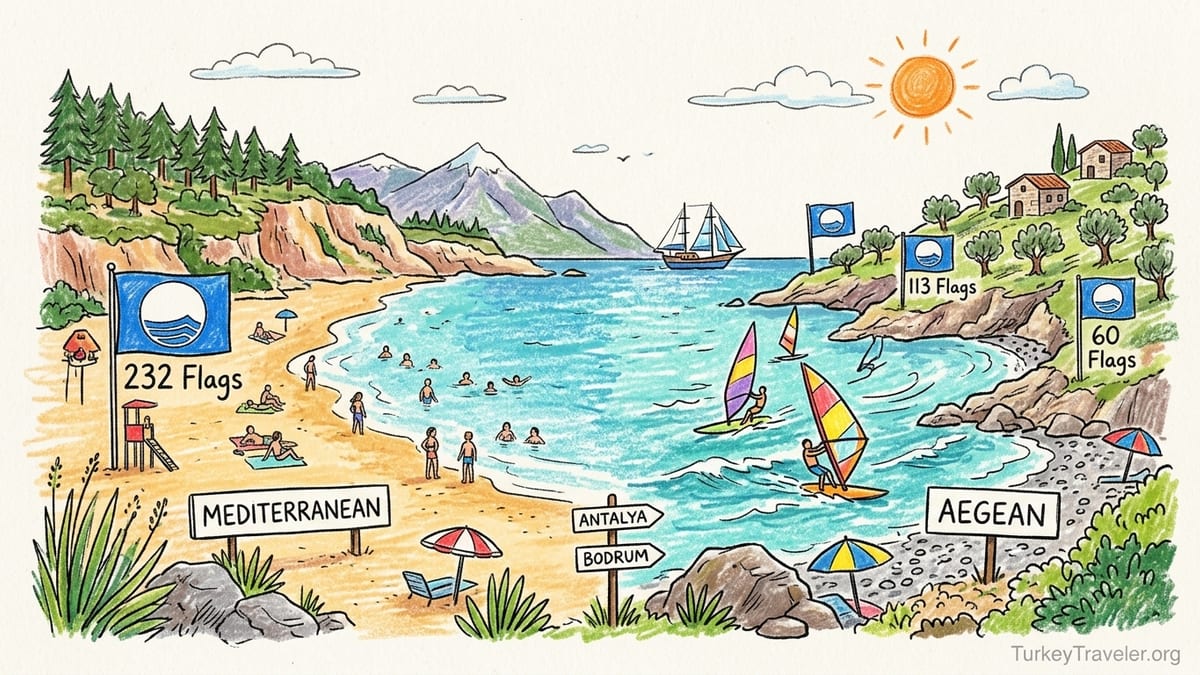
Turkey’s coasts are not only varied, they are heavily certified. For the 2026 season, the country has 580 Blue Flag beaches, confirmed by the Ministry of Culture and Tourism and the national environmental education foundation. That places Turkey among the world leaders in this international program. Antalya alone counts 232 Blue Flag beaches, Muğla, which includes Fethiye, Marmaris and Bodrum, has 113, and İzmir, home to Çeşme and the northern Aegean, has 60. Those numbers are eye catching, but it is important to understand what a Blue Flag does and does not guarantee.
The Blue Flag program evaluates beaches against criteria grouped under water quality, environmental management, education, safety and services, and accessibility. To qualify, a beach must meet strict microbiological water quality standards, have regular testing, provide information about the local environment, manage waste responsibly, and ensure basic safety measures. On busier beaches, that includes lifeguard coverage during the main season, signposted first-aid points and clear systems for responding to pollution or emergencies.
However, a Blue Flag is not a promise that the sea will always be calm, that there will be no jellyfish or occasional litter, or that a particular beach will match your personal preferences for sand over pebbles. Heavy rain, storms or unusual winds can temporarily affect water clarity or currents, even at certified beaches. Nor does Blue Flag status say anything about entry fees or whether a stretch of sand is dominated by private beach clubs and hotel sunbeds or stays mostly natural. For example, both the developed city beach of Konyaaltı in Antalya and quieter, more nature-focused sands such as İztuzu near Dalyan have Blue Flags.
For travellers, the Blue Flag count is best used as a quick indicator that a region takes beach management and water quality seriously. If you are choosing between Antalya and a less developed stretch of Black Sea coast, the number of certified beaches reflects long-term investment in infrastructure as much as natural beauty. Once you have picked a region, you still need to check the specific beach name, local rules such as no smoking zones or turtle nesting restrictions, and recent visitor feedback for up-to-date impressions of crowds, cleanliness and costs.
Calm Coves and Sheltered Swimming: Ölüdeniz, Kumburnu and Beyond
If your main goal is peaceful, easy swimming rather than waves or windsurfing, the Mediterranean’s famous lagoons and coves are likely to suit you best. Ölüdeniz, a short drive from Fethiye and Dalaman Airport, is one of the country’s most photographed bays. The main Belcekız Beach faces the open sea and can have some chop on windy days, but the protected Kumburnu lagoon just around the headland offers some of Turkey’s calmest, shallowest water. It sits within a protected nature park, so there is an entrance fee and vehicle access is controlled in peak holiday periods. Once inside, you can rent a sunbed and umbrella from simple beach cafes or just lay a towel on the pebbly-sand mix at the water’s edge.
Families with young children often choose Kumburnu for its gentle gradient and minimal swell, especially in the morning. By mid-summer, water temperatures are comfortably warm, and even nervous swimmers can ease in gradually. The trade-off is popularity. On a summer weekend or during Turkish public holidays, parking around Ölüdeniz fills early, and shuttle minibuses from Fethiye can be crowded. To experience the lagoon at its most serene, plan to arrive before 9 a.m. or visit in late May, June or late September instead of the busiest school holiday weeks.
Other sheltered swimming spots in the region have different characters. The pebble beaches around Kaş and Kalkan offer very clear, deep water close to shore, better suited to confident swimmers and snorkellers than toddlers. In Antalya, the west end of Konyaaltı has small, semi-sheltered coves near the beach park, with municipal-operated platforms and showers that appeal to city residents on a quick after-work swim. These contrasts illustrate a key point about Turkey’s beaches: even within a single district, sea depth, wave exposure and atmosphere can change dramatically over just a few kilometres.
When choosing a sheltered beach, consider your access options. Ölüdeniz and Kumburnu are easy to visit without a car by using frequent dolmuş minibuses from Fethiye. Smaller, more local coves, particularly on the Datça Peninsula or around Marmaris, may require at least one change of minibus or a boat taxi from the nearest harbour. If you are travelling with children and luggage, staying within walking distance of a calm beach can be worth paying more for accommodation.
Dramatic Scenery and Wild Sands: Kaputaş, Patara, İztuzu and Çıralı
Turkey’s most striking beach photographs often come from spots where the scenery is as memorable as the swim. Kaputaş Beach, on the road between Kaş and Kalkan, is one of these. The cove sits at the mouth of a narrow gorge, hemmed in by high cliffs and accessed by a long staircase from the roadside. The beach itself is relatively small, with golden coarse sand and shingle, and the sea drops off quickly into a deep, intense turquoise. On calm days, that depth creates incredible colour, but waves can be powerful when the wind is up. There is usually a small municipal cafe renting sunbeds and umbrellas for a set fee, and in high season taxis and minibuses run regularly from both Kaş and Kalkan.
About an hour’s drive to the west lies Patara, which delivers a completely different experience. Backed by shifting dunes and the ruins of the ancient city of Patara, this beach stretches for around 18 kilometres, making it one of the longest sandy strands in Turkey. Entry is via a protected archeological and environmental zone, so there is a per-person fee that helps fund conservation and facilities. Once past the modest cluster of cafes and sunbed areas at the main entrance, you can walk for a long way and find space even in August. Patara is a nesting site for sea turtles, so night access is restricted in season, lighting is minimised, and beach furniture is removed from the sand in the evening to leave the shore clear.
To the east near Dalyan, İztuzu Beach combines a river-delta setting with a protected turtle conservation zone. The beach forms a narrow spit between the river and the sea, with views back towards reed beds and mountains. One end is reached by boat along the Dalyan River, the other by a road that climbs over the hills. There are simple facilities at both ends, but the middle remains undeveloped. Like Patara, İztuzu operates under strict regulations during nesting season, and visitors are expected to respect roped-off sections and information boards set up by the local turtle research and rehabilitation centre.
Çıralı, south of Antalya, offers a gentler but equally atmospheric take on natural beachfront. The wide, mostly pebbly bay sits in front of a low-rise village of guesthouses, small pensions and garden restaurants. There are no high-rise hotels or large resorts directly on the beach because the area is part of a national park and also a turtle nesting site. At the north end, you can walk from the sand through the ruins of ancient Olympos or hike to the eternal flames of Yanartaş in the hills above. For travellers who value quiet evenings, stargazing and simple beach bars over nightlife, Çıralı has become a popular base, particularly among independent European visitors.
City Coastlines and Resort Comfort: Antalya and Alanya
Not every visitor wants dunes and limited facilities. If you prefer easy airport access, city services and a choice of beach clubs, Antalya and Alanya can be more practical bases than small villages. In the city of Antalya itself, two main beaches dominate. Konyaaltı stretches for several kilometres west of the old town, backed by a promenade, park, cafes and residential neighbourhoods. The shore is mostly coarse sand and small pebbles, and the sea gets deep within a few steps, which suits lap swimmers. Much of the beach is free to access, with sunbed rentals run either by private operators or the municipality, and showers and changing cabins spaced at intervals.
On the opposite side of the city, Lara Beach offers a very different feel. Here the sand is finer and shallower near the shore, and a long row of large resort hotels occupies much of the beachfront. Many packages sold in European markets bundle flights with all-inclusive stays in Lara specifically because the transfer from Antalya Airport is often 20 to 30 minutes and the hotels are designed to keep guests on site. There are still public sections of beach and independent beach clubs, but the overall impression is of a highly developed resort strip rather than a traditional town. Costs here vary widely: public access is free, but a day at a stylish beach club with pools and waiter service can run significantly higher than renting a simple sunbed from a municipal kiosk on Konyaaltı.
Further east, Alanya has its own emblematic city beach, Cleopatra Beach, stretching west from the historic castle headland. The sand here is a mix of fine grains and small pebbles, and the seabed slopes moderately, so waves can be energetic on windy days. The backshore is fully urban, with cafes, shops, apartment blocks and hotels across the coastal road. For many travellers, the combination of castle views, long promenade and plentiful facilities is exactly what they want from a resort holiday. Lifeguard posts appear at intervals in summer, and parasols and loungers are rented by the day.
When comparing these city beaches, consider not only aesthetics but also cost and transport. Konyaaltı is integrated into Antalya’s public tram network, making it inexpensive to reach even if you stay in the old town. Lara often requires a taxi or bus. Cleopatra Beach is walkable from most central Alanya hotels, and Alanya itself is typically reached via Antalya or Gazipaşa Airport with a transfer of one to two hours depending on traffic. These details matter if you plan frequent beach trips or have children who tire easily in the heat.
Aegean Identity: From Windy Çeşme to Quiet Datça Coves
The Aegean coast deserves to be considered on its own terms, not just as a cooler offshoot of the Mediterranean. Around Çeşme, west of İzmir, beaches like Ilıca and Altınkum highlight what sets this region apart. Ilıca has a long, gently shelving sandy beach and shallow, thermally influenced water that can feel almost bath-warm in summer. Steady winds from the north and northwest make it a favourite area for windsurfing and kitesurfing, especially around nearby Alaçatı. Visitors here often split their time between relaxed mornings on the sand and active afternoons out on the water or exploring village streets lined with stone houses and boutique hotels.
Altınkum, meaning “golden sand,” sits closer to Çeşme town and lives up to its name with light-coloured sand and clear water. The vibe is more conventional resort, with beach clubs, music and a crowd that skews younger on summer weekends when people drive out from İzmir. Both Ilıca and Altınkum exemplify a key Aegean contrast to the Mediterranean: beaches are often windier, which can be refreshing in July and August but less ideal if you want glassy seas for stand-up paddleboarding or if you are visiting at the very start or end of the season in May or October.
South in the Bodrum area, Bitez and Ortakent-Yahşi stand out among dozens of small bays. Bitez’s gently curving beach has a narrow strip of sand and shingle with rows of sunbeds, many belonging to cafes where a drink or snack purchase covers your use of a lounger for the day. The sea here is relatively shallow, and a line of yachts usually anchors just offshore. Ortakent-Yahşi offers a slightly wider beach and a more relaxed atmosphere, with family-run pensions mixed in among mid-range hotels. In both bays, evenings are about seafront dinners rather than late-night clubs, which are largely concentrated in Bodrum town itself.
Even quieter is the Datça Peninsula, between the Aegean and Mediterranean. Here, small villages such as Ovabükü and Palamutbükü front pebbly bays with exceptionally clear water. The beaches are narrow compared to Patara or Sarımsaklı, but with fewer visitors and low-rise development, they appeal to travellers seeking a simple, village-based stay. Reachability is the trade-off. Datça is a longer drive from the nearest major airports at Dalaman and Bodrum-Milas, and the peninsula’s winding roads mean transfers can take several hours. For visitors without a car, limited bus schedules mean you may want to stay specifically in one of these bays, within walking distance of the shore.
Further north again, Sarımsaklı near Ayvalık offers a very different Aegean experience, with a wide, sandy arc facing the setting sun and a more traditional Turkish holiday-town atmosphere. Across the water, Bozcaada’s Ayazma Beach combines clear, cool Aegean water with modest white-sand coves reached by dolmuş from the island’s only town. Both areas are more popular with domestic travellers than package tourists, which influences everything from restaurant menus to the language you hear on the promenade. Prices for sunbed sets tend to be moderate by international standards, though they have risen alongside broader inflation in recent years.
Marmara and Black Sea: Shorter Seasons and Wilder Waters
Although Mediterranean and Aegean beaches get most of the international attention, the Sea of Marmara and the Black Sea coasts offer alternatives that may suit certain travellers. Around the inland Sea of Marmara, Istanbul residents often head to island and seaside towns for short summer breaks. Avşa Island is one of the best-known weekend getaways, with a mix of sandy and pebbly beaches, simple pensions and seasonal nightlife catering mainly to domestic tourists. Access is typically by ferry from ports south of Istanbul, making it attractive if you are already in the city and want a beach escape without flying.
On the Thracian side of Marmara, Şarköy in Tekirdağ province has a long seafront promenade and narrow sandy beach backed by apartment blocks and small hotels. The town is within driving distance of Istanbul, so summer weekends are busy. Sea temperatures here warm up more slowly than in Antalya but can be pleasant from late June to early September. The overall feel is more small-town Turkey than international resort, with many visitors bringing their own umbrellas and chairs to the public beach and buying snacks from bakeries and local cafes rather than organised beach clubs.
The Black Sea is a different proposition entirely. Towns such as Amasra and İnkumu in Bartın province, Akçakoca further west, Kilyos north of Istanbul, and Sinop and Atakum along the central coastline all have beaches that can be very attractive on a sunny July day. However, the region’s climate is more variable, with frequent cloud, occasional heavy rain even in summer, and a shorter season in which sea temperatures feel genuinely warm. The Black Sea is also known for stronger, less predictable currents and heavier surf than the Mediterranean, particularly when winds pick up from the north.
These conditions mean that swimming here requires more caution. Many popular Black Sea beaches operate lifeguard services and use coloured flags to signal daily conditions, but not every stretch of sand is supervised, and sudden drop-offs can surprise inexperienced swimmers. Local authorities sometimes issue advisories after storms, urging people not to enter the water even if the sun is shining. For travellers, this variability suggests that the Black Sea works best as part of a broader cultural or nature-focused itinerary rather than as a dedicated "lie on the beach every day" holiday. Combining stays in towns like Amasra or Sinop with visits to inland plateaus, forests and villages can provide a more rewarding use of time, especially if a few beach days turn out to be cool or windy.
How to Match a Turkish Beach to Your Travel Style
With so many options, it helps to think about Turkish beaches not as a single ranking of “best” but as a set of experiences defined by sand type, water depth, wind, facilities, cost and access. Sand versus pebbles is one of the most basic distinctions. If you dislike pebbles underfoot, long sandy stretches such as Patara, Lara, Sarımsaklı, Ayazma on Bozcaada and many Black Sea town beaches are better options. If clarity of water matters more than soft footing, pebbly bays like those on Datça or around Kaş and Kalkan usually offer extremely clear conditions, especially in the morning.
Water depth and wave exposure also shape the feel of a beach. Sheltered lagoons like Kumburnu, shallow Ilıca and some parts of Atakum on the Black Sea are suited to wading and family play. In contrast, Konyaaltı, Kaputaş, much of Cleopatra Beach and the exposed parts of Amasra’s coast deepen quickly and can have stronger shore breaks. Wind is another key factor: Çeşme and Alaçatı are famous for their reliable breezes, which delight sailors and windsurfers but can frustrate those seeking perfectly still seas. By comparison, the innermost Mediterranean coves and some Marmara town beaches often feel more wind-sheltered.
Facilities and lifeguards vary considerably between regions and even between adjacent beaches. Heavily developed city beaches such as Konyaaltı, Lara and Cleopatra usually have organised lifeguard services during the high season, marked swimming zones, showers and changing cabins, and a mix of free areas and sections rented by cafes or hotels. More natural sites like Patara, İztuzu and Çıralı offer basic facilities at access points and seasonal lifeguard presence, but long stretches remain unserviced. On the Black Sea, popular town beaches tend to have at least summer lifeguard coverage, but smaller coves may not. Travellers who prioritise supervised swimming, especially with children, should check recent local information once they have chosen a region.
Costs have risen across Turkey in recent years, and beach services are no exception. Public entry to most beaches remains free, but there may be charges for sunbed sets, umbrellas, parking or access through protected areas. For example, entering Patara involves a ticket that also covers the archeological site, while Kumburnu lagoon operates a separate gate fee from the main Ölüdeniz seafront. In resort strips like Lara or parts of Bodrum, private beach clubs can charge a daily entrance fee in addition to food and drink, whereas municipal sections of Konyaaltı or Ayvalık’s Sarımsaklı offer more budget-friendly setups.
Season and airport access are final, practical considerations. Antalya and Muğla airports serve the main Mediterranean and southern Aegean resorts, with direct flights from many European cities in summer. İzmir Airport is the gateway for Çeşme and much of the northern Aegean. These three regions usually have reliable beach weather from around June to late September, with May and October suitable for some travellers depending on their tolerance for cooler water. Marmara and the Black Sea have shorter, less predictable seasons and generally require combining flights with bus or car travel. If you are visiting Turkey outside the core summer months, focusing on the Mediterranean and southern Aegean will maximise your chances of warm, swimmable days.
Decision Matrix: Find Your Ideal Turkish Beach
Different types of travellers tend to be happier on specific parts of the Turkish coast. Families with young children often gravitate to sheltered, sandy spots with shallow entries and easy facilities. Kumburnu lagoon at Ölüdeniz, Ilıca in Çeşme, Lara Beach near Antalya and stretches of Sarımsaklı or Atakum all fit this profile, provided you choose sections with lifeguard coverage in season. Staying in walking distance of the sand simplifies logistics, especially for afternoon naps and mealtimes.
Couples seeking atmosphere and scenery might prefer Patara’s wild dunes, Çıralı’s low-key pensions, or smaller Aegean bays such as Bitez, Ortakent-Yahşi and Datça’s Palamutbükü and Ovabükü. These places combine appealing beaches with sunset views, seafront taverns and relatively quiet nightlife, while still giving access to historical sites like Olympos, Knidos or local island boat trips. For couples who enjoy a livelier scene, basing yourselves near Cleopatra Beach in Alanya or in Bodrum town while day-tripping to calmer beaches can provide a balance of daytime relaxation and evening energy.
Budget-conscious travellers should look toward areas with strong public transport and substantial stretches of public beach. Konyaaltı in Antalya, central Alanya, Ayvalık’s Sarımsaklı, parts of Marmaris and many Marmara and Black Sea towns have promenades lined with free or low-cost municipal sections where you can bring your own towel or rent a basic sunbed set at a clear, posted price. Using dolmuş minibuses rather than taxis between towns like Fethiye and Ölüdeniz or between Kaş and Kaputaş keeps costs down and avoids parking issues in high season.
Naturally, dedicated swimmers and snorkellers often prioritise water clarity and depth over sand. For them, pebbly bays around Kaş and Kalkan, the rocky stretches of Konyaaltı, the Datça coves and some Black Sea headlands offer long, satisfying swims in clear water, with the understanding that currents and waves demand respect. Photographers, on the other hand, may be drawn first to dramatic settings: the staircase descending to Kaputaş, the aerial view over Ölüdeniz’s lagoon, Patara’s dunes at sunset, the ruined facades of Olympos behind Çıralı, or castle-topped peninsulas like Alanya and Amasra.
Travellers without a car need to think especially carefully about logistics. Antalya and Alanya, with their integrated public transport and long urban beaches, are among the easiest bases, as is Fethiye for reaching Ölüdeniz and nearby coves by dolmuş and boat. Çeşme and Bodrum towns offer bus connections to Ilıca, Altınkum, Bitez and Ortakent-Yahşi, though services can be crowded in August. Reaching quieter places like Datça’s smaller bays, Black Sea villages beyond main towns, or remote Turtle nesting areas often requires either renting a car or joining organised tours from nearby hubs. When in doubt, base yourself somewhere with at least one good beach within walking distance and treat further-flung coves as optional side trips.
The Takeaway
Choosing the best beach in Turkey is less about chasing a single “number one” spot and more about matching seas, seasons and settings to your travel style. The Mediterranean around Antalya and the Turquoise Coast offers warm water, long seasons and a spectrum from city promenades to protected nature beaches like Patara, İztuzu and Çıralı. The southern and northern Aegean balance sand and rock with more wind and a slightly cooler climate, from Ilıca’s shallow, family-friendly bay to Bozcaada’s coves and Datça’s quiet pebbly inlets.
Marmara and the Black Sea add further layers, from accessible weekend-style resorts close to Istanbul to moody, wave-lashed bays that reward flexible, nature-oriented travellers. Across all coasts, Turkey’s 580 Blue Flag beaches signal a broad commitment to water quality and safety, especially in Antalya, Muğla and İzmir, but they do not replace on-the-ground checks of depth, currents, facilities and crowds on the dates you plan to travel.
Start by deciding whether you care more about sand or scenery, bustle or quiet, steady winds or glass-calm lagoons, and how far you are willing to travel from the nearest airport. Then, use the examples here to shortlist a few specific areas that fit your profile, and plan around them. With realistic expectations about season, weather and access, Turkey offers enough beach variety that most visitors can find a stretch of shoreline that feels as if it was designed for their own ideal holiday.
FAQ
Q1. Are all Turkish beaches sandy like the pictures of Ölüdeniz?
No. Turkey has a mix of long sandy beaches, coarse sand, and pebble or shingle shores. Patara, Lara, Ilıca, Sarımsaklı and many Black Sea town beaches are mostly sandy, while places like Konyaaltı, Datça’s Palamutbükü and many coves near Kaş and Kalkan are pebbly but have very clear water.
Q2. When is the best time of year to swim on the Mediterranean and Aegean coasts?
On the Mediterranean around Antalya and Fethiye, the main swimming season typically runs from June through late September, with very warm water in July and August. The southern Aegean, including Bodrum and Çeşme, has a similar but slightly shorter season, with sea temperatures feeling pleasant from roughly mid-June to mid-September, though confident swimmers often get in the water in May and October as well.
Q3. Why is the Black Sea considered more challenging for swimming?
The Black Sea has cooler water, a more changeable climate and stronger, less predictable currents compared with the Mediterranean. Waves can build quickly when winds shift, and some beaches have steep drop-offs close to shore. Even on sunny days, local authorities may advise against swimming if conditions are rough, so it suits confident swimmers who are willing to follow daily safety flags and local advice.
Q4. What does a Blue Flag on a Turkish beach actually guarantee?
Blue Flag status means a beach meets international criteria for water quality, environmental management, information, safety measures and basic services in the season it is awarded. It indicates regular testing and certain minimum standards, especially on busier beaches. It does not guarantee calm water every day, empty sands, or that the beach will match your preferences for sand versus pebbles or low development versus resort hotels.
Q5. Which Turkish beaches are best for families with small children?
Sheltered, shallow spots with nearby facilities work well. Kumburnu lagoon at Ölüdeniz, sandy sections of Ilıca in Çeşme, Lara Beach near Antalya and family-oriented strips of Sarımsaklı or Atakum are all popular with families, especially when there are lifeguards on duty. Booking accommodation within walking distance of the beach can make a big difference with strollers and nap schedules.
Q6. I do not plan to rent a car. Where should I base myself for beach access?
Antalya city, Alanya, Fethiye, Bodrum town and Çeşme all offer good beach access without a car. Konyaaltı and Lara in Antalya, Cleopatra Beach in Alanya, city beaches in Bodrum and Çeşme’s Ilıca and Altınkum are reachable by public transport or short taxis. For quieter coves like Datça’s bays or some Black Sea villages, no-car travel is more complicated and may involve infrequent buses or organised tours.
Q7. Are there entrance fees to Turkish beaches?
Most public beaches are free to enter, but there can be charges for sunbeds, umbrellas, parking, or for entering protected areas. Patara combines archeological ruins and beach access under a single ticket. Kumburnu lagoon at Ölüdeniz charges a separate nature park fee from the main seafront. Private beach clubs in places like Lara or Bodrum sometimes charge a daily entrance fee that may include a sunbed and towel.
Q8. How do I choose between the Mediterranean and the Aegean for a first trip?
If you want very warm, generally calm water, a long season and a choice of large resorts and protected nature beaches, the Mediterranean around Antalya, Fethiye and Kaş is usually the safer bet. If you prefer slightly cooler air, more wind, sailing or windsurfing, and a mix of resort towns and smaller, often less crowded bays, the southern Aegean around Bodrum, Datça and Çeşme may suit you better.
Q9. Is it safe to swim near turtle nesting beaches like Patara, İztuzu and Çıralı?
Yes, daytime swimming is allowed and common on these beaches, but there are strict rules to protect nesting turtles. Visitors are asked to avoid roped-off sections, keep beach furniture and belongings away from the upper sand, respect night-time access restrictions in season, and follow any additional guidelines posted by local conservation groups and authorities.
Q10. How expensive are sunbeds and beach clubs in Turkey now?
Prices vary widely by region and type of operation, and they have risen with inflation. Municipal sections of beaches such as Konyaaltı or Sarımsaklı usually offer the most affordable sunbed and umbrella rentals, while private beach clubs in Lara, Bodrum or Çeşme can charge significantly more, sometimes with a minimum spend. Checking current prices through local tourism information or your accommodation before committing to a specific beach club is advisable.