


From the air, Butterfly Valley on Turkey’s Turquoise Coast looks unreal. A sheer V of cliffs, dropping three hundred metres to a white strip of sand and impossible blue water, framed in every drone video and tourism poster for Fethiye and Ölüdeniz. On my first visit in 2026, I arrived with the same expectations as everyone else: turquoise solitude, waterfalls and clouds of butterflies. What I found instead was a stark gap between the paradise in the photos and the uncomfortable, sometimes dangerous reality of actually reaching it.
The Promise From Above: A Valley That Sells Itself
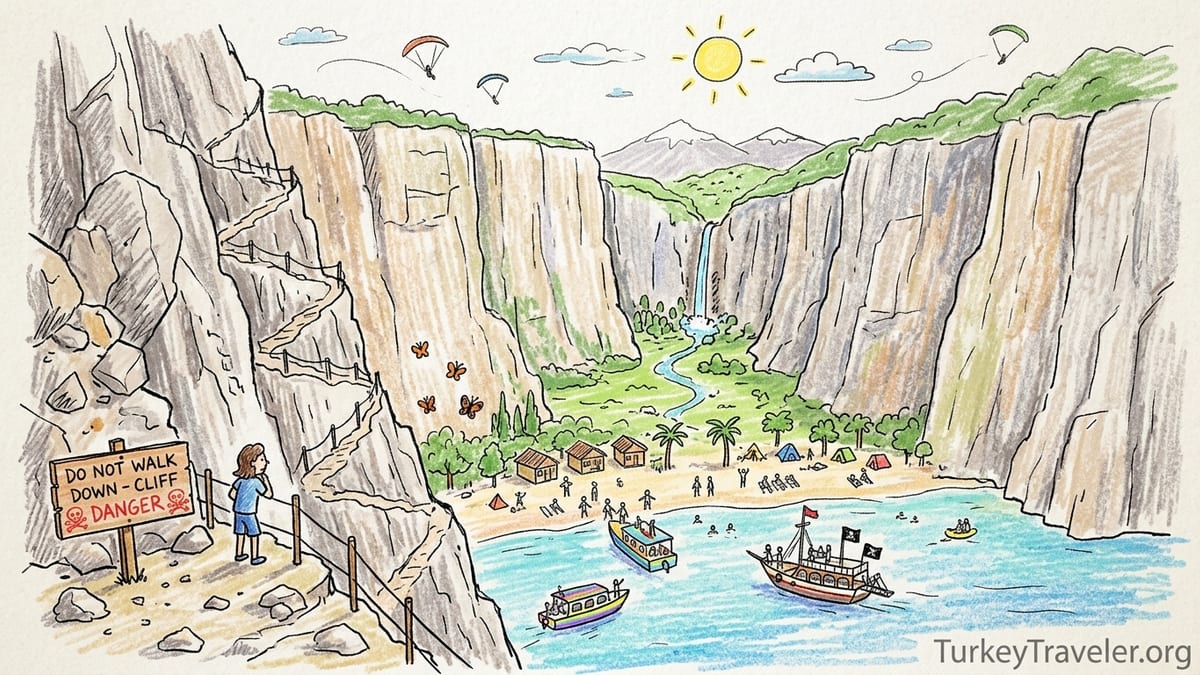
I first met Butterfly Valley, like most people, through a screen. The classic footage is always the same: the camera gliding along the Lycian cliffs near Faralya, then dropping over the edge to reveal a perfect wedge of sand, clear water and a narrow green valley that seems hidden from the rest of the world. There are no roads carving up the slopes, no hotel blocks stacked on the beach, only a handful of tents and bungalows dwarfed by rock walls that rise roughly 300 to 350 metres on both sides.
On the ground above the valley, near Faralya village, the view is just as staggering. A short walk from the roadside pensions and cafes brings you to the brink of the cliff, where the rock falls almost vertically to the sea. This is the vantage point that fills social media. It also hides a crucial truth from anyone planning a visit: there is no ordinary road to the beach. The only practical way in and out for most visitors is by boat from Ölüdeniz, and the apparent path that snakes down from the cliffs is not a normal hiking trail in any common sense of the term.
By the time I arrived in October 2026, local authorities and tourism operators were repeating the same message, sometimes reluctantly, sometimes in bold language: Butterfly Valley may look like a casual hike, but the terrain, the height and the accidents that have already happened tell a different story. This is a place where the camera angles make everything look easy, but gravity still has the final word.
Faralya’s Cliffs: Spectacular Viewpoint, Documented Danger
Faralya itself is a quiet hillside settlement about a 15-minute drive from Ölüdeniz, strung along the road that follows the Lycian Way hiking route. Several pensions and cafes advertise “Butterfly Valley Viewpoint,” and in 2026 a typical taxi from Ölüdeniz quoted around 300 to 400 lira one way for the trip, depending on negotiation and season. The roadside looks innocuous: a dirt lay-by, a few parked scooters, homemade signs inviting you in for tea and pancakes, plastic chairs on terraces looking out to the sea.
Walk beyond the terraces, however, and the ground quickly gives way to jagged limestone, loose gravel and void. At one popular viewpoint a banner now states, in Turkish, that the area beyond is closed to walking and visiting. Local TV reports in October 2026 showed tourists ignoring the sign and climbing over the rocks to pose inches from the drop, despite previous fatal and serious accidents on these cliffs. In June 2024, for example, a young man fell from the same Faralya escarpment while visitors watched from nearby, a grim reminder that this is not virtual reality but a 300-metre fall to the sea.
The risk does not only come from the vertical drop. In August 2024 a 22-year-old woman was killed in the valley after what was first thought to be a fall turned out to be a rock strike to the head, according to a report from Turkey’s national broadcaster in early 2025. The investigation highlighted what locals already knew: moving around beneath or along these cliffs is not a trivial activity. Loose stone, erosion and crowd behaviour all matter here, and the more people treat the viewpoint like a theme-park balcony, the more likely it is that something goes badly wrong.
As a writer, I am used to looking for a middle ground between alarmism and reassurance. Standing on those rocks, though, watching a couple clamber past the “closed” sign in flip-flops to re-create a drone shot, I struggled to find it. The view is extraordinary, but the price of a mistake is extreme, and there is no barrier or gentle gradient to slow you down if you slip.
No Ordinary Hiking Route: Why the Descent Is Treated as Mountaineering
From certain angles above Faralya, you can see a zigzagging line that appears to lead all the way down into Butterfly Valley. On hiking apps and loosely drawn maps this line is often marked as a route between the Lycian Way and the beach. The temptation is obvious: why pay for a boat when there is a “trail” right here? In reality, local government statements and experienced guides describe the route in very different terms from a normal footpath.
Fethiye’s district authorities have repeatedly warned that the descent between Faralya and Butterfly Valley is extremely steep, with sections that require rope assistance and involve exposure above cliffs. Mountaineering instructors quoted in Turkish national newspapers say that serious accidents happen on this route every year, and that some segments amount to climbing rather than hiking. Specialist canyoning and mountaineering sites list the valley as a technical environment, not a casual beach walk.
On my autumn visit, I spoke with staff at a Faralya guesthouse who were blunt. They described seeing inexperienced hikers freeze on exposed sections and call for rescue, especially in high season. One owner pulled out their phone to show me photos of old fixed ropes fraying where the path cuts across a rock face. When I asked whether they ever recommended guests take the descent without training and proper climbing-grade gear, the answer was an immediate no. Their advice was simple: unless you have mountaineering experience, treat the cliff path as off limits and use the boat like everyone else.
This matches national tourism guidance that when a route involves rope sections above serious drops, it should only be attempted with appropriate mountaineering training and equipment. In practice that means helmets, harnesses, proper anchors and the skills to evaluate all three. The presence of an informal “path,” or of old ropes and faded waymarks, does not turn a mountaineering problem into a Sunday stroll. If you are looking for an easy walk to a beach, this is the wrong valley to experiment on.
By Sea Only: Shuttle Boats, Party Cruises and Compromised Quiet
Once you accept that you are not going to walk safely down from Faralya, Butterfly Valley becomes almost entirely dependent on boats from Ölüdeniz. There are two main ways in: the small shuttle boats that run directly to the valley and back, and the larger shared day cruises that hop between several bays along the coast.
In September 2026, a local tour information site in Fethiye recorded the return shuttle ticket at around 500 lira per person, purchased at the booth on Ölüdeniz’s main Belcekiz Beach. Traveller reports through 2025 mention prices up to roughly 700 lira in peak season. The crossing itself takes about 20 to 30 minutes, depending on sea conditions. There is no rigid timetable: in summer the first boats usually leave mid-morning and continue every hour or so until late afternoon, with the last return often advertised for around 17:00 or 18:00. Off season, particularly from November to March, services become far less predictable and may not run in poor weather.
The alternative is to buy a place on one of the big day boats that line Ölüdeniz’s waterfront, including the towering pirate-themed vessels and more modest wooden gulets. These trips typically last all day, call at several bays and islands, and make a short stop in Butterfly Valley as part of the circuit. On one popular itinerary I joined, the advertised price was just under the equivalent of 25 euros, including lunch and multiple swim stops, but the time in Butterfly Valley itself was limited to around 45 minutes from anchor to horn blast.
From the water, the valley is unquestionably beautiful. Sheer white rock, a slice of pale sand and gravel, and a hint of green canyon behind. Yet the experience is shaped by how you arrive. Shuttle boats can be crowded and exposed, with little shade and engine noise dominating the otherwise quiet bay. The big day boats bring their own compromises: packed decks, loud music systems echoing off the cliffs, and passengers queueing along the gangplank to get ashore. Campers I spoke to inside the valley complained that at midday in high season the soundscape feels more like a floating funfair than a remote nature reserve.
If your expectation is that the boat is simply a neutral taxi to wilderness, that gap in perception matters. You are not buying a private landing in a secret cove; you are entering a place where hundreds of other people are trying to squeeze their own slice of paradise into the same two or three peak hours.
On the Beach: Limited Facilities, Crowds and Short Stays
Once you step ashore, the valley itself is smaller and more confined than the typical drone shot suggests. The usable beach narrows quickly where the shingle meets the rock walls, and much of the flat area is taken up by the simple wooden bungalows, tent platforms and communal spaces of the long-established campground. In 2026 there was a basic restaurant and bar, cold showers, primitive toilets and a small office where staff collected a modest entrance or environmental fee from day visitors.
The facilities are adequate if you have chosen to stay overnight with a backpack and flexible expectations, but they can feel strained when several large boats disgorge passengers at once. Shade is at a premium in the middle of the day, so people cluster tightly under trees and canopies. The narrow strip of sand becomes a tangle of towels, drone launches and beach games. The water remains wonderfully clear, but getting in and out means negotiating a line of people trying to take the same photos you saw online, often while holding phones in waterproof pouches rather than looking around.
On the day I visited, the shuttle timetable meant that many people faced a choice: cut short their time in the water or risk missing the intended return boat and having to wait an hour or two for the next one. Those arriving on full-day cruises had even tighter windows. Several fellow passengers told me they would have liked to walk further up the valley or sit quietly under the cliffs, but the reality was a rushed swim and a scramble to reboard before the horn sent everyone back to their assigned deck.
Visitor pressure is not yet on the scale of some Mediterranean hotspots, but it is growing, and it shows. I found occasional litter in the bushes behind the beach and along informal paths: plastic bottles, snack wrappers, cigarette butts. Camp staff conduct regular clean-ups, and the central area was generally tidy, yet the edges of the valley hinted at how fragile its image of pristine nature really is when hundreds of people cycle through each day for a few hours at a time.
Where Are the Butterflies? Managing a Loaded Name
The question every first-timer quietly carries ashore is the same: where are the butterflies? The valley took its name from the populations of Jersey tiger and other species that breed here, attracted by the humid microclimate and the stream that trickles down from the waterfall at the back. Tourist brochures still lean heavily on images of orange and black wings against lush green foliage.
Yet butterfly numbers are seasonal and sensitive to temperature, time of day and human disturbance. Local guides and long-time campers told me the most reliable period for sightings is late spring and early summer, especially in the calmer, shadier hours of the morning and evening. By the time I arrived in early autumn, under a hot midday sun with a dozen day boats offshore, I saw only a handful of individuals flickering through the undergrowth.
This does not mean the valley has been emptied of butterflies altogether, but it does underline how misleading the name can be for casual visitors. I met a family from Europe whose children had been promised “clouds” of insects. After an hour on the beach without seeing a single one, the parents looked increasingly uncomfortable. The only wings reliably on display that day belonged to paragliders tracing lazy arcs high above from the launch sites on Babadağ.
If your primary reason for visiting Butterfly Valley is to be surrounded by butterflies, it is essential to align your expectations with ecology rather than marketing. Out of season, or at the wrong time of day, your experience may be of a beautiful canyon, clear sea and a pleasant, if busy, beach, with butterflies a rare bonus rather than the main act.
Walking Inside the Valley: Waterfall Trail and Practical Limits
From the beach, a narrow path follows the stream inland through orchards and tall reeds. After a few minutes you enter the shaded floor of the canyon, where fruit trees and simple huts give way to a more rugged, rocky channel. This is the beginning of the waterfall walk that so many reviews mention. Having come this far, I wanted to see it for myself, while still respecting the safety issues that characterize every vertical surface in this landscape.
The initial section is straightforward enough: easy rock-hopping, the scent of herbs crushed underfoot, dragonflies skimming the water. Then the canyon walls squeeze in and the route steepens, protected in places by fixed ropes anchored into the rock. On my visit, campground staff had posted clear signs warning that beyond a certain point the route demanded good footwear, at least basic scrambling ability and a willingness to get wet. Some people turned back at the first rope. Others continued in sandals and beachwear, clutching plastic bags of belongings in their teeth as they pulled themselves up.
I chose to stop at a point where the rock became polished and slick, just before a steeper chimney which would have required proper climbing moves. This decision meant I did not reach the upper waterfall, but it felt like the responsible limit without dedicated gear. Later, chatting with the camp manager over tea, I learned that twisted ankles and minor injuries on this route are common, and that in past years there have been evacuations when visitors pushed on beyond their comfort zone.
Inside the valley, the lesson is the same as on the cliffs above: tread carefully, and do not let the word “trail” fool you into expecting a gentle woodland stroll. Even the shorter, interior walks can involve more risk than first-time visitors anticipate, especially after rain when the rock and soil become slick and unstable.
Day Trip, Overnight Stay or View From Above?
Most people experience Butterfly Valley as a compressed day trip: arrive on a mid-morning boat, swim, wander a little, buy a simple lunch or a drink, then shuffle back to the dock for the return. If that is all you attempt, the biggest drawbacks are usually crowding, short stops and the sense of being processed through a postcard rather than participating in a landscape. You may find the visit still worthwhile, but it is unlikely to match the solitary dream projected by aerial images.
Staying overnight changes the rhythm. A basic bungalow or pre-pitched tent can cost the equivalent of a mid-range guesthouse in nearby Ölüdeniz, depending on season, though prices shift frequently with inflation and demand. Sleeping in the valley means you can swim at dawn before the boats arrive, hear the rock walls echo with birds rather than bass, and walk the interior paths in cooler air. Several long-term campers told me that sunset, when the last day boats depart and the cliffs turn orange, is when the place comes closest to the paradise in the photos.
The trade-off is comfort and practicality. Supplies in the valley are limited. There is no supermarket, no pharmacy, no bank. Power cuts are not unusual. If the sea turns rough, departures may be delayed. You need to pack as if you are going camping somewhere that you cannot simply drive away from in ten minutes. For some travellers this is part of the appeal; for others, it can feel like too much compromise for an overnight stay, especially in a country where excellent coastal pensions are easy to find.
There is a third option that many visitors quietly adopt: treat Butterfly Valley primarily as a viewpoint rather than a destination. From Faralya and the roadside cafes, you can absorb the geometry of the cliffs and the full sweep of the bay without committing to the boat schedule or the crowds on the narrow beach. This approach only works if you respect the safety boundaries and remain behind warning signs, but it allows you to honour the visual magnetism of the place without forcing the rest of your day into the bottleneck of limited access and facilities below.
The Takeaway
By the time I left Fethiye in 2026, my feelings about Butterfly Valley had settled into something more nuanced than the glossy brochures allow. On one hand, this is genuinely one of the most striking coastal landforms on Turkey’s Mediterranean shore. Viewed from safe vantage points above or in the calm moments when the boats are gone, it can feel like a hidden amphitheatre of rock and sea, a reminder of why the Lycian coast has drawn travellers for so long.
On the other hand, the gap between image and reality is wide. Dangerous land access from Faralya that is often misrepresented as a simple path, total dependence on boats that can be crowded, noisy and irregular, short and rushed stopovers on many cruises, limited and sometimes overstretched facilities in the valley, and heavily inflated expectations about butterflies themselves all chip away at the dream. Add to that a record of fatal accidents on the cliffs and continuing risky behaviour in areas explicitly marked as closed, and it becomes hard to describe Butterfly Valley as a carefree day at the beach.
My verdict, after a first-hand look and many conversations with locals, is firm but not dismissive. Butterfly Valley can still be extraordinary, but only if you approach it on honest terms. That means accepting that you are not going to hike safely down from Faralya unless you are trained, equipped and fully aware of the risks. It means treating the boat as part of the experience, with its costs and its compromises. It means understanding that the valley’s name is an ecological description, not a promise of a butterfly show on demand. Above all, it means planning with safety and humility, rather than letting a drone video dictate your choices.
If you do that, you may still come away with something closer to the quiet, luminous scenes that first caught your eye. If you do not, you risk joining the growing number of visitors who disembark from the shuttle, look around at the crowds and the cliffs, and murmur the same quietly damning phrase: “It looks better from above.”
FAQ
Q1. Is there a safe walking path from Faralya down to Butterfly Valley?
There is a route, but it involves steep, exposed sections and rope-assisted downclimbs, so local authorities and guides say it should only be attempted with mountaineering training and proper equipment, not as a casual hike.
Q2. How high are the cliffs around Butterfly Valley?
The rock walls that frame the valley rise roughly 300 to 350 metres above sea level, creating very serious exposure both on the Faralya viewpoints and on any descent routes.
Q3. How much does the boat from Ölüdeniz to Butterfly Valley cost in 2026?
Local tourism information in late 2026 reports return shuttle tickets at around 500 lira per person, with some travellers mentioning higher prices in peak months, so it is wise to confirm locally just before you go.
Q4. How long do day boats actually stop in the valley?
Direct shuttle boats allow you to choose your return time within service hours, but large multi-stop day cruises often give only 30 to 60 minutes ashore in Butterfly Valley before moving on to the next bay.
Q5. Will I definitely see lots of butterflies when I visit?
No. Butterfly activity depends on season, temperature and time of day, and many visitors outside late spring or early summer, especially at midday, see very few insects despite the valley’s name.
Q6. Are there enough facilities for a comfortable day trip?
The valley has basic toilets, simple food and drink, and limited shade, which can feel crowded when multiple boats arrive; if you want comfort, you should bring water, sun protection and any essentials you might need.
Q7. Is it worth staying overnight in Butterfly Valley?
It can be, if you are prepared for simple camping-style accommodation and limited services; overnight guests enjoy quieter dawn and dusk periods that day trippers never see.
Q8. Can I rely on the boat schedule outside the main summer season?
No. From roughly November to March, shuttle services may run less frequently or be cancelled due to weather or low demand, so you should always check the latest information in Ölüdeniz before planning a trip.
Q9. Are the Faralya viewpoints safe for photos?
The views are spectacular, but accidents have occurred on these cliffs, and local reports in 2026 highlight tourists ignoring warning banners, so you should stay behind signs and avoid approaching the very edge for pictures.
Q10. Is Butterfly Valley still worth visiting despite the drawbacks?
Yes, if you go with realistic expectations, respect the safety advice and accept the limitations of boat access and basic infrastructure, the valley’s natural setting can still offer a powerful and memorable experience.