

The road to Datça feels like a test of commitment. After an hour of curves across the Datça Peninsula, the bus from Marmaris finally dropped me in town, my stomach slightly unsettled, my eyes trying to keep up with the landscape. Dry, tawny hills rolled away on both sides, cut by silvery olive groves and almond trees that looked almost ghostly in the late afternoon light. After the built-up promenades of Marmaris and the marina sprawl of Bodrum earlier in the week, this narrow tongue of land already felt different: quieter, tougher, more agricultural, with the sea appearing in flashes far below instead of dominating every scene.
Arriving on a Narrow Peninsula Between Two Seas
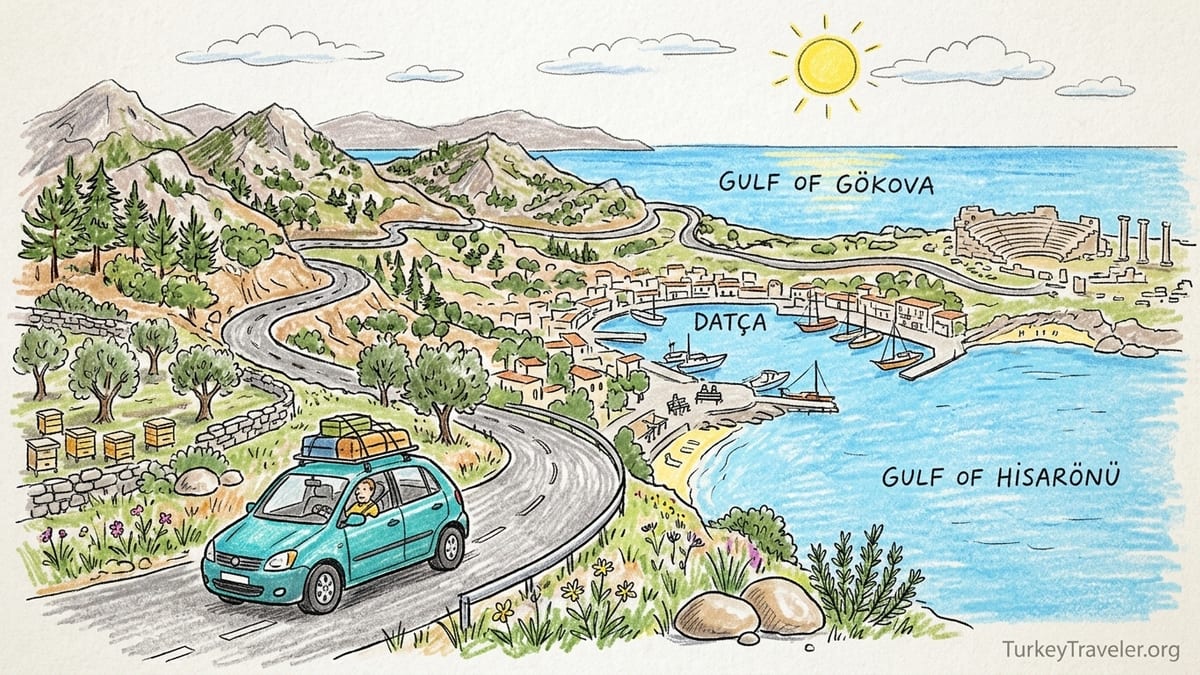
I arrived in Datça in early September, taking the morning intercity bus from Marmaris and then the local minibus that crawls across the spine of the peninsula. There is a Bodrum to Datça ferry, and many travelers now sensibly pair it with flights to Milas Bodrum Airport, but on this trip I wanted to feel the distance in every bend of the road. The peninsula is only about 70 to 80 kilometres long, yet the drive feels longer as the road folds back on itself, climbing and dropping through low mountains, with glimpses of the Gulf of Gökova to the north and the Gulf of Hisarönü to the south.
As we approached Datça town, the landscape changed subtly. The slopes were patched with neatly planted olive and almond orchards, some irrigated, some left to survive on winter rains. Tractors stood in front of stone houses and small sheds stacked with beehives. It was a working countryside rather than the villa estates and water parks that ring much of Bodrum. The air felt drier, with a faint herbal smell of sage and scrubby pine. Even the sea, when it finally came into full view, seemed clearer, a more transparent blue than the hazy bays I had left behind.
Datça town itself is modest, a low-rise sprawl wrapped around a double-sided coastline. Fishing boats and small excursion craft line the harbor, but there are no massive hotel complexes or giant cruise ships. Instead of nightclub beats, I heard the clink of tea glasses and the chatter of locals on the seafront benches. This would be my base for a two-day beach-hopping road trip, looping westwards along the south coast to Mesudiye’s coves, Palamutbükü’s long shingle and finally the wind-swept ruins of ancient Knidos.
By the time I checked into a small pension near the harbor, the light was already soft and gold. I dropped my bag and walked straight down to the water. In Bodrum and Marmaris, the beaches blend into club terraces and branded loungers. Here, the town beaches sit right against a lived-in centre, but the atmosphere is slower, more neighborly. Day one would be all about these urban strands and the next bay or two, a way of easing into Datça’s water before tackling the longer road west.
Day One: Urban Swims at Hastane Altı, Kumluk and Taşlık
My beach-hopping started on foot. From the harbor it took less than ten minutes to reach Hastane Altı, the first of Datça’s town beaches. The name literally means “below the hospital,” and the beach curves roughly 700 to 800 metres along the town’s north-facing shore, a narrow strip of coarse sand and small pebbles with a Blue Flag for water quality. The surface underfoot was firm, with a mix of gritty sand and smoothed stones. I could walk barefoot, though stepping carefully near the waterline where pebbles became more frequent.
The water at Hastane Altı in early September felt brisk at first plunge, maybe around 24 degrees Celsius, then quickly comfortable for a long swim. The seabed remained shallow for the first several metres, ideal for families; children splashed near the shore while older swimmers like me headed for the floating platform anchored a short distance out. Because the beach sits inside a relatively protected embayment, there was almost no surf, just a gentle chop. Without water shoes I was fine, although a few people wore them and moved more confidently over the stonier patches. Behind the beach, small cafes and a couple of modest hotels lined the road, offering shade, coffee and the eternal sound of backgammon pieces hitting wooden boards.
Curving around the headland into the town’s south-facing side, I reached Kumluk, Datça’s main sandy beach right in the centre. Here the surface turned about as soft as Datça gets: fine sand at the water’s edge mixed with some patches of coarser grains. Sun loungers and umbrellas extended out from restaurant terraces, each section belonging to a different seafood place or cafe. The water was again clear and generally shallow for the first twenty or so metres, though it shelved a little faster than Hastane Altı. I swam here around midday and noticed the temperature felt slightly warmer, perhaps because the south-facing bay gets more direct sun and is sheltered from the stronger northern winds that ruffle the north coast.
Urban swimming here was very different from anything I had experienced in Marmaris. There, the strip along Uzunyalı is hemmed in by hotel blocks; here in Datça the seafront is lower, with many family-run pensions and independent restaurants. Prices reflected the difference in scale. A fish lunch at a waterfront restaurant behind Kumluk cost me the equivalent of a mid-range cafe meal in a European city, not a luxury resort premium. Most places allowed free use of the loungers if you ordered drinks or food, though some charged a small fee that stayed reasonable compared with the large resorts further east.
In the late afternoon, I walked the short distance to Taşlık Beach, tucked into a smaller cove on the town’s south side. True to its name, Taşlık was mostly pebbles, ranging from olive-sized stones to larger, flattish rocks that worked as makeshift seats near the water. Here, as soon as I stepped in, the seabed dropped a little more quickly. Within about three or four steps I was in water up to my waist, which then deepened steadily. The pebbles grew more uneven underfoot, and this was the first place in Datça where I genuinely wished I had brought water shoes. That said, the clarity made up for it. Looking down with goggles, I could count individual stones on the bottom several metres below, and small fish flickered between the rocks.
Kargı Bay: First Taste of a Wilder Datça
To break out of town on day one, I took a short dolmuş ride to Kargı Bay, about 3 kilometres west of the centre. The minibus left from near the main bus stop and followed a low road skirting apartment blocks and scrubland before dropping sharply into a deeper cove. Kargı immediately felt less urban than the town beaches. Framed by low rocky hills dotted with pines and brush, the bay opened southwards with nothing but open water ahead. A few small hotels and pensions sat back from the shore, but the overall impression was of a beach in a natural bowl rather than a seafront extension of the town.
The beach itself is long and varied, stretching along much of the bay. Underfoot it was mostly coarse sand with plenty of small pebbles mixed in, gradually becoming stonier toward the western end. Entry into the water was slightly steeper than at Kumluk. After two or three steps the water was already at my knees, and within about seven or eight steps it reached my chest. For weaker swimmers this might feel less comfortable than the gradual slope of Karaincir or Hastane Altı, but for me it was perfect. The depth allowed for easy lap-style swimming parallel to the shore without venturing far out.
Here I finally dug out the packable water shoes I had stuffed into my backpack and not bothered with in town. They transformed the experience. Instead of tiptoeing over sharp pebbles, I simply strode in and out. In Kargı, as in many Datça bays, the waterline can be uneven, with larger stones rolled by winter storms sitting near the edge. With shoes, I did not have to scan every step. The water temperature felt similar to Kumluk, still around the mid-20s Celsius, and I stayed in for a solid 30 minutes without a chill. Because the bay is deeper and more open to the south, I could feel a very slight current, but nothing that pulled me off course.
Comparing Kargı to the beaches around Marmaris highlighted Datça’s different character. There were sun loungers and a couple of small beach bars, but no jet-ski rental stands buzzing back and forth, no high-decibel music. A few families picnicked on mats at the quieter western end where businesses gave way to open shore. I grabbed a simple grilled fish plate at a family-run restaurant under tamarisk trees. The owner’s teenage son alternated between taking orders and diving off the stone jetty with his friends, a rhythm that felt more village than resort.
The Road West: Winding Asphalt and Time Lost to Views
Day two was dedicated to the road. I rented a small hatchback from a local agency in Datça town, picking it up right after breakfast. It would have been possible to do much of the route by dolmuş, as the Datça to Palamutbükü minibus line runs several times a day, passing the junctions for Mesudiye and other villages. However, I wanted the freedom to pull over whenever the coastline demanded it, and on this peninsula that happens often.
Leaving Datça, the road climbed fairly quickly, switchbacking up from the seafront into low hills. The asphalt was in generally good condition, but the curves were tight. It was the sort of road where local drivers knew every bend and took them at full confidence, while visitors like me stayed prudently under the limit. Every few kilometres, a short dirt lay-by offered a place to stop and take in the dual-sea views. Each halt, though, added minutes. A journey that planners might calculate at 45 minutes to Palamutbükü easily stretched to an hour and a half with photo breaks.
At a signed junction, I turned off toward Mesudiye, dropping down again on a narrower road that threaded through olive groves and small farms. Tractors moved slowly between fields; chickens scratched in dusty yards. Though tourism has arrived in these villages in the form of guesthouses and summer homes, agriculture still defined the scene. In Bodrum’s hinterland, construction sites and gated complexes now dominate many side roads. Here, stone walls, beehives, and stacks of almond branches for winter fuel still set the tone.
As I approached the coast again, the asphalt narrowed further and parking became part of the story. In each cove of Mesudiye there were only a handful of informal spaces right by the beach and a few more places tucked under olive trees higher up. I spent a good ten minutes in both Hayıtbükü and Ovabükü easing the car into tight gaps, sometimes guided by a guesthouse owner or cafe worker who had clearly repeated the manoeuvre countless times for summer visitors.
Mesudiye’s Trio: Hayıtbükü, Ovabükü and the Detour to Akçabük
Mesudiye’s coastline is an intricate necklace of coves. I began at Hayıtbükü, a compact, U-shaped bay that many Turkish families favour. The beach was a mix of coarse sand and small pebbles, fairly uniform along its length. Entry into the sea was gentle; I walked several metres before the water reached my waist, and even farther before it reached my shoulders. This shallow gradient, combined with the sheltering arms of the bay, made the surface almost glassy in the morning hours. The water temperature here felt slightly warmer than in Datça town, likely thanks to the enclosed shape and limited circulation. I swam out towards the centre and could still see the bottom in mottled shades of beige and grey under the sun.
Behind the shore, a tight line of small pensions and restaurants hugged the curve, their terraces shaded by vines, mulberry trees and the hayıt bushes that give the bay its name. Breakfast plates and gözleme griddles were already in full swing by mid-morning. Compared with Datça centre, everything felt closer together here, but still small-scale. You are never more than a few dozen metres from someone frying eggplants or hanging towels out to dry.
Next door, separated by a low headland and a few minutes of driving, Ovabükü stretched out longer and felt more open. The beach surface here tipped back toward pebbles, with sections of rounded stones that grew larger near the western end. I slipped my water shoes on again and did not regret the choice. Entering the sea without them would have been possible, but each step would have required concentration. With them, I strode in and reached chest-deep water within about six or seven steps. The seabed dropped more quickly than at Hayıtbükü, and the water colour deepened into a stronger turquoise.
The character of Ovabükü suited me. Slightly fewer people, slightly more space between pensions, a touch more wildness in the hills behind. I grabbed a late-morning coffee at a seafront cafe and watched as a small fishing boat returned, the crew unloading crates straight into a restaurant kitchen. Later that evening, many of those fish would likely be on diners’ plates. It was a very short and direct supply chain, nothing like the generic buffet spreads in the big coastal resorts further east.
From Ovabükü I made a short detour along a rougher side road to Akçabük, one of the smaller coves west of Mesudiye. The final stretch was partly unpaved and quite narrow, so I drove slowly, pulling into a passing place when a local pickup came the other way. Here, tourism thinned out significantly. A few cars were parked haphazardly among the pines, and the beach itself was a quiet curve of pebbles and rocks, with only one or two small seasonal establishments set back from the shore. The water was exceptionally clear but dropped off close to shore. I wore my water shoes again, more out of habit than necessity, and took a short, cooler-feeling swim. A light breeze funneled through the small valley behind the cove, reminding me that these hidden corners can be more exposed than the brochure images suggest.
Palamutbükü: A Long Shingle Strip with a Fishing-Village Heart
From Mesudiye I rejoined the main coastal road toward Palamutbükü. Here the drive became more exposed, with sections where the land fell away to the sea in steep, scrub-covered slopes and others where the road threaded between stone-walled terraces of olives and almonds. The combination of curves, occasional potholes and drivers stopping randomly for photos slowed everyone down. It took nearly 40 minutes to cover what looked on the map like a very short distance.
Palamutbükü revealed itself suddenly, as the road descended into a wide bowl open to the south. The bay is long, roughly 2.5 kilometres from end to end, lined almost entirely by a narrow strip of shingle beach, a simple low road and an unbroken procession of pensions, small hotels, private homes and restaurants. Compared with the extremely compact coves of Hayıtbükü and Akçabük, Palamutbükü felt big. Compared with Bodrum or Marmaris, however, it still read as a village. There were no tower hotels, no shopping malls, no big-brand clubs. At the western end near the small harbour, fishermen tinkered with nets beside their modest boats.
The beach surface in Palamutbükü is almost entirely pebbles. In places the stones are fine and rounded, in others they are larger, egg-sized and slightly awkward to cross barefoot. Water shoes here were not just nice to have; they were genuinely helpful. Once in the sea, the depth increased moderately quickly. After five or six steps, the water at mid-bay was already at my chest. This made it an excellent place for proper swimming. I spent nearly 45 minutes doing easy laps parallel to the shore, occasionally diving down between shoals of tiny silver fish that sparkled in the clear water.
Despite the length of the beach, the atmosphere remained low-key in early September. Couples read under umbrellas, grandparents watched children paddle at the edge, and a few Turkish day-trippers snoozed in the shade of tamarisk trees. Many of the seafront restaurants displayed the morning’s catch in iced trays, ready for the evening. Prices felt slightly higher than in Datça town but not by a huge margin. The main difference was the pace. Apart from the hum of the occasional passing car or dolmuş turning around at the end of the line, life in Palamutbükü moved to the rhythm of swims, naps and unhurried meals.
Palamutbükü also served as a reminder that some of Datça’s most tempting coves are more easily reached by boat. Regular daily boat trips depart from the small harbour in the main season, visiting places like Domuzbükü, a beautiful indentation of the coast with no road access. Standing on the shingle, watching a gulet motor slowly out toward that inaccessible notch on the map, I understood why many repeat visitors schedule at least one boat day. For this short road trip, I kept my focus on shores I could reach by land, but it was hard not to mentally plan a return by sea.
Onward to Knidos: Dolmuş Routes, Last Asphalt and Real Ruins
After an afternoon in Palamutbükü, I continued my drive toward ancient Knidos, at the very tip of the peninsula. It is important to understand how the transport works here. From Datça, the official minibus line toward Palamutbükü and Belen runs several times a day, following the 9-5 route west with stops in villages like Zeytincik, Sındı, Yaka and Kumyer. In practice, this means that even without a car you can ride from Datça to Palamutbükü and then onward to the end-of-the-road settlement near Knidos. However, local information and posted timetables make clear that the dolmuş is there to serve the villages and the last inhabited point, not to act as a door-to-gate shuttle specifically for the ruins.
On the ground, that translated into some legwork. The last stretch of asphalt narrows as it nears the archaeological area. There is a small cluster of buildings, a basic cafe and a parking area before you reach the actual site entrance. Dolmuş drivers often turn around at or near this cluster rather than driving right up to the gate. With my rental car I could continue to the signed parking lot, but I watched one minibus drop passengers short and loop back, leaving them to walk the final stretch under the afternoon sun. It was not a long distance, perhaps ten to fifteen minutes at a moderate pace, but on a hot day it would feel much longer without shade or water.
Arriving at Knidos in my own car, I parked in the paid lot just above the harbour basin that once formed the inner heart of the city. A handful of cats lounged in the shade of parked vehicles, and a few taxis waiting for returning hikers idled near the exit. From there, a clearly marked path led to the ticket booth. The entry fee for foreigners was comparable to other mid-level archaeological sites in Turkey, and payment could be made in cash or by card. Behind the booth, a simple plan of the site indicated the main accessible areas: the theatres, the upper acropolis, sections of the city walls and, further out, scattered remains on the promontory.
Walking into Knidos is a very physical experience. The site spills down the slope between two natural harbours, and the terrain is uneven. Low stone steps, packed earth, loose gravel and occasional exposed rock required sturdy shoes and a bit of attention. I was glad I had changed out of my beach sandals and into trainers. There are no manicured lawns or heavily reconstructed forum spaces of the sort you might find at some more developed sites. Instead, half-tumbled walls lie in situ, columns fragments line faint streets, and goat tracks sometimes intersect with the official footpaths.
Access to the upper parts of the site remained open, but the climb was steep and exposed. From the upper theatre I could look back across the entire Datça Peninsula, its dry hills tapering into the blue haze where Bodrum lay somewhere beyond the horizon. Information panels were sparse but present at key points, offering brief explanations in Turkish and English. There were no heavy layers of modern romantic narrative, just short descriptions of temples, streets and public buildings. In several areas, scaffolding or fenced-off trenches indicated ongoing archaeological work, and those sections were strictly out of bounds. This was not the kind of ruin where you can wander anywhere your curiosity leads.
Eski Datça and Evenings Between Stone and Sea
On my way back to Datça town after visiting Knidos, I made one last stop in Eski Datça, the “Old Datça” village set slightly inland from the modern town. The contrast with the beaches and with bigger resorts elsewhere on the coast could not have been sharper. Eski Datça is a compact warren of stone lanes and old houses restored into a mix of private homes, pensions, small boutiques and cafes. Many facades are draped in bougainvillea, and the soundscape is more about clinking cutlery and conversation than waves or traffic.
Eski Datça is also a key point on the long-distance Carian Trail, the hiking route that connects Datça to Knidos and further. In the early evening, I saw several backpacked walkers nursing cold drinks on shady terraces, their boots dusty from stages that pass through Domuzçukuru, Mesudiye and Palamutbükü. It was a reminder that this peninsula invites slow travel on foot as much as by car or bus. While I had focussed on the beaches reachable by road, the trail stitched them together in a different rhythm.
I wandered Eski Datça’s lanes for an hour, then drove the short distance back down to the modern town for one last swim at Kumluk. The late light caught the gentle ripples just off the sandy shore, and beyond them the mass of the peninsula rose dry and brown, dotted with those same olive groves and almond trees that had greeted me on arrival. In Bodrum, evenings often revolve around marinas and nightlife. In Datça, mine revolved around simple dinners, long swims, and the knowledge that just beyond the next headland lay another quiet cove rather than another megahotel.
My accommodation for these two nights was a small pension one block back from the harbour, with basic but clean rooms, air-conditioning and a simple breakfast of bread, olives, cheese, tomatoes and tea served on a terrace. It anchored the trip in the town without cutting me off from the road. Over the two days I probably spent around five or six hours actually in the water and a similar amount driving or riding dolmuşes. The rest of the time dissolved into meals, small walks and quiet observation.
The Takeaway
What stayed with me most from this two-day beach-hopping road trip was how Datça’s peninsula compresses very different experiences into short distances. In Datça town, I swam at Hastane Altı, Kumluk and Taşlık, each with its own balance of sand and pebbles, gentle slopes and quicker drop-offs, urban convenience and clear water. A short ride away, Kargı hinted at a wilder coastline while still offering a few cafes and pensions. Further west, the Mesudiye trio of Hayıtbükü, Ovabükü and nearby Akçabük revealed family-friendly shallows, deeper turquoise stretches and quieter rocky coves where water shoes suddenly mattered.
Palamutbükü, with its long 2.5 kilometre shingle strand and small fishing-village heart, felt like the natural culmination of the beach part of the journey. From there, the last run to Knidos turned the trip from coastal holiday into something older and more layered, with actual walking, dust, and ruins that require attention rather than just admiration from afar. Public transport in the form of the Datça to Palamutbükü and Belen dolmuş line makes much of this accessible without a car, but it does not deposit you neatly at every cove or the archaeological gate. There is almost always a final stretch of road, track or footpath to cover on your own legs.
As for a favourite bay, I surprised myself by choosing Ovabükü. Palamutbükü is the obvious showpiece, and Knidos the obvious headline, but Ovabükü’s combination of pebble-underfoot clarity, quick drop to swimmable depth, modest scale of pensions and the sense of being slightly removed from main flows suited what I wanted from Datça. It embodied the peninsula’s difference from the larger resort zones around Bodrum and Marmaris: human in scale, rugged at the edges, intensely linked to both land and sea, and best appreciated with time, sturdy shoes and a willingness to slow down for every bend in the road.
FAQ
Q1. How can I get from Datça town to Palamutbükü without a car?
There is a regular minibus (dolmuş) route linking Datça and Palamutbükü that runs several times a day in the main season, stopping at villages along the way. Services typically depart from the main bus area in Datça and take around 45 to 60 minutes depending on stops and traffic.
Q2. Does public transport go all the way to the entrance of ancient Knidos?
Minibuses on the Datça to Belen and Knidos route will take you to the end of the inhabited road, near the small cluster of buildings before the site. From there, you should be prepared to walk the final stretch to the archaeological entrance, especially if the driver turns around before the gate.
Q3. Do I need water shoes for the beaches on the Datça Peninsula?
Water shoes are not essential for all beaches, but they are very useful. Town beaches like Kumluk and Hastane Altı are comfortable barefoot, while pebbly shores such as Taşlık, Ovabükü, Akçabük and especially Palamutbükü are much easier to enter and exit with water shoes.
Q4. How deep does the water get at the main beaches mentioned?
At Hastane Altı and Hayıtbükü the seabed stays shallow for several metres, which suits families and less confident swimmers. At Taşlık, Ovabükü and Palamutbükü the water becomes chest-deep within roughly five to eight steps, which is better for those who enjoy proper swimming close to shore.
Q5. Is the Datça Peninsula suitable for travellers without interest in nightlife?
Yes, Datça is a good choice if you prefer quiet evenings over loud nightlife. The focus is on small restaurants, pensions and low-key cafes rather than clubs and large bars, especially compared with Bodrum and Marmaris.
Q6. Can I visit coves like Domuzbükü by car during this kind of road trip?
Some remote coves around Datça, including Domuzbükü, do not have direct road access and are generally reached by boat tours from Datça or Palamutbükü. For a two-day road trip it is more practical to focus on beaches and bays that do have road or track access.
Q7. How much time should I plan for swimming versus driving on a two-day trip?
On my two-day trip I spent roughly five to six hours in the water and a similar amount driving or in minibuses. The winding roads and frequent viewpoints mean driving often takes longer than the map suggests, so it is wise to allow generous time between coves.
Q8. What kind of accommodation is typical around Datça and Palamutbükü?
Most lodging options are small-scale: family-run pensions, guesthouses, modest hotels and a few apartment rentals. In Palamutbükü and the Mesudiye bays, many places have direct or very easy access to the sea, often with their own small line of sun loungers.
Q9. Is Knidos a heavily reconstructed archaeological site?
No. Knidos has visible theatres, walls and building remains, but they are largely in a ruinous state rather than rebuilt into complete structures. Paths involve packed earth, stones and loose gravel, so it feels like an active archaeological zone where some areas are still fenced off for research.
Q10. Which bay would you personally recommend as a base for swimmers?
If your priority is swimming, I would suggest Ovabükü or Palamutbükü. Ovabükü offers a balance of clear water, quick access to depth and a quieter feel, while Palamutbükü provides long shingle, varied entry points and more dining and accommodation options along its 2.5 kilometre shore.