

Southeastern Anatolia is where Turkey feels at its most layered: Roman roads and Silk Road caravanserais, Arabic call to prayer echoing off basalt walls, and plates of pistachio baklava or lamb kebab that justify trips on their own. Choosing the right hotel in this region is about far more than star ratings. You are deciding how you will experience cities like Gaziantep, Şanlıurfa, Mardin, Diyarbakır and Adıyaman, and whether you prioritise stepped stone terraces, secure parking on a road trip, or a chilled room to come back to after a 40-degree afternoon of sightseeing.
How to choose hotels in Southeastern Anatolia
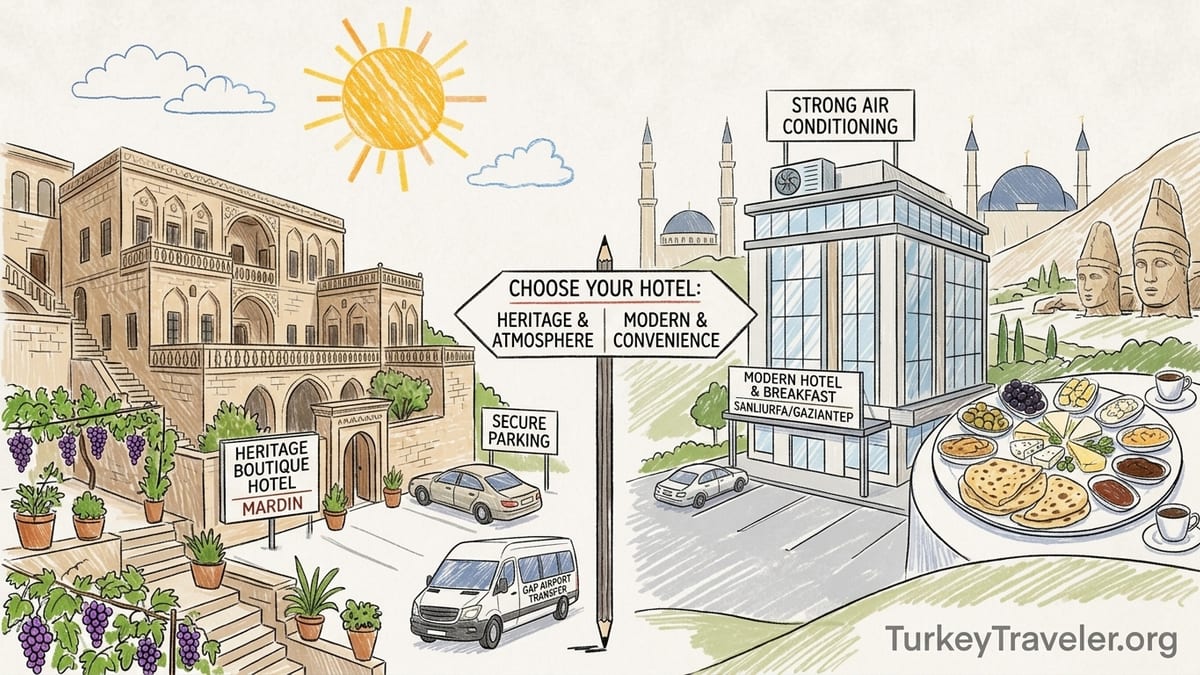
Across Gaziantep, Şanlıurfa, Mardin, Diyarbakır and Adıyaman/Kahta, hotel choice divides into three broad types. First are atmospheric boutique and heritage conversions: old stone mansions, caravanserais or traditional houses with courtyards and terraces. Second are modern 4 and 5 star properties that deliver familiar comforts like powerful air conditioning, big breakfast buffets and airport transfers. Third are practical mid-range or roadside hotels that work well for drivers focused on day trips rather than design details. Booking platforms currently list roughly 112 stays in Mardin, 89 in Şanlıurfa, 61 in Gaziantep and 43 in Diyarbakır, so there is real variety in every category.
When comparing places, five factors matter more here than in many other regions of Turkey: parking, breakfast quality, airport access, air conditioning and location for sightseeing. In compact old towns like Mardin and Şanlıurfa, being able to leave your car in a secure lot at the edge of the historic core can add half a day of extra exploring. In summer, strong and quiet air conditioning is not just a luxury. Temperatures regularly climb above 35 degrees, and older stone houses that look perfect at sunset can feel stifling by mid-afternoon if cooling is not properly upgraded. Finally, eastern breakfasts are a highlight everywhere, usually heavy on local cheeses, olives, tahini, fresh flatbreads and regional specialties.
Prices fluctuate with the Turkish lira and seasonal demand, but as of 2026 many good boutique hotels in this region sit in a mid-range band rather than a luxury bracket by international standards. Simple but comfortable rooms in city centres can often be found at relatively modest nightly rates outside peak festival or holiday periods, while the most characterful mansions in Mardin or Şanlıurfa command higher prices, especially on weekends.
Gaziantep: gourmet base with reliable modern hotels
Gaziantep is the most cosmopolitan and businesslike of the cities in this guide, and its accommodation scene reflects that. The city has a solid spread of branded 4 and 5 star hotels on or near main arteries, plus a growing number of small renovated houses in the old city lanes near the castle and Bakırcılar Bazaar. Travellers who are driving or arriving late from Istanbul often choose one of the modern tower hotels near the main boulevard for easy access, underground parking and efficient airport transfers to and from Gaziantep Oğuzeli Airport.
Modern properties around the city centre typically offer full breakfast buffets that lean into the local food culture: expect baklava on the table next to menemen, local cheeses and Antep pistachios. Many of these hotels include free parking for guests and can arrange fixed-price transfers from the airport, which sits to the southeast of town. They are less atmospheric than converted mansions but usually have stronger air conditioning, larger rooms and amenities like small gyms or business centres, which can be useful if Gaziantep is your regional hub for several days of day trips.
For travellers determined to stay within walking distance of the Zeugma Mosaic Museum, the castle and the best baklava shops, heritage options in older neighbourhoods are worth considering. These small guesthouses occupy early 20th century stone houses with internal courtyards and balconies. They tend to have fewer rooms and a more personal feel, with made-to-order breakfast in a courtyard instead of a buffet. Access by car can be tight, and parking is often in nearby public lots rather than on site. If you are on a road trip, it is wise to contact the hotel in advance and ask exactly where you can leave your car, and whether staff can help you navigate the one-way backstreets when you arrive.
Şanlıurfa: around Balıklıgöl and the Göbekli Tepe gateway
Şanlıurfa’s accommodation market is anchored around two areas: the old town next to Balıklıgöl and the Dergah complex, and the newer districts along the main avenues that lead out toward the ring road and the highway to Göbekli Tepe. Many visitors want to be as close as possible to Balıklıgöl’s reflective pools and the bazaar, and several boutique and mid-range hotels have been created in restored stone houses within walking distance. These are ideal if your priority is walking to the holy sites at dawn or late evening, when the heat and crowds ease.
Boutique hotels in historic Urfa houses typically feature thick stone walls, cross-vaulted rooms with arches, and central courtyards where breakfast is served. In a good example, you might start your day with a spread of local cheeses, honey, flatbreads and Urfa pepper pastes under a grapevine pergola before walking to the cave associated with the Prophet Abraham. Parking here is usually limited. Some properties will give directions to small municipal lots a few minutes away and may reserve spaces when possible. Air conditioning is crucial, as Şanlıurfa becomes extremely hot in summer, so focus on properties that describe upgraded cooling systems rather than relying only on traditional stone insulation.
If you are visiting primarily for Göbekli Tepe or planning a wider loop through Harran’s beehive houses and the Atatürk Dam, a modern hotel along the main arteries can be more practical. These tend to offer easier parking, quicker access to highways, and airport transfers to Şanlıurfa GAP Airport. Rooms may feel generic, but blackout curtains and good air conditioning deliver predictable rest before early morning departures. Several such hotels also run large breakfast buffets, which suit travellers leaving early for Göbekli Tepe tours that start before the main heat of the day.
Mardin: stone-house boutiques above the Mesopotamian plain
Mardin has one of the most distinctive hotel scenes in Turkey, defined by stone-house boutique properties that step down the hillside above the vast Mesopotamian plain. The old city, known as Artuklu, is a ridge of limestone terraces lined with madrassas, churches and mansions. Many of these mansions have been converted into small-scale hotels, so that guests can actually sleep inside the architecture they came to see. As of 2026, the best known heritage options in the old town occupy restored caravanserais and centuries-old konak houses, with courtyards, colonnades and arcaded terraces facing south.
Premium boutique hotels in old Mardin usually have between 8 and 25 rooms and offer a full heritage experience: carved stone rooms with high vaulted ceilings, arched windows that frame the plain, and large terraces where breakfast is served as the sun rises over Syria. Some properties occupy monumental buildings such as former hans or religious complexes, with cloistered courtyards and arcades. These hotels tend to be priced at the upper end of the local market and book out early for spring and autumn weekends. Air conditioning has been added discreetly in most cases, but in older rooms you may still feel the stone’s retained heat at the end of a hot day.
Smaller guesthouses and pensions in the old city offer similar stone textures at more modest prices. Many are in narrower townhouses on the stepped lanes, with fewer amenities but plenty of atmosphere. Breakfasts are often homemade, and you may share a terrace with the owners’ family. Parking is the main challenge. The medieval street grid was not built with cars in mind, and many hotels advise guests to leave vehicles in designated lots lower down the hill. Some arrange shuttles or meet guests at specified points on the main street to help with luggage. If you are arriving by rental car, clarify in advance whether you can drive to the door, where you will park overnight and whether parking is included or paid.
In contrast, new city Mardin, on the plateau behind the ridge, is lined with modern 3 and 4 star hotels that feel more like those in any Turkish regional capital. These properties usually offer straightforward on-site parking, stronger air conditioning, lifts, and larger rooms suited to families. Their locations are less photogenic, but they can be convenient bases if you plan day trips to Midyat, the Mor Hananyo Monastery or Dara ancient city rather than lingering in the old city at night. Many visiting families choose a night or two in the old city for atmosphere and then move to a new city hotel with easier access and lower nightly rates.
Diyarbakır: basalt walls, city energy and practical bases
Diyarbakır is the region’s largest urban centre, famous for its black basalt city walls and vibrant street life. The accommodation picture here leans more strongly toward modern city hotels than boutique mansions, although a small number of restored houses exist within the walled Sur district. For many visitors, especially those arriving with rental cars, the most practical choice is a mid or upper mid-range hotel just outside the old city walls, where access to parking and ring-road connections is easier.
Modern 4 star hotels in Diyarbakır often cluster along main boulevards that lead toward the airport and commercial districts. They tend to offer secure parking, large breakfast buffets and reliable air conditioning, suited to both business travellers and tourists. This style of property works well if you plan to explore the city walls, the Ulu Cami and the Hevsel Gardens by day, but prefer to sleep slightly away from the busiest nightlife streets. Airport transfers are straightforward here. Diyarbakır Airport is close enough that you can usually reach most central hotels in around 15 to 20 minutes depending on traffic, and many hotels can prearrange a taxi or private car.
Inside Sur, a handful of boutique stays make use of historic stone houses set around small courtyards. These provide a more atmospheric base, with basalt walls, wooden balconies and rooftop sitting areas looking across mosque domes and minarets. However, access by car can be constrained by pedestrianised streets and occasional local restrictions in the old quarter. If you are relying on your own vehicle, you may prefer to stay nearer one of the gates, park in a nearby lot and walk the remaining distance with your luggage. As in other cities, confirm details by phone or message before committing, especially about parking, since policies evolve as the municipality adjusts traffic plans.
Adıyaman and Kahta: staging posts for Mount Nemrut
Adıyaman city and the smaller town of Kahta function largely as gateways to Mount Nemrut and the surrounding Commagene sites. Rather than grand design hotels, you will mostly find straightforward mid-range properties, small local chains and family-run guesthouses geared toward one or two night stays. The main decision is whether to base yourself in Adıyaman, with better city services and a slightly wider hotel selection, or in Kahta or the nearby villages closer to the mountain for easier dawn or sunset ascents.
Hotels in Adıyaman city typically sit along the main roads and offer simple, clean rooms with en suite bathrooms, air conditioning and breakfast included. Parking is usually available on site or in adjacent lots, which suits travellers arriving by rental car from Malatya, Gaziantep or Şanlıurfa. Because most people are here to visit Nemrut, many hotels can arrange shared or private transfers and tours that time ascent for sunrise or sunset. Airport access is a practical consideration. Adıyaman Airport has limited but useful domestic connections, and several hotels can organise early-morning taxis or shuttles timed to flights.
Kahta and nearby villages offer a smaller cluster of hotels and pensions geared even more tightly around Nemrut access. These properties can feel quieter and more rural, with terraces overlooking valleys and simple but hearty dinners served on site. Rooms are generally basic but comfortable, with functional air conditioning and hot showers. From here, the drive up toward the Nemrut parking area is shorter than from Adıyaman city, which matters if you want a bit more sleep before a sunrise visit. For road trippers, the key questions to ask are whether your hotel provides secure overnight parking, how early breakfast can be served on summit days, and whether staff can help coordinate transfers or guides if the road conditions or weather change.
Balancing heritage charm with comfort and logistics
Travellers often face the same dilemma across Southeastern Anatolia: the most atmospheric properties are usually in century-old buildings set in tight historic streets, while the easiest stays for drivers and families are modern hotels set back from the centre. One common solution is to mix both. For example, you might stay two nights in a stone-house boutique hotel in Mardin’s old city to soak up the view and then move to a modern hotel in new Mardin or Diyarbakır with simpler access and lower stress parking. Similarly, you could book a restored mansion in Şanlıurfa’s old town near Balıklıgöl for a single night and choose a more contemporary hotel closer to the highway for the night before a long drive.
Whichever style you choose, pay close attention to air conditioning and heating details. Summers in this region are hot and dry, and some older buildings struggle to balance historic preservation with modern climate control. Look for recent reviews that mention room temperature and noise, especially for properties that rely on in-wall systems rather than individual units. In shoulder seasons, night temperatures can drop, so check that heating is available if you are travelling in late autumn or early spring. Asking hotels directly about these issues, along with parking and breakfast arrangements, can help you avoid surprises on arrival.
Breakfast is worth considering not only as a perk but as part of the cultural experience. Many boutique hotels in Mardin, Şanlıurfa and Gaziantep pride themselves on local spreads with regional cheeses, homemade jams, tahini and pekmez, and freshly baked flatbreads. Larger chain hotels compensate with variety rather than intimacy, offering standard Turkish buffet staples alongside some regional touches. If you expect to leave very early for flights or excursions, ask whether the hotel can prepare an early or takeaway breakfast, something many are happy to do if asked in advance.
The Takeaway
Choosing the right hotel in Southeastern Anatolia is less about finding a single best property and more about matching your priorities city by city. In Gaziantep, a modern central hotel with parking and easy access to the baklava shops and mosaic museum may suit you best. In Şanlıurfa, a traditional house near Balıklıgöl could bring the city’s spiritual and historic atmosphere right to your doorstep. Mardin almost demands at least one night in a stone-house boutique perched above the Mesopotamian plain, even if you then shift to a more practical base. Diyarbakır rewards those who balance old-city exploration with the conveniences of modern hotels just outside the walls. Around Adıyaman and Kahta, simple, well-run hotels that understand the rhythms of Mount Nemrut visits matter more than elaborate design.
Across all five destinations, the key filters remain the same: secure parking if you are driving, solid and quiet air conditioning, breakfast times that match your schedule, and a location that either immerses you in history or speeds you onto the next stage of your journey. With Booking and similar platforms listing dozens of stays in each city, there is no shortage of choice. Taking the time to read recent reviews, communicate with hotels about logistics, and mix heritage stays with modern comforts can turn a good Southeastern Anatolia itinerary into an outstanding one.
FAQ
Q1. Is it better to stay in old or new Mardin for first-time visitors?
For a first visit, at least one or two nights in old Mardin are ideal so you can experience the stone-house architecture and terraces, then you can add nights in the new city if you want easier parking and faster road access.
Q2. Do I need a car to enjoy Gaziantep, Şanlıurfa and Mardin?
You can explore the historic centres on foot and by taxi, but a car makes day trips, such as to Göbekli Tepe, Harran, Midyat or Nemrut, more flexible; if you do drive, prioritise hotels with clear parking arrangements.
Q3. How important is air conditioning in Southeastern Anatolia hotels?
Air conditioning is very important from late spring to early autumn, especially in inland cities like Şanlıurfa and Diyarbakır where daytime temperatures are high and stone buildings retain heat.
Q4. Are boutique stone-house hotels suitable for families with children?
Many are, but layouts can be vertical with stairs and terraces, so families with very young children or mobility concerns may find modern hotels with lifts and larger rooms more practical.
Q5. Can hotels in Adıyaman or Kahta arrange trips to Mount Nemrut?
Yes, most hotels in Adıyaman and Kahta regularly arrange sunrise or sunset transfers, small-group tours and, if needed, private guides for Mount Nemrut and nearby ruins.
Q6. Is parking usually included in hotel rates in this region?
At modern city hotels parking is often included or modestly priced, while in old-town boutiques it is more common to use nearby public lots; always confirm costs and distance in advance.
Q7. How early do I need to book hotels in Mardin and Şanlıurfa?
For spring and autumn weekends, booking several weeks ahead is sensible, especially for popular stone-house boutiques which often sell out earlier than standard city hotels.
Q8. Are airport transfers worth arranging through hotels?
They can be convenient in cities where airports are outside town; hotel-arranged transfers avoid language issues, fixed prices are clear, and drivers know exactly where to drop you in historic areas.
Q9. What should I expect from hotel breakfasts in Southeastern Anatolia?
Expect generous Turkish-style breakfasts with local cheeses, olives, breads, eggs and regional specialties, with boutique hotels often adding homemade jams and dishes unique to their city.
Q10. Is it safe to arrive late at night at hotels in these cities?
In general it is fine to arrive late, especially at modern city hotels with 24-hour reception, but for small old-town properties you should inform them of your arrival time so they can help with directions and check-in.