


Southeastern Anatolia is finally appearing on more Turkey itineraries, and with good reason. World class archaeology, layered old cities and serious food culture are packed into a relatively compact region anchored by Gaziantep, Şanlıurfa, Mardin, Diyarbakır and Adıyaman/Kahta. The challenge is not what to see, but where to base yourself so you are not spending more time in a minibus than in a museum or at a mezze table.
How to Choose Your Base in Southeastern Anatolia
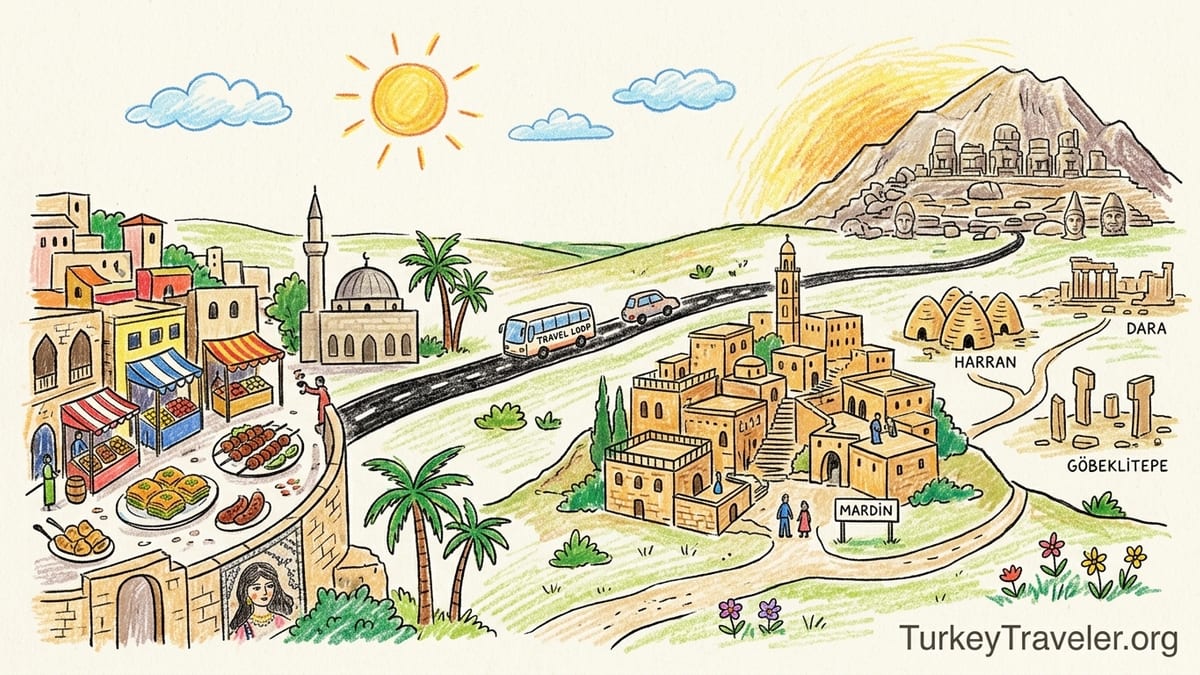
Most travelers arrive in the southeast with a familiar wish list: Gaziantep for food and the Zeugma Mosaic Museum, Şanlıurfa for Göbeklitepe and Harran, Mardin for stone architecture and side trips to Midyat and Dara, Diyarbakır for its UNESCO listed walls and transport connections, and Adıyaman/Kahta for Mount Nemrut. All of these are doable on a single loop in five to eight days. The key decision is whether to keep one or two main bases or to change hotels as you move between sights.
In practice, Booking’s strongest hotel inventory is in Mardin, Şanlıurfa, Gaziantep and Diyarbakır. That mirrors on the ground reality. These four cities have the widest choice of mid range and boutique hotels, from converted stone mansions in Mardin’s old town to business style towers near Şanlıurfa’s Balıklıgöl. Kahta and Adıyaman, by contrast, are functional staging points for Nemrut with a handful of simple hotels and pensions clustered along the highway.
Distances look short on the map but the region’s roads wind through plateaus and low mountains. A one way drive from Gaziantep to Kahta is roughly 170 kilometers and often takes 2.5 to 3 hours by car, while Şanlıurfa to Kahta or Nemrut is in the region of 200 kilometers. When you factor in a steep final climb to the Nemrut car park and the pre dawn or post sunset timing, some day trips become long and tiring. That is why the smartest plans combine a couple of multi night bases with no more than one or two hotel switches.
For most visitors, a practical pattern is to use Gaziantep or Şanlıurfa as an entry point, continue to Mardin with an optional night in Diyarbakır, and then decide whether Nemrut is important enough to justify a night in Kahta or Adıyaman. If you are coming from Cappadocia or central Anatolia by bus, Adıyaman can even be your first or last stop, but you will still want to spend your longer stays in the bigger hubs where dining and evening atmosphere are richer.
Gaziantep: Food Capital and Gateway to Zeugma
Gaziantep’s appeal starts with the plate. This is one of Turkey’s great food cities, known nationally for its pistachio baklava, layered kebabs like ali nazik and onion rich yuvalama soup. In practical terms that translates into dozens of specialist restaurants around the castle and Zincirli Bedesten. A mid range place like a classic kebab salon will serve a generous mixed grill and salad spread for a price that still feels modest compared with Istanbul, while a patisserie near the Bakırcılar Çarşısı might charge only a few dollars for a serious slice of baklava.
Zeugma Mosaic Museum alone justifies at least one full day in Gaziantep. The museum, one of the largest mosaic collections in the world, houses Roman floor mosaics rescued from the ancient city of Zeugma on the Euphrates before it disappeared under the waters of the Birecik Dam. Standing in front of the famous Gypsy Girl mosaic or the vivid Dionysus scenes is far more rewarding when you can walk there in 10 or 15 minutes from your city hotel, rather than adding museum time to a long day trip from another city.
Accommodation options in Gaziantep skew toward business hotels and refurbished townhouses. Around the castle and old bazaar you will find small boutique hotels occupying restored stone buildings, often with breakfast courtyards and traditional decor. Further out, near the main boulevard, chains and newer properties offer larger rooms and predictable comfort. For most travelers, two nights in Gaziantep is enough to explore the bazaars, the food scene and Zeugma without rushing, particularly if your flight arrives late in the day.
Using Gaziantep as a springboard for other major sights is possible but has limits. A day trip to Halfeti on the Euphrates or to small villages west of the city is realistic. But driving from Gaziantep to Nemrut and back in a single day means at least five hours on the road, plus the tortuous final ascent and time on the summit. If Nemrut is a priority, it is more comfortable to change hotels to Kahta or Adıyaman rather than treating Gaziantep as a universal hub.
Şanlıurfa: Best Base for Göbeklitepe and Harran
Şanlıurfa, often shortened to Urfa, is where the region’s deep history comes into sharp focus. Less than an hour’s drive away lies Göbeklitepe, the hilltop site with massive T shaped stone pillars, sometimes called the world’s oldest known monumental temple complex. Another hour south again brings you to Harran, with its distinctive beehive houses and ruined city walls on the flat Mesopotamian plain. On a practical level, this makes Şanlıurfa the most convenient and comfortable base for combining pioneering Neolithic archaeology with village life in a single two or three night stay.
Hotels in Şanlıurfa cluster around the old city near Balıklıgöl, the sacred fish ponds associated with Abrahamic traditions, and the newer commercial districts to the north. In the old town, small courtyard hotels converted from traditional houses offer thick stone walls and shaded gardens, a welcome relief in the summer heat when temperatures can sit around the high thirties Celsius. In the newer areas, business style hotels appeal to travelers who want larger rooms, easier parking and strong air conditioning. Booking platforms show a particularly strong spread of mid range and upper mid range options here, more than enough to find a comfortable base even at busy times.
From Şanlıurfa, organized tours and private drivers run daily to Göbeklitepe and Harran. A typical day might see you leaving your hotel after breakfast, reaching Göbeklitepe’s visitor center in under an hour, spending two or three hours between the interpretation center and the sheltered excavation areas, then continuing to Harran for lunch and a walk around the beehive houses before returning to your Şanlıurfa hotel by late afternoon. This pattern is hard to replicate if you try to stay in Gaziantep or Mardin and “commute” for the day, as you add at least two more hours of driving to an already full schedule.
You should plan to change hotels into Şanlıurfa rather than running long day trips if Göbeklitepe is a must see highlight. For example, going from Gaziantep to Göbeklitepe, on to Harran and then back to Gaziantep in one day can easily mean over 400 kilometers of driving. More importantly, you miss the evening atmosphere in Şanlıurfa’s old town, where locals gather in courtyard restaurants for sıra gecesi music nights and families stroll around the illuminated Balıklıgöl complex. Those experiences are part of what makes Şanlıurfa a rewarding base rather than just a day trip target.
Mardin: Stone Terraces, Midyat and Dara
Mardin’s old town climbs a long ridge above the Mesopotamian plain, a honey colored skyline of stone terraces, minarets and church towers. For many travelers it is simply the most photogenic base in Southeastern Anatolia. The walking experience here is different from Şanlıurfa or Diyarbakır. Mardin’s main street is lined with historic medreses, churches and hans, while narrow lanes break away uphill and downhill through archways and stone staircases. Cafes and rooftop terraces look out over the plain, making it a natural place to slow your pace.
Hotel choice is one of Mardin’s big advantages. Booking sites consistently show a dense cluster of restored mansions and boutique hotels within the old city, many of them with rooftop breakfast terraces and carved stone rooms. Prices vary widely, but for what you might pay for a standard chain room in a big city you can often secure a vaulted stone suite here. Newer, more modern hotels sit in the lower “Yenişehir” new town, which is convenient for drivers but lacks the old city’s atmosphere.
Mardin is also the best base for trips to Midyat and Dara. Midyat, about an hour’s drive east, has its own smaller stone old town and is a center of Syriac Christian culture and silver filigree jewelry workshops. Dara, roughly 30 to 40 minutes south of Mardin by car, is an atmospheric late Roman and Byzantine site of rock cut tombs, cisterns and city walls set amid farm fields. Public transport exists in the form of dolmuş minibuses between Mardin, Midyat and nearby villages, but most visitors either hire a taxi driver for the day or join a small group excursion to combine both sites without worrying about timetables.
Because Midyat and Dara lie in different directions and offer very different experiences, staying in Mardin and treating them as day trips works extremely well. A sensible pattern is three nights in Mardin, with one full day for the old town, one for Midyat and one for Dara and nearby monasteries. Shifting hotels to Midyat rarely makes sense unless you specifically want a quieter base and have your own car. The road infrastructure radiating from Mardin, and the sheer concentration of accommodation in the city itself, make it the natural hub for this part of the region.
Diyarbakır: UNESCO Walls and Regional Transport Hub
Diyarbakır sits on a high plateau above the Tigris River, surrounded by imposing black basalt walls that stretch for several kilometers. These fortifications and the adjacent Hevsel Gardens are inscribed together as a UNESCO World Heritage cultural landscape. Walking along sections of the wall, with views over the gardens and the river plain, is one of the most memorable urban experiences in the southeast. Inside the walls, the old city’s mosques, churches and hans testify to a layered history under Romans, Byzantines, Artukids, Ottomans and more recent powers.
Accommodation inside the old walled city tends toward characterful boutique hotels and guesthouses in converted stone houses, some with inner courtyards and rooftop terraces, while newer districts outside the walls host larger hotels used by business travelers and conferences. Evening life is livelier than many outsiders expect, with cafes around the old caravanserais and streets where young locals gather. Prices for food and lodging are still generally lower than in Istanbul or Cappadocia, which makes Diyarbakır a budget friendly base for a couple traveling on mid range standards.
Diyarbakır’s role as a regional transport hub is another reason to consider at least one night here. The city has an airport with frequent flights to Istanbul and Ankara, and bus lines radiate toward Mardin, Şanlıurfa, Van and the north. If you are stitching the southeast onto a longer trip that includes Eastern Anatolia or the Black Sea, arriving or departing via Diyarbakır can cut hours off your overland journeys. For example, you might fly into Gaziantep, travel by road through Şanlıurfa and Mardin, then exit the region on a flight from Diyarbakır without backtracking.
In terms of day trips, Diyarbakır is less of a springboard to big name sights than Mardin or Şanlıurfa, and more of a destination in its own right and a useful gateway. You can, in theory, attempt long excursions to Hasankeyf or even toward Nemrut, but these make for exhausting days and are better suited to travelers with private vehicles and a high tolerance for time on the road. For most visitors, it is more logical to allot one or two nights to fully enjoy the walls, old city and food scene, then move on to a different base closer to their next major sight.
Adıyaman and Kahta: Essential for Mount Nemrut
Mount Nemrut takes more planning than most southeast sights. The summit, at over 2,000 meters, is famous for its first century BC tumulus and the colossal stone heads of the Commagene kingdom arranged on terraces. The classic way to visit is at sunrise or sunset, when the light is low, temperatures are slightly gentler and the statues cast long shadows across the gravel. To make that timing work without dangerously sleepy driving, it is usually best to sleep near the mountain the night before your visit.
Kahta and Adıyaman are the two main staging points. Kahta lies roughly 40 kilometers south of Nemrut, and Adıyaman sits a similar distance further away again. From the perspective of base choice, Kahta is closer to the summit but smaller and more utilitarian, with a strip of modest hotels and pensions that mainly serve tour groups and independent visitors headed to the mountain. Adıyaman offers a bit more city infrastructure, including more restaurants, but still feels primarily functional compared with Mardin or Şanlıurfa.
Public information from Turkey’s Ministry of Culture notes that in addition to Adıyaman Airport, travelers can reach Kahta using the airports at Şanlıurfa, Malatya and Gaziantep, all about 1.5 to 2.5 hours away by road. That means you could, for example, fly into Şanlıurfa, spend two nights exploring Göbeklitepe and Harran, then transfer by shuttle or private car to Kahta for an overnight and a sunset or sunrise at Nemrut before continuing on by bus to Cappadocia or back to the coast. Several local agencies in Kahta and Adıyaman sell guided Nemrut tours that include stops at Kommagene era sites like Arsemia, Cendere Bridge and Karakuş tumulus on the same day.
The main reason to actually change hotels into Kahta or Adıyaman rather than attempt Nemrut as a day trip is safety and comfort. A return drive from Şanlıurfa or Gaziantep to the summit and back can mean six or more hours on the road. If you factor in a pre dawn departure for sunrise or a late night return after sunset, fatigue becomes a real issue, especially on the steep and sometimes rough final access road. By staying the night nearby, you shorten that final approach to roughly 1.5 to 2 hours each way and can catch some sleep before or after your summit visit.
When to Change Hotels and When to Stay Put
The temptation on any road trip is to minimize hotel changes, but in Southeastern Anatolia some moves pay off in time saved and richer evenings. The rule of thumb is simple: if your key sights cluster within about an hour and a half of one city, keep that city as a base. If a highlight requires more than two hours of one way travel, especially at awkward times of day, it is usually worth a hotel switch.
Applying that logic, it makes sense to use Mardin as your fixed point for exploring Mardin itself, Midyat and Dara. All three are within comfortable reach without predawn departures or midnight returns. The same is true for Şanlıurfa with Göbeklitepe and Harran. A traveler might, for instance, spend three nights in Şanlıurfa, visiting Göbeklitepe one morning and Harran the next, with afternoons and evenings left free for the city’s bazaars and museums. There is no need to move to Harran itself, where accommodation options are limited and basic.
By contrast, Nemrut almost always justifies at least one night in Kahta or Adıyaman. Trying to roll Nemrut into a day trip from Gaziantep, Şanlıurfa or Diyarbakır means long highway stretches and a tiring final ascent, undercutting the magic of sunrise or sunset at the summit. Similarly, although it is technically possible to base yourself in Gaziantep and day trip to Şanlıurfa or vice versa, doing so on consecutive days soon becomes a grind of repeated long drives. Most itineraries feel more relaxed if you accept at least two or three hotel changes while keeping your stays in each base to a minimum of two nights.
For a one week trip, a realistic pattern might look like this in practice: two nights in Gaziantep for food and Zeugma, two or three nights in Şanlıurfa, three nights in Mardin with a day trip to Midyat and a day trip to Dara, and an optional final night in Diyarbakır before flying onward. If Nemrut is a must, you can fold in a Kahta or Adıyaman stop between Şanlıurfa and Mardin or at the beginning or end of the loop. The right answer will depend on flight availability and whether you prefer to travel by rental car, bus or private transfers.
The Takeaway
Southeastern Anatolia rewards travelers who think carefully about where to sleep as well as what to see. Gaziantep shines as a start or end point for its food culture and the unmatched Zeugma Mosaic Museum, best enjoyed over at least two unhurried days. Şanlıurfa is the natural base for Göbeklitepe and Harran, with enough atmosphere and hotel choice to justify a multi night stay. Mardin delivers the region’s most memorable cityscape and acts as a convenient hub for Midyat and Dara.
Diyarbakır, with its monumental UNESCO listed walls and growing flight network, is both a destination and a practical gateway, while Adıyaman and Kahta function as essential staging posts for Mount Nemrut rather than full service bases. Recognizing that pattern helps you avoid over stretching yourself with long day trips and instead match each cluster of sights to the city that serves it best.
Most importantly, be willing to change hotels when the combination of distance, road conditions and timing makes it sensible. Spending one extra morning packing a bag can easily save you six hours in a minibus and allow you to watch the sun rise over Nemrut or set behind Mardin’s terraces without worrying about a long, dark drive home. In this part of Turkey, where the light on stone is as much a highlight as any museum, choosing the right base at the right time is what turns a good itinerary into a memorable journey.
FAQ
Q1. Can I base myself in a single city and day trip everywhere in Southeastern Anatolia?
It is technically possible with a rental car, but not recommended. Distances to Nemrut, Göbeklitepe and Harran quickly turn into long days, and you will miss evening atmosphere in cities like Şanlıurfa and Mardin.
Q2. If I only have five days, which two bases make the most sense?
For a first visit, combining Şanlıurfa and Mardin works well. From Şanlıurfa you can see Göbeklitepe and Harran, while Mardin covers its own old town plus Midyat and Dara.
Q3. Is Gaziantep or Şanlıurfa better as a starting point?
Gaziantep is ideal if you are flying in primarily for food and the Zeugma Mosaic Museum. Şanlıurfa works better if your focus is Göbeklitepe and Harran and you plan to continue overland toward Mardin.
Q4. Do I really need to stay in Kahta or Adıyaman for Mount Nemrut?
Staying near Nemrut is strongly advised. It shortens the pre dawn or sunset drive and makes the visit safer and more enjoyable than attempting a very long day trip from another city.
Q5. How many nights should I spend in Mardin?
Three nights is a good minimum. That gives you one full day for the old town and terraces, one for Midyat and one for Dara and nearby monasteries without rushing.
Q6. Is Diyarbakır worth a stop if I am mainly interested in archaeology?
Yes. The UNESCO listed city walls and Hevsel Gardens are significant in their own right, and the old city offers a different architectural and cultural feel from Mardin or Şanlıurfa.
Q7. Can I visit Göbeklitepe and Harran in one day from Şanlıurfa?
Yes. Many visitors combine both as a full day trip from Şanlıurfa, starting with Göbeklitepe in the morning and continuing to Harran in the afternoon before returning to the city.
Q8. Is it safe and practical to use public transport between these cities?
Intercity buses and dolmuş minibuses are widely used by locals and generally safe and affordable, though they can be slower than private transfers and require more flexibility with timing.
Q9. When is the best time of year to visit Nemrut and the southeast?
Spring and autumn are ideal, when daytime temperatures are milder and high places like Nemrut are accessible but not snowbound. Summer can be very hot, especially on the plains.
Q10. Should I book hotels in advance or find them on arrival?
In peak seasons such as spring holidays and autumn, advance booking is wise in Mardin, Şanlıurfa, Gaziantep and Diyarbakır. Kahta and Adıyaman usually have space, but booking ahead helps secure a hotel close to Nemrut tours.