


Stretching from the port city of Mersin to the Syrian border beyond Samandağ, the far eastern Mediterranean coast of Turkey feels like a world apart from the big resort hubs around Antalya. This is old Cilicia, a region of long sandy beaches, castle-topped headlands, citrus groves and deeply layered history, where you are more likely to share a seaside café with local families from Adana than with overseas tour groups. For independent travelers, couples, families and road trippers who want a more authentic slice of the Mediterranean without giving up warm seas and excellent food, this stretch of coast is one of the most rewarding parts of Turkey to explore.
Mediterranean Turkey’s Quiet Corner: How the Region Fits Together
On a map, the route from Mersin to Samandağ traces a long arc along Turkey’s southeastern Mediterranean, skirting the historic plains of Cilicia before the coastline bends south toward the border. Compared with western hotspots like Kaş, Fethiye or Bodrum, this area receives far fewer foreign visitors, but domestic travelers know it well for its warm sea, relatively affordable prices and dense concentration of ruins. Mersin Province alone has more than 300 kilometers of coastline, much of it sandy beach backed by citrus orchards and low-rise holiday homes rather than high-rise resorts.
For planning purposes, it helps to think of the region in three clusters. The first is around Mersin city, with Tarsus inland and Kızkalesi, Silifke and Anamur stretching west along the coast. The second is the Adana area, where Yumurtalık serves as the main seaside escape for city residents. The third is Hatay Province, anchored by Antakya and the coastal town of Samandağ. Each cluster has a different balance of beach life, ancient sites and food culture, and road trippers can realistically link them in a week to 10 days, driving roughly 600 to 700 kilometers in total.
After the major earthquakes in southern Turkey in February 2023, Antakya and parts of Hatay suffered serious damage and reconstruction is still ongoing. Many hotels and restaurants have reopened, but infrastructure and museum access can be more limited than in Mersin or Adana. Travelers should check recent local updates, but with prudent planning, it is again possible to include Antakya and Samandağ in an overland Mediterranean itinerary.
What unites the entire route is a sense of being in a lived-in, working part of Turkey rather than in a purpose-built resort zone. Ports, factories and greenhouses share the coastline with fishing villages, castle ruins on the sand and long, undeveloped strands where endangered sea turtles still nest. Expect fishing boats and cargo ships on the horizon, minarets in town centers and heaps of fresh herbs and peppers in market stalls alongside the ubiquitous beach umbrellas.
Mersin & Tarsus: City Energy, History and Food
Mersin itself is the region’s largest urban center, a busy port city lined with apartment blocks, palm trees and a long seafront promenade. It is not a classic beach town, but makes a practical base for travelers who prefer city comforts. There are modern business hotels near the marina, plentiful cafés and patisseries, and air-conditioned shopping malls for escaping the midday heat. A plate of fresh fried calamari and a beer in a casual meyhane by the water might cost less here than in more touristy western resorts, and seafood restaurants around the marina often display the day’s catch on ice for you to choose from.
For ancient history, Tarsus, about 30 to 40 minutes inland by car or suburban train, is the real star. Once the capital of the Roman province of Cilicia, it is dotted with archaeological fragments: a Roman-era road with preserved paving stones, parts of an old city wall, and a well that local tradition associates with the biblical figure of Saint Paul. The old town’s narrow streets, stone houses with wooden balconies and small mosques give a glimpse of pre-modern Cilician urban life. Many travelers base in Mersin and visit Tarsus on a half-day trip, combining a stroll through the historic core with lunch at one of the city’s lokantas serving stewed chickpeas, lamb dishes and stuffed vegetables.
For food-focused visitors, Mersin and Tarsus are a major draw. This is the homeland of tantuni, a local specialty of finely chopped beef or lamb cooked in oil and spices then wrapped in lavash, and of cezerye, a carrot-based sweet studded with nuts and dusted with coconut. In the bazaar near central Mersin, you will see shopfronts stacked with trays of cezerye alongside dried fruits and pistachios. A quick-and-satisfying lunch for two of tantuni wraps, ayran and tea in a basic local place can easily come in under the cost of a single sit-down main course in Istanbul’s more upscale neighborhoods.
Culturally, Mersin and Tarsus appeal to couples and food lovers who enjoy urban exploration more than long days on the sand. Families with small children may prefer to continue along the coast to smaller towns, using Mersin as an arrival and departure hub rather than as the main holiday base.
Kızkalesi & Silifke: Castles on the Sea and Classic Beach Time
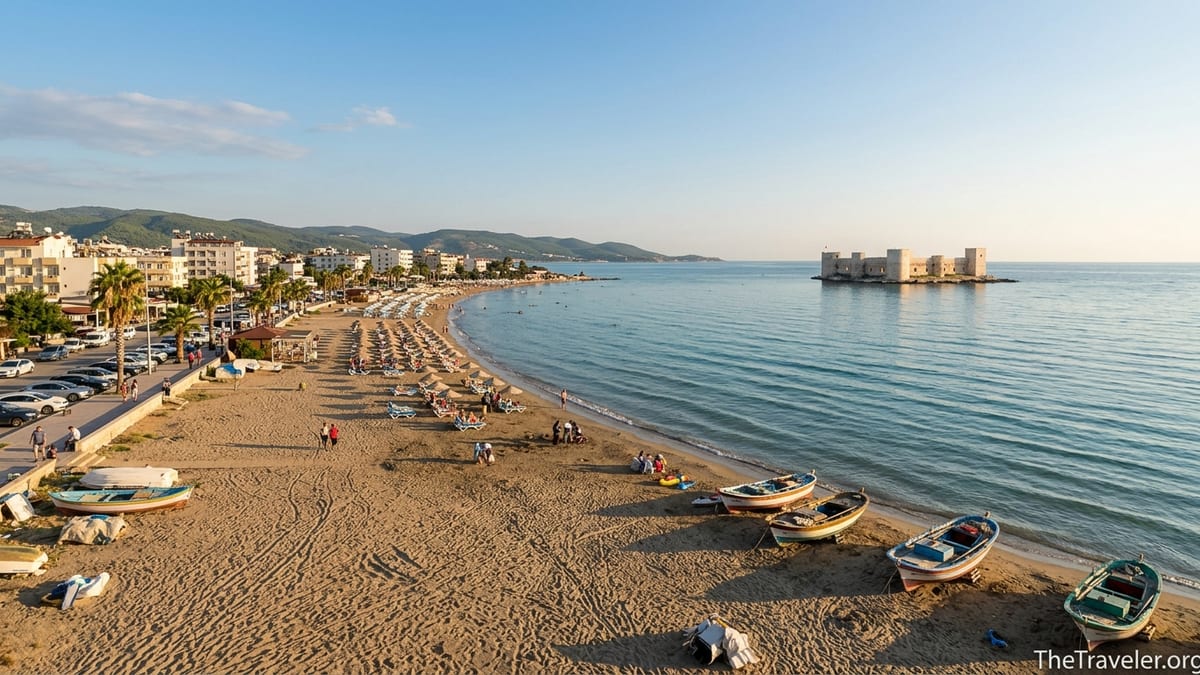
About an hour’s drive southwest of Mersin, Kızkalesi is the area’s best-known beach resort and one of its most atmospheric stops. The town takes its name from the “Maiden’s Castle,” a fort that rises from a tiny island just a few hundred meters off the shore. You can see its stone walls and towers from almost every point on the town beach, and small shuttle boats run out to the island in summer for short visits, while confident swimmers sometimes cross under their own power. On the mainland, the remains of another fortress, often called the Land Castle, sit on a rocky outcrop immediately behind the beach, creating a uniquely layered historic seascape.
For travelers comparing seaside bases, Kızkalesi hits a sweet spot between local and resorty. There is a run of small hotels and pensions directly on or just behind the sandy beach, with sun loungers and umbrellas for rent, ice cream kiosks and casual seafood restaurants. Prices are generally moderate, with simple family-run hotels often including breakfast and sometimes dinner in half-board arrangements. In high summer, the town fills up with domestic holidaymakers from inland cities, so the vibe is lively and very Turkish, with evening strolls along the seafront, music from beach bars and children playing late into the night.
Silifke, 20 to 30 minutes further along the coast and set slightly inland on the Göksu River, is less of a beach town but a major center for ancient sites. Above the town rises Silifke Castle, whose foundations date back to the Hellenistic or early Roman period and which later took on a typical medieval fortress form after centuries of repairs and rebuilding. Nearby, the countryside is dotted with ruins: the abandoned city of Uzuncaburç in the hills, with its temple remains and colonnaded streets, and the religious complex at Aya Tekla, associated with one of early Christianity’s first female saints. Travelers interested in history often base themselves in Kızkalesi or Silifke for several nights, using a rental car to make day trips to these sites, as well as to the spectacular Cennet and Cehennem sinkholes carved out of the limestone plateau.
For couples, Kızkalesi works particularly well when combined with explorations around Silifke. You can spend a lazy morning swimming in warm, shallow waters with a view of the castle, then head inland in late afternoon to wander through quiet ruins in the hills as the light softens, before returning to the coast for grilled fish and meze. Families appreciate the town’s safe, gently shelving beaches, boat trips and the sense that everything is within easy walking distance. Road trippers have the added bonus of quickly accessing mountain roads above Silifke that offer cooler air and sweeping views back to the Mediterranean.
Anamur & the Western Edge: Ruined Cities by the Sea
Continuing west, the coastline becomes wilder and more rugged as you approach Anamur. This town sits near the point where Turkey’s Mediterranean coastline begins its long stretch toward Antalya, and although it remains off the main foreign tourist circuit, it offers some outstanding historic and natural sites. The standout is Mamure Castle, one of the best-preserved fortresses in the country, rising directly above the sea on a rocky promontory. Its walls and towers extend along the shoreline, and during quiet periods you may find only a handful of other visitors exploring its ramparts.
Just outside Anamur, the ancient city of Anemurium occupies a low headland above the beach, with the sea on one side and the modern highway on the other. Walking among its scattered ruins of houses, baths and churches, with waves breaking on the pebbly shore below, offers a tangible sense of how closely tied to the sea many ancient Cilician settlements were. The beaches themselves are less developed than around Kızkalesi, with more pebbles and waves at certain times of year, but there are long, quiet strands where you may have large sections to yourself, particularly outside Turkish school holidays.
Anamur’s town center feels more like a straightforward agricultural hub than a resort, with banana plantations and greenhouses surrounding the built-up area. You will find simple hotels, apartment rentals and a few small pensions, but far fewer seafront properties than in Kızkalesi. Dining options skew toward hearty local fare: kebabs, stews and grilled meats alongside plates of seasonal vegetables. Prices reflect its workaday character, and you are unlikely to see the kind of premium rates common in heavily touristed parts of the coast.
For travelers deciding whether to extend their route as far as Anamur, the main question is time. If you have 10 or more days and a rental car, the combination of Mamure Castle, Anemurium and the wilder feel of the coastline is very rewarding, especially for photographers and history enthusiasts. Families with young children may find the longer driving distances and more limited childcare-oriented infrastructure less appealing, but older children often enjoy clambering around the castle walls and exploring near-empty beaches.
Adana & Yumurtalık: City Heat, Coastal Escape and Culinary Capital
East of Mersin, the city of Adana dominates the Cilician plain. It is not on the sea itself, but serves as the gateway to the resort town of Yumurtalık about 40 kilometers away. Adana is famous across Turkey for its food culture. Adana kebab, a spicy minced meat kebab molded onto wide skewers and cooked over charcoal, is the best-known local specialty, but the city’s culinary repertoire runs much deeper. Breakfast tables groan under plates of olives, cheeses, herbs, eggs and multiple breads, and dessert shops fill trays with künefe, a syrupy cheese pastry baked to order.
Travelers often use Adana as an arrival point thanks to its airport and rail links, spending a night or two sampling restaurants before heading to the coast. For couples and food-focused travelers, a stop in Adana is almost obligatory: a simple kebab meal at a well-known but still local-feeling ocakbaşı restaurant, with meze, salad and drinks, is usually remarkably good value by international standards. Street food runs the gamut from liver skewers for breakfast to stuffed mussels and sesame-crusted simit.
Yumurtalık, around an hour’s drive from Adana, is the main summer escape for city residents. Once an important port known historically as Aegeae and later Ayas, today it is a modest beach resort lined with holiday apartments and small hotels. The town beach is sandy and, in high season, busy with umbrellas, folding chairs and families. An old harbor area and fortress add visual interest, and there are casual fish restaurants where you can eat grilled sea bream or anchovies on simple plastic tables overlooking the water.
For travelers comparing Yumurtalık with Mersin-area beaches, the former feels more like a local weekend and summer-home destination than a purpose-built resort. You are unlikely to hear much English on the sand, but the atmosphere is relaxed and friendly. The sea is generally calm in summer months, and the presence of endangered sea turtles nesting on nearby stretches of coast underlines the ecological importance of this section of shoreline. For families staying in Adana, Yumurtalık works well as an easy day trip; for couples or road trippers, it can serve as a low-key overnight stop that adds variety to an itinerary heavily weighted toward castles and ruins.
Antakya & Samandağ: Deep History and Evolving Realities
Hatay Province, with Antakya as its historic heart, has long been known within Turkey as a place where cultures, religions and cuisines meet. Antakya, identified with ancient Antioch, once ranked among the great cities of the Roman world. Its old town packed an extraordinary concentration of churches, mosques and traditional houses into a tight riverside area, and its regional cuisine mixed Turkish, Arab and Levantine influences in dishes like humus, oruk (a local version of kibbeh) and pepper-heavy stews.
The earthquakes of February 2023 changed Antakya profoundly, damaging large parts of the historic center, hotels and infrastructure. Reconstruction is ongoing and some of the most famous institutions, including the major archaeology museum, have faced extended closure and phased reopening plans. Travelers considering a visit should be prepared for a city in transition: new buildings rising beside cleared lots, temporary premises for some businesses and services, and transport and accommodation options that may shift from one season to the next. At the same time, many residents and small businesses are eager for visitors to return, and some boutique hotels and restaurants have already reopened or relocated.
About 25 kilometers from Antakya, the coastal town of Samandağ offers a very different atmosphere. Its long, straight beach at Çevlik runs for kilometers, backed for much of its length by dunes and agricultural land rather than dense development. The waves here can be stronger than in more sheltered bays farther west, and the water sometimes feels cooler due to currents, but on calm summer days it is an atmospheric place to swim or simply walk along the shoreline. Above the town and nearby hills are scattered archaeological sites linked to ancient Seleucia Pieria and other Hellenistic and Roman remains, including tunnel-like waterworks hewn from the rock.
For travelers focused on beaches alone, Samandağ cannot match Kızkalesi’s sheltered, family-friendly coves, but it does offer a sense of space and a wilder, more elemental feel. For history and culture enthusiasts already committed to visiting Antakya, dedicating a day or two to Samandağ can provide a welcome coastal interlude. This part of the trip currently suits patient, flexible travelers who are comfortable with less predictable infrastructure, value engaging with local realities after the earthquakes, and see their visit as both a journey and, in a small way, a contribution to the local economy.
Choosing the Right Base: Couples, Families and Road Trippers
When weighing destinations along this part of Mediterranean Turkey, it can help to be clear about your priorities. Couples looking for a romantic but low-key seaside break with good food and a memorable historic setting often gravitate toward Kızkalesi combined with day trips to Silifke-area ruins. The sight of the castle on its island at sunset, small fish restaurants on the sand and evening walks along the busy but still mostly Turkish promenade create the kind of atmosphere that feels special without being staged. Adding a night or two in Mersin or Adana for urban food experiences rounds out the trip.
Families usually need safe, accessible beaches, manageable driving distances and a balance of activity and downtime. For them, Kızkalesi and Yumurtalık stand out. Kızkalesi’s shallow, warm waters, boat rides to the castle and compact layout mean that older children can often enjoy limited independence within sight of the beach hotels. Yumurtalık’s town beach and relaxed holiday-home feel appeal to families staying in Adana who want straightforward sea access without changing bases. Longer drives to Anamur or Samandağ with smaller children can be tiring, so many families keep those segments for a second or third visit.
For dedicated road trippers, the full Mersin to Samandağ stretch remains an under-the-radar gem. Starting in Mersin or Adana, you can drive west via Kızkalesi and Silifke to Anamur, then loop back through the Cilician plain toward Adana and on to Antakya and Samandağ, or reverse the direction. Rental cars are widely available in the larger cities, and major sections of the highway network have been upgraded, though coastal roads near Anamur still feature plenty of bends and occasional slow-moving trucks. A typical day might combine a morning on a quiet beach, an afternoon exploring a fortress like Mamure Castle or Silifke Castle, and an evening sampling regional dishes in a small-town restaurant.
Travelers particularly focused on ancient sites may want to concentrate their time between Tarsus, Silifke, Kızkalesi and Anamur, where the density and variety of ruins is greatest. Those more interested in food and contemporary culture should consider splitting their nights between Mersin and Adana, with shorter seaside forays to Kızkalesi and Yumurtalık. For visitors curious about post-earthquake Hatay, adding Antakya and Samandağ at the beginning or end of a broader itinerary can provide important context on the region’s resilience and ongoing recovery.
FAQ
Q1. Is it safe to travel to Antakya and Samandağ after the 2023 earthquakes?
Conditions are evolving, but by 2025 many hotels, guesthouses and restaurants had reopened or relocated, and intercity transport was functioning again. You should expect ongoing reconstruction, occasional infrastructure disruptions and a more limited range of accommodation than in Mersin or Adana. Checking very recent local information and booking flexible, cancellable stays is advisable.
Q2. Which destination is best for a classic beach holiday: Kızkalesi, Yumurtalık or Samandağ?
For a classic, walkable beach town with shallow, generally calm water and plenty of small hotels, Kızkalesi is usually the best choice. Yumurtalık offers a more local, summer-home feel and works well for day trips from Adana. Samandağ’s long, open beach is scenic but can have stronger waves and feels more atmospheric than resort-like, so it suits travelers who prioritize space and scenery over full-service facilities.
Q3. How many days do I need to explore Mersin, Kızkalesi, Silifke and Anamur?
A compact but satisfying circuit can be done in five to seven days. Many travelers spend one or two nights in Mersin for urban comforts, three or more nights in Kızkalesi or Silifke for beaches and nearby ruins, and one or two nights in Anamur for Mamure Castle, Anemurium and quieter stretches of coastline. With more time, you can add extra rest days or side trips into the Taurus Mountains.
Q4. Are the beaches in this part of Turkey suitable for young children?
Yes, several are. Kızkalesi in particular has gently shelving, usually calm waters that families with young children appreciate, and many seafront hotels provide easy access and shaded areas. Yumurtalık also attracts local families from Adana. Parents should still watch for occasional waves, heed any local safety flags, and remember that sun in midsummer can be intense, so early morning and late afternoon swims are often more comfortable.
Q5. What kind of budget should I expect compared with western Mediterranean resorts in Turkey?
In general, this region remains more affordable than heavily touristed hubs like Antalya or Bodrum. Simple, clean family-run hotels or pensions in places like Kızkalesi or Silifke often cost noticeably less than equivalent properties in the west, especially outside peak Turkish holiday periods. Meals based on local specialties in modest restaurants and lokantas can also be very good value. High-end luxury resorts are rarer here, so ultra-premium prices are less common.
Q6. Do I need a rental car to enjoy this region, or can I rely on public transport?
You can reach major cities like Mersin, Adana and Antakya, and even towns like Kızkalesi and Silifke, by intercity buses and minibuses, and locals use these services daily. However, a rental car provides far more flexibility for combining beach time with out-of-the-way ruins, mountain drives and small coastal stops. For travelers who prioritize freedom to explore at their own pace, especially couples or friends on a road trip, hiring a car in Mersin, Adana or another major hub is highly recommended.
Q7. Which spot is best if I care more about food than beaches?
Adana leads for food, with Mersin a close second. Adana’s kebab culture, meze traditions and dessert shops are rightly famous, and Mersin offers excellent seafood along with regional dishes like tantuni and cezerye. You can easily base yourself in one of these cities and make day trips to nearby beaches such as Yumurtalık or Kızkalesi, rather than the other way around, if your priority is eating very well every day.
Q8. What is the best season to visit Mediterranean Turkey’s far east coast?
Late spring and early autumn are the most comfortable times, roughly from May to early June and from late September into October, when sea temperatures are pleasant and daytime heat is more manageable. July and August bring very hot weather and higher humidity, especially in the cities of Adana and Mersin, though the sea is at its warmest and domestic holiday life is in full swing. Winter is quieter, cooler and sometimes rainy, better suited to cultural exploration than to long days on the beach.
Q9. Are there good options for couples seeking a quieter, romantic stay?
Yes, but the atmosphere is more low-key than overtly luxurious. Couples often favor smaller seaside hotels or pensions in Kızkalesi with balconies overlooking the castle, or simple guesthouses near Silifke with access to both beaches and hilltop ruins. In Antakya, some boutique properties in or near the old town aim at couples, though availability can vary while reconstruction continues. The romance comes more from sunsets over castle-dotted bays, shared plates of meze and walks through ancient sites than from high-end spa facilities.
Q10. How should I combine Antakya and Samandağ with the rest of my trip?
If you want to include Hatay, a common pattern is to start or finish your itinerary there. For example, you might fly into Adana, spend time in Adana and Mersin, continue to Kızkalesi, Silifke and Anamur, then return across the Cilician plain and onward to Antakya and Samandağ for a few final days. Alternatively, you can focus first on Antakya and Samandağ, then head west for more classic beach time. Building in some flexibility for transport and accommodation in Hatay is wise given ongoing changes.