


I arrived in Ölüdeniz with a familiar postcard in my mind: a quiet turquoise lagoon cupped by pine-covered mountains, a pale sand spit curling into still water, and only a handful of people in the frame. The reality that greeted me in 2026 at Turkey’s most famous beach was far more complicated, far more expensive, and far less idyllic than the aerial shots that built its global reputation.
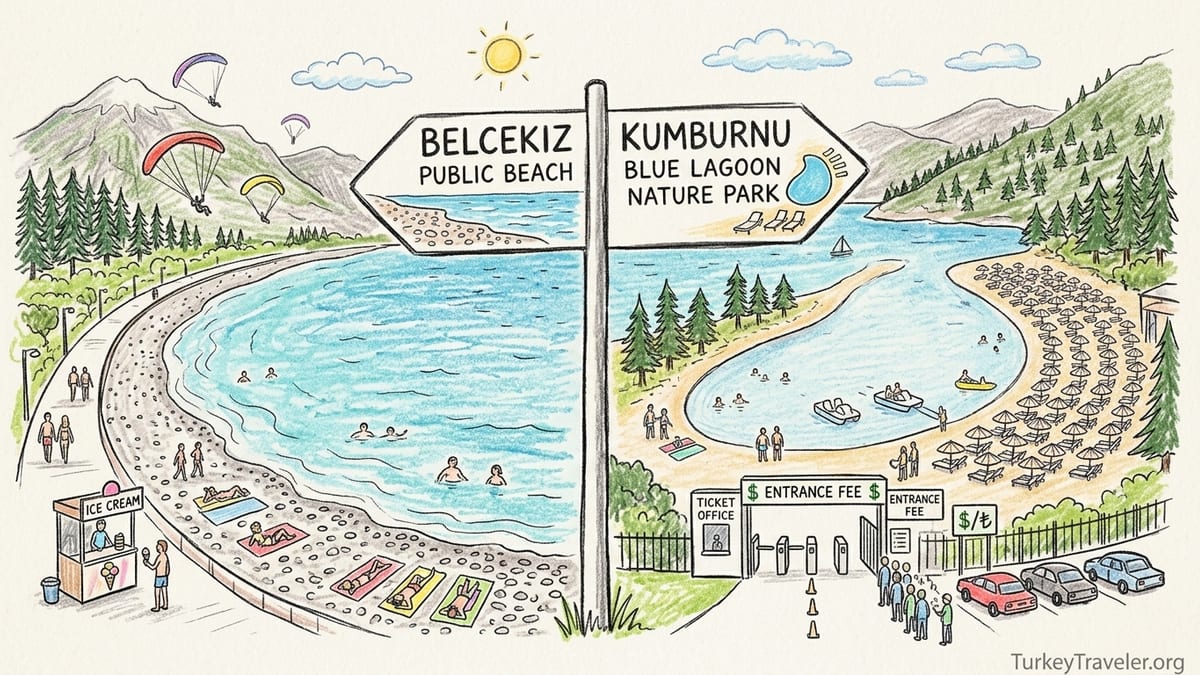
Belcekız vs Kumburnu: Understanding Which “Ölüdeniz Beach” You Are Actually Visiting
The first surprise hit me before I even reached the water. In most travel brochures, everything is simply labeled “Ölüdeniz Beach” or “Blue Lagoon,” as if the entire bay were one seamless place. On the ground it is a patchwork of very different experiences. Belcekız Beach, the long shingle strip fronting the main resort, is technically the public beach. This is where the paragliders swoop down every few minutes, landing dramatically just behind the promenade. It is free to enter, you can drop a towel almost anywhere, and the atmosphere is busy but recognizably like any other Mediterranean resort front.
The famous lagoon, however, is not Belcekız. The iconic teardrop shape from the drone shots belongs to Kumburnu Beach inside the Ölüdeniz Nature Park, which is managed as a protected area and ring-fenced behind entrance gates and turnstiles. The thin spit that separates the open Mediterranean from the still inner lagoon is what people imagine when they say “Blue Lagoon.” Standing on Belcekız and looking south, you can barely see that distinctive shape at all. You only understand where those marketing images come from if you look at a map or rise above the bay.
This distinction matters because it is the difference between a free beach and a heavily monetized one. Belcekız costs you nothing to enter. Kumburnu, and thus the Blue Lagoon itself, already starts with a price tag before you even touch the sand. Many first-time visitors, including me, do not grasp that until they are physically at the park entrance, surrounded by signs listing tariffs and queues of cars inching forward to pay.
Once I realised that the postcard lagoon lived behind gates, the question was no longer just whether Ölüdeniz was beautiful. It became whether this particular beach experience was worth the layered, often opaque costs that have escalated in recent seasons.
The 2026 Price Wall: Entrance, Parking and Loungers as Separate Tickets
Ölüdeniz Lagoon sits inside an officially protected area, and that status is often used to justify charging a gate fee. For 2026, multiple local sources and the published fee schedules I checked showed pedestrian admission to Ölüdeniz Nature Park, including Kumburnu Beach, set at around 150 Turkish lira per person, while standard car entry was around 750 lira, irrespective of how many people were inside the vehicle. These prices are broadly consistent with regional protected area tariffs confirmed by Turkey’s forestry and national parks authorities, which have been raised several times in recent years.
At first glance 150 lira sounds manageable. Converted at current exchange rates it might still feel like a modest sum to many foreign visitors. The problem is that this is simply the opening charge. Once inside, the real financial gravity kicks in around the lounger zones. Recent 2026 reviews and receipts shared by Turkish and foreign visitors describe paying around 1,300 to 1,500 lira for the standard set of two sunbeds plus a fixed umbrella at the main operated section of Kumburnu. One June 2026 review detailed a bill of 1,500 lira for two loungers and an umbrella at the facility right on the spit, broken down as 500 lira per lounger and 500 for the umbrella itself.
This means a couple arriving by car can easily spend close to 2,400 to 2,700 lira before they have even bought a bottle of water. A solo visitor walking in without a car might get away with 1,450 to 1,650 lira if they choose the full lounger setup. For many Turkish families, already strained by inflation, these numbers are heavy. One recent Turkish-language social media post from summer 2026 described paying 800 lira for vehicle entry on a peak day, then struggling to find any free patch of ground among sunbeds that felt more like a “beach club” than a public nature park.
Technically you do not have to rent a lounger. There are still narrow strips of pebbly shore where you can put down your own mat. In practice, the most appealing seafront is dominated by regimented rows of beds. Staff patrol the edge between “free” and “paid” zones, and the message is clear: the comfortable way to enjoy this poster-child lagoon is no longer part of your basic park entry. It is a separate, high-margin product.
Budgeting the Lagoon: Solo, Couple and Family Cost Scenarios
To understand the real price of a day at Kumburnu, I sketched out several 2026 scenarios using the current entrance fees and on-the-ground prices reported by visitors this season. These are not theoretical; they reflect what you are likely to pay if you follow the path that most people do once inside the park gates.
A solo traveller who walks from Ölüdeniz town avoids the vehicle fee and pays 150 lira at the pedestrian gate. If they decide comfort is worth it and rent a sunbed and umbrella in the main operated zone at a representative 2026 price of around 700 to 800 lira for a single lounger and shared umbrella portion, then add two soft drinks at around 80 to 100 lira each and a simple gözleme or toastie from one of the snack kiosks at around 200 to 250 lira, a “basic” day comes to roughly 1,200 to 1,400 lira. Opt into a short kayak or pedal boat rental on the lagoon side, which locals price around 500 to 700 lira for an hour, and you are now nudging or exceeding 2,000 lira for one person.
For a couple arriving by rental car, the arithmetic climbs fast. Add the 750 lira vehicle entry to two individual pedestrian charges if collected separately, or treat vehicle-plus-occupants as one combined fee depending on how staff apply the rules that day. Conservative estimates still come to around 900 lira just to enter and park. A 1,300 to 1,500 lira fee for two loungers and an umbrella, two light lunches at perhaps 250 to 300 lira each, and four soft drinks or beers at around 100 to 150 lira each can easily push the total for a relaxed full day past 3,500 lira. If you add a 30-minute paddleboard session for both partners at a combined 1,000 lira, the total climbs toward 4,500 lira.
Families face the steepest curve. A car with two adults and two older children will likely pay the 750 lira vehicle fee plus at least partial pedestrian charges depending on how the staff interpret age brackets; younger children may enter free or at reduced cost, but older teenagers are often counted as adults. Suppose the gate total sits at 1,000 to 1,200 lira. Two loungers and an umbrella for parents and maybe an extra loose chair or beanbag for a teen could hit 1,600 to 1,800 lira. Add four or five snacks at 200 lira each and multiple rounds of drinks through a hot day, and it is not difficult to reach 4,000 to 5,000 lira without any water sports. Include one shared pedal boat or kayak session at around 700 lira and a couple of ice creams per child, and a “special family day at the Blue Lagoon” now represents a serious financial decision.
Prices in Turkey in 2026 are volatile, and each stall or operator will set its own numbers, but the direction of travel is unmistakable. Entrance fees and lounger rentals at Kumburnu have moved out of the casual, spontaneous purchase range and into the territory where it makes sense to sit down before your trip and align expectations with your travel companions. For a beach that markets itself as a pristine natural wonder, the incremental charges create a relentless paywall feeling.
On the Ground: Loungers, Music, Photographers and the Missing Postcard
Walking through the pine belt toward the lagoon, I braced myself for crowds but still half expected that the protective status of the park would mean some restraint in development. Instead, the first view that opened up was an almost military grid of sunbeds stretching down the spit, punctuated by stripes of umbrellas. From water level, the teardrop lagoon looks less like a hidden cove and more like a waterfront resort product line.
There are natural pockets of quiet, especially in the early morning and near the less-developed edges of the park, but in the central section where most visitors cluster, the atmosphere is overtly commercial. Pop or dance music drifts from café speakers. Drone buzzes mix with the bass line as professional photographers chase couples and families for staged shoots. Staff shuttle drinks trays down packed aisles between loungers. Children play in the shallows with inflatable flamingos and unicorns, while a queue forms at the pedal boat kiosk. It is energetic, even joyful in moments, but it bears little resemblance to the serene lagoon that fills travel magazine covers.
It would be wrong to say the area is always overcrowded. I visited on a clear weekday outside of the absolute peak Turkish public holiday weekends, and there were still gaps in the rows, especially in the late afternoon when day-trippers began drifting out. Locals and regulars say that late September and early October can be surprisingly calm, with warm water and more space between towels. However, recent 2026 reviews and social media posts describing “one meter of sand per person” and “almost impossible to find a free patch after 11 am in July” ring true in high season. Traffic into the park can reportedly back up for three kilometers along the access road, turning the last stretch from Fethiye into a 60-to-90-minute crawl.
At beach level, the famous aerial shape simply disappears. You can walk from the Mediterranean side to the lagoon in a couple of minutes, but you never really see the full curve that sold you the dream in the first place. The only times it reveals itself are from the surrounding mountains, particularly Babadağ where the paragliders launch, or from a drone flight or boat offshore. On the ground your view is of sunbeds and a flat horizon of water framed by slopes. It is pretty, and the color of the water on sunny days is indeed a rich, almost electric blue, but the iconic curve belongs to marketing more than to the average visitor’s lived experience.
Swimming the Lagoon vs the Open Sea: Two Different Experiences
Once I set aside the crowds and prices and actually went into the water, the strengths of Ölüdeniz did come into focus. The inner lagoon at Kumburnu is remarkably calm. Protected on almost all sides, it feels like a vast natural pool. The bottom slopes so gently that adults can stand far from shore, and the temperature in late summer edges into bathwater territory by midday. For cautious swimmers, families with young children, or anyone who simply wants to float for an hour without fighting waves, it is a deeply pleasant place to be.
That same calmness contributes to the commercial atmosphere. The safety profile of the lagoon makes it ideal for paddleboards, kayaks and pedal boats, which occupy the outer sections. Operators work with the park authorities under license, and designated swimming and craft zones are marked, but the visual impression is of a shared recreational surface rather than a wilderness cove. If you wander toward the buoys you find yourself weaving between boards and boats. Peace is possible closer to shore, yet the sense of a shared, heavily programmed space is constant.
Walk a few dozen meters across the narrow spit to the Belcekız side, and the mood shifts. Here you are back on the open Mediterranean. The shingle underfoot is coarser, the entry slightly steeper, and the water a shade darker. Small waves break on most days, enough to make things fun but rarely dangerous in settled weather. Stronger swimmers and those who dislike the stillness of lagoons may actually prefer this side. It is free, a little wilder, and more spacious because loungers are not packed down the full length in quite the same regimented fashion.
In practical terms, the best way to experience the contrast is to bring reef shoes or sturdy sandals to cope with the pebbles, swim on the lagoon side in the morning shade, then walk over to Belcekız for a more invigorating swim in the afternoon. Doing this without renting any loungers at Kumburnu immediately cuts your costs. The trade-off is that you will likely spend more time on rough pebbles, leaning against your backpack, than reclining under an umbrella in the front row of the Instagram zone.
Conservation vs Commercialization in a “Protected” Lagoon
Ölüdeniz’s Blue Lagoon is formally designated as a protected area, and there are signs at the entrance setting out conservation rules. Open fires and barbecues are banned. Visitors are discouraged or prohibited from feeding fish and wildlife. Littering carries fines, and waste bins are placed at regular intervals. The vegetation belt around the beach, with its pines and low bushes, is largely intact behind the main path. These measures are real and, to some extent, effective. Even in busy hours I saw staff clearing stray trash, and the water, though busy, did not feel visibly polluted on the days I visited.
However, the same gates that enforce conservation are also monetized aggressively. Nature park status gives authorities the right to charge an entrance fee, but it has also created what feels like a semi-private, concession-heavy beach environment where every comfort beyond access to the shore has been turned into a revenue stream. Critics in local Turkish media and in community forums have pointed out the tension between protecting the bay as a public good and outsourcing large chunks of shoreline to private operators whose main incentive is to increase turnover of sunbeds and services.
Environmental reports on the wider Fethiye coast in recent years have highlighted pressures from intensive tourism: coastal erosion, light and noise pollution, and impacts on marine life from increased boat traffic and personal watercraft. Around Belcekız and the approach to the lagoon there are numerous speedboat and tour boat operators lining the waterfront, many of them advertising “Blue Lagoon tours” that are in fact short, high-traffic loops in and out of the same narrow bay. Conservation rules limit where boats can enter, but the broader picture is one of a fragile coastal system asked to absorb hundreds of thousands of visitors each season.
In fairness, total bans on services and facilities would not be realistic for a beach that has become world famous. People need toilets, shade, food and lifeguards. The uncomfortable truth at Ölüdeniz is that the pendulum has swung too far toward commercialization without a corresponding sense that revenues are being transparently reinvested in protection and access. From a visitor point of view, the protected status is experienced less as a shared environmental responsibility and more as an entry fee and a long list of add-ons.
Kumburnu in Context: Belcekız, Kıdrak and Other Fethiye Alternatives
Is the Blue Lagoon the only way to swim in water like this around Fethiye? Definitely not. After a couple of days based in Ölüdeniz I began to understand why many locals quietly steer friends toward other bays. Just a short drive south, Kıdrak Beach sits in another cove included within the same broader protected coastline. Updated 2024 and 2025 information puts Kıdrak’s pedestrian entry in the range of 40 to 60 lira and vehicle entry around 120 to 180 lira, substantially lower than Kumburnu’s 2026 tariffs. The setting is pine-fringed, the water is clear, and while there are paid loungers and a snack bar, the scale feels more restrained. Recent local comments describe Kıdrak as a favourite among Fethiye residents precisely because it feels less like a beach club and more like a classic national park beach.
Back in Ölüdeniz itself, Belcekız remains underrated by many foreign visitors fixated on the “Blue Lagoon” label. It costs nothing to walk onto the pebbles. You can still rent loungers from private businesses along parts of the strip, but you are also free to lay your own towel between them. The constant spectacle of paragliders landing behind the promenade can feel hectic, yet the sea is beautiful and, with a short stroll away from the central bars, there is a surprising amount of straightforward seafront to enjoy without paying for anything except what you choose to eat or drink.
Further afield, Fethiye’s Çalış Beach stretches for kilometres along the bay and remains fully free to access, with a more modest, everyday Turkish resort vibe. Water quality and scenery cannot match the drama of Ölüdeniz, but if your priority is to swim and sit by the sea without watching a meter tick for each comfort, Çalış offers a different sort of freedom. Boat trips from Fethiye harbour also open up quieter coves in the surrounding islands that, while not free, often provide a more balanced cost-to-experience ratio than a full day at Kumburnu’s main strip.
Framed against these alternatives, the Blue Lagoon begins to look less like a must and more like a premium, curated product. Beautiful, yes. Unique in shape and fame, certainly. But no longer the only or even necessarily the best way to connect with this corner of the Turquoise Coast, especially once you attach actual prices to those postcard blues.
Five Real Disappointments Behind the Iconic Imagery
After several days of walking, swimming and watching at Ölüdeniz, five particular disappointments stood out to me in 2026. The first was the layering of separate charges. You pay to enter the nature park. You pay again, and often heavily, to sit comfortably near the water. You pay premium prices for drinks, snacks and simple extras like lockers or showers. Each fee can be justified in isolation, but together they create a sense that you are feeding a meter at every step.
The second disappointment was the practical reality of peak crowds. Even allowing for natural variation by day and season, the combination of tight access roads, limited parking and ambitious visitor numbers has created a fragile system. The drive from Fethiye to Ölüdeniz should be a scenic twenty to thirty minutes. On busy summer weekends locals report spending over an hour stuck in barely moving traffic for the last few kilometres alone, only to find long queues at the park entrance and a scramble for any free patch of shade inside.
The third was the commercial atmosphere layered over what is sold as a natural sanctuary. I expected some cafés, but not the full beach-club feel of coordinated music, photographers pitching staged shots, aggressive upselling of water sports and the dense rank of branded parasols. It is not that such things are inherently bad. Plenty of travellers enjoy that energy. The issue is the mismatch between the global image of a tranquil, untouched lagoon and the on-the-ground reality of a tightly managed recreational venue.
The fourth disappointment lay in the beach-level views. Aerial shots had led me to expect a panorama that would be obvious from the sand. In practice, unless you hike to a viewpoint or gain height via a paraglider or drone, you never see the classic curve. From within the park, the lagoon looks like a sheltered bay. Pretty, certainly, but not vastly more dramatic than many other corners of the Turkish coast that attract less hype and charge far gentler fees.
The fifth and subtler disappointment involved transport and access. Without a car, you depend on dolmuş minibuses or package shuttles that drop you at or near the park entrance. With a car, you face the combined stress of traffic, limited parking and high entry fees. There is no simple, low-cost, low-stress way for a family staying in Fethiye town to enjoy the lagoon spontaneously. Everything about the logistics nudges you toward packaged experiences and advance planning, which undermines the casual, drop-in beach day vibe that many travellers hope for on a coastal holiday.
The Takeaway
So, is Ölüdeniz’s Blue Lagoon overrated in 2026? From a purely visual standpoint, when the sun is high and the water glows that impossible turquoise, it still has the power to stop you in your tracks. The interplay of mountains, pine forests and bay is genuinely beautiful, and the calm inner lagoon remains one of the safest and most enjoyable natural swimming pools on this stretch of coast. Yet beauty is only one part of the story, and the rest of the picture is harder to romanticize.
The prices at Kumburnu have climbed to a point where a full-service day can be a major expense, especially for couples and families. The commercialization inside a nominally protected area feels out of step with the park’s environmental branding. The crowds in peak season and the disconnect between postcard imagery and beach-level reality demand honest expectation management. Judged against its own hype, the Blue Lagoon struggles to live up to the fantasy.
Is it still worth visiting once? I would say yes, but with a clear strategy. If you are curious, go early in the morning or outside of peak holiday weeks. Consider walking in to save on vehicle fees. Bring your own towel or lightweight mat and, if you can cope without a lounger, skip the sunbed rental entirely. Carry water and a few snacks from town rather than relying solely on park kiosks. Spend time in the lagoon, then wander back to Belcekız or take a boat or dolmuş to Kıdrak or Çalış on another day to experience the coast in a less monetized form.
Above all, treat the Blue Lagoon not as a sacred once-in-a-lifetime shrine that must absorb a whole day and a large portion of your budget, but as one stop in a broader Fethiye itinerary. Go in with open eyes. Enjoy the particular glow of the water, notice the paragliders arcing silently overhead, and then make peace with leaving before the illusion and the meter both run too long.
FAQ
Q1. Is there a way to see the famous Blue Lagoon shape without paying the park entrance fee?
Not from ground level. The teardrop shape that appears in postcards and drone footage is only obvious from height or offshore. You can catch a partial view from higher viewpoints on local hiking trails or from Babadağ if you take the cable car or join a paragliding flight, but those experiences have their own separate costs.
Q2. Can I visit Ölüdeniz Blue Lagoon on a tight budget in 2026?
Yes, if you are disciplined. Walk or take the dolmuş to Ölüdeniz, use the pedestrian entrance to the nature park, avoid renting loungers, bring your own towel, water and simple snacks, and limit or skip paid water sports. You will still pay the park fee, but you can keep the total under what many people spend just on loungers and drinks.
Q3. Is Belcekız Beach really free and is it as nice as the lagoon?
Belcekız Beach is free to access and offers clear, deep blue water on the open Mediterranean. It is less sheltered than the lagoon and more exposed to waves, but many visitors find it just as enjoyable, especially if they prefer a slightly wilder feel and do not want to pay multiple separate fees.
Q4. When is the best time of day to visit the Blue Lagoon to avoid crowds?
Early morning, roughly before 10 am, and late afternoon after 4 pm tend to be quieter, especially outside of peak public holiday periods. Midday in July and August is usually the busiest, both on the beach and on the access road from Fethiye.
Q5. Are there genuinely quieter alternatives to Kumburnu near Ölüdeniz?
Kıdrak Beach a short drive south of Ölüdeniz, and Çalış Beach closer to Fethiye town, are two realistic alternatives. Kıdrak offers a similar pine-fringed setting with generally lower entrance fees and a less intensive commercial presence, while Çalış is fully free to access and spreads visitors over a long shoreline.
Q6. Do I have to rent loungers and an umbrella at the lagoon?
No. There are still sections where you can sit on your own towel or mat on the pebbles. However, much of the most convenient waterfront is occupied by paid loungers, and staff may steer you toward these areas. If you want to avoid lounger costs, be prepared to walk a little farther and accept less comfort underfoot and less shade.
Q7. Is the Blue Lagoon suitable for children and non-swimmers?
Yes. The inner lagoon at Kumburnu is one of the calmest and shallowest natural swimming areas along this coast, which makes it appealing for families and nervous swimmers. Parents should still supervise children closely, especially near the zones where paddleboards and pedal boats operate.
Q8. How strict are the environmental rules inside Ölüdeniz Nature Park?
Rules against open fires, littering and damaging vegetation are clearly posted, and staff do carry out basic enforcement and cleanup. However, the presence of dense lounger zones, loud music and heavy visitor numbers means the park feels more like a commercial beach area with some conservation rules attached than a quiet wilderness reserve.
Q9. Is it better to stay in Ölüdeniz or in Fethiye town if I want to visit the lagoon?
Staying in Ölüdeniz removes the risk of long traffic jams on the road in and allows you to walk to both Belcekız and Kumburnu. Staying in Fethiye town gives you more varied accommodation, dining options and access to other beaches and boat trips. If the lagoon is only one of several goals, Fethiye can be a more flexible base.
Q10. Overall, should I include Ölüdeniz Blue Lagoon in a short Turkey itinerary?
If you are already in the Fethiye area, it is worth seeing once, with realistic expectations about costs and crowds. For a very short trip focused on value and variety, you might prioritize a mix of less commercial beaches, coastal hikes and boat trips instead of dedicating a full day and substantial budget solely to the lagoon experience.