


I arrived at Aphrodisias expecting another handsome ruin of columns and broken pediments. I left understanding a working Roman city whose real genius was not only its temples or stadium, but its marble: quarried in nearby hills, carved in busy workshops, and shipped across the empire as portraits of emperors, gods and conquered peoples. Spending a full day in this quiet valley beside the village of Geyre turned a dot on the map into a three-dimensional lesson in how Roman sculpture was imagined, produced and used.
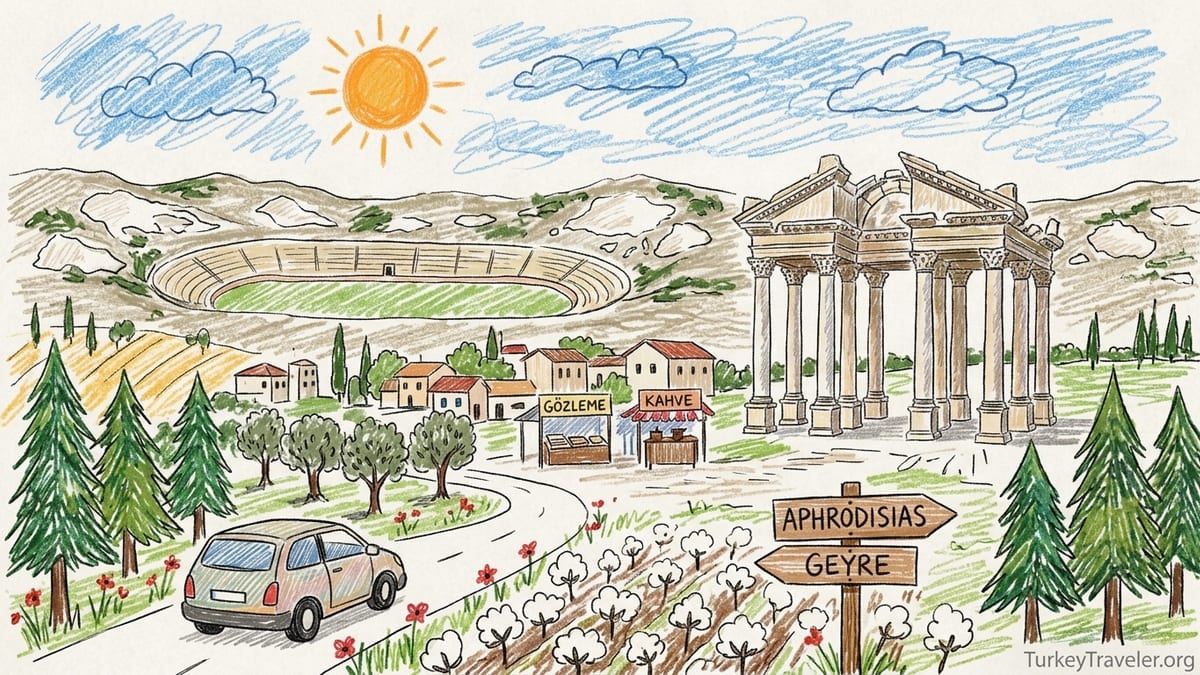
Getting To Aphrodisias From Denizli And First Impressions Near Geyre
I based myself in Denizli, a practical choice if you have already visited the travertine terraces and ruins at Pamukkale and Hierapolis. Early in the morning, just after sunrise, I picked up a compact rental car near Denizli bus station and headed west on the D585, then turned south toward Tavas and Karacasu. The drive to Aphrodisias is roughly 95 to 100 kilometers and takes about 1 hour 40 minutes in light traffic. As the road climbed into the hills, cotton fields gave way to pine and olive, and billboards thinned out. Compared to the steady stream of buses that sweep into Ephesus from Kuşadası and Izmir, the road to Geyre felt almost introspective, a narrowing of focus before the site itself.
Approaching the village of Geyre, brown heritage signs finally announced “Aphrodisias” and pointed toward a fenced parking area north of the archaeological zone. Private cars and small tour minibuses park here, a few hundred meters from the main entrance. On my visit the parking fee was collected in cash by an attendant at the gate; prices change periodically, so it is worth having small Turkish lira notes and asking your hotel the latest figure the night before. A scattering of simple cafés, gözleme stalls and souvenir stands lines the path between parking and ticket office, handy for a coffee or bottle of water before or after your visit.
The modern ticket office and the Aphrodisias Museum stand together at the edge of the ancient city. According to the Turkish Ministry of Culture, the site opens at 08:30 and closes at 17:30 in the current schedule, with the ticket desk closing at 17:00, and it is open every day. A single ticket covers both the ruins and the museum, and the national Museum Pass is accepted. I arrived just after opening, when the air was still cool and the tour buses had not yet appeared. It is the ideal time; the light slants across the stadium and reliefs, shadows are long, and the stone is easier to read.
From the entrance, a broad path leads into the archaeological zone. What surprised me immediately was the sense of containment. Unlike Ephesus, where the main street drops away toward the theater and harbor, Aphrodisias sits in a bowl of low hills. Beyond the ruins I could see the edges of the UNESCO-protected quarry landscape to the northeast, reminders that this city’s fortunes were carved directly out of the surrounding rock. Even before seeing a single sculpture, the geography framed the story: this was a place where marble was both raw material and identity.
Walking Through The Tetrapylon To The Temple Of Aphrodite
Most visits begin with a short walk of around 400 meters from the entrance toward the Tetrapylon, Aphrodisias’ most photographed monument. The path is largely unshaded, so I was glad I had filled my reusable bottle at the fountain near the museum, where potable water was available. By mid-morning in late spring, the sun already had bite, and a hat and sunscreen felt like essential archaeological tools rather than accessories.
The Tetrapylon stands suddenly ahead, a freestanding monumental gateway of sixteen columns and exuberant Corinthian capitals. It once marked the processional approach into the sanctuary of Aphrodite, the city’s patron goddess of love and beauty. Up close, its mix of fluted shafts, spiraled columns and richly carved pediments makes it clear that this was meant to impress visitors arriving for festivals and rituals. I took several minutes to walk around it in a full circle. The gateway is reconstructed from its original blocks, and the differing patinas, chips and joins show how careful conservation has given it back a volume without pretending it is untouched.
Beyond the Tetrapylon lie the remains of the Temple of Aphrodite itself. At first glance it resembles a familiar Roman peripteral temple: a long rectangle of columns, with a raised platform and steps at one end. Yet what we see today is not the original pagan sanctuary, but the result of a dramatic transformation around the late 5th or early 6th century AD, when the temple was converted into a Christian basilica. Archaeological studies and on-site panels explain that the columns were dismantled and re-erected in long colonnades down the new church’s nave, the orientation was altered, and the interior was reshaped to focus on an apse rather than an inner cella for a cult statue.
Standing inside this hybrid shell, I could trace that change with my feet. Where a classical visitor might have approached from the east to leave offerings to Aphrodite, I found myself imagining a procession of bishops entering a basilica aligned differently to the rising sun. The reusing of pagan columns to frame Christian worship was more than recycling; it was a visible statement of continuity and control. The same marble and craftsmanship that once proclaimed the goddess and her city were now harnessed to a new religious order. Understanding that shift on the ground, in the exact stones, made the often abstract story of Christianization feel bodily and architectural.
The Sebasteion: Sculpting Emperors, Myths And Conquered Peoples
From the temple, I followed a gently descending path for about 300 meters to the Sebasteion, passing stretches of inscriptions and scattered column drums. Even half ruined, the Sebasteion’s footprint is legible. This was Aphrodisias’ great complex for the imperial cult, built between about 20 and 60 AD by two prominent local families and dedicated jointly to Aphrodite and the Julio Claudian emperors. On the ground, it reads as a long ceremonial street roughly 80 meters in length and around 14 meters wide, flanked on both sides by tall, multi story portico buildings whose facades once carried a dense program of sculpted reliefs.
Today, you stand within the lower story of those porticoes. The paving stones underfoot are original, slick in places from centuries of wear, and the fragmentary columns give only hints of the height these galleries once reached. The true power of the Sebasteion lies not in the surviving masonry, but in the relief panels that once decorated its upper levels. Most of the best preserved examples have been moved indoors to the Aphrodisias Museum, where they are displayed in a dedicated Sebasteion Hall. Before I visited the museum, however, I paused by the on site explanations and tried to imagine this long corridor alive with processions, banners, incense and the visual noise of carved stone.
Later in the museum, that imagination was given hard edges. In the cool of the Sebasteion Hall, panels from the second and third stories of the complex are arranged along the walls, roughly echoing their original sequence. Some show scenes from Greek mythology: Herakles wrestling monsters, Achilles and Penthesilea, and episodes that bridge Hellenistic narrative with Roman imperial taste. Others are explicitly political. I found myself in front of a relief where an emperor, identified by inscription in other examples, strides in heroic nude, trampling or restraining a personification of a province. Scholars have linked panels like the famous Claudius and Britannia or Nero and Armenia to a visual language of conquest, where foreign territories are cast as feminized, sometimes partially draped women who are subdued yet dignified.
Nearby, another panel personified an entire people or region, labeled in Greek. In some cases these figures are serene and idealized, suggesting loyal subjects more than beaten enemies. Taken together, the mythological and imperial series creates a narrative of the Roman emperor as a godlike figure standing amid a hierarchy of gods, heroes and conquered nations. Seeing these reliefs in the museum, with their crisp drill work and surviving polish, corrected the impression given by the ruins alone. Outside, the Sebasteion can feel like a shell. Inside, it becomes clear that Aphrodisias was not just consuming images shipped from Rome but actively producing and curating its own visual statement about power, identity and empire.
What struck me most was that these were local creations. The marble came from quarries within the same World Heritage property, and the sculptors’ signatures and styles show that Aphrodisias had its own school of carving. Standing before a panel where an emperor stands over a kneeling barbarian, I could almost picture the workshop that produced it, blocks hauled down from the hills, apprentices roughing out poses, masters crisping the folds of drapery. The Sebasteion, in that moment, ceased to be a monument to imperial ideology alone and became an archive of local craftsmanship in the service of Rome.
The Stadium And Theatre: Performance In A City Of Stone
From the Sebasteion, I walked north and then west, roughly 500 meters in total, along a mixture of gravel paths and ancient paving, to Aphrodisias’ stadium. It is one of the best preserved in the Roman world, and nothing prepares you for its scale. The long, oval structure stretches about 270 meters, with seating for an estimated 30,000 spectators arranged in tiers around a central track. Climbing halfway up the seating on the south side, I looked along its full length. Unlike a Roman amphitheatre, which is usually a closed, almost circular arena designed for gladiatorial combat and spectacles on a central sand floor, a stadium is elongated and tailored to athletic races and processions. The curve at one end and the more rectilinear starting area at the other tell you that bodies here moved in straight bursts and sweeping turns rather than chaotic melees.
The difference is not just architectural but experiential. In an amphitheatre like the Colosseum, attention is drawn to the center from all directions, and the building becomes a vessel for blood sport and acclamation. In this stadium, attention is pulled along the axis, following runners, chariots or ritual marches. Sitting among chipped seats with weeds growing between them, I could imagine the cheers rolling like a wave from one end to the other, the track chalked, the city’s elite watching from privileged front rows. In the soft morning light, with only a few other visitors scattered along the steps, it was easy to feel the shape of those events.
From the stadium, the theatre is about a 10 to 15 minute walk back toward the center of the site, another 600 to 700 meters with short stretches of shade under pines and cypresses. The theatre nestles against a natural slope and preserves a substantial part of its cavea of seating, as well as parts of the stage building. Its capacity was smaller than the stadium, but the space feels more intimate, framed by the curve of seats and the rectangle of the stage. Here, too, the Aphrodisian talent with stone is on display in the carved details of the stage architecture and the precision of the seating rows.
On the day I visited, conservators had cordoned off a section of the orchestra where fallen blocks were being documented. It was a useful reminder that Aphrodisias is not a frozen ruin but an active research project. Interpretive panels in Turkish and English explain the phases of use, including modifications in late antiquity when performance culture shifted and the theatre began to host different kinds of gatherings. Between the stadium and theatre, you get a sense of a city where movement, spectacle and sound were carefully staged in stone.
Baths, Agora And The Everyday Life Of A Marble City
Leaving the theatre, I followed signs to the bath complex and agora, looping through the center of the city. Distances here are compact: from the theatre to the Hadrianic baths is roughly 300 meters, and from the baths to the agora another 200 to 300 meters. Underfoot, the main streets alternate between ancient flagstones and packed earth, with occasional raised curbs that once kept pedestrians above the muck of daily traffic.
The baths, like so many across the Roman world, combine practicality with architectural theater. Walking through their sequence of rooms, I could still read the progression from cold to warm to hot spaces, with fragments of marble wall revetment and pools suggesting how luxuriously finished they once were. Given the presence of nearby quarries, it is no surprise that even functional buildings in Aphrodisias were given generous marble cladding. Here the city’s role as a sculpture and stoneworking center is felt at the level of interior design rather than freestanding statuary.
The agora extends beyond, framed by colonnades that would once have sheltered shops and stalls. Today, only the foundations and some columns remain, but the scale of the space, together with the bath complex and nearby civic buildings, conjures a town where commerce, conversation and politics all unfolded among marble surfaces. In one corner, an “archival wall” preserves copies of imperial letters and decrees carved into stone, a curated record of the city’s relationship with Rome. Reading about grants of privilege and tax exemptions here, literally built into the city’s masonry, underscores how Aphrodisias cultivated its status not only through art but through legal favor.
Even under blue skies, this central zone offers pockets of shade beneath trees and along the colonnade stumps, but it can still feel exposed, especially around midday. There were a few drinking water points and benches, yet I found myself grateful that I had planned for at least half a day. Rushing through in an hour would reduce these spaces to a checklist of ruins. Taking time allowed the distances between them to register, the relationships between sacred, civic and commercial areas to unfold as a walkable map.
Quarries, Workshops And A UNESCO Landscape Of Marble
The real turning point in my understanding of Aphrodisias came when I connected the quiet hills beyond the city with the sculptures in the museum. UNESCO’s inscription of Aphrodisias as a World Heritage Site explicitly includes not only the walled archaeological zone but also the ancient marble quarries to the northeast. These quarries supplied the fine, blue grey and white marble that became the city’s calling card, feeding an industry of sculpture workshops whose products traveled across the Roman world.
From inside the ruins, you cannot easily walk to the quarries themselves in a casual visit, as they lie several kilometers away and current access is limited, but their outlines are visible on the ridges beyond, pale scars against darker rock. Site information panels describe how quarry faces were opened where marble strata met other stones, and how channels were cut to detach blocks which were then dragged down to the city. Knowing that this landscape is legally protected as part of the same heritage property changes the way you see the ruins. The city is not just a collection of buildings; it is the processing and marketing arm of a much larger extractive enterprise.
Archaeological evidence from Aphrodisias shows workshops equipped with tools, unfinished pieces and practice reliefs, and inscriptions preserve the names of local sculptors who gained renown beyond their home town. When I walked past a half finished column drum or a discarded block with sketched guidelines, I realized these were not isolated accidents but traces of systematic production. The Sebasteion reliefs, the imperial portraits in the museum, the sarcophagi lined up in the courtyard, all represent different outputs from a network of specialists who could produce everything from official propaganda to private funerary art.
Recognizing Aphrodisias as a factory as much as a forum reoriented my sense of Roman sculpture more broadly. In many museums, marble statues appear decontextualized, elevated on plinths under controlled light, their biographies compressed to a caption. Here, you can trace the chain from quarry face to workshop to sanctuary or grave. The UNESCO documentation emphasizes that the integrity of this combined landscape, with few modern intrusions, helps convey its outstanding universal value. Standing between city and hills, that statement does not feel abstract. It feels grounded in the grit of stone dust and the logistics of hauling ton after ton of marble.
Time In The Aphrodisias Museum And Why An Hour Is Not Enough
I saved the museum for the heat of early afternoon. Conveniently, it sits right by the site entrance, a few minutes’ walk from the parking area. According to the official Aphrodisias project, the museum reopened to visitors in August 2026 after renovation, with reorganized galleries and improved lighting. A single ticket still covers both site and museum, and security screening at the entrance is routine and swift.
Inside, the first impression is of coolness and calm, a sharp contrast to the bright courtyards. I began in the halls devoted to portrait sculpture. Here, rows of Roman emperors, local notables and benefactors stand or gaze from busts, many carved from the same local marble as the Sebasteion reliefs. One emperor’s head is slightly overscaled, hair drilled in tight curls; another local notable wears a himation pulled across his chest, his expression somewhere between beneficent and stern. Seeing them together, you sense both the shared language of Roman portraiture and the distinctive touch of the Aphrodisian school, particularly in the delicate transitions between skin and hair and the sharply cut pupils of the eyes.
The Sebasteion Hall, however, is where the intellectual weight gathers. Reliefs are mounted at roughly human height, allowing close inspection of tool marks, drilled folds and chipped noses. I lingered in front of a panel showing an emperor in dynamic pose, right arm raised as if about to strike, with a cowering, personified region at his feet. The woman’s body is beautifully modeled, her drapery swirling around her legs. Her name, once inscribed below, would have told ancient viewers exactly which newly subjected people she stood for. In adjacent panels, mythological scenes place these political images within a universe where gods, heroes and emperors share a stage.
Elsewhere in the museum, sarcophagi carved with garlands, hunting scenes and portraits line walls and courtyards. One large chest shows a couple reclining on its lid, as if at a perpetual banquet, while underneath, dancing figures and baskets of fruit fill each panel. In another room, smaller finds including inscriptions, architectural fragments and everyday objects round out the picture of Aphrodisian life. Audio guides and bilingual labels make interpretation relatively straightforward, especially compared to the more crowded and sometimes text heavy museums in larger cities.
The official excavation team suggests allowing at least 2.5 hours for the ancient city and one hour for the museum. After spending almost the entire day on site, I would say that a one hour visit to the museum alone would be deeply inadequate. It took me that long just to move through the Sebasteion Hall slowly, then return to a few panels after revisiting the ruins in my mind. The museum is where the city’s identity as a sculpture center crystallizes. Without time to study the objects in detail, to compare imperial portraits with local ones, or to connect sarcophagi motifs to the quarry landscape, Aphrodisias risks being reduced to “that place with the nice stadium and gate.”
Aphrodisias And Ephesus: Crowds, Clarity And Space To Think
Because many travelers pair Aphrodisias with Ephesus on a western Turkey itinerary, it is tempting to compare them. I had visited Ephesus several days earlier, walking its marble streets in the company of several cruise ship groups, local school excursions and independent visitors. There, the density of tourism can be intense, especially around the Library of Celsus and the Great Theatre. Guiding is excellent, but it can also mean that audio from multiple tours overlaps, and finding a quiet corner to contemplate a single inscription or frieze can be a challenge.
Aphrodisias felt markedly different. On my weekday visit outside high summer school holidays, I often found myself alone in entire sectors of the site. In the stadium, I counted fewer than a dozen other visitors scattered across the seating. At the Sebasteion, I could stand in front of information panels and align them with the ruins without jostling. In the museum’s Sebasteion Hall, there were moments when I was the only person present, free to move from panel to panel without blocking anyone’s camera.
That lower density of visitors affects more than atmosphere. It changes the way interpretation lands. Where Ephesus dazzles with its scale and the drama of its streets, Aphrodisias excels in readability. The combination of clear bilingual signage, active excavation, and the immediate proximity of museum, quarries and ruins encourages a slower, more analytical visit. You can trace how a statue base fits with the reliefs you just saw inside, or how a marble type visible in a sarcophagus reappears in building veneers across the site.
In practical terms, both sites are easily reachable by car or organized tour, and both accept the Museum Pass. Yet Ephesus often functions as a highlight reel of urban Roman life, compressed into a few headline monuments. Aphrodisias, by contrast, invites you behind the scenes of that world, into the studios and supply chains that made its imagery possible. For travelers interested in archaeology, art history or the material mechanics of empire, the relative quiet of Aphrodisias is a gift.
The Takeaway
By the time I walked back to the parking lot in the late afternoon, the shadows across the stadium were long again, and the tour buses were already gone. My phone’s step counter suggested I had covered well over eight kilometers within and immediately around the site, looping between Tetrapylon, temple, Sebasteion, stadium, theatre, baths, agora and museum, with pauses in patches of shade and at water taps. I had spent close to seven hours in total, including a short lunch at one of the cafés near the entrance. At no point did it feel like too much.
Could you visit Aphrodisias in an hour? Technically yes, if all you wanted was a photograph at the Tetrapylon and a quick sweep through the museum. But you would miss the layers that make this place exceptional: the physical conversion of a pagan temple into a Christian basilica, the narrative program of the Sebasteion reliefs and what they reveal about how a provincial Greek city saw Rome, the athletic focus of a stadium that resists easy comparison to an amphitheatre, and the economic reality of quarries and workshops woven into the hills.
For most travelers, I would argue that Aphrodisias deserves at least a dedicated half day, and ideally a full day as a stand alone excursion from Denizli, Pamukkale or even Kuşadası. Its relative remoteness and quieter visitor numbers reward the effort it takes to get there. More importantly, seeing marble in situ, both as raw landscape and as finished sculpture, alters how you will look at Roman art elsewhere. After Aphrodisias, a statue in any museum ceases to be just a beautiful object. It becomes evidence of quarry contracts, transport routes, workshop hierarchies and local hands shaping imperial narratives.
My own understanding of Roman sculpture shifted from admiring individual masterpieces to appreciating a system in which provincial centers like Aphrodisias played a central role. Here, among the ruins of Geyre’s ancient predecessor, the empire’s image was not just displayed. It was carved, panel by panel and portrait by portrait, in a city that still smells faintly of stone dust and olive trees.
FAQ
Q1. How long does it take to drive to Aphrodisias from Denizli or Pamukkale?
From central Denizli, the drive is roughly 95 to 100 kilometers and usually takes about 1 hour 40 minutes by car in light traffic. From Pamukkale and Hierapolis, which lie just north of Denizli, the journey time is similar once you have cleared local roads and joined the main route toward Tavas and Karacasu.
Q2. What are the current opening hours and ticket arrangements for Aphrodisias?
As of late 2026, official information from the Turkish Ministry of Culture lists opening hours from 08:30 to 17:30, with the ticket office closing at 17:00, and the site open every day. A single ticket covers both the archaeological area and the Aphrodisias Museum, and the national Museum Pass is accepted. Since ticket prices change periodically, it is best to confirm the latest fee with your accommodation or a local tourism office shortly before visiting.
Q3. Is one hour enough to see Aphrodisias?
One hour is not enough for a meaningful visit. The official Aphrodisias project recommends at least 2.5 hours for the ancient city and one additional hour for the museum. To walk the main route through Tetrapylon, Temple of Aphrodite, Sebasteion, stadium, theatre, baths, agora and then spend time in the Sebasteion Hall and portrait galleries, a half day is a realistic minimum. A full day allows you to move at a comfortable pace and connect the ruins, museum objects and quarry landscape.
Q4. How does the stadium at Aphrodisias differ from a Roman amphitheatre?
The stadium at Aphrodisias is a long, oval structure about 270 meters in length, designed primarily for athletic competitions and processions. Seating runs along the length of a central track, and attention follows movement along this axis. A Roman amphitheatre, by contrast, is more circular or elliptical, focused on a central arena for gladiatorial games and spectacles viewed from all sides. The layout and atmosphere of Aphrodisias’ stadium are closer to a monumental running track than to a combat arena.
Q5. What is special about the Sebasteion and its reliefs?
The Sebasteion is a large imperial cult complex built between about 20 and 60 AD, consisting of a processional street flanked by multi story porticoes decorated with sculpted reliefs. Its panels combine Greek mythological scenes with political images of emperors, gods and personified conquered peoples. Many of these reliefs are now displayed in a dedicated hall in the Aphrodisias Museum, where their fine carving and ideological messages can be studied closely. This combination of architecture, sculpture and inscriptions from a single context is considered unique in the Roman world.
Q6. How was the Temple of Aphrodite transformed into a Christian church?
Around the late 5th or early 6th century AD, the pagan Temple of Aphrodite was converted into a Christian basilica. Builders dismantled and reassembled the temple’s columns to form interior colonnades, altered the building’s orientation and created a new apse for Christian liturgy. This physical reworking of the sanctuary shows how late antique communities reused existing sacred architecture to express a new religious identity, while still relying on the prestige and materials of the older monument.
Q7. Are the marble quarries and workshop landscape part of the World Heritage site?
Yes. UNESCO’s inscription of Aphrodisias covers both the walled archaeological city and the ancient marble quarries to the northeast. These quarries provided the high quality stone used in the city’s temples, stadium, baths and statues. Archaeological evidence for sculpture workshops within the city, including tools and unfinished pieces, shows how closely urban life and marble production were linked. The combined protection of city and quarries helps preserve the full story of Aphrodisias as a center of marble sculpture production.
Q8. How much walking is involved, and are there shaded areas and water?
Visiting all the main monuments involves several kilometers of walking on a mix of gravel, earth paths and ancient paving. The route from the entrance through Tetrapylon, temple, Sebasteion, stadium, theatre, baths, agora and back to the museum can easily add up to eight kilometers with exploration and backtracking. There are trees and some shaded spots, particularly near the theatre and along parts of the central area, but many stretches are exposed. Public water taps are available near the entrance and at some points within the site, but carrying a refillable bottle, hat and sunscreen is strongly recommended.
Q9. How does Aphrodisias compare with Ephesus for crowds and interpretation?
Ephesus usually receives far more visitors, including large cruise ship groups, which can make its central streets and monuments feel crowded and noisy, especially in peak season. Aphrodisias, by contrast, tends to be quieter, with fewer tour groups and more space around each monument. Interpretation panels in Turkish and English, combined with the on site museum and ongoing excavation work, make it easier to connect individual buildings with broader themes such as the imperial cult and marble production. Travelers interested in archaeology often find Aphrodisias more contemplative and easier to read in detail.
Q10. Does Aphrodisias merit a dedicated excursion, and from where is it best visited?
Aphrodisias merits at least a dedicated half day and ideally a full day. It works well as a day trip from Denizli or Pamukkale, using a rental car or an organized tour, and can also be reached from Aydın or Kuşadası with a longer drive. Because of its relative remoteness and quieter atmosphere, staying longer on site rewards travelers who want to understand Roman sculpture and urban life beyond the most famous stops. Experiencing both the ruins and the museum in one unhurried visit offers a clearer sense of Aphrodisias as a place where the empire’s marble images were actually imagined and carved.