


The morning I left Ankara for the old Hittite capital, the city was still wiping sleep from its eyes. I had seen so many marble theaters and colonnaded avenues around the Mediterranean that I thought I knew what an ancient city felt like. Hattusa, high on a Central Anatolian plateau of wind, wheat and oak scrub, would prove me wrong.
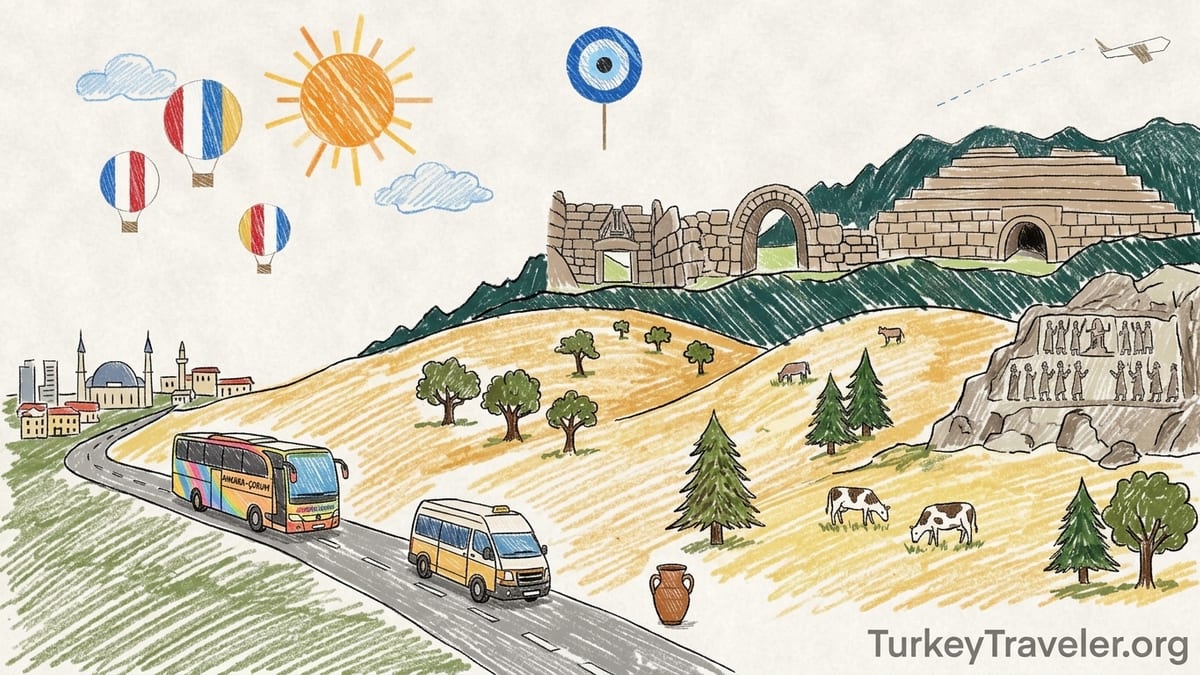
Leaving Ankara for the Hittite Plateau
I started in Ankara, boarding a mid-morning intercity bus toward Çorum, with Boğazkale as my final goal. The highway north-east left behind the dense suburbs and shopping malls and began to climb onto the Anatolian plateau. The light flattened and widened. Instead of the coastal haze I knew from Ephesus or Side, the sky above Central Anatolia felt hard-edged and dry, an inverted bowl over rolling fields.
At Sungurlu I changed to a dolmuş minibus for Boğazkale. The driver waited until the seats were reasonably full, then swung off the main highway toward low hills dappled with oak and pine. The villages grew smaller. Tractors pulled carts of straw; cows dozed in roadside shade. It took roughly thirty minutes from Sungurlu to Boğazkale, just enough time for the asphalt to narrow and the air to cool slightly as we climbed.
Boğazkale itself feels like a frontier town, even though Ankara is only about 210 kilometers away. A few small guesthouses line the main street, along with tea houses where men lean over backgammon boards. Above the village, dark green ridgelines frame an unexpectedly broad valley. Somewhere up there, invisible from below, lie the stone circuits and gates of Hattusa, once administrative, military and religious capital of an empire that controlled much of Anatolia and northern Syria in the second millennium BCE.
I checked into a simple family-run pansiyon near the main junction, the kind of place where rooms are basic but clean and the owner will point out both the bus stop and the best place for beans and rice. Dropping my bag, I could already see a section of ruined wall tracing the crest of the hills to the south. It looked less like a classical monument and more like a fossilized coastline, curving around the valley.
First Impressions of a Bronze Age Capital
The next morning I walked up toward the ticket office of the Boğazköy Hattusha archaeological site. The road climbed in a series of bends, past small fields, walnut trees and the occasional grazing horse. At the site entrance, the ticket booth opened at 08:30, matching the summer schedule of 08:00 to 19:00 for the ruins and their gate hours. A Müzekart was accepted, and individual entry cost roughly the equivalent of a modest restaurant meal in Ankara. Prices can change, but for a major World Heritage site, it felt accessible.
Even before stepping inside the official boundary, the scale was disorienting. Hattusa is not a compact ruin like Priene or a tightly organized forum like Perge. The site stretches over several square kilometers, spilling from the lower city on the valley floor to the upper city that rises on terraced slopes about 300 meters above. You do not stand in one place and contemplate everything at once. You move, and keep moving, just as the Hittite administrators, soldiers and priests would have done three thousand years ago.
Near the entrance, interpretive panels place the Hittite Empire in its Bronze Age context. In the fourteenth and thirteenth centuries BCE, the Hittite Great Kings of Hattusa rivaled New Kingdom Egypt, Mitanni and later Assyria. From this plateau capital they controlled routes south toward Aleppo and Carchemish, west toward Arzawa in western Anatolia, and east toward the Upper Euphrates. Hattusa was not simply a royal residence. It functioned as administrative center, archive, ceremonial heart and military command post, a fused capital where bureaucracy, religion and war shared the same streets.
Yet there is almost no marble here. No gleaming colonnades, no amphitheater seating rising in perfect semi-circles. Hattusa is built in rough-hewn limestone, basalt and mudbrick. Its grandeur lies in mass, alignment and relationship to the land rather than decorative finish. The walls follow contours; huge stone blocks define terraces and gates. It feels older than the later Greek cities on the Aegean, and also stranger, because it does not obey their architectural grammar.
The Great Temple and the Lower City
I started, as most visitors do, at the Great Temple in the Lower City, the largest religious complex at Hattusa and one of the most impressive Bronze Age sanctuaries in Anatolia. From the small car park, a path leads across a flat expanse into a rectangle of massive stone foundations. The plan is still clear: an outer courtyard where storerooms once held grain, oil and offerings, inner courts and finally the twin cella where the storm god and the sun goddess of Arinna were worshipped.
Here the contrast with Mediterranean marble cities is most obvious. The remaining walls are barely chest height, rough and gray. There are no fluted columns, only squared stone blocks and the ghost outlines of mudbrick superstructures that long since eroded away. Yet standing in the central courtyard, with low walls on all sides and the sky a brilliant, nearly colorless blue above, I felt an unexpected sense of enclosure. The Hittite architects were not trying to impress through verticality, but through controlled space and procession. You would have entered from the street, crossed a threshold, then moved through a series of increasingly restricted courts before reaching the divine presence.
To one side of the temple, an excavation trench drops down to the foundations of what is believed to be part of the Hittite tablet archive. Across Hattusa, archaeologists have recovered around twenty-five to thirty thousand clay tablets and fragments recording treaties, royal edicts, religious instructions, legal cases and even literature. These are now divided among museums in Ankara, Istanbul, Boğazkale and elsewhere, but their discovery here transformed our understanding of the Hittites from a barely known people in Egyptian and biblical texts into a fully documented Bronze Age state.
Among those tablets were copies of the Egyptian Hittite peace treaty, drawn up around 1269 BCE after the Battle of Kadesh between Ramesses II of Egypt and Hattusili III of Hatti. This treaty, whose Egyptian version is now displayed in replica at the United Nations, is often described as one of the world’s earliest surviving international peace agreements. Its Akkadian cuneiform text, impressed on clay and stored in the archives of Hattusa, addressed borders, prisoner exchanges and mutual defense. When you stand beside the Great Temple storerooms, it is not just stone you are looking at, but the shell of one of humanity’s first documented chancelleries.
Climbing to the Upper City and Yerkapı
From the Lower City, a modern paved loop road rises toward the Upper City, with numbered stops at major monuments. It is possible to walk the entire circuit, but the elevation gain and distances are significant, and summer temperatures can climb well above 30 degrees Celsius by midday. I chose a compromise: walking sections between closely spaced gates and using a local taxi, hired from Boğazkale the previous evening, to leapfrog the long stretches. For travelers without a car, arranging a ride in the village is more than a convenience; it can determine how much of the site you truly see.
The first great gate I approached was the Lion Gate, guarding the south-western approach. The walls here are made of large, roughly squared blocks, their weight alone securing them. Flanking the narrow passage are two great lion figures, carved in relief on upright stones. Their mouths gape slightly, eyes alert. These lions are original Hittite sculptures, though they have been carefully conserved. The wear and softening of their surfaces speaks of three millennia of harsh plateau winters and hot summers, a kind of stone fatigue that no reconstruction can imitate.
Farther along the circuit, the King’s Gate stands on the eastern side of the Upper City. From outside, its profile resembles the Lion Gate, with massive stones and a narrow vaulted passage. Inside, however, a relief figure of a warrior king in horned helmet, once carved into the gate jamb, has been removed for protection. The sculpture at the site is now a copy, while the original resides in the Museum of Anatolian Civilizations in Ankara. It is a good example of the necessary compromises between conservation and authenticity at Hattusa. Many of the most delicate original reliefs have been relocated to museums, leaving robust but somewhat blander stonework in situ. As a visitor, it helps to know when your sense of contact with the ancient surface is real and when you are looking at a surrogate.
The climax of the defenses is at Yerkapı on the southern ridge, where the curtain wall rises above a great artificial ramp. Here the Hittite engineers reshaped the slope into a glacis of piled stone blocks, then crowned it with a casemated wall and the Sphinx Gate. Climbing the modern steps, I could see the logic of the design. Any attacker would have been exposed and exhausted before even reaching the foot of the ramp, then forced to ascend under missile fire from defenders above. It is defensive engineering by topography rather than by height alone, and it feels radically different from the later, more vertical fortifications of Greek or medieval cities.
The Sphinx Gate itself once had four sphinx statues at its corners. The originals, like the sphinxes of Bogazköy that now sit in the village museum and in Ankara, were removed for conservation and international loan, later repatriated and eventually placed in safer indoor settings. The figures at the gate today are copies, their features crisp and pale compared to the weathered originals. Stepping through the gate, I descended into the famous postern tunnel, a corbelled stone passage that runs beneath the rampart. Its length, cool shade and tight enclosure are striking, especially after the fierce light of the ridge. Every stone seems to push toward the center, proof of a Bronze Age understanding of load and stress that feels instinctive yet precise.
Understanding Scale, Walking Effort and Modern Logistics
Nothing at Hattusa is neatly contained. From Yerkapı you can look back north across a rolling plateau studded with other temples, house terraces and administrative buildings of the Upper City. The ruins of Büyükkale, the acropolis and royal citadel, sit on a separate rocky promontory across a small valley, another climb away. The distances between these clusters are large enough that walking all of them in high summer, without transport, turns the visit into a full-day hike rather than a casual stroll.
I visited in late spring, when temperatures were warm by midday but still manageable. Even so, my phone recorded over twelve kilometers of walking inside the site, not counting the descent back to Boğazkale. There is little shade once you are beyond the occasional stand of trees, and the sun at around one thousand meters elevation feels sharper than at sea level. Water is not widely available once you leave the entrance area, so carrying at least one and preferably two bottles is essential. A hat and sunscreen are not accessories here, but survival gear.
For visitors with their own car, the loop road offers parking bays near each stop. Those without should consider hiring a taxi in Boğazkale for several hours, agreeing on a price that reflects fuel, time and the circuit’s length. On my visit, a half-day arrangement cost roughly comparable to a mid-range dinner for two in Ankara, fair compensation given the distances involved. As with any such negotiation, it is wise to confirm whether the driver will wait at each stop or simply drop you once and meet you later.
Accommodation in Boğazkale remains modest. I stayed in a small pansiyon where a simple room with private bathroom, breakfast and evening soup cost about what a budget hotel in central Ankara might charge for a room alone. The trade-off is that you are within walking distance of the site entrance and can start early, avoiding both crowds and heat. There are also basic restaurants in the village serving grilled meat, lentil soup and regional specialties, but no nightlife beyond the occasional conversation at a tea house.
Yazılıkaya: Open-Air Sanctuary of the Hittite Gods
In the afternoon I turned my attention to Yazılıkaya, the rock sanctuary located about two kilometers from Hattusa’s main ruins. A short drive leads up through fields to a separate ticket point. The sanctuary, carved into natural limestone outcrops, was the empire’s open-air shrine, a stage where stone and sky formed the backdrop for Hittite religious ceremony.
Yazılıkaya consists of a main court and two rock-cut chambers, often labeled Chamber A and Chamber B. Entering the main court, you step into a natural cleft whose walls have been elaborately carved. On the right, a procession of male deities advances in relief, each figure distinguished by horned headdress, weapons or attributes. On the left, female deities proceed in parallel. At the narrow northern end, the two processions converge before a central divine couple, usually identified as the storm god Teshub and the sun goddess Hebat.
These are not decorative figures in a modern sense. Their arrangement reflects a structured pantheon and, according to recent interpretations, may encode a cosmological calendar. Scholars have argued that the sequences of gods could correspond to days, months or specific celestial cycles. Standing in front of them, I felt more strongly the sense of movement than of ornament. The gods are striding forward, their feet extended, garments swirling. This is a permanent, carved version of a ritual procession that must once have taken place here in flesh and color, accompanied by song, incense and the metallic clink of weapons and jewelry.
Chamber B is smaller and more intimate, carved deeper into the rock and possibly associated with the funerary cult of King Tudhaliya IV. Here, relief figures are larger and more deeply cut, including an imposing representation of the king embraced by a protective god. The chamber feels almost subterranean, and when I visited, the air was cool and slightly damp. It was easy to imagine torches smoking against the walls, the reliefs flickering in unstable light. If the Great Temple in the Lower City expressed state religion in a broad civic space, Yazılıkaya feels like the esoteric counterpart, where selected participants confronted divine images at close range.
It is important to note that this Yazılıkaya has no connection to the more widely advertised Phrygian "Yazılıkaya" near Eskişehir, sometimes called the Midas Monument. The latter is an Iron Age rock façade carved centuries later by a different culture, associated with the Phrygians and local cults. Both share a descriptive Turkish name meaning "inscribed rock," but they belong to distinct periods, peoples and religious systems. Confusing them would be like mixing up a Roman forum and a medieval cathedral simply because both are built of stone.
Tablets, Treaties and Why Hattusa Matters
After leaving Yazılıkaya, I stopped at the Boğazköy Museum in the center of Boğazkale, a compact but well-curated institution that completes the experience of walking through stone by showing what once filled those spaces. Renovated in the last decade and organized thematically, the museum holds original sphinx sculptures from Hattusa, cult statues, pottery, tools and, crucially, clay tablets from the local archive.
Standing in front of the cuneiform tablets, encased and softly lit, I was struck by their modest size. Some are no bigger than a smartphone, yet they carry the administrative weight of a kingdom. The wedge-shaped Akkadian and Hittite signs record palace edicts, festival instructions, oracles, land grants and diplomatic letters. It is from tens of thousands of such pieces, many first unearthed at Boğazköy in the early twentieth century, that the Hittite language was deciphered and the history of the empire reconstructed.
Among the tablets once stored at Hattusa’s archives were versions of the Egyptian Hittite peace treaty, concluded after years of conflict around the city of Kadesh on the Orontes. The treaty set stable borders between the two great powers, arranged for extradition of fugitives and pledged mutual support against future threats. Today, the text survives both in cuneiform tablets from Hattusa and in hieroglyphic inscriptions on temple walls in Egypt. Modern diplomats in Ankara and New York sometimes point to it as an ancestor of contemporary international law. That continuity runs through these clay rectangles in a small Anatolian museum case.
A separate but related piece of Hattusa’s written heritage is the so-called Hattusa Bronze Tablet, found near the Yerkapı rampart in the 1980s. It records a treaty between Tudhaliya IV and a vassal king named Kurunta and is the only known Hittite treaty preserved on metal rather than clay. The original now resides in the Museum of Anatolian Civilizations in Ankara. Its discovery confirmed that some especially important texts were indeed inscribed on more durable materials in antiquity, as the clay tablets themselves often mention.
All of this may sound academic until you connect it with the ground you walked in the morning. The Great Temple storerooms where agricultural surplus was collected, the royal citadel on Büyükkale where kings decided war and peace, the gates where sentries checked travelers and messengers, the sanctuary at Yazılıkaya where gods processed in stone: these are all scenes in a political drama we can now read from Hattusa’s tablets. The site matters intellectually because it anchors the written record of one of the Bronze Age’s major powers in a specific, walkable landscape.
The Takeaway: Who Will Hattusa Reward, and How to Plan a Day
By the time I sat down for dinner in Boğazkale, watching the hills turn purple above the valley, I knew that Hattusa is not a casual detour. It is not like pulling off a coastal highway to snap a few photos of a theater and colonnade before rushing back to the beach. The city reveals itself slowly, in altitude gained, dust on shoes, and a growing sense of how a Bronze Age power organized space and belief.
If your interest in history is light and you are mainly seeking picturesque ruins, you may find Hattusa austere. The stones are rough, the architecture fragmentary, and the visual drama comes from landscape rather than decoration. There are no intact temples with standing columns, few statues left in place, and almost no polychrome surfaces. What you gain instead is a feeling of proximity to a different kind of antiquity, earlier than classical Greece and Rome and shaped by other priorities. The way the walls follow the ridges, the way gates are embedded in earthworks, the way deities march in file at Yazılıkaya: all of this belongs to the world that produced the earliest international treaties and complex, multilingual archives.
For travelers willing to engage with Bronze Age history, however, Hattusa is one of the most rewarding sites in Turkey. It offers a chance to connect the dots between Troy, Mycenae, Ugarit and Thebes, to understand that the Mediterranean of the late second millennium BCE was already a network of states negotiating, trading and sometimes destroying each other. Walking its loop, you feel the empire’s size in your legs, not just in an exhibition label.
An efficient full-day plan from Ankara might look like this: depart around 07:00, reaching Boğazkale by late morning whether by rental car or a combination of intercity bus and dolmuş. Check into a guesthouse or, if returning the same day, confirm return bus times with the driver. Begin at the Hattusa ticket office as close to opening as possible. Spend the late morning in the Lower City at the Great Temple and surrounding structures, when temperatures are still mild and your mind is fresh enough to absorb the interpretive panels.
After a simple lunch in Boğazkale or a picnic carried from Ankara, devote the early afternoon to the Upper City using either your own car or a hired local taxi to navigate between the Lion Gate, King’s Gate, Yerkapı and Büyükkale. Allow time to walk the postern tunnel and at least one stretch of wall on foot to absorb the scale. In mid to late afternoon, when the light softens, continue to Yazılıkaya for roughly an hour among the rock-cut deities. Finish with a visit to the Boğazköy Museum in the village before it closes, to see original reliefs and tablets that tie the scattered stones together. A late return to Ankara is possible, but staying one night in Boğazkale allows a slower pace and a dawn or dusk view of the ridgeline walls.
Hattusa demands some effort: long walks, sun exposure, mental adjustment away from marble colonnades toward earth and rock. In exchange, it offers a rare thing in travel, a feeling not just of seeing an ancient place but of learning to think, briefly, as its builders did. If you can accept that bargain, the lost capital of the Hittites will not feel distant at all.
FAQ
Q1. How do I get from Ankara to Hattusa and Boğazkale without a car?
There are regular intercity buses from Ankara to Çorum or Sungurlu, operated by national and regional companies. From Sungurlu, minibuses and shared taxis run to Boğazkale, usually taking around thirty minutes. Schedules can change seasonally, so it is important to confirm departure times at Ankara’s main bus terminal on the day of travel.
Q2. How much time do I need to visit Hattusa and Yazılıkaya properly?
A full day is highly recommended. Hattusa alone can easily absorb five to six hours if you include both the Lower and Upper City. Yazılıkaya and the Boğazköy Museum together require at least another two hours. A rushed half-day visit risks seeing only a fraction of the gates and missing the open-air sanctuary entirely.
Q3. Are there reliable opening hours for Hattusa and Yazılıkaya?
Recent information from regional museum authorities indicates summer opening hours around 08:00 to 19:00 for Hattusa, with ticket sales typically from 08:30 to 18:30. Yazılıkaya follows similar daylight hours. However, hours can shift in winter and during public holidays, so travelers should check locally in Boğazkale or via official tourism channels just before their visit.
Q4. Do I need a guide to understand the site, or can I visit on my own?
You can visit independently using the numbered stops and on-site panels, which provide a solid introduction. However, hiring a local guide in Boğazkale, even for a few hours, can significantly deepen your understanding of the Hittite Empire, the defensive system and the religious meaning of Yazılıkaya’s reliefs. For travelers specifically interested in Bronze Age history, a guide is a worthwhile investment.
Q5. What is the walking difficulty at Hattusa?
The walking involves moderate to strenuous sections, especially in the Upper City. Expect uneven paths, some steep slopes and limited shade. Visitors in good health who are used to day hikes will manage comfortably, but those with mobility limitations should plan to use a vehicle for most of the circuit and focus on more accessible stops like the Great Temple, Lion Gate and Yazılıkaya.
Q6. How hot does it get, and what should I bring?
In late spring and summer, midday temperatures often rise above 30 degrees Celsius on the plateau, with strong sun and low humidity. Essential items include a hat, high-factor sunscreen, sturdy walking shoes, and at least one to two liters of water per person. There are few places to buy drinks once inside the main loop, so stocking up in Boğazkale before starting is wise.
Q7. Are the reliefs and statues I see on site original?
Some, like the lions at the Lion Gate, are original but heavily weathered. Others, such as the warrior figure at the King’s Gate and the sphinxes at Yerkapı, are reproductions. Many original reliefs and fragile sculptures have been moved to museums in Ankara, Çorum and Boğazkale for conservation. On-site signage usually indicates when a piece is a copy.
Q8. Is there any connection between this Yazılıkaya and the Midas Monument near Eskişehir?
No, they are completely separate. The Yazılıkaya near Hattusa is a Hittite open-air sanctuary dating from the Bronze Age, with processions of deities carved in relief. The so-called Midas Monument near Eskişehir is a later Phrygian rock façade from the Iron Age, associated with a different culture and religious tradition. They share a descriptive Turkish name but nothing more.
Q9. Can I see the famous Egyptian Hittite treaty during my visit?
You will not see the original treaty tablet on display at Hattusa itself, but Boğazköy Museum exhibits clay tablets from the local archive and information on the peace agreement between Hattusili III and Ramesses II. Major museums in Ankara and Istanbul also display important Hittite diplomatic texts. The treaty’s significance is best appreciated by visiting Hattusa’s archives, then later exploring these urban museums.
Q10. Is Hattusa suitable for children or casual travelers?
Families with children who enjoy the outdoors may find the walls, tunnels and wide-open spaces exciting, but the lack of shade and long walking distances can be challenging. For very casual travelers seeking quick, visually striking ruins, coastal sites like Ephesus or Aspendos may be easier. Hattusa is most rewarding for visitors prepared to spend time, walk considerable distances and engage with Bronze Age history as much as with scenery.