


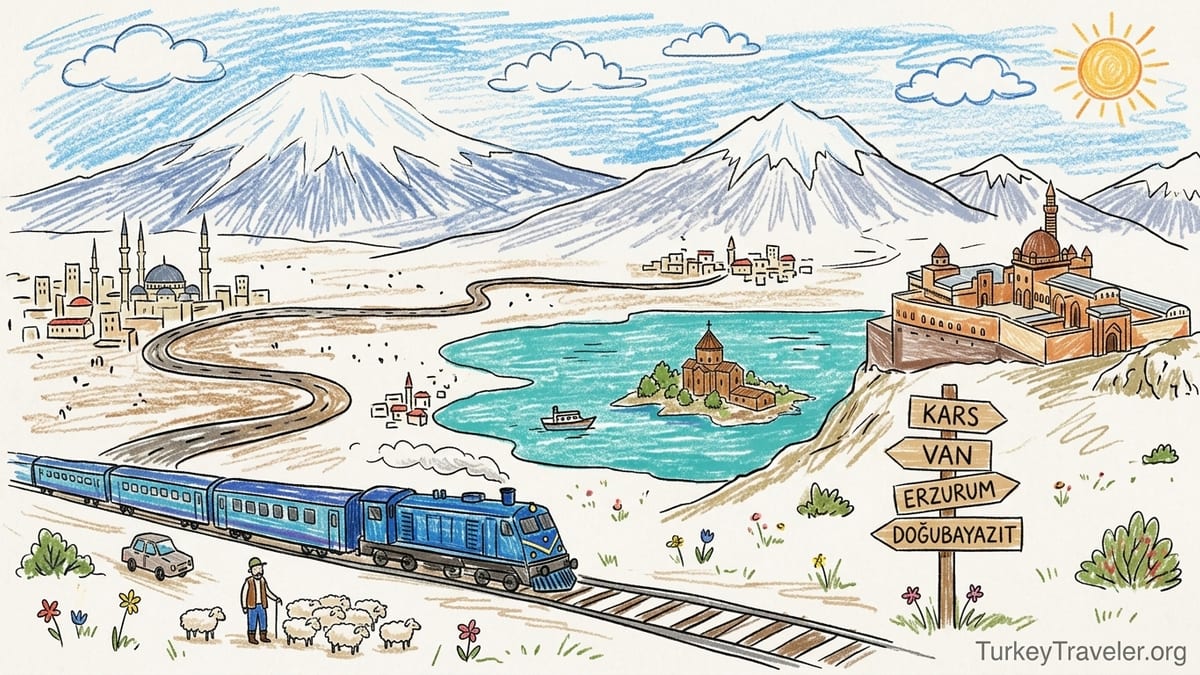
Eastern Anatolia feels like a different country from Türkiye’s turquoise coasts. This is a high-mountain frontier of volcanic lakes, ancient citadels, long snowy winters and vast distances. GoTürkiye presents it as Türkiye’s high-mountain eastern region, highlighting Mount Ararat, Lake Van, archaeological sites and ski resorts, and for many first-time visitors those themes frame the trip of a lifetime. This guide focuses on the Kars–Ani–Sarıkamış–Doğubayazıt–Mount Ararat–Van–Lake Van–Ahlat–Erzurum and Palandöken corridor, and explains how to turn these places into a realistic, rewarding first journey.
Understanding Eastern Anatolia’s Scale and Character
Eastern Anatolia is Türkiye’s highest and one of its largest regions, a plateau and mountain world where many towns sit well above 1,500 meters and peaks like Mount Ararat rise over 5,000 meters. That altitude shapes everything: the light feels sharper, summers are brief and hot, and winters can run from November into April with deep snow. Compared with western Türkiye, the landscape is sparsely populated, with long stretches of empty steppe and serrated mountains between small cities.
Distances are easy to underestimate. On the map, Kars, Doğubayazıt, Van and Erzurum seem like neighboring dots, yet driving between them often takes five to seven hours on twisting, high-elevation roads. Road conditions on main highways are generally good, but heavy trucks, mountain passes and winter weather slow travel. A traveler used to hopping between Aegean resort towns in an hour or two has to reset expectations here.
This scale rewards travelers who move a little slower. Instead of racing to “cover” the entire region on a first trip, it is usually better to focus on a single corridor. The Kars–Van–Erzurum axis gives a representative mix of frontier castles, Silk Road caravan routes, church and mosque architecture, Kurdish and Azeri village life, and serious skiing, without pretending to stand in for Eastern Anatolia’s Kurdish southeast, the Munzur mountains, or the far north on the Georgian border.
The region’s atmosphere is distinct. In and around Kars and Erzurum you will likely hear Azerbaijani-accented Turkish and see stone houses with steep roofs for shedding snow. Near Van and Doğubayazıt the culture feels more Kurdish and Persian-influenced. Old Urartian fortresses, medieval Armenian churches and Seljuk caravanserais dot the landscape. GoTürkiye’s official descriptions, which foreground Mount Ararat, Lake Van, archaeological sites and ski resorts, mirror what most first-timers actually remember: vast peaks, an inland sea, and a sense of deep time.
Getting In and Around: Airports, Trains and Roads
For a first journey, the most practical entry points are the regional airports at Kars, Van and Erzurum. They are small but busy domestic hubs, usually with several daily flights from Istanbul and often from Ankara. Schedules change seasonally, but a typical pattern is early-morning and late-evening flights from Istanbul to Kars Harakani Airport, Van Ferit Melen Airport and Erzurum Airport, designed to connect with European arrivals. Flying into Kars and out of Erzurum, or vice versa, lets you travel the corridor in one direction without backtracking.
Within the region, buses and shared minibuses remain the main public transport. Intercity coaches connect Kars with Erzurum, Erzurum with Van, and Van with Doğubayazıt; travel times can range from three to eight hours depending on distance. For example, a Kars to Erzurum coach can take around four hours, while Van to Doğubayazıt is typically two to three hours. Tickets are inexpensive by European standards, and major companies usually include tea stops at roadside lokantas serving grilled meats, soups and fresh bread.
The famous Eastern Express, an overnight train from Ankara to Kars, has become an attraction in its own right. Classic seated and couchette cars run year-round, taking roughly 24 hours, while a more touristic version with sleeper cars and longer photography stops is often scheduled in winter when the snow-covered plateau is at its most photogenic. Tickets sell out quickly around school holidays; first-time visitors who want to combine the Eastern Express with Eastern Anatolia generally ride from Ankara to Kars, then continue overland toward Ani and Van.
Renting a car is the most flexible way to explore the Kars–Van–Erzurum corridor, especially if you want to reach remote viewpoints or small archaeological sites. In summer, a compact car is usually enough, but in winter and early spring a vehicle with good tires and experience driving in snow is important. A typical one-way rental from Kars to Erzurum or Van is possible with national brands that have desks at the airports, though a modest one-way fee is common. Fuel prices fluctuate; budgeting at a mid-range European level for petrol is sensible.
Seasons, Weather and How They Shape Your Trip
GoTürkiye highlights Eastern Anatolia as a high-mountain destination for skiing and winter sports, but for general travelers the best broad windows are usually late June to mid-October for hiking and heritage travel, and December to March for skiing. Shoulder months like May and early June can be beautiful around Lake Van and Ahlat when the plateaus are green and wildflowers line the roads, but some high passes may still see patches of snow and occasional cold snaps.
Winter is both magical and demanding. Snow blankets Kars, Sarıkamış, Erzurum and Palandöken, and temperatures can drop well below freezing, especially at night. The Palandöken and Sarıkamış ski resorts generally aim for a season from December into March, with lifts running daily when conditions allow. Domestic skiers from Istanbul and Ankara fly in for long weekends, filling hotels near the slopes. For non-skiers, winter travel brings risks of road closures on minor routes and occasional delays on the main highways during storms, though the big roads are usually cleared quickly.
Summer, by contrast, brings long sunshine and dry heat, especially around Van and Doğubayazıt, which sit in basins at roughly 1,700 meters. Daytime highs can exceed 30 degrees Celsius in July and August, but nights generally cool down. This is the best time for boat trips on Lake Van, visits to Akdamar Island, and hikes among the crater lakes around dormant volcanoes like Nemrut (near Tatvan) or plateau walks near Mount Süphan. In Kars and Erzurum, evenings in July can still feel cool enough for a sweater.
Autumn, from mid-September into October, is often ideal for a cultural road trip. The harvest brings markets full of local honey, dried fruits and Kars gravyer cheese, and the larch forests around Sarıkamış turn golden. Crowds thin out at major sites like Ani and Akdamar, and accommodation prices often dip compared with peak summer and New Year holiday weeks. The trade-off is shorter days and the first hints of winter; by late October, high passes can see early snow.
Kars, Ani and Sarıkamış: A High-Plateau Introduction
Many first-time visitors begin in Kars, reachable by air or the Eastern Express. The city sits on a high plateau, surrounded by rolling hills and distant snowcaps. Its center combines Russian-era stone buildings from the 19th century with Ottoman mosques and a riverside citadel. Streets are compact and walkable. A realistic first day might include strolling from the central square to the Kars Castle for views over the town, then warming up with a bowl of ayran aşı soup in a small lokanta before seeking out a café selling the region’s famous honey and thick cream.
Ani, about 45 kilometers from Kars near the Armenian border, is one of Eastern Anatolia’s most important archaeological sites. Once a medieval Armenian capital, it now spreads across a windswept plateau cut by a deep gorge. Visitors walk between partially restored churches, city walls and old gates, with wide views over the steppe. In practice, most travelers either hire a taxi from Kars for a half-day trip or join a small group tour arranged by local agencies or hotels. Road conditions are good in summer, but in winter snow and wind can make the site feel very exposed; warm layers are essential.
Southwest of Kars, Sarıkamış is a small town edged by pine forests and a growing ski resort. GoTürkiye notes the quality of its dry, powdery snow, which often lasts from December into March. For skiers, a typical stay might involve flying into Kars, transferring one hour to Sarıkamış, and skiing three or four days on the slopes before adding a day trip to Kars and Ani. Non-skiers sometimes base here in summer to walk in the forests and visit waterfalls in the surrounding countryside, enjoying cooler temperatures than Van or Doğubayazıt.
From a logistics standpoint, Kars and Sarıkamış pair well. It is feasible to spend three nights in Kars, with one full day for Ani and another for exploring the city and castle, then move to Sarıkamış for two or three nights of skiing or hiking before continuing south. Road transfers between them take roughly an hour, and local taxi cooperatives and hotels can arrange private cars if public buses do not match your schedule.
Doğubayazıt, Mount Ararat and the Frontier Feel
From Kars or Sarıkamış, many travelers swing southeast toward Doğubayazıt, a frontier town in the shadow of Mount Ararat. The drive reveals the region’s grand emptiness: long straights across upland plains, distant views of snow-capped peaks, and occasional villages with flocks of sheep and goats. Doğubayazıt itself is a workaday center with busy commercial streets catering to local trade and overland truck traffic heading toward the Iranian border.
Above the town, Ishak Pasha Palace is one of Türkiye’s most atmospheric hilltop complexes. Perched on a ridge with layered courtyards, ornate portals and views over the plain, it was largely completed in the 18th century and served as a regional power center. Opening hours change seasonally; for example, in mid-2024 the summer schedule ran from morning until early evening, with Mondays closed during that specific period. In practical terms, most travelers come for two to four hours in late afternoon, when the low sun warms the stone and the plain below glows.
Mount Ararat dominates the horizon along the road between Doğubayazıt, Iğdır and the Iranian frontier. Official descriptions emphasize its status as Türkiye’s highest peak and its position near the borders with Iran, Armenia and Nakhchivan. Climbing expeditions require permits and specialized mountain guides, so they sit outside a typical first-time visitor’s plan. However, day travelers can drive or join tours to viewpoints above Doğubayazıt for sunrise or sunset perspectives over the twin summits, often combined with visits to local Kurdish villages or short walks along old herding tracks.
Doğubayazıt also gives a sense of Eastern Anatolia’s geopolitical position. Trucks queue at the border, Iranian shoppers browse Turkish supermarkets, and travelers swapping stories in small hotels may be on their way overland between Europe, the Caucasus and Iran. For many first-time visitors who began their journey on an overnight train or domestic flight, this feels like the edge of another world, even though it is still firmly inside Türkiye.
Van, Lake Van and Ahlat: Inland Sea and Ancient Shores
Southwest from Doğubayazıt, the road climbs and then descends toward Van, passing extinct volcanoes and open pastureland. Van city is the largest urban center in this corridor, with traffic, shopping streets and a broader choice of hotels, including modern waterfront properties along the lakeshore. Van Ferit Melen Airport sits just a short drive from the city center, making it a logical exit or entry point for one-way itineraries.
Lake Van, Türkiye’s largest lake, lies in a high basin framed by volcanoes such as Nemrut and Süphan. Its water is alkaline and unusually buoyant. GoTürkiye and other official guides emphasize its geological drama and cultural history. On the southern shore near Gevaş, boats shuttle visitors to Akdamar Island, where a medieval church with sculpted stone reliefs stands above the water. In practical terms, a typical half-day excursion involves a minibus or taxi from central Van to the small harbor, a short boat ride to the island, time to wander the paths and church, and a return by late afternoon.
Along the western shore, Ahlat preserves a different slice of history. Once a significant medieval center, it is now best known for an expansive cemetery of carved tombstones and remnants of fortifications. Travelers often visit Ahlat on a day trip from Tatvan or as a stop on a long drive between Van and Bitlis. In summer, local families picnic under trees near the lake, and informal tea gardens serve glasses of çay with views across the water. The site’s atmosphere, with weathered stones emerging from grass above the lake, captures that mix of nature and archaeology that defines much of Eastern Anatolia.
For a first-timer, Van and Lake Van reward at least three nights. One realistic pattern is to spend a day exploring Van Castle and the city, another visiting Akdamar Island, and a third doing a longer excursion toward Ahlat or the volcanoes around Nemrut or Süphan. Public minibuses cover many of these routes, but arranging a private car for the Ahlat day often makes sense, especially if you want flexibility to stop at small lakeside villages along the way.
Erzurum and Palandöken: Alpine City and Ski Slopes
Northwest from Van or west from Kars lies Erzurum, the biggest city in this highland region. It feels both conservative and student-driven, with large mosques, a historic madrasa, and a sizable university population filling tea houses and pastry shops. In the old center, travelers can visit the Çifte Minareli Medrese, walk among old stone houses and caravanserais, and sample local specialties like cağ kebabı, a horizontally roasted lamb skewer served slice by slice.
Just outside the city rises Palandöken, one of the country’s best-known ski areas and a flagship in GoTürkiye’s promotion of Eastern Anatolia’s ski resorts. The slopes stretch along a mountain ridge above Erzurum, with hotels clustered near the lifts and additional lodging back in the city. In a typical winter, domestic ski clubs, university groups and families from western Türkiye fill the hotels for school holidays and New Year. Ski passes and rental prices are generally lower than in the Alps, which can make Palandöken attractive to budget-conscious skiers willing to travel further.
Erzurum works well as both a purely urban stop and a ski base. Travelers focused on culture may spend two nights exploring its mosques, medreses and citadel, perhaps adding a short excursion to nearby villages or hot springs, then continue on to Kars or Erzincan. Ski-focused visitors might stay three to five nights, splitting time between the slopes by day and Erzurum’s restaurants and tea houses in the evenings. Regular taxis and shuttle buses connect the city with the ski hotels, so it is possible to stay in town and commute to the mountain if resort prices are higher.
Because Erzurum sits at high elevation, weather in winter can be severe. Streets are generally cleared quickly, but pavements are often icy, and temperatures at night can feel extreme to visitors used to milder parts of Türkiye. Good footwear, layered clothing, and realistic expectations about occasional delays in flight or road schedules are an important part of any Palandöken or winter-city plan.
Structuring a First Trip Along the Kars–Van–Erzurum Corridor
On a first visit, trying to cover the entirety of Eastern Anatolia in one journey can lead to rushed, exhausting days. A more satisfying approach is to choose a backbone route and allow room for slow mornings, weather delays and spontaneous stops. The Kars–Van–Erzurum corridor is well suited to this, connecting two or three domestic flight gateways with a string of key sites: Ani, Sarıkamış, Doğubayazıt, Mount Ararat viewpoints, Lake Van, Akdamar, Ahlat and Palandöken.
A classic ten-day outline might look like this in practice. Fly into Kars and spend three nights: one day for the city and castle, one for a half- or full-day at Ani. Transfer to Sarıkamış for two nights of forest walks or skiing in season. Continue to Doğubayazıt for one or two nights, visiting Ishak Pasha Palace and taking in dawn or dusk views of Mount Ararat. Travel on to Van for three nights focused on the lake, Akdamar Island and a day trip toward Ahlat. Finally, fly from Van or travel overland to Erzurum for two or three nights, adding Palandöken skiing if visiting in winter.
Shorter trips can pivot around one or two hubs. In five to seven days, you might fly into Erzurum, spend a couple of nights in the city and on Palandöken, then coach or drive to Kars for Ani and Sarıkamış. Alternatively, a Van-centered week could focus on Lake Van, Akdamar, Nemrut and Ahlat, with a side trip to Doğubayazıt and Mount Ararat viewpoints, flying in and out of Van Ferit Melen Airport. In both cases, it is wise to keep one “buffer day” without fixed reservations to absorb any weather or transport disruptions.
Whatever structure you choose, remain aware that this corridor, while representative of Eastern Anatolia’s high-mountain character, does not encompass everything the wider region offers. To the south and west lie other centers such as Elazığ, Malatya and the Munzur mountains around Tunceli; to the north, corridors toward Kars’ borderlands and Artvin blend into the Black Sea world. Many travelers treat their Kars–Van–Erzurum trip as an introduction, then return on a later journey to explore another slice of the highlands.
The Takeaway
Eastern Anatolia is not a region for a rushed checklist. Its high plateaus, big skies, remote archaeological sites and long winters reward travelers who accept distance and weather as part of the story. GoTürkiye’s emphasis on Mount Ararat, Lake Van, historic monuments and ski resorts aligns closely with what a first-time visitor will likely experience along the Kars–Van–Erzurum corridor.
By combining Kars and Ani’s windswept ruins, the frontier feel of Doğubayazıt and Ishak Pasha Palace, the inland sea of Lake Van and Ahlat’s ancient stones, and the alpine cityscape of Erzurum and Palandöken, you gain a broad sense of this high-mountain region. With realistic expectations about travel times, seasons and simple logistics like domestic flights and road conditions, a first journey here can feel less like ticking off sights and more like entering a coherent, memorable mountain world.
FAQ
Q1. How many days do I need for a first trip to Eastern Anatolia?
Most first-time visitors find that 8 to 12 days works well for the Kars–Van–Erzurum corridor, allowing time for Ani, Lake Van, Ishak Pasha Palace and at least one ski or hiking area without constant rushed transfers.
Q2. Is it better to start in Kars, Van or Erzurum?
For a corridor trip, many travelers fly into Kars or Erzurum and out of Van or the reverse, depending on flight availability. Starting in Kars pairs naturally with the Eastern Express, while beginning in Van suits those focused on Lake Van and Doğubayazıt.
Q3. Do I really need a rental car, or can I rely on buses?
You can travel this corridor using intercity buses and minibuses, especially between major hubs. However, a rental car gives more flexibility for side trips to remote viewpoints, smaller archaeological sites and lakeshore villages, particularly around Van and Ahlat.
Q4. When is the best time to visit if I am not skiing?
Late June to early October is generally ideal for non-skiers, with long days and clear roads. Spring and autumn shoulder months can be beautiful but may bring colder nights and occasional snow on higher passes.
Q5. How cold does it get in winter around Kars and Erzurum?
Winters are long and harsh. Temperatures can drop well below freezing, especially at night, and snow often covers the ground from roughly December into March, sometimes longer in high areas like Palandöken and Sarıkamış.
Q6. Is it easy to add skiing at Palandöken or Sarıkamış to a cultural trip?
Yes. Many visitors spend several days on the slopes at Palandöken near Erzurum or Sarıkamış near Kars, then add cultural days in nearby cities or at sites like Ani and Van Castle. Resorts are close enough to airports and cities to combine in one itinerary.
Q7. Are there any permits needed to visit Mount Ararat?
Standard viewpoint visits around Doğubayazıt do not require special permits beyond usual identification checks. Technical climbing or multi-day treks on Mount Ararat itself are regulated and typically require going with authorized guides who handle permit arrangements.
Q8. How crowded are major sites like Ani and Akdamar Island?
In peak summer and during national holidays, domestic tourism can make Ani and Akdamar feel busy, especially midday. Outside those periods, visitor numbers are moderate, and in shoulder seasons it is common to explore with relatively few other people around.
Q9. Can I use Eastern Anatolia as a base to cross into neighboring countries?
Practically, most first-time visitors treat Eastern Anatolia as a standalone trip within Türkiye. While there are official border crossings with Iran and other neighbors, overland international travel requires checking up-to-date visa rules, safety advice and transport options separately.
Q10. Is Eastern Anatolia suitable for independent travelers, or should I join a tour?
Independent travel is realistic for experienced visitors comfortable with long distances, variable weather and basic Turkish phrases. Those who prefer fixed logistics, local guiding and language support often find that a small-group or private tour for all or part of the corridor reduces stress.