


Southeastern Anatolia is rapidly moving from niche destination to mainstream circuit, with tour operators across Europe now selling packaged routes that thread together Gaziantep, Nemrut, Şanlıurfa and Göbeklitepe, Mardin and Midyat, and Diyarbakır. For 2026 departures, a seven-day Mesopotamia itinerary can start around €895 per person on a land-only basis, while flight-inclusive packages from European gateways are typically advertised from about €1,095. At the same time, compact five-day discovery tours now promise essentially the same headline sights. The result is a mature, competitive market where the challenge is not finding a tour, but choosing the right structure, pace and price.
The Classic Southeastern Anatolia Route: What “Gaziantep to Diyarbakır” Really Means
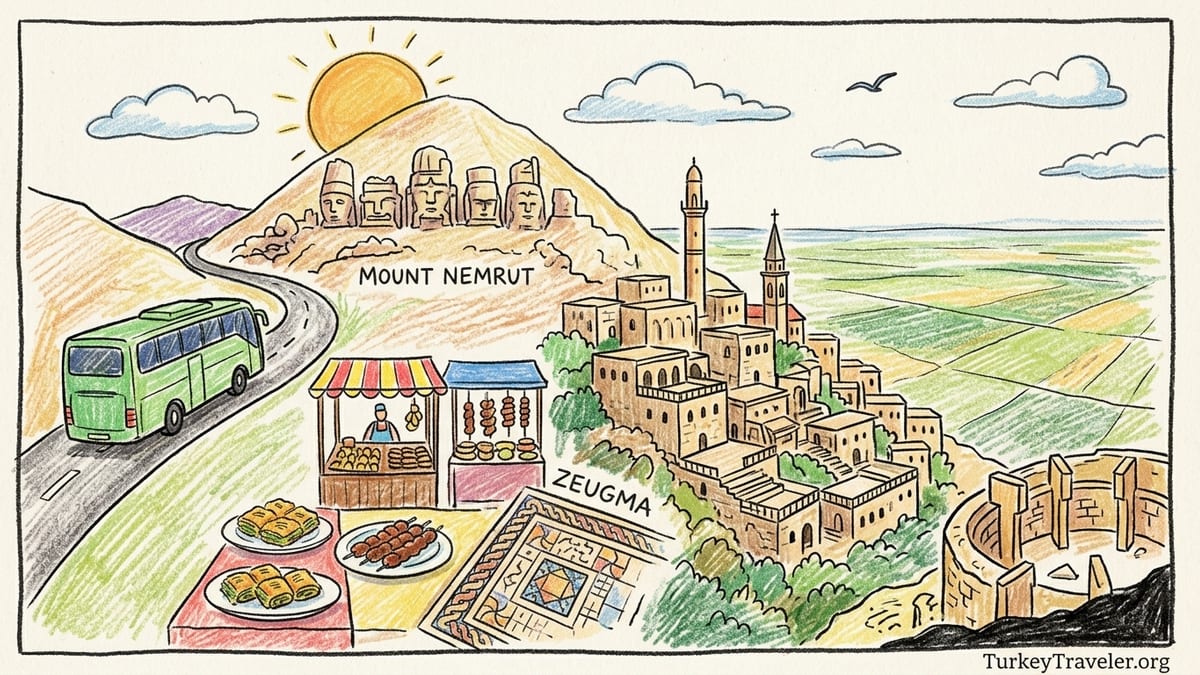
Most multi-day tours in Southeastern Anatolia now follow a broadly similar arc: beginning in Gaziantep, climbing to Mount Nemrut, then looping through Şanlıurfa and Göbeklitepe, on to the stone-built terraces of Mardin and Midyat, and ending among the black basalt walls of Diyarbakır. A typical seven-day “Discover Mesopotamia” program sold for around €895 per person in 2026 follows this pattern, marketing itself as a complete overview of ancient Upper Mesopotamia with a comfortable pace and mid-range hotels in each stop.
Gaziantep has become the preferred gateway because it is well connected by domestic flights from Istanbul and Ankara and has enough infrastructure to host international arrivals on fixed days. Tours generally include a half or full day in the city, with visits to the Zeugma Mosaic Museum and the restored bazaar streets. Many itineraries advertise dinners built around Antep’s pistachio-rich cuisine, from kebabs and lahmacun to syrupy baklava, which is often one of the most memorable meals of the week.
From Gaziantep, groups usually turn north and east toward Adıyaman and Kahta in order to access Mount Nemrut for either sunrise or sunset. Operators know that the Nemrut visit is a decisive marketing hook, and five-day and seven-day programs alike promise time among the colossal 1st century BC statues of the Commagene Kingdom. The mountain roads and relatively basic accommodation in the Nemrut area can be a surprise to travelers used to Istanbul or Cappadocia, making the choice between three-star and four-star options an important detail to check before booking.
Once Nemrut has been ticked off, tours push south into the heart of the Mesopotamian plain. Şanlıurfa, Harran and the temple complex of Göbeklitepe form the archaeological centerpiece, while Mardin, Midyat and finally Diyarbakır provide atmospheric old towns and Syriac, Kurdish and Turkish cultural strands. On paper, a five-day loop looks very similar to a seven-day one, but the number of nights you actually sleep in Şanlıurfa or Mardin can be dramatically different, and that is where the practical differences between packages begin to show.
Five-Day “Fast Track” Mesopotamia Tours: Pace, Pricing and Trade-offs
At the compact end of the market, five-day Mesopotamia discovery tours have multiplied in recent seasons. One example, sold by a regional operator for roughly €700 to €800 land-only, advertises a 5-day route starting in Adıyaman or Gaziantep and taking in Mount Nemrut, Diyarbakır, Mardin, Gobeklitepe, Şanlıurfa, Harran, Halfeti and Gaziantep. Another 5-day program branded as a “guided Mesopotamia tour” combines Nemrut, Şanlıurfa, Göbeklitepe, Mardin, Midyat and Dara, using domestic flights plus private ground transport for a small group.
The key to understanding these five-day options is the pace. Fast-track itineraries typically include one night or even no night at all in key stops. For example, it is common to see programs with a single overnight in Şanlıurfa, using the afternoon for Göbeklitepe and the evening for Balıklıgöl and the bazaar, before departing early the next morning. Mardin may also be limited to one night, with visits to Dara and the monasteries of Deyrulzafaran or Mor Gabriel compressed into a long touring day with early start and late arrival back at the hotel.
Because the same core sights must fit into fewer calendar days, travel days become long and bus time increases. A compact 5-day loop might include three or four days with eight to ten hours on the road, especially when transferring from Nemrut to Şanlıurfa and then onward to Mardin and Diyarbakır. For some travelers this is acceptable, particularly if time in Turkey is limited and Southeastern Anatolia is just one segment of a wider trip that also includes Istanbul and Cappadocia. For others, especially those sensitive to early starts and bus fatigue, five days may feel rushed.
Pricing at the five-day level also reflects inclusions. Operators offering private 4-night / 5-day tours with 4 or 5 star hotels and half board can price in the US$900 to US$1,200 range for two travelers sharing, while seat-in-coach group departures can dip lower but usually use simpler three-star accommodations and larger buses. Many of the more aggressively priced 5-day packages exclude domestic flights and lunches, so the apparent saving over a seven-day circuit can shrink once internal flights and meals are added back into your budget.
Seven-Day Mesopotamia Circuits: Where the Extra Time Actually Goes
The seven-day Mesopotamia circuit has become the standard “full” version of this route, with a number of Turkish and European tour companies selling 7-day or 7-night programs that closely resemble one another. A representative example in 2026 is a Discover Mesopotamia 7-day itinerary marketed around €895 per person in a double room on a land-only basis. Another operator in Europe sells a similar week-long package including international flights from select cities for about €1,095, reflecting group air contracts and charter allocations.
Examining published day-by-day plans shows where those extra two days typically go. First, seven-day tours tend to grant more time in Şanlıurfa and Mardin. It is common to see two nights in Şanlıurfa, providing one full day for Göbeklitepe and Karahantepe or Harran, and another day for the archaeological museum, Balıklıgöl complex and the old bazaar. Likewise, Mardin often gets two nights, allowing for a more relaxed exploration of the old town, plus excursions to the ancient city of Dara and Syriac monasteries, or to nearby Midyat and its hidden underground city known as Matiate.
Second, a week-long itinerary typically includes a more measured approach to Nemrut. Rather than racing from Gaziantep via Halfeti and Kahta to arrive just in time for a sunset climb, a seven-day tour may include an overnight closer to the mountain, with time on arrival and the flexibility to attempt sunrise if weather forces changes. This keeps individual days to a more manageable length and reduces the risk of missing the Nemrut experience due to delays.
The extra time also cushions the itinerary in practical ways that do not always appear in brochures. For example, a seven-day trip might build in a lighter afternoon in Diyarbakır, letting travelers explore the basalt city walls and Hevsel Gardens at their own pace, or simply rest before evening flights. It may also offer more realistic departure times, avoiding the pre-dawn starts that can feature in compressed 5-day programs. For older travelers, families, or those combining this tour with earlier busy days in Istanbul, that slower pace can be worth the additional budget.
Private vs Group Tours: Comfort, Flexibility and True Cost
Southeastern Anatolia’s tour market now spans mass-market coach groups and bespoke private circuits using the same rough route. On the group side, large Turkish agencies and European wholesalers sell fixed-date GAP or Mesopotamia tours in standard three-star or four-star hotels, with 30 to 45 guests per coach. These packages are where the headline prices of around €895 for a seven-day land-only program or just above €1,000 including European flights are most often found, relying on volume bookings to keep costs down.
Private and small-group tours sit at the other end of the spectrum. One 5-day Göbeklitepe and Mardin-focused private tour, for example, is structured as a 4-night program using four and five-star hotels on a half-board basis, with domestic flights plus private ground transport included. Such itineraries often quote rates per group or per person based on a minimum of two or four participants, and can easily reach or exceed €1,200 per person over five days if you request top-tier heritage hotels in Gaziantep and old-town Mardin.
The trade-offs revolve around flexibility and experience. In a private tour, your driver can stop at viewpoints over the Mesopotamian plain near Mardin, or add unscheduled coffee breaks in village squares, without derailing the schedule for a coach of forty. It is easier to adjust departure times if you wish to photograph Nemrut at sunrise rather than sunset, or to spend more time in Göbeklitepe’s interpretation center. However, language skills, patience with variable road conditions, and an understanding that services in Southeast Turkey can be more basic outside the main cities are still required, even on a private basis.
Group tours, by contrast, are economical and sociable, but come with stricter timetables and fewer hotel options: a three-star concrete block on the highway outside Mardin may be functionally fine but less atmospheric than a stone-built boutique property in the old town. If you see very low lead-in prices, check whether single supplements are high, how many passengers typically join the departure, and whether any optional excursions are in practice essential to see the headline sites, as these can add significantly to the advertised cost.
Flights, Buses and On-the-Ground Logistics
Reaching Southeastern Anatolia usually starts with a domestic flight from Istanbul or Ankara to Gaziantep, Şanlıurfa or Diyarbakır. Many seven-day group circuits choose Gaziantep for arrival and Diyarbakır for departure, which allows the route to unfold linearly: Gaziantep to Nemrut, onward to Şanlıurfa and Göbeklitepe, then through Mardin and Midyat before finishing in Diyarbakır. Some five-day programs, especially those marketed to independent travelers already in central Turkey, instead begin in Cappadocia or Ankara and drive directly to Nemrut or Şanlıurfa, but this demands long days on the road from the outset.
Within the region, buses and mid-size coaches remain the backbone for multi-day tours. For example, typical published schedules list a two-hour bus transfer from Gaziantep to Şanlıurfa, and another two hours from Mardin to Diyarbakır, on well-used intercity routes. While roads are generally in good condition, distances add up, and Nemrut in particular involves mountain roads and a final stretch that may require a minibus or even a short hike above the parking area. Travelers prone to motion sickness should plan accordingly, and ask their operator whether the group coach reaches the upper car park or changes to local shuttles.
The prevalence of domestic flights in premium small-group tours means you may find combinations like Istanbul to Adıyaman or Şanlıurfa on day one, then Diyarbakır to Istanbul on day five or seven. This cuts down on bus time but requires careful coordination of flight schedules, especially during shoulder seasons when frequencies can be reduced. It also explains why some European packages highlight “flight-inclusive” pricing from city of origin all the way through to regional airports: buying everything as a bundle can smooth logistics, though it reduces your flexibility to extend before or after the tour.
Regardless of format, it is worth reading the fine print on transfer timings. Some budget tours advertise five days but effectively deliver four touring days, with late-night arrival in Gaziantep and early-morning departure from Diyarbakır. In contrast, a well-structured seven-day circuit may allow meaningful sightseeing on both arrival and departure days, such as an afternoon in Gaziantep’s bazaar and a final morning walking along Diyarbakır’s Roman and medieval walls before heading to the airport.
Hotels, Meals and How Many Nights in Şanlıurfa vs Mardin
For many travelers, the quality and location of hotels, along with the included meal plan, are as important as the headline price. In Gaziantep, standard group tours often use modern four-star business hotels in the new town, while higher-end private circuits may book boutique conversions within walking distance of the old bazaar. Around Nemrut, options are more limited, and even premium tours may rely on simple three-star properties in Kahta or the surrounding villages, emphasizing proximity to the summit over character or amenities.
In Şanlıurfa, the pattern varies sharply between five-day and seven-day tours. Fast itineraries sometimes include only one night or even treat Şanlıurfa primarily as a daylight stop en route between Nemrut and Mardin, with Göbeklitepe and the city sights visited in a single long day. Longer circuits are more likely to give Şanlıurfa two nights, especially when they include side trips to Harran or Karahantepe. That extra night can make the difference between a rushed evening stroll past Balıklıgöl’s sacred carp ponds and a relaxed exploration with time to appreciate the city’s courtyard houses and local restaurants.
Mardin usually benefits even more from additional nights. Several experienced travelers and local commentators suggest that Mardin rewards at least two nights, not least because the surrounding region offers Syriac monasteries, Roman-era Dara, and the stone houses and churches of Midyat and nearby villages. Premium seven-day itineraries often respond to this by scheduling two nights in Mardin and, occasionally, one night in Midyat itself. Shorter tours may settle for a single night in Mardin, which allows only a few hours to explore the old town’s stepped lanes and panoramic rooftops before or after day trips.
Meal plans are another variable to examine closely. Many land-only week-long tours at the €895 level include daily breakfast and several dinners, typically at hotel restaurants or selected local venues, leaving lunches and some evenings free. In contrast, more expensive small-group archaeological tours may include all dinners and some lunches, especially on days when there are no restaurant options near Nemrut or Göbeklitepe. Considering restaurant prices in the region are generally lower than in Istanbul, choosing a package with more free meals can be a smart way to keep costs down while exploring local food scenes on your own.
Who Should Choose 5 Days, Who Needs 7, and When to Go
Choosing between a five-day and seven-day Southeastern Anatolia tour ultimately comes down to your travel style, overall trip length and tolerance for pace. If you have a two-week Turkey itinerary that already includes Istanbul, Cappadocia and the Aegean coast, and you simply want to “sample” Mesopotamia’s key sights, a concentrated 5-day loop can be an efficient solution. You will see Nemrut, Göbeklitepe, Şanlıurfa, Mardin and Diyarbakır, and come away with a solid introduction to the region’s landscapes and cultures.
However, if your primary focus is Southeastern Anatolia, or if you are particularly interested in archaeology, Syriac Christian heritage or photography, a seven-day circuit is more appropriate. Two nights each in Şanlıurfa and Mardin, plus breathing space in Gaziantep and Diyarbakır, allow you to move beyond checklist sightseeing. You gain time for sunset views from Mardin’s terraces, slower walks along Diyarbakır’s walls, and more flexible windows for visiting Göbeklitepe at quieter hours.
Seasonality also matters. Spring and autumn are widely regarded as the best times for this region, with milder temperatures that make Nemrut’s summit and long days of touring more comfortable. In high summer, daytime heat can make midday site visits tiring, and compressed five-day tours with little room to adjust timetables may feel more punishing. Cooler months can bring rain and low cloud over Nemrut, which makes the safety margin built into seven-day itineraries more valuable, as there is a chance to reschedule sunrise or sunset attempts if necessary.
Finally, consider your own comfort level with independent travel. Confident travelers sometimes choose to stitch together this route by themselves using local buses and rental cars, taking inspiration from the same Gaziantep–Nemrut–Şanlıurfa–Mardin–Diyarbakır arc used by packaged tours. If you prefer the predictability of pre-booked hotels, dedicated guides and structured days, then choosing carefully between a faster 5-day and a more rounded 7-day tour, and between private and group formats, will be the most important decision you make for this part of your Turkey journey.
The Takeaway
Southeastern Anatolia’s Gaziantep to Diyarbakır circuit has matured into a clearly defined product, with a dense marketplace of five-day discovery tours and seven-day Mesopotamia circuits offered by both Turkish and European operators. The price headlines for 2026 sound attractive, with week-long land-only tours marketed from around €895 and flight-inclusive European packages from about €1,095. But the real value of a tour lies not just in its cost, but in how it allocates nights between Gaziantep, Nemrut, Şanlıurfa, Mardin, Midyat and Diyarbakır, and how it balances time on the bus against time on the ground.
In broad terms, five-day itineraries are best suited to travelers with limited overall time in Turkey, who are comfortable with long driving days and primarily want to see the region’s headline archaeological and historic sites. Seven-day circuits, on the other hand, serve travelers who want to experience Southeastern Anatolia in greater depth, with multiple nights in Şanlıurfa and Mardin, better odds of good weather windows at Nemrut, and more opportunity to appreciate the slower rhythms and layered cultures of Mesopotamia’s northern edge.
Whether you choose a private small-group tour with boutique hotels or a larger coach package at keener prices, focusing on the route structure, hotel locations and included meals will help you decode what each brochure is really offering. Looking beyond generic labels like “Mesopotamia discovery” and asking targeted questions about nights in Şanlıurfa and Mardin, bus hours and internal flights will ensure that the tour you book matches the Southeastern Anatolia experience you imagine.
FAQ
Q1. How many nights do most seven-day Mesopotamia tours spend in Şanlıurfa and Mardin?
Typical seven-day circuits allocate two nights in Şanlıurfa and two nights in Mardin, with remaining nights divided between Gaziantep or Adıyaman/Kahta near Nemrut and sometimes Diyarbakır.
Q2. Are five-day Southeastern Anatolia tours too rushed for most travelers?
They can feel rushed, as the same core sights are fitted into fewer days, leading to longer bus hours and fewer evenings free, but some travelers with limited time find the trade-off acceptable.
Q3. What is a realistic price range for a quality seven-day land-only tour in 2026?
For a mid-range group tour with three- and four-star hotels, prices around €895 per person in a double room are realistic, with higher rates for smaller groups or boutique hotels.
Q4. Do flight-inclusive European packages offer better value than booking flights separately?
Flight-inclusive offers around €1,095 can be good value if you live near the departure airport, but independent travelers may prefer booking separate flights for more flexibility.
Q5. Is it better to choose a private tour or a group coach tour for this route?
Private tours cost more but offer flexibility, quieter hotels and customized pacing, while group coach tours are more economical and sociable but follow stricter schedules and use standard hotels.
Q6. How challenging are the road conditions around Mount Nemrut and the wider region?
Major highways between cities are generally good, but the approach to Nemrut includes winding mountain roads and a final segment that can be steep and exposed to weather.
Q7. Can I visit Göbeklitepe, Mardin and Diyarbakır independently without a tour package?
Yes, independent travel by bus, rental car and local guides is possible, but requires more planning, basic Turkish or Kurdish phrases, and comfort with variable infrastructure.
Q8. Which months offer the best weather for a Gaziantep–Nemrut–Şanlıurfa–Mardin–Diyarbakır trip?
April to early June and late September to October generally provide pleasant temperatures and clearer skies, making both Nemrut and long sightseeing days more comfortable.
Q9. Are meals usually included in Southeastern Anatolia tour prices?
Most packages include breakfast and some dinners, while lunches and additional dinners are often left free so travelers can sample local restaurants and street food.
Q10. Is Southeastern Anatolia safe for tourists booking these multi-day tours?
Tour operators monitor conditions closely and adjust routes if needed; most visitors who join organized tours report feeling safe in the main cities and tourist sites, with normal precautions.