


On paper, Aydıncık Beach on Gökçeada sounds like a kitesurfer’s dream: a long sandy bay on Türkiye’s largest island, a shallow lagoon on one side, the Aegean on the other, and wind that local schools claim blows more than 300 days a year. I went in high summer to see whether this much-hyped north Aegean spot actually delivers for a real day of wind sports, and what it feels like on the sand and in the water when you are the one clipping into the harness.
Getting to Gökçeada and First Impressions of Aydıncık
Reaching Gökçeada already filters visitors down to those willing to make a bit of an effort. I drove from Çanakkale’s Kabatepe port and took the car ferry across, a crossing of roughly an hour and a half that felt closer to a small expedition once you factor in loading, unloading and the winding road across the island. The closer I got to the south coast and Aydıncık, the emptier the roads became, with only the occasional pick-up loaded with boards or a small hatchback carrying twin-tip kitesurf boards on the roof rack hinting at what awaited at the beach.
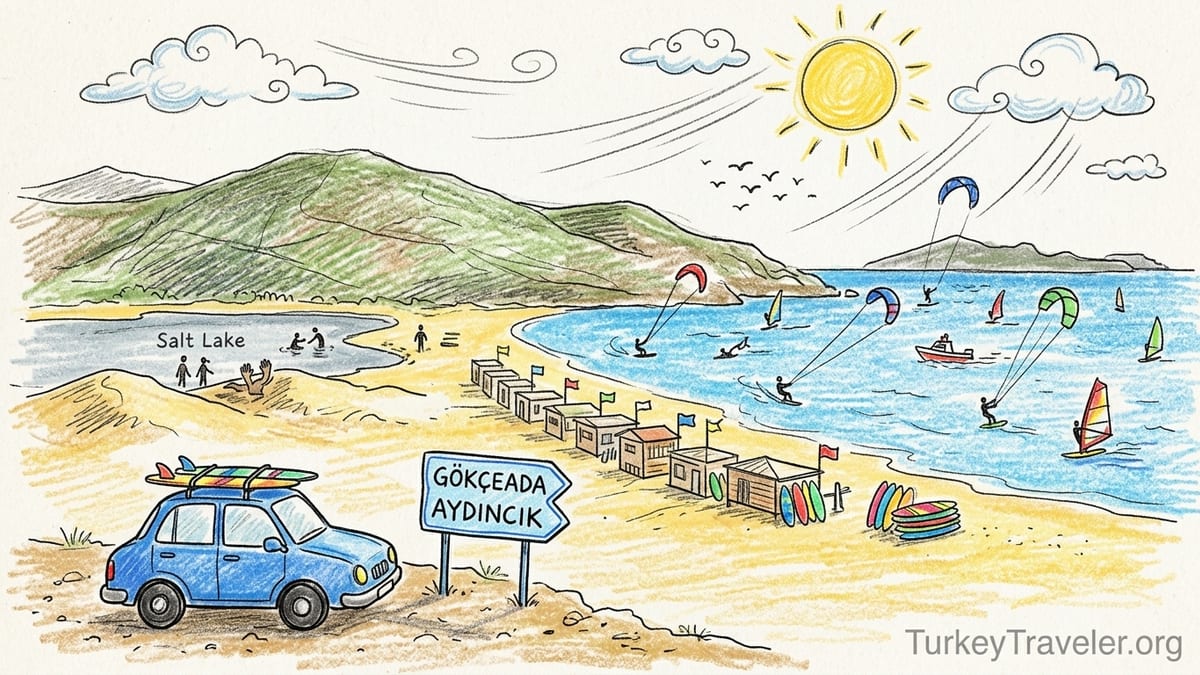
Aydıncık itself is a long, golden strip, often referred to locally as Kefalos. On one side is the open Aegean, on the other the shallow Salt Lake behind the dunes. Surf schools and a few small beach bars are strung out behind the sand, but the bay feels pleasantly undeveloped compared with better-known Turkish spots. When I parked on the hard-packed sand behind the surf centers, the sound of lines fluttering in the wind and the occasional slap of a kite hitting the water made it instantly clear that this is first and foremost a wind spot, not a general swimming beach.
Wind dominates everything on Gökçeada, and it hits you as soon as you step out of the car. Even before I checked in with a school, the steady hum in my ears told me this was not going to be one of those frustrating no-wind days that every kiter secretly fears on a dedicated trip.
Wind on the Day: Strength, Direction and Water State
I rode Aydıncık during a classic meltemi pattern in late July, when the north to northeast summer winds are known to be strongest in the Aegean. By mid-morning, around 10:30, the beach flags were snapping almost straight, and the local instructors at one of the schools were reading 18 to 20 knots cross-off from the small weather station mounted on their container. They expected it to build through the afternoon to the low-20s, which is exactly what happened between about 1 p.m. and 4 p.m.
The key thing about Aydıncık is that the wind blows from the land out to sea on the main kite side of the bay. That means cross-offshore wind: smooth and powerful once you are out on the water, but technically more committing because you get pushed away from the beach. In practice, the schools manage this with dedicated rescue boats running a loose patrol and by requiring beginners to stay inside defined lesson zones. More experienced riders use 9 to 11 square meter kites on typical summer days; I was comfortably powered on a 10 meter kite at 80 kilograms, riding a standard freeride twin-tip.
The water state was a big part of what made the session enjoyable. Near shore, in the first 100 to 150 meters, the surface was almost flat, with only small ripples running downwind, ideal for practicing edging and first transitions. Slightly further out, small chop built up but never reached the messy, confused conditions you often find in onshore beach breaks. The combination of steady wind and relatively flat water explained quickly why freestyle riders favor this place and why some windsurf brands run clinics here in late summer.
Choosing a School: Lessons, Rentals and Equipment Quality
There are several established operators on Aydıncık Beach that offer both kitesurf and windsurf tuition as well as rental. I based my day with a mixed kitesurf and windsurf center that has been active on the island for more than a decade and operates under Turkish Sailing Federation supervision. A row of neatly stacked boards, quivers of recent model kites and sails, and clearly marked storage racks gave an immediate impression of a professionally run operation instead of an improvised seasonal shack.
For a realistic sense of cost, the schools on Aydıncık in 2026 generally price beginner kitesurf lessons in packages starting around the equivalent of a few hundred euros for a multi-day course, while windsurf beginner bundles for several hours of tuition sit lower than that. Daily windsurf rental for higher-end sails and boards, and daily kitesurf rental for recent kites and twin-tips, tends to be in the range of a few thousand Turkish lira. Prices are updated each season and are sensitive to the exchange rate, but at the time of my visit, the cost was transparent and posted clearly on the school boards in Turkish and English.
Equipment quality was high. The center I used stocked recognizable international brands for both kites and windsurf rigs, with kites mostly within the last three model years and windsurf sails rigged on modern RDM masts. Lines were free of visible knots or fraying, and all quick-release mechanisms were demonstrated before use. For windsurfing, the range went from wide, stable beginner boards to freeride and bump-and-jump shapes sized around 100 to 120 liters. One welcome touch for traveling riders was the availability of impact vests and helmets included in lesson packages, something that is not universal at all Turkish spots.
Launch Area, Shallow Water and Crowds on a Busy Summer Day
The launch at Aydıncık is a broad, sandy section of beach that gradually shelves into the water. The absence of rocks at the main kite launch area makes it beginner-friendly in principle, but the mix of different sports means you need to stay alert. Schools have carved out clear zones where they rig their kites and lay lines perpendicular to the water, marked by flags and teaching banners. Outside these, there are unmarked stretches where independent kiters tend to set up a little further downwind.
In the first 50 meters, the water is typically shallow enough for most adults to stand in chest-deep water, which is helpful for body-dragging practice and for resetting boards during early waterstarts. As you move further out, it deepens smoothly without sudden drops. There is no enclosed lagoon on the main kite side, so you are always in open sea, but because the bay curves gently and is partially sheltered by headlands, it maintains a friendly feel even in stronger wind.
Crowding is a real factor in peak season. On my visit in late July, by early afternoon there were around two to three dozen kites in the air at any one time and a similar number of windsurfers operating from the same stretch of coast. That still felt reasonable given the bay’s length, but in the main lesson zones near the schools it could be busy, especially when multiple beginner groups were trying their first rides simultaneously. The schools mitigated this with staggered start times and by pushing more advanced students further upwind. Compared with a place like Alaçatı on a windy August day, Aydıncık still felt relatively relaxed, but riders looking for solitude will not find it in mid-summer.
Beginner Suitability, Safety and What Happens When the Wind Misbehaves
Instructors at the beach often describe Gökçeada as a forgiving place for beginners because of its steady summer wind and long run-off areas. From my day on the water and time watching lessons, I would say Aydıncık suits beginners who already feel comfortable in open water and are not intimidated by the idea of cross-offshore wind with rescue cover. First-time kitesurfers on their very first days might feel more comfortable at strictly side-onshore lagoons, but anyone past the initial body-dragging stage will likely appreciate the smooth power here.
Safety procedures were visible. Each school ran at least one small boat that cruised downwind of the main riding area, picking up riders who could not relaunch or had drifted too far. Before launching, instructors discussed the wind orientation and what to do in the event of equipment failure, including using the quick release and swimming towards shore while signaling for help. Helmets and buoyancy aids were the norm in lessons. The windsurf zones were set slightly closer to shore to avoid direct overlap with kiters on powered runs.
My own frustration came not from a lack of wind, but from a brief period in the late afternoon when gusts pushed into the high twenties in knots. On a 10 meter kite, this meant edging very hard to stay in control and, at one point, coming in to swap down to a smaller kite while the gusts passed. Several less experienced riders chose to sit that hour out under the shade of the beach cafes. It was a reminder that even at a “dream” spot, you are still at the mercy of the weather. Locals mentioned that full no-wind days do happen outside the core meltemi period in May or late September, and a few visitors during my week on the island had already lost one or two planned ride days earlier in the season.
Life on the Beach: Transport, Parking, Food, Shade and Facilities
Practicalities at Aydıncık are straightforward but still carry the flavor of a relatively low-key island spot. Arriving with a rental car is by far the easiest option. The final approach to the beach is on a mostly paved road that turns into compacted sand and gravel in the last stretch. Cars simply pull up behind the dune line or next to their preferred surf school. Parking was informal but free on my visit, and even on a busy afternoon there was room to maneuver if you arrived before midday.
Facilities have improved noticeably in recent years. Several small cafes and snack bars behind the schools serve simple meals such as gözleme, grilled meat, burgers and salads, along with cold drinks and espresso-based coffee. Prices reflected island conditions and post-2024 inflation, so a basic lunch and drink cost more than on the mainland villages but remained reasonable by European standards. Crucially for long beach days, there were shaded seating areas under wooden pergolas or fabric canopies where non-kiting friends could escape the sun, as well as rentable sun loungers closer to the water.
Changing and washing facilities varied by school. The larger centers offered simple changing cabins, freshwater showers and toilets for guests and students. Some also had storage containers where you could leave your own gear for a fee during the season, useful for riders planning a week of sessions. Independent visitors without a school affiliation still had access to a few public showers and toilets run by the local municipality or attached to the beach cafes, although standards were basic and you should not expect spa-level locker rooms.
Salt Lake and Mud Baths: A Realistic Detour, Not a Main Event
Behind the dune line at Aydıncık lies Gökçeada’s Salt Lake, a shallow lagoon that nearly dries out by late summer. On the afternoon I visited, the water had retreated enough to leave large sections of dark, mineral-rich mud exposed. A handful of visitors, including a couple of off-duty windsurfers, walked out barefoot, scooped up handfuls of the thick mud and spread it over their arms, shoulders and faces. After letting it dry to a matte grey crust in the sun, they rinsed off in the sea.
I joined in more out of curiosity than conviction in any health benefit. The mud felt cool and smooth going on, but walking across the cracked flats required attention; some sections were firmer, while others gave way unexpectedly, swallowing a foot to the ankle. There were no formal facilities at the mud area itself: no showers, no lockers, just the bare landscape, the wind and the streaked silhouettes of people covered head-to-toe. It was a fun, slightly absurd twenty-minute detour between sessions, but it did not compare to dedicated spa mud-bath setups in places better known for thermal tourism.
Importantly, the Salt Lake and mud area sit close enough to the main beach that non-kiters can wander over on foot while their companions ride, adding at least one extra activity to an otherwise wind-focused day. For families, this seemed to break up the routine: I watched children happily painting each other’s arms while parents took photos and then hustled them back to the sea to wash off before the mud baked completely dry.
How the Wind Feels for Non-Kiting Companions
Gökçeada’s wind that delights riders can wear down those on the sand. Throughout my day at Aydıncık, the breeze rarely dipped below the mid-teens in knots and regularly pushed higher. Under direct sun, this can feel refreshingly cool, but it also whips up sand that stings bare legs and blows towels, hats and beach toys if they are not weighed down. My non-kiting companion spent the first hour enjoying the breeze under a straw umbrella, then quickly learned to anchor everything with bags and rocks when gusts picked up.
The constant noise of wind, flapping kites and the muffled thump of boards landing tricks creates its own atmosphere. Some people find it energizing, others tiring after several hours. I noticed a steady trickle of non-kiters retreating to the slightly more sheltered cafes or even leaving the beach mid-afternoon in search of quieter coves elsewhere on the island. Those hoping to combine a serene “lie and read a book” beach holiday with a partner’s intensive kite course should be realistic: Aydıncık is not a still, postcard bay. It is a working wind sports beach, and the island’s famous breeze shapes everything from hairstyles to how you drink your coffee.
That said, the same wind that complicates hair and sand also strips away some of the oppressive heat common at Turkish resorts in midsummer. Even at peak afternoon temperatures, the apparent temperature at Aydıncık felt several degrees cooler than inland villages. For me, and for many of the other riders I spoke to, that trade-off was more than worth it.
Who Will Love Aydıncık and How It Compares to Other Turkish Kite Spots
By early evening, as the sun dropped toward the horizon and a few kites remained silhouetted against the orange sky, I had a clear sense of who Aydıncık really serves best. Confident beginners through to advanced riders who like powered freeride and freestyle in mostly flat water will feel at home here. If you already know how to go upwind and are starting basic jumps or transitions, the smooth, steady pull and absence of heavy shorebreak give you room to progress without fighting messy conditions.
Absolute beginners can also start here with the right school, given the rescue cover and structured lesson areas, but they must be comfortable trusting instructors in a cross-off environment. Riders who want to experiment with both windsurf and kitesurf during the same trip will appreciate the multiple disciplines available on one beach, with centers offering both sets of equipment. More experienced windsurfers chasing high-wind days will also find Aydıncık rewarding, especially when summer systems push gusts into the upper range of common freeride sails.
Compared with other Turkish kite destinations such as Alaçatı on the Çeşme Peninsula or Akyaka in the Gulf of Gökova, Gökçeada feels wilder and less built-up. Alaçatı offers a denser concentration of schools and a lively town scene but also heavier crowds and more regimented water traffic. Akyaka has its own shallow, beginner-friendly lagoon but can become extremely packed, especially at weekends. Aydıncık sits somewhere between. It has developed infrastructure, certified schools and enough non-kite distractions on the island, yet it still retains a relatively raw, windswept charm. Personally, for a pure riding trip focused on steady wind and a touch of adventure, I would choose Gökçeada over the more polished mainland spots, while acknowledging that those seeking nightlife and extensive dining options might be happier basing themselves around Alaçatı or Urla.
If I were planning a week-long kitesurf holiday in Türkiye with a mix of progression and relaxed island atmosphere, Aydıncık on Gökçeada would be at the top of my list. If the priority were guaranteed lesson-friendly conditions for very first timers, with minimal mental load from wind direction and rescue logistics, then a fully enclosed side-on lagoon elsewhere might still edge ahead. Ultimately, Gökçeada’s appeal lies in the interplay of serious wind with an island that has not yet fully sacrificed itself to tourism, and that balance is what will draw many riders back.
The Takeaway
My day at Aydıncık Beach confirmed that Gökçeada’s reputation as a leading Turkish wind destination is not just marketing language. The wind on the day was as strong and consistent as the surf schools promise, the water state was friendly and often close to flat, and the combination of professional centers, available rescue and wide sandy launch made actual time on the board feel both productive and safe. It was not a flawless, postcard-perfect experience: the cross-off orientation demands respect, gusty spikes in the afternoon called for active kite management, and the ever-present wind limited the comfort of those who came only to sunbathe.
For riders, though, those same traits are positives more than negatives. The spot rewards preparation and a willingness to adapt to the day’s conditions. When the wind cooperates, as it did on my visit, sessions can stretch for hours, with long powered tacks down the bay and enough space to practice tricks without constantly dodging others. When it misbehaves, you accept that wind sports are weather-dependent and move to a cafe, the Salt Lake, or another sheltered cove until the next window opens.
Who should book lessons here? Motivated beginners comfortable in open water, anyone looking to step from basic riding into their first jumps or transitions, windsurfers who want reliable breeze with room to blast, and mixed groups who value a quieter island base over resort-style nightlife. Advanced riders will enjoy the power, the relative uncrowded feel outside peak weeks, and the potential for long, technical sessions, though pure wave hunters may look elsewhere.
If given the choice between Gökçeada and another Turkish kite destination for a future trip focused on progression and atmosphere, I would return to Aydıncık. Its blend of strong wind, relatively flat water, straightforward beach logistics and the rugged character of Türkiye’s largest island made the frustrations of occasional gusts and wind-sand in everything feel like a fair price for some of the most satisfying sessions I have had in the north Aegean.
FAQ
Q1. Is Aydıncık Beach on Gökçeada suitable for complete beginner kitesurfers?
For absolute first-timers, Aydıncık can work if you book with a reputable school that provides close supervision and boat rescue, but the cross-offshore wind means it is better suited to beginners who are already comfortable swimming in open water and are ready for structured lessons rather than casual self-teaching.
Q2. What time of year offers the most reliable wind at Aydıncık?
The most reliable wind typically arrives in the main meltemi season from roughly mid-June through early September, with July and August seeing the strongest and most consistent north to northeast breezes, although there can still be lighter or gustier days at either end of that window.
Q3. Do I need a car to reach Aydıncık Beach from the ferry port on Gökçeada?
Having a car makes life significantly easier, as it lets you carry gear, reach the beach in under an hour from the port area and explore other coves if the wind does not cooperate; while there are occasional local minibuses and some schools arrange transfers, most riders prefer the flexibility of a rental car.
Q4. Are there equipment rentals available if I do not bring my own gear?
Yes, several surf centers on Aydıncık rent modern kites, boards, windsurf sails and boards, along with harnesses and safety equipment; you can usually reserve in advance or arrange rentals on arrival, though high season dates are worth booking early to be sure your preferred sizes are available.
Q5. How crowded does the water get during peak season?
On busy summer afternoons, you can expect a few dozen kites and a similar number of windsurfers in the bay, with the highest density near the lesson zones in front of the schools; there is still enough room to ride, but you need to stay aware of right-of-way rules and give learners extra space.
Q6. What facilities are available on the beach for non-kiters?
Non-kiters will find simple beach cafes, shaded seating areas, toilets and freshwater showers at or near the main surf centers, plus the nearby Salt Lake and mud flats for a short walk and photo stop, though those seeking a very quiet, sheltered swimming cove might prefer other beaches on the island.
Q7. Is there a safe area for swimming at Aydıncık during kite hours?
Swimming is possible closer to shore and in areas designated away from the main kite and windsurf lanes, but because this is primarily a wind sports beach with active lines and boards, families with small children often choose to swim only at the edges of the activity or visit calmer bays elsewhere on Gökçeada for dedicated swimming days.
Q8. Can windsurfers and kitesurfers share the same area without conflict?
Yes, they generally coexist well by following clear zoning and right-of-way rules, with windsurfers tending to sail slightly closer in and kiters further out; respecting lesson zones and communicating with the local schools before heading out helps keep traffic predictable and friendly.
Q9. What should I pack for a day of kitesurfing at Aydıncık in summer?
For summer sessions you will want a swimsuit or boardshorts, a light rashguard or thin shorty wetsuit for sun and wind protection, reef-safe sunscreen, sunglasses with a strap, a hat for time on the beach, and, if you have them, your own harness and impact vest, though schools can provide safety gear for lessons and rentals.
Q10. Would you recommend Gökçeada over better-known Turkish spots like Alaçatı for a first kitesurf trip?
If your priority is strong, steady wind in a less built-up island setting and you are comfortable with a slightly more adventurous logistics and cross-offshore conditions, Gökçeada is an excellent choice; if you want a very controlled lagoon environment, extensive nightlife and a more polished resort atmosphere, Alaçatı or similar mainland spots might suit you better for a first trip.