


On paper, Gökçeada looked like the perfect place for a slow, car free escape. Türkiye’s largest island, marketed with photos of wind shaped beaches, stone villages and organic farms, seemed made for walking and dolmuş minibuses. I had managed Bozcaada easily without driving and assumed Gökçeada, with its Cittaslow label and promises of sustainability, would be similar. A few ferry rides and shared taxis, I thought, and I would be dipping into coves and mountain villages at my own pace. The reality on the ground was more complicated.
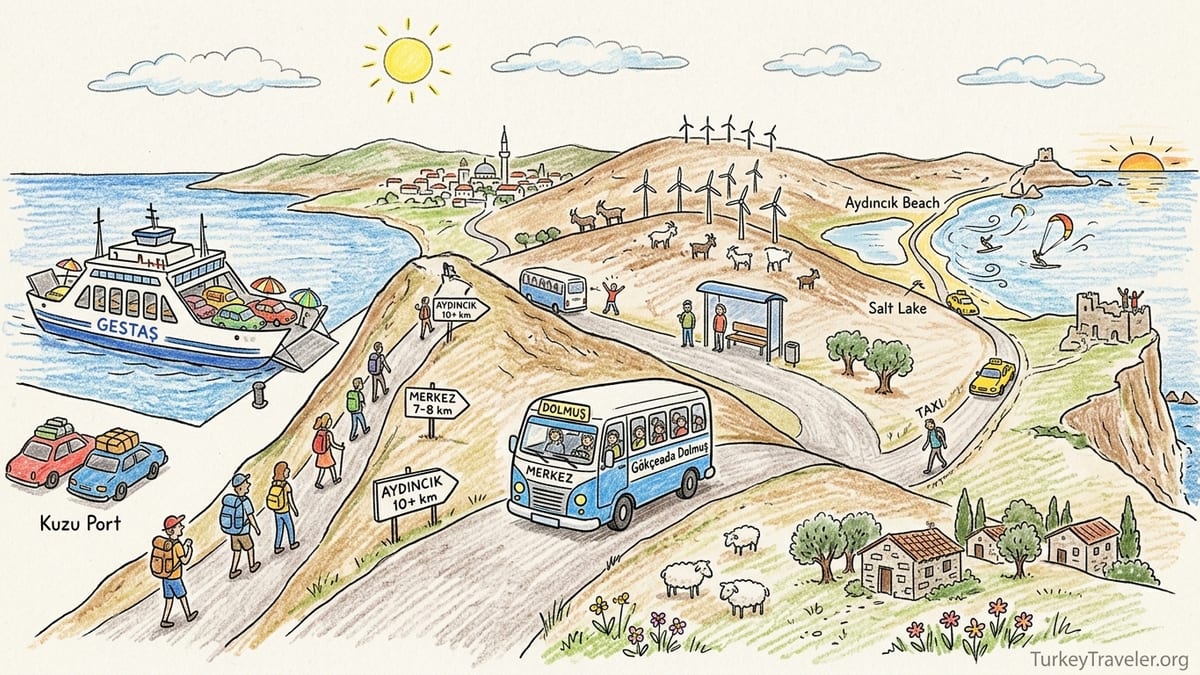
First Impressions From the Ferry: Distances I Underestimated
I arrived on a late afternoon ferry from Kabatepe to Kuzu Port, the main entry to Gökçeada. The crossing was straightforward. GESTAŞ operates the line, and in summer 2026 there were up to eight sailings a day on busy weekends between Kabatepe and Gökçeada, with a foot passenger return ticket advertised at about 250 lira and cars from around 1,400 lira return depending on size and season. The deck was full of vehicles. I noticed how many families had packed their own cars with beach umbrellas, coolers and bikes. At the time, I read it as over preparation. It was actually my first warning sign.
Stepping off the ferry as a foot passenger, the island felt immediately larger than I expected. Maps had told me that Gökçeada is roughly 279 square kilometers, significantly bigger than Bozcaada, but those numbers had stayed abstract. At Kuzu Port, the road to the main town, simply called Merkez, wound uphill for about 7 to 8 kilometers. With no promenade or cluster of cafes around the port, you either boarded a waiting minibus or committed to a long walk on an exposed road with trucks and buses leaving the ferry.
I had read that extra dolmuş services run between Kuzu Port and the town center timed to ferry arrivals, so I followed the small crowd and asked the driver “Merkez mi?” He nodded, quoted 30 lira, and we squeezed into a well worn minibus. The ride took about 15 minutes. Along the way I could see why locals insist Gökçeada is a driving island. Villages appeared far apart across brown and green hills, with long stretches of nothing but wind turbines, fields and goats between them.
By the time I checked into my guesthouse in the town center, I was still optimistic. The square felt manageable on foot, with a few bakeries, a supermarket, ATMs and a line of taxis. My plan was simple. I would treat the town as a hub, use dolmuş services to reach beaches and villages, and fill gaps with taxis if needed. Within 48 hours that plan would start to unravel.
Trying to Rely on Dolmuş: Schedules, Gaps and Long Waits
Before arriving I had looked up a 2025 dolmuş and transport guide compiled by local tourism businesses. It confirmed what academic studies and older municipal documents hinted at: Gökçeada’s public transport exists, but frequencies are limited and heavily concentrated around the town and ferry times. Routes usually radiate from the center to Kuzu Port, some villages and popular beaches, but often with just a handful of departures per day outside peak August weekends.
On my first full day I walked to the informal dolmuş “terminal” near the main square just after 9 in the morning. Small signs in Turkish taped to the windshields indicated destinations: Kuzu Limanı, Uğurlu, Aydıncık, Zeytinli, Tepeköy. When I asked in basic Turkish what time the next minibus to Aydıncık Beach (also known as Kefalos) would leave, the driver said “On bir buçuk, on iki gibi,” suggesting sometime between 11:30 and noon. It was barely 9:15. There had been an earlier departure closer to 8 for locals and workers that I had missed.
Rather than sit for more than two hours, I switched plans and took the next minibus back to Kuzu Port. That part of the system worked well. Ferries anchor much of daily life, so the Kuzulimanı–Merkez route sees extra services around each sailing. I waited less than 15 minutes, paid around 25 lira, and rode back down the hill I had climbed the day before. The downside was that I was simply going in circles. To reach beaches on the south and west coasts you generally need specific routes, and those rear out during shoulder seasons or on weekdays.
Later in the week I finally caught the Aydıncık dolmuş from town. The ride took about 25 minutes and cost just under 40 lira. That part was efficient enough. The real constraint revealed itself when I asked about the last return. The driver shrugged and said the final guaranteed bus back to town was around 18:00. In July that meant packing up long before the golden light that makes Gökçeada’s wind and salt beaches famous. If the minibus filled earlier with day workers or families, he implied, it might leave ahead of schedule. There was no evening bus posted that would allow a sunset swim and dinner by the sea without a backup ride.
Reaching the Edges: Aydıncık, Uğurlu and “Too Far to Walk”
Gökçeada’s main attractions are not centralized. Aydıncık stretches across a long isthmus on the south coast, often breezy enough to host wind and kite surfers around the salt lake just inland. Uğurlu and its nearby coves, including remote spots like Gizli Liman at the far west of the island, are often described as some of the last places in Türkiye where you can feel completely away from development. Several travel guides and local sites are frank about it: these areas are easiest by private car or rental, and taxis can be expensive for the distances involved.
From the town center to Uğurlu is roughly 30 kilometers of twisting road across the island’s spine. On a map that did not look intimidating. I have happily cycled longer distances elsewhere. In person, with afternoon heat, no cycle lane, and trucks heading to construction sites and farms, it felt very different. There is a Uğurlu dolmuş route, but when I asked on a weekday in June, drivers quoted two services in each direction, one mid morning and one mid afternoon. Times were described with “around” and gestures instead of printed timetables.
To test the feasibility, I committed to the morning bus. It left the square shortly after 10:00, about 20 minutes later than loosely suggested, and charged 70 lira for the hour long ride. We passed bare hills and a scattering of villages, then descended toward the small settlement around Uğurlu Beach. There was no tourist information point and only a few cafes in early season. When I asked a cafe owner about a return bus, she shook her head and pointed back to the main road, indicating I should watch for the same minibus coming from Gizli Liman in the late afternoon.
The idea of staying for sunset at the very western coves, where the sun is often romanticized as the “last to set in Turkey,” quickly felt impractical without a car. The final minibus that would safely get me back to Gökçeada town before dark passed through around 17:30, well before the long summer dusk. Missing it would mean trying to negotiate a one way taxi fare with no guarantee of availability and only patchy mobile reception. The distance that had once seemed manageable on a flat map now translated into a rigid day, pinned to one return option.
Aydıncık posed a similar dilemma. It lies closer to town, just over 10 kilometers away, but the road runs largely exposed and without much shade. I considered walking one way and taking the dolmuş back. After three kilometers under the sun, on a shoulder barely wide enough in some sections, I understood why even local walkers focus their hikes on quieter interior paths and short village to village routes rather than main arteries. The scale and road design both work against a casual, car free beach day that starts and ends when you want.
Taxis, Hotel Transfers and the Hidden Costs of Flexibility
I had assumed that where dolmuş services thinned out, taxis would fill the gap. Around Gökçeada’s main square, yellow cabs line up, and most pensions will call a driver they know. What I had not understood beforehand was just how expensive those trips can become by island standards when multiplied over a week.
On one afternoon when I misread the dolmuş window for Aydıncık, I asked a taxi for a last minute round trip later in the day, with a pick up a little after sunset. The driver was friendly and direct. For a one way run from Merkez to Aydıncık he quoted 450 lira, pointing out that he would have no guarantee of a paying passenger back to town. For a return, waiting to pick me up just before dark, he proposed 800 lira all in. For a solo traveler that was a serious addition to a day that might otherwise cost 250 to 300 lira including food and a beach umbrella.
Hotel transfers help, but they are uneven. On my third day I moved from a simple room in town to a small family run hotel closer to Kaleköy, the harbor settlement and castle area on the northeastern shore. The owner, a local who had run the place for more than a decade, offered to pick me up once from the port or center and drop me once at my onward ferry as part of the room rate. Anything beyond that, he explained, would incur a fee similar to local taxis because of fuel prices and the time lost shuttling back and forth instead of cleaning rooms or serving breakfast.
I asked whether he could organize a transfer to Uğurlu one afternoon. He made a quick call and came back with a price of about 1,200 lira for a private car to take me there and bring me back after sunset. His reasoning echoed others on the island: the western drive eats an entire evening for the driver, the roads are demanding and the return leg is often empty. For a group of four that cost per person would feel more palatable. Alone, it nudged me back toward planning trips that fit narrow dolmuş slots rather than my ideal hours.
By the middle of my stay I had spent nearly as much on occasional taxis and transfers as the return foot passenger ferry ticket from Kabatepe to Gökçeada. The island was still beautiful and welcoming, but the financial and logistical picture of “doing it without a car” was far from the low cost, flexible vision I had in mind when looking at promotional phrases about sustainable, car free travel.
Where Walking and Local Transport Worked Beautifully
All of this is only half of the picture. There were moments when being without a car felt exactly right on Gökçeada. The town itself is compact enough that you can walk from the square to most guesthouses, supermarkets and bakeries in under ten minutes. Early mornings were especially pleasant. I would grab a simit and coffee, then linger on benches watching daily life. Without a vehicle to worry about, I did not have to think about parking rules or narrow streets, and it was easy to drop into small shops and chat.
Kaleköy and the nearby village of Zeytinli were also very walkable within their own boundaries. From my second hotel it took about 20 minutes on foot to reach Kaleköy’s harbor, with its line of fish restaurants and small boats. Climbing up to the old castle ruins for sunset, I was grateful not to be hunting for a place to abandon a car. The footpath is steep but manageable, and lingering until the sky shifted orange and pink over the Aegean was one of the few sunsets I could fully enjoy without checking my watch for the last bus.
The Greek villages in the hills, especially Zeytinli and Tepeköy, reward slow ambles through stone lanes. I reached Zeytinli by a mid morning dolmuş from the town center. The driver announced the departure loudly, and the minibus filled with locals carrying bread and groceries. The ride cost less than 40 lira, and I spent the day wandering from one cafe to another, trying dibek coffee and local desserts. Because the village itself is compact, the lack of onward transport for a few hours did not matter. I arranged a taxi back to Kaleköy in the late afternoon with the help of a cafe owner, sharing the cost with another couple who happened to be heading in the same direction.
In those places Gökçeada lived up to its “slow island” image. The problem was stitching these experiences together across a spread out landscape when you cannot, or choose not to, drive. Walking works very well once you are within a specific settlement or around certain coastal stretches. It is the in between, the long exposed sections of road between Kuzu Port, Merkez, the western coves and the southern beaches, where the car dependent reality shows through.
Who Can Realistically Visit Gökçeada Without a Car
After a week of experimenting, I do not believe everyone needs to arrive with a vehicle. It depends heavily on your expectations, your base location and your willingness to limit your wishlist. Some travelers are well suited to a car free Gökçeada, while others will find it frustrating.
If you are happy to focus on the town, Kaleköy and one or two nearby villages, staying centrally without a car can work very well. Couples who enjoy long meals, short walks and occasional taxi rides to specific viewpoints will find enough variety within a small radius. Base yourself in Gökçeada town or Kaleköy, confirm that your accommodation is within a 10 to 15 minute walk of the main square or harbor, and plan to visit Aydıncık or Uğurlu only once or twice with organized transfers or carefully timed minibuses.
Solo travelers on a tight budget, on the other hand, will feel the constraints more sharply. The accumulation of taxi fares and the risk of missing the last dolmuş make spontaneous sunset trips to remote beaches a gamble. For someone who does not mind repeating the same nearby spots and prioritizes reading, swimming and village cafes over “seeing everything,” it can still be a satisfying trip. But if your dream is to hop between multiple beaches on both the south and west coasts over just a few days, doing so without a car is unlikely to match that dream.
Families with young children or lots of luggage may appreciate the relaxed atmosphere of Gökçeada but should calculate the logistics carefully. Wrestling strollers and beach gear on and off packed minibuses in the heat, then waiting 90 minutes or more for the next bus back from the beach if a child becomes tired, can turn a holiday into a test of patience. In conversations with local hoteliers, several candidly said that families are happiest when they either bring their own car on the ferry or rent one from local agencies for at least part of their stay.
Lessons Learned and a Hybrid Mobility Strategy for Next Time
Looking back over my notebook, I counted more time spent trying to sync with dolmuş schedules and negotiating taxi prices than I had imagined when I booked my foot passenger ticket from Kabatepe. Yet the moments when I could simply walk through villages, sit on harbor walls or climb up to ruined castles without worrying about a parked car were some of the trip’s highlights. For me, the answer is not that everyone must drive on Gökçeada, but that a more flexible, hybrid approach makes the most sense.
On a future visit I would still arrive as a foot passenger, both to avoid queuing with cars at Kabatepe and to keep my environmental impact lower over the long journey from Istanbul. Once on the island, however, I would arrange a rental car for one or two specific days through a local agency in town. Prices change frequently with fuel costs and season, but even if a small car cost the equivalent of several taxi rides, the freedom to string together Aydıncık, Uğurlu, Gizli Liman and a couple of inland villages in one circuit would justify the expense.
On days when I did not rent a car, I would either stay fully local on foot or consider a scooter or small motorcycle, provided I had the appropriate license and insurance. Some stretches of road are exposed to strong crosswinds, and helmets are non negotiable, but the distances between the town, Kaleköy and Zeytinli in particular are well within the range of a comfortable scooter ride. Many Turkish islands already have informal arrangements where accommodations arrange scooter rentals through trusted contacts, and while regulations can evolve, it is worth asking your hotel or pansiyon about current options rather than assuming none exist.
Finally, I would choose accommodation that explicitly advertises transfers, not just from the port but also to at least one beach. Several guesthouses mentioned offering scheduled shuttles to Aydıncık on specific days in peak season, and a few west coast pensions near Uğurlu and Gizli Liman provide pick up from the ferry or town. Clarifying in advance how often they run these services, whether there is a surcharge, and what time the last evening return operates can make the difference between a relaxed sunset and a nervous walk back to the main road hoping for a passing car.
Gökçeada remains one of Türkiye’s most distinctive islands, with a mix of Greek and Turkish heritage, a strong focus on organic agriculture and a sense of space that smaller islands like Bozcaada simply cannot match. Experiencing that space without a car is possible, but it demands realism about distances, patience for limited public transport and a willingness to build in a few days of private wheels when you want to push beyond the immediate horizon.
The Takeaway
Travel marketing often suggests that Cittaslow labels, organic projects and small scale tourism automatically translate into easy, car free holidays. My days on Gökçeada told a more nuanced story. This is an island where life still orbits private vehicles, from the long ramp of the Kabatepe ferry to the convoy of cars heading west for sunset at Gizli Liman. Dolmuş routes, while vital for residents, run on rhythms that suit work and school more than beach hopping visitors. Taxis and hotel transfers provide vital backup but at a cost that quickly adds up for solo travelers or budget conscious guests.
Yet the same island rewards anyone willing to slow down and accept limits. Stay near the main town or Kaleköy, pick a small cluster of beaches and villages instead of a long list, and you can move mostly on foot, augmented by a few carefully chosen dolmuş rides and pre booked transfers. For broader exploration, especially to Uğurlu, Aydıncık and isolated coves on the west and south coasts, short bursts of car rental or licensed scooter use can turn a rigid schedule into a flexible adventure.
Next time, I will not arrive on Gökçeada expecting it to behave like compact, walkable Bozcaada. I will treat its size with respect, think of mobility as a mix of walking, shared minibuses, taxis and temporary private wheels, and design my days around what the island’s geography and infrastructure actually allow. That, more than any slogan, is what it means to travel Gökçeada slowly and well.
FAQ
Q1. Is it possible to visit Gökçeada without a car at all?
Yes, it is possible, especially if you base yourself in Gökçeada town or Kaleköy and focus on nearby villages and one or two beaches, but you must accept limited flexibility and plan carefully around dolmuş and taxi options.
Q2. How often do dolmuş minibuses run on Gökçeada?
Frequencies vary by season and route, but many lines outside the main town and port operate only a few times per day, often linked to ferry arrivals and departures, so printed timetables can be sparse and you should always confirm times locally.
Q3. Can I reach Aydıncık Beach without a car?
Yes, there is usually a dolmuş from the town center to Aydıncık, and some hotels offer shuttles in high season, but the last return to town is often early evening, which can make staying for sunset difficult without arranging a taxi.
Q4. What about getting to Uğurlu and the western coves like Gizli Liman?
There are dolmuş services toward Uğurlu, typically only once or twice a day outside peak periods, and taxis or private transfers are possible but can be expensive due to distance, so many travelers choose to rent a car or scooter for that part of the island.
Q5. Are taxis easy to find and how much do they cost?
Taxis are usually available around the main square in Gökçeada town and can be called by hotels or cafes, but one way trips to beaches like Aydıncık or villages like Uğurlu may cost several hundred lira each way, especially if the driver expects to return empty.
Q6. Which areas are most walkable on Gökçeada?
The town center, Kaleköy, Zeytinli and Tepeköy are all comfortable for walking within their boundaries, with cafes, small shops and viewpoints close together, although the roads between these settlements are longer and less suited to walking.
Q7. Is scooter or motorcycle rental a good alternative to a car?
For confident riders with the correct license and insurance, scooters can be a practical way to cover medium distances between town, Kaleköy and nearby villages, but strong winds, traffic on some main roads and safety considerations mean they are not suitable for everyone.
Q8. How should solo travelers on a budget plan their stay without a car?
Solo travelers should consider staying centrally, limiting themselves to a few key destinations reachable by dolmuş, sharing taxis when possible, and possibly renting a car or scooter for just one or two intensive exploration days instead of throughout the trip.
Q9. Do hotels and guesthouses offer their own transfers?
Many accommodations will pick up guests from Kuzu Port or the town once, and some run scheduled shuttles to nearby beaches in high season, but these services are not universal and may carry extra fees, so it is important to ask about exact options and times before booking.
Q10. What is the best overall mobility strategy for Gökçeada?
The most balanced approach is a hybrid one, combining walking in and around your base, selective use of dolmuş and taxis, and short term car or scooter rental, or booking accommodations that provide transfers, on the days you want to reach more remote beaches and villages.