


On maps it is Gökçeada, in older memories Imroz, a volcanic Aegean island where stone villages cling to hillsides and the past is still visible in door lintels and chapel courtyards. Rather than a general island checklist, this guide follows Gökçeada’s historic village network Kaleköy, Zeytinli, Tepeköy, Bademli and Dereköy and looks at why each stop matters, how they connect by road, and how to move through them with more curiosity than haste.
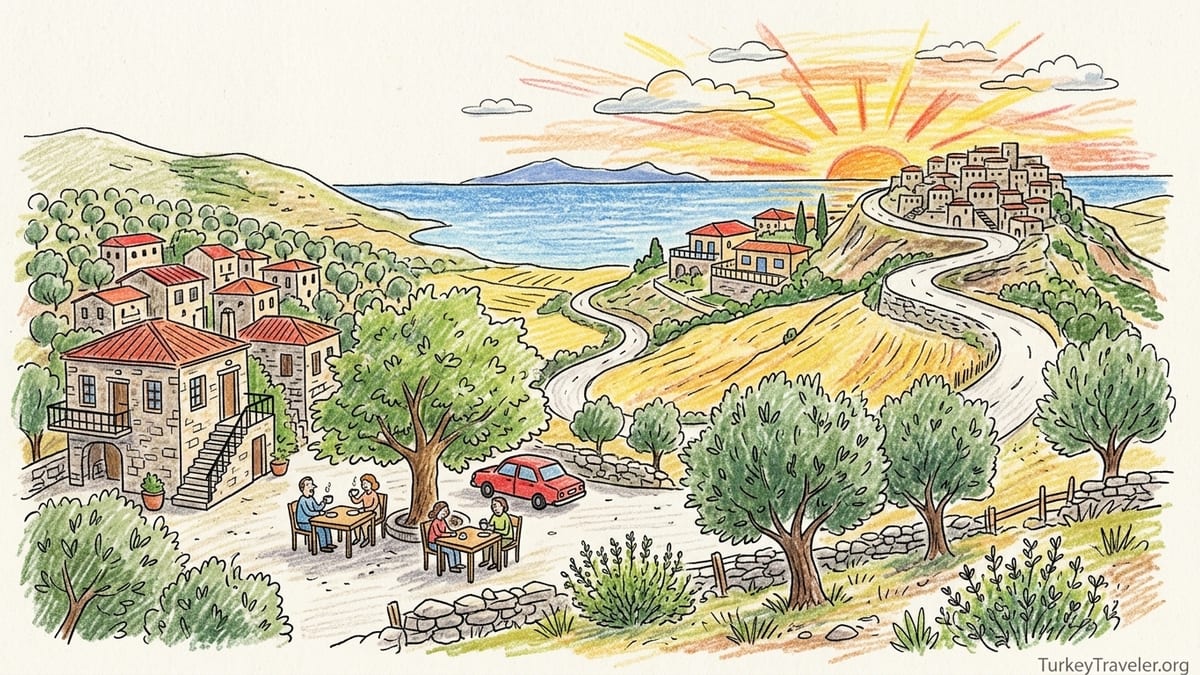
Imroz to Gökçeada: An Island of Layered Villages
Gökçeada sits off the coast of Çanakkale, reached by car ferry from the mainland port of Kabatepe to Kuzulimani on the island’s east. Historically known as Imroz or Imbros, it was home to a majority Greek population whose stone villages, churches and cobbled streets still structure the landscape, even though many residents left in the second half of the 20th century. Today around eleven thousand people live here year round, a mix of Turkish settlers from different regions and a smaller but visible Greek community who maintain homes, churches and seasonal businesses in villages such as Zeytinli, Tepeköy and Dereköy.
The five villages covered here Kaleköy, Zeytinli, Tepeköy, Bademli and Dereköy form a rough horseshoe around the island’s northern and western flanks. Distances between them are modest, generally 5 to 15 kilometres, but the roads are narrow, often with steep curves and strong winds on exposed ridges. This is an island to drive slowly. A full day is enough to see all five villages once, yet their character rewards lingering, whether you pause for coffee under plane trees, chase the last light from a hillside terrace, or wander abandoned stone lanes where fig trees grow from living room floors.
Culturally, the villages embody overlapping layers: Greek Orthodox churches sharing skylines with new mosques, Turkish coffee and Greek-style frappe ordered from the same counter, conversations switching between Turkish, Greek and, in summer, German or English. Architecture and layout are the most visible traces of this past. Two storey houses built in volcanic stone, external staircases to upper floors, shared washing fountains, communal squares edged with cafes, and chapels tucked into side alleys are common elements. Visitors are part of these living places, not just passing photographers.
Practically, having a car either brought over on the ferry or rented in Gökçeada town makes village hopping feasible. Public minibuses serve some routes in summer but are limited and rarely align with sunset or late dinners. Fuel is available in and around the main town, while charging points for electric vehicles are still scarce. Parking in most villages is informal, in dirt lots at the entrance or along the roadside, and in high season you may need to leave the car a few minutes’ walk below the historic cores. Sturdy shoes matter more than dressy outfits, and a light jacket is useful even in August once the meltemi wind starts sweeping the ridges.
Kaleköy: Liveliness, Castle Ruins and Sea-facing Sunsets
Kaleköy, also known as Kastro, is the most obviously lively of Gökçeada’s historic villages and the one where most travellers feel the shift from beach day to evening culture. It rises above the small harbour on the northeast coast, about 4 kilometres and a 10 minute drive from Gökçeada town and a similar distance from the ferry port. A main asphalt road brings you to a cluster of pensions, seafood restaurants and parking areas just below the older upper village, which crowns a rocky outcrop beneath the remains of a medieval Genoese and Byzantine castle.
The lower part of Kaleköy feels almost like a small resort village, with fish restaurants presenting trays of the day’s catch, meze counters and raki bottles on white-clothed tables along the waterfront. Above this, the upper village still has stone houses in various states of repair, narrow lanes and small chapels. Walking up from the harbour to the castle ruins takes about 10 to 15 minutes, partly on cobbles and partly on dirt paths, and rewards you with one of the island’s classic sunset views across the bay and towards the tiny islet off Yıldız Cove. On busy August evenings, locals and visitors alike gather along the castle wall or at simple bars that have set up wooden benches for the view.
Kaleköy’s architecture is less intact than in some protected villages, yet its mixed-use character is obvious. Traditional houses converted into guesthouses sit next to small shops selling local olive oil and thyme honey. Greek church towers rise among newer buildings, while old cisterns and a stone-lined cistern path recall the settlement’s strategic location above the harbour. Compared with quieter villages inland, Kaleköy is where you most easily feel the current rhythm of island life: fishing boats coming in, families eating outdoors until late, teenagers sharing ice cream on the quay, and service staff switching between Turkish and Greek as regulars arrive.
By car, Kaleköy is often the first stop for travellers who arrive on a morning ferry, drop bags at their accommodation, and then drive out for a late lunch and harbour walk. Parking in high season can be tight around the lower harbour; there is usually space slightly uphill by the roadside, from where you can walk down. Roads are paved and in reasonable condition, though narrow in places when buses or delivery trucks pass. It is entirely feasible to pair Kaleköy with Zeytinli and Bademli on a relaxed afternoon loop, returning after sunset, or to end a full island day here with dinner and the castle viewpoint.
Zeytinli: Café Culture, Stone Lanes and Everyday Greek Presence
A short drive west from Gökçeada town, Zeytinli also known by its Greek name Agioi Theodoroi sits on a gentle hillside amid olive groves. The distance from the town centre is roughly 3 kilometres, reached in about 7 minutes by car on a good though narrow asphalt road. Compared with Kaleköy’s harbour bustle, Zeytinli’s pull is its café culture and intact village layout, making it one of the best places to feel everyday life in a still-inhabited Greek-rooted settlement.
The heart of Zeytinli is a small square where stone houses lean close to cobbled lanes and several well known coffeehouses serve Turkish coffee, Greek-style frappe and, in summer, chilled mastika and homemade lemonade. One popular stop is a dibek coffee café where beans are pounded in a stone mortar before being brewed, producing a rich, thick cup served in small porcelain cups alongside a piece of lokum or homemade cookie. Prices as of 2024 are modest by European standards and even in peak season a coffee and dessert normally stays within an accessible range, which keeps the square full of both locals and visitors lingering under vines and grape arbors.
Architecturally, Zeytinli shows the typical two storey stone houses of Imroz villages, with rectangular or L-shaped plans, wooden shutters and external staircases leading to upper living floors. An Orthodox church with a walled courtyard and bell tower anchors one side of the settlement, and there are also small chapels, communal fountains and lanes where the original stone pavement survives. Laundry sometimes hangs above your head, cats trace the contour of roofs, and Greek and Turkish conversations drift from open doorways. It is important to remember that many of the houses are private homes or seasonal residences; taking photos is fine in public alleys, but pointing cameras directly into courtyards can feel intrusive.
Parking for Zeytinli is straightforward in the lower approach area, where visitors leave cars in an informal gravel lot or along the road before walking the last two or three minutes up into the square. The village can be combined easily with Bademli and Kaleköy on one loop, with driving times between each stop ranging from 5 to 15 minutes. Roads here are mostly in good shape, though some side streets are steep and not suitable for large campervans. Zeytinli does not have dramatic sea views, but it is one of the best places on the island to sit for an unhurried coffee, observe the mix of cultures that still shapes Imroz, and appreciate the texture of daily life beyond the beach.
Tepeköy: Hilltop Views, Festivals and Strong Village Form
Higher in elevation and slightly more remote, Tepeköy known in Greek as Agrídia stands on the western side of the island, roughly 10 to 12 kilometres from both Gökçeada town and Zeytinli, which translates to about a 20 minute drive. The road climbs steadily and in places quite steeply, with impressive views back across the island’s interior plateau and out to the Aegean. Drivers should expect some sharp bends and occasional livestock on the shoulder, but the surface is asphalt and maintained, making the trip comfortable for standard rental cars.
Tepeköy’s character feels more traditional than seaside Kaleköy and more rural than café-focused Zeytinli. Houses cluster along the slope, again mostly two storey stone structures with thick walls, small windows facing prevailing winds, and external steps leading to enclosed balconies. Narrow streets paved in stone thread between them, converging on a central square shaded by old plane trees. Here, a couple of tavern-style restaurants and cafés open from spring into late autumn, serving grilled meat, fresh salads, village bread, and simple dishes built from local produce. In August, Tepeköy becomes particularly animated around the Feast of the Dormition on August 15, when diaspora Greeks return, religious services are held at the village church, and long tables appear under the trees for music and shared meals.
The generous views are one of Tepeköy’s main draws. From streets on the upper edge of the village, you can look west to the sea and south toward the island’s interior highlands. At sunset the horizon glows deep orange, and some visitors prefer this vantage point to crowded castle walls in Kaleköy. Tepeköy feels less commercialized; you are more likely to see older residents sitting outside houses, chatting in Greek, than souvenir shops. There is a sense of a village that emptied and then partially revived as people returned to restore houses as summer homes, which gives it a slightly seasonal rhythm.
Parking is typically at the entrance or along the main road just below the square. On busy festival days space can be limited, and you may need to park further down and walk uphill for 5 to 10 minutes. Tepeköy combines well with Dereköy on a western circuit, with about 8 to 10 kilometres between them along a partly winding but paved road. Travellers with one full day can time a late lunch in Tepeköy, continue to explore Dereköy’s ghostly streets in the cooler late afternoon, and then return either to town or across to Kaleköy for a second sunset viewpoint.
Bademli: Intimate Stone Village With Sea-facing Terraces
Bademli, often called Eski Bademli to distinguish it from newer settlements, sits on a ridge between Gökçeada town and the northern coves, about 4 kilometres or a 7 to 10 minute drive from the town centre. The approach road winds gently upward and then levels as you reach a compact stone village with one of the island’s most photogenic outlooks over the sea and towards Samothrace on the horizon. In contrast to livelier Kaleköy or festival-filled Tepeköy, Bademli offers a quieter, more intimate atmosphere with a handful of pensions and cafés rather than a full restaurant strip.
The village core is a tight cluster of stone houses, again predominantly two storey, with a mix of restored and semi-ruined façades. Narrow alleys, arches and staircases open onto small courtyards, some of which have been converted into guesthouse terraces or tiny garden restaurants. There is an old school building, an Orthodox church, and public fountains that recall the shared water infrastructure of earlier decades. Bademli’s position on a ridge means that many lanes suddenly frame broad sea views, especially as evening approaches and the light flattens into silver across the water.
Several small cafés and pensions in Bademli now highlight the view in their design, setting up simple wooden tables or cushioned benches facing north and west. Ordering a coffee or a glass of local wine here is not merely a pause; it is the main activity, as clouds drift past and the island’s northern coast reveals its contour. Prices are generally moderate, with snacks and drinks comparable to or slightly below those in Kaleköy’s waterfront establishments, and open hours usually stretch from late morning into late evening during the main season from June through September. In shoulder seasons, some businesses may open mainly on weekends, so it is worth asking in town before planning a sunset outing specifically around a certain café.
Parking for Bademli is on the outskirts, where a small pull-off and roadside space allow you to leave the car and walk into the core in a few minutes. Streets inside the village are too narrow for comfortable driving and better experienced on foot. Bademli combines very easily with Zeytinli and Kaleköy in a single afternoon loop, with each leg between 5 and 10 minutes of driving. It is an ideal stop for travellers who enjoy architecture and views but prefer a calm, small-scale setting to heavy crowds. While there are not many individual “attractions” to tick off, the overall atmosphere is precisely what makes the village worth a lingering coffee or slow photography walk.
Dereköy: Ghost Village, Silent Architecture and Time Needed
Dereköy, sometimes referred to by its Greek name Schinoudi, lies toward the western side of Gökçeada, about 12 to 15 kilometres from the main town and 8 to 10 kilometres from Tepeköy. The road from town first crosses the island’s plateau and then descends gently through fields before the first stone houses rise on either side. At one time Dereköy was among the largest and wealthiest villages on Imroz, with nearly two thousand households, multiple coffeehouses, two cinemas, an olive oil factory and extensive terraced agriculture. Today, many of those stone buildings stand roofless, with trees and vines threading through windows, which has given Dereköy its reputation as a “ghost village.”
Walking Dereköy’s deserted lanes is a different experience from visiting the other villages and deserves time measured in unhurried hours rather than a quick roadside stop. The architecture is impressive and often still monumental, even in disrepair: long rows of two storey houses in local stone, once containing shops, storage rooms and living quarters; public laundries with vaulted roofs where village women used to gather; and large churches and chapels whose bell towers still punctuate the skyline. Studies of the village’s built fabric highlight its significance as a preserved rural landscape, despite the ongoing challenges of abandonment and incomplete conservation plans.
In recent years, some taverns and small guesthouses have opened in or near Dereköy, and a handful of homes have been restored, often by families with roots in the village who now use them as summer houses. Even so, you may meet relatively few people while exploring, especially outside August, which makes it essential to move respectfully. Many ruined houses remain private property, and entering unstable structures is risky as well as potentially disrespectful. Better to stay on lanes and in open spaces, using your walk to read the landscape: the alignment of houses along former commercial streets, the location of the olive oil mill, the position of fountains that still carry water.
Parking is easiest at the entrance to the inhabited part of the village, where there is space to leave several cars by the roadside or near small businesses. From there, you can follow streets on foot deeper into the abandoned quarters. Allow at least an hour simply to wander, and more if you want to photograph, sit at a café or taverna, or walk further toward nearby coves such as Laz Bay after your village visit. Dereköy’s size and atmosphere warrant different timing from compact Kaleköy: rather than a quick dinner-and-sunset pair, it offers a slow encounter with history in which silence, empty squares and weathered stone are the main impressions.
Driving, Road Conditions and How Villages Connect
The spatial relationship between these five villages shapes how you experience them. Starting from Gökçeada town, Zeytinli and Bademli form a close pair on the slopes immediately to the west and north, each about 3 to 4 kilometres away on paved, if narrow, roads. From there, Kaleköy sits roughly to the northeast, another 4 kilometres along a main road that also connects to the ferry port and northern coves. Tepeköy and Dereköy are further west and southwest, set 10 to 15 kilometres from town depending on the route, with a paved link between them forming a natural loop.
Road conditions are generally sound, with asphalt surfaces and clear basic signage, though visitors should not expect large highways. Many segments are single lane in each direction with limited shoulders, and in peak summer traffic can slow as cars park informally near village entrances and beach turnoffs. The island is known for strong winds, particularly the meltemi in summer, which can add a lateral push on exposed ridges, so it is wise to keep both hands on the wheel and avoid sudden overtaking. At night, street lighting is sparse outside towns and villages, and wandering animals sometimes cross, so cautious driving is important after late dinners in Kaleköy or Tepeköy.
Parking practices are pragmatic. In Kaleköy, you will often find cars lined up along the last stretch before the harbour, and in very busy periods you may need to accept a 5 to 10 minute walk up or down. In Zeytinli and Bademli, small informal lots or widened roadside areas serve visitors, and locals are used to helping direct traffic to avoid blocking access for residents. Tepeköy and Dereköy have more space but fewer marked spots; aim to park where your vehicle does not narrow the main road or cover access to paths and gates. Even if you see others squeezing into awkward gaps, err on the side of caution and courtesy in these small communities.
Combining villages in a single outing is not only possible but often the most satisfying way to experience the island’s variety. One realistic circuit can run from town to Zeytinli for mid-morning coffee, then to Bademli for a short walk and daytime views, continuing to Kaleköy’s harbour for a swim or lunch, before returning via town. Another route takes you across to Tepeköy and Dereköy for an afternoon of hilltop panoramas and ghost-village exploration, finishing either with a simple tavern dinner in Tepeköy or a late drive back toward Kaleköy for a second sunset viewpoint. Because no single leg between these villages exceeds about 25 minutes of driving, fatigue is more about sensory overload than time behind the wheel.
Culture, Architecture and Visiting With Respect
Moving through Gökçeada’s villages is not only a journey between viewpoints but also an encounter with a complex history. The shift from the name Imroz to Gökçeada mirrors deeper changes, including population movements, property transfers and evolving identities. Many of the stone houses, churches and public buildings you see in these villages were built by Greek Orthodox communities over centuries, often with local volcanic stone and techniques adapted to the windy, seismic environment. Later waves of residents from other parts of Turkey brought their own customs and building practices, and in recent decades diaspora families have returned seasonally, restoring some homes while others continue to decay.
The architecture expresses this layered story. Houses are typically rectangular or L-shaped, often two storeys high, with simple facades, thick masonry walls and wooden shutters. Ground floors historically held storage, stables or shops, while upper floors contained living areas accessed by exterior stairs or internal ladders. Squares were not purely picturesque objects but working spaces: places for markets, coffeehouses, festivals and decision-making, surrounded by churches, chapels, fountains, laundries and, in some villages, schools, small factories and olive oil workshops. Stone-paved streets, sloping gently for drainage, knit these functions together, and in places such as Zeytinli and Tepeköy you can still trace these patterns almost intact.
As a visitor, it helps to remember that these are not open-air museums created for tourism, even when parts of Dereköy look almost frozen in time. People still attend services in churches, maintain graves in cemeteries, argue over renovation styles, and debate how much to open their communities to outsiders. Asking before photographing individuals, avoiding drones without local consent, and not entering obviously private courtyards are simple ways to show respect. In small cafés, a short conversation about where you are from and how you came to the island can open space for residents to share their own stories of Imroz, Gökçeada, and the changes they have seen.
Commerce also shapes the experience. In Kaleköy and, to a lesser extent, Zeytinli, you will find menus printed in Turkish, Greek and sometimes English or German, with grilled fish priced by weight, meze plates listed individually, and house wines or ouzo poured in modest carafes. In Bademli and Tepeköy, offerings can be simpler and more seasonal: grilled lamb or goat, local cheese, tomatoes and cucumbers grown in nearby gardens, and desserts such as baked halva or homemade spoon sweets. Paying in cash is still common, especially in smaller establishments, although card payment has become more widespread by 2024. Tipping a little above the included service, when present, is appreciated but not compulsory.
One-day and Two-day Village Circuits
With only one full day, it is tempting to try to “do” all five villages, but timing them by character rather than simply by map can significantly improve your experience. A realistic one day route might start in Gökçeada town after breakfast, driving first to Zeytinli mid-morning. Spend an hour in the main square, order dibek coffee and a small pastry, and wander two or three cobbled lanes to observe the stone houses and church courtyard. From Zeytinli, continue up to Bademli for late morning views. Park at the entrance, walk into the core, and give yourself at least thirty to forty minutes to explore the alleys and perhaps sit for a short second coffee or a lemonade on a terrace facing the sea.
By early afternoon, drive across to Tepeköy, arriving in time for lunch in the central square. Choose a tavern-style restaurant, sample grilled meat or a vegetarian plate, and then walk up the village’s higher streets for panoramic views and a look at its churches and stone houses. Allow around two hours in Tepeköy if you enjoy architecture and photography. In mid to late afternoon, descend to Dereköy while there is still good light. Park at the entrance and follow your curiosity along a few deserted streets, visiting the public laundry, observing ruined houses and chapels, and absorbing the atmosphere. Aim for at least ninety minutes here; rushing Dereköy misses its quiet power. As evening approaches, drive back across the island to Kaleköy, have a simple seafood dinner by the harbour and climb to the castle remnants or upper village paths for sunset.
For travellers with two days, the same elements can be stretched into a much more relaxed circuit. On day one, focus on the eastern trio. Start with Zeytinli late morning, linger over coffee and conversations, and then move to Bademli for a slow exploration of its alleys and a long lunch with sea views. In the afternoon, descend to Kaleköy, explore both lower and upper parts in daylight, swim or sit by the harbour, and then claim a vantage point on the castle hill well before sunset. Stay overnight in Kaleköy or nearby, giving yourself the chance to see the village both in lively evening mode and in quieter early morning.
On day two, dedicate your time to Tepeköy and Dereköy. Drive west mid-morning, reaching Tepeköy in time for a stroll through its lanes and a simple lunch in the square. In the early afternoon, when light begins to soften, head to Dereköy and treat it as an open-ended walk rather than a checklist. Sit at one of the small cafés or taverns, if open, then wander through several different streets to see how the village fans out across the hillside. Pay attention to details such as carved stone lintels, remnants of shop signs, and the way vegetation is reclaiming certain structures. If you still have energy and daylight, consider a detour from Dereköy toward a nearby cove for a short coastal pause before returning to town.
In this slower plan, each village gets the attention it merits. Zeytinli is where you linger over coffee, Bademli where you breathe with the view, Kaleköy where you embrace convivial evenings, Tepeköy where you balance architecture with wide horizons, and Dereköy where history and silence ask you to walk slowly. Together, they form a network that tells the story of Imroz and Gökçeada more vividly than any single beach or viewpoint ever could.
FAQ
Q1. Do I need a car to visit Gökçeada’s villages in one or two days?
It is strongly recommended to have a car, either brought on the ferry or rented on the island. Distances between villages are 5 to 15 kilometres, roads are narrow and hilly, and public transport is limited and does not reliably match sunset or dinner times.
Q2. Which village on Gökçeada feels the liveliest for evenings?
Kaleköy is the liveliest, especially in summer evenings. Its harbour restaurants, bars and the walk up to the castle viewpoint create a steady flow of people, making it a good base for dinner and sunset.
Q3. Where is the best place for sunset in the villages?
Kaleköy’s castle hill offers classic sea-facing sunsets over the harbour, while Tepeköy’s upper streets provide wide views west and south with fewer crowds. Bademli also has appealing terrace views, though on a smaller scale.
Q4. Which village has the strongest sense of historic Greek architecture?
Zeytinli, Tepeköy and Dereköy all retain strong Greek architectural character in their stone houses, churches and street layouts. Dereköy is particularly striking for its scale and partially abandoned fabric, while Zeytinli and Tepeköy combine preserved buildings with active community life.
Q5. Is Dereköy safe to explore given its abandoned houses?
Dereköy is generally safe to explore if you stick to streets and open spaces. Many houses are structurally unstable, so it is wise not to enter ruined buildings or climb on walls. Respect private property and use caution with loose stones underfoot.
Q6. Can I visit all five villages in one day without rushing?
It is possible to see all five in one long day, but you will need to keep an eye on time. A more relaxed trip gives each stop at least an hour. If you only have one day, consider shorter visits in Bademli and perhaps a quicker walk in one of the villages, saving a deeper exploration for a future trip.
Q7. How is parking in the villages during peak summer?
Parking is informal and can be tight in August, especially in Kaleköy and Zeytinli. Arriving earlier in the day or before the dinner rush helps. In most villages you park on the outskirts or along the road and walk in for a few minutes.
Q8. Are the villages open year round, and will cafés be operating outside summer?
The villages themselves are inhabited year round, but many cafés and taverns reduce hours or close completely outside the main season from roughly June to September. In spring and autumn more places open on weekends than weekdays, so it is wise to check locally.
Q9. How should I behave respectfully in these multicultural villages?
Dress modestly enough for village life, ask before photographing people, avoid intruding into church services, and do not enter private courtyards or clearly marked properties. Simple greetings and small purchases in cafés support local businesses and open friendly conversations.
Q10. Is it better to stay overnight in a village or in Gökçeada town?
Staying in Kaleköy, Zeytinli or Bademli gives you atmospheric evenings, while Gökçeada town offers more practical services and central access to all routes. Many travellers choose a mix, with at least one night in a historic village for the quieter early morning and late-night mood.