


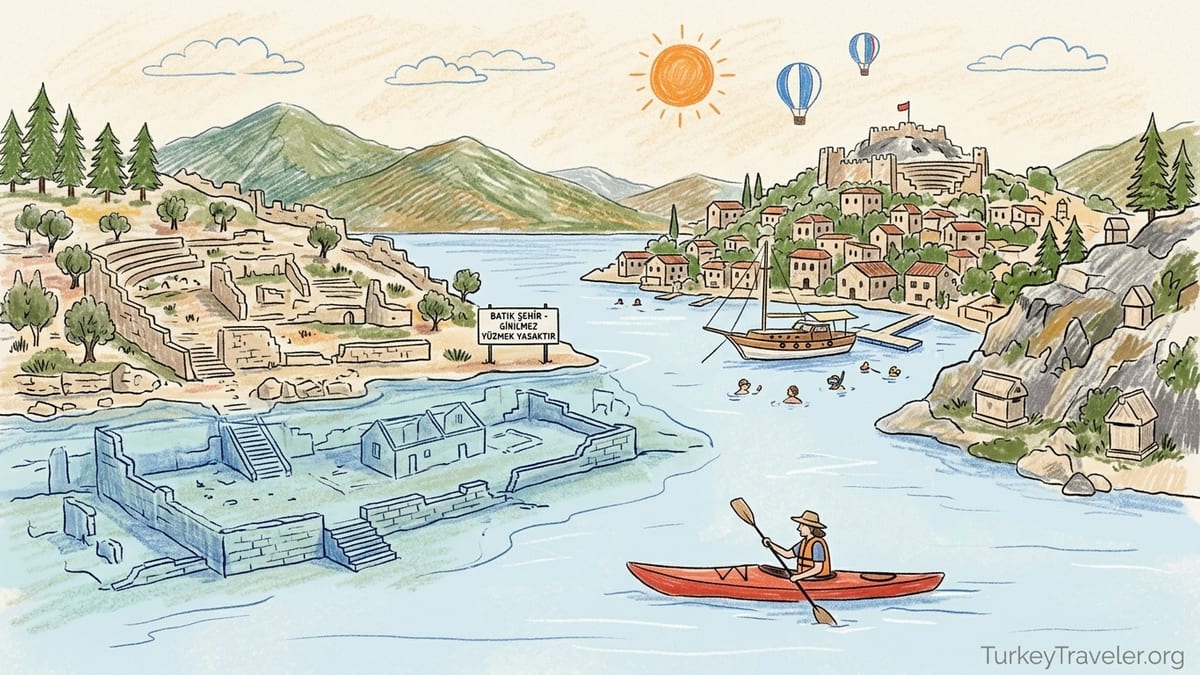
Kekova Island, off Türkiye’s Turquoise Coast between Kaş and Demre, offers one of the country’s most distinctive archaeological seascapes. Along the sheltered northern shore of the island, the remains of an ancient Lycian settlement lie partly submerged, its terraces, walls and stairways slipping into clear, blue-green water. Modern marketing often calls it the “Kekova Sunken City,” and both tour boats and guided sea kayaks trace the same narrow channel so visitors can look straight down onto the ruins. This is not a theme-park ruin or a scuba playground. It is a legally protected archaeological zone inside a wider marine reserve, and the experience is shaped as much by regulations, light and sea conditions as by history itself.
Understanding Kekova and Its Protected Status
Kekova is a small, elongated island in Antalya province, facing the mainland villages of Kaleköy, also known by its ancient name Simena, and Üçağız, once the Lycian port of Teimiussa. The island and its inshore waters form part of the Kaş–Kekova Specially Protected Area, first declared in 1990 to safeguard marine ecosystems and an exceptional concentration of coastal archaeology. Within this wider reserve, the submerged ancient settlement along Kekova’s northern shore holds first-degree archaeological site status under Turkish heritage law. That is the strictest category, comparable to a museum without walls.
Protection here is not theoretical. Turkish regulations treat the ruins as an underwater extension of a land excavation. The archaeological strip is zoned to prohibit swimming, snorkelling, scuba diving and anchoring directly over the remains. Local captains and kayak guides are licensed on the understanding that they keep to a fixed transit lane, move slowly and keep visitors on the surface. The coastguard patrols the channel, and fines or tour suspensions are real risks for operators who disregard the rules. This is why you will often hear some version of “you cannot swim here, it is forbidden” as your boat throttles back by the ruins.
For visitors, the protected status has two direct consequences. First, the underwater view is limited to what you can see from a boat deck or the surface of a kayak. You will not be allowed to slip over the side to snorkel above staircases or swim through doorways. Second, the very fact that access is controlled means there is still something to see. Compared with unprotected Mediterranean shorelines where looting, souvenir hunting and careless anchoring have stripped out detail over decades, Kekova still shows continuous terraces, harbor structures and long stretches of straight masonry exactly because hands and fins have been kept off them.
The protection regime can occasionally feel strict to travelers who arrive expecting a more open-ended adventure. Yet if you approach the sunken city as an outdoor museum and remember you are a guest inside a fragile archaeological corridor, the limitations make more sense. They also help frame the key practical choice: whether to see Kekova from a standard boat tour or from a guided sea kayak, both of which operate under the same rules but deliver a different style of experience.
Boat Tours from Kaş, Demre and Üçağız
Standard Kekova boat tours remain the most popular way to visit the sunken city, and they come in several flavors depending on departure point. From Kaş, roughly 20 to 25 nautical miles to the west, operators typically run full-day itineraries that include a bus transfer across the peninsula to the small port of Üçağız or Çayağzı near Demre, then a six to eight hour cruise across the Kekova lagoon. Packages promoted by agencies in Kaş often start in the region of 65 euros per person for small-group days that combine Kekova Island with the rock tombs of Myra and the church of St Nicholas, lunch included.
From Demre and Üçağız themselves, the pattern changes. Here, a cluster of family-run boats offer a mix of shared and private tours focused solely on the Kekova archipelago. Shared day trips around the lagoon, including the sunken city transit and swimming stops in bays like Tersane, Aquarium or Çamlık, commonly start around 1,250 to 1,500 Turkish lira per adult for 2026, with lunch and tea on board. Private full-day charters for a group of six to twelve people generally run from about 25,000 lira per boat at current published rates, moving upward for longer itineraries or dinner-return options.
Most full-day itineraries from these closer ports trace a similar loop. Boats leave mid-morning, motor east or west along the sheltered channel, slow to a crawl over the sunken city itself so passengers can line the starboard rail, then continue to the car-free village of Kaleköy for an onshore break. Afterwards, they work through a sequence of coves and inlets on the seaward side of the archipelago, stopping two or three times for swimming and snorkelling where it is allowed. The atmosphere on shared trips is relaxed and social, with music sometimes playing on deck, plastic glasses of tea circulating and families, couples and local groups mixing in the shaded stern.
For many travelers based in Kaş, Demre or the larger resorts around Antalya, a day on a Kekova tour boat is as much about swimming and scenery as archaeology. Timetables are fixed by the need to be back in harbor before sunset, a coastguard rule rather than simply an operator preference. That means most boats pass over the sunken city between late morning and mid-afternoon, when light is strong but crowds are heaviest. On some high-season days in July or August, a visitor looking across the channel from Kaleköy castle will see a line of wooden excursion boats queuing along the same narrow strip of water, each drifting for ten or fifteen minutes above the ruins before nudging onward.
Guided Sea Kayak Trips and How They Differ
Guided sea-kayak trips at Kekova follow a broadly similar route to the boat tours but on a very different scale. Most operators base themselves in Üçağız, launching sit-on-top or closed-cockpit kayaks from the small village harbor or a nearby pebble beach. Some Kaş companies include a minibus transfer across the hills, then meet their guests at the waterline with kayaks already set out. Many tours are half-day outings of three to four hours on the water, while a few companies offer longer full-day programs that include a late lunch and extra swimming stops.
The defining difference is group size and pace. Where a shared wooden tour boat might carry 20 to 40 passengers, a typical guided kayak group runs with six to twelve paddlers plus one or two instructors. After a basic shore briefing on paddle technique, safety and the day’s route, the group sets out in single or double kayaks, hugging the mainland coast to stay out of any chop before crossing the sheltered channel toward Kekova Island. Progress is deliberate rather than rushed, with guides adjusting speed to suit the least experienced paddlers and allowing time to drift quietly over features of interest.
In the sunken city zone itself, kayaks enjoy one key privilege. While they share the same transit lane and are equally banned from stopping dead or letting people swim, they can move more slowly and closer to the rocks without damaging the site. Guides often arrange the group into a long, thin line, then let paddlers pause their strokes and simply glide forward. Instead of craning over a crowded rail, you sit a few centimeters above the surface with no engine noise or diesel smell, looking almost vertically down into the water. For many visitors, the silence and low perspective make the difference between glimpsing a scatter of stones and actually reading the profile of a drowned terrace or staircase.
Sea-kayak itineraries also tend to reach Kaleköy at slightly different hours than the main boat flotillas. Some companies time their stops so that castle visits and ice-cream breaks fall either mid-morning or late in the afternoon, when the village lanes are quieter. Others design routes that include a swim or snorkel in one of the side bays where the ruins are minimal and therefore not restricted. Prices for guided sea kayaking over Kekova’s sunken city, including equipment, guiding and usually a simple lunch or snack, are widely advertised from around 55 euros per person for 2026. That puts them slightly higher than the cheapest shared boat tours but well below private charters.
What You Actually See Underwater
For all the romantic marketing language about a “sunken city,” the visible ruins along Kekova’s north shore are subtle and linear rather than spectacularly vertical. You are not looking down on the Colosseum or a row of intact temples. You are looking sideways at what was once a coastal street-front, warped and tilted by earthquakes over the centuries so that some doorways now sit at the current waterline while other rooms and courtyards have slid below.
From a boat or kayak on a clear, calm day, you can usually pick out long, straight wall lines running just beneath the surface, especially where algae growth highlights their edges against the pale seabed. Flights of stone steps descend into water, ending abruptly in blue space. Rectangular outlines of rooms and terraces overlap one another like a faint architectural drawing. There are the worn stumps of jetties and harbor platforms, where iron mooring rings once tied ships from across the eastern Mediterranean. In shallower patches you may see pottery shards embedded in the seabed, although local guides are careful to emphasise that nothing should ever be touched, let alone lifted.
The level of detail you see depends heavily on light and sea state. On a bright morning in early summer, with the sun high enough to penetrate at a steep angle but before afternoon winds roughen the surface, visibility can be striking. Passengers sitting on the low bow of a modest tour boat or in kayaks directly above the ruins often report that the town plan “suddenly snaps into focus,” as if someone has traced the lines with dark ink. In contrast, on a windy afternoon when small whitecaps dimple the channel, the glare and constant surface movement can reduce the view to pale smudges or nothing at all, regardless of how good your eyes are.
It is important to calibrate expectations against other, more immersive archaeological experiences along the coast. At Aperlai, a quieter bay further west within the same region, swimmers are allowed to snorkel above half-submerged harbor ruins. At historic wreck sites accessible to divers from Kaş, there are amphora fields and relics at scuba depth. Kekova’s sunken city is crucially different. It is about intact context and coastline rather than individual objects, and you witness it from the surface, looking down, within a tightly managed zone. Travellers who understand that in advance tend to appreciate what they see much more than those who arrive expecting a lost Atlantis below the keel.
Routes, Sea Conditions and Swimming Stops
The basic geography of the Kekova lagoon makes this a relatively gentle sea environment, but conditions still shape the day. The narrow channel between Üçağız on the mainland and Kekova Island forms a semi-enclosed, almost fjord-like stretch of water sheltered from full Mediterranean swell. Winds tend to be lighter in the morning, especially outside the high summer meltemi pattern, and build a light chop through the early afternoon. Water temperatures in the main Kekova season from May to October commonly range from the low twenties to high twenties Celsius, warming toward August and September.
Typical boat-tour routes cover between 15 and 25 kilometers over the course of a full day, though passengers rarely feel that distance as more than an easy sequence of motoring and swimming. The core elements are a slow pass along the sunken city zone on the island’s north shore, a stop at Kaleköy village, and one or more swimming halts in coves like Tersane Bay, famed for its combination of clear water and scattered shoreline ruins of a Byzantine-era shipyard. Many full-day itineraries add an offshore stop at Aquarium Bay or the open side of Kekova Island, where water clarity can be exceptional on still days and depth drops away sharply from rocky ledges.
Kayak routes are naturally shorter in distance but more intimate in feel. A common three to four hour route from Üçağız logs roughly seven to ten kilometers of paddling. Groups typically follow the mainland shoreline past stone sarcophagi and rock-cut tombs, cross the channel at its narrowest point, then run westward in single file above the sunken city before looping back via Kaleköy for a rest and optional castle climb. Some operators offer a slightly longer variant that adds a swim in a side bay where anchoring and entering the water are permitted.
Whether you travel by boat or kayak, it helps to understand where you may and may not swim. Swimming, snorkelling and diving are prohibited directly above the sunken city and in the archaeologically zoned corridor along that stretch of island. Captains are expected to keep moving, and even dropping a mask and fins over the side to peer more closely is discouraged. In contrast, swimming is not only allowed but positively encouraged at designated stops away from the dense ruin zone. On warm days, the most popular bays hum with activity as people dive from deck rails, float on pool noodles and explore the rocky edges with masks and snorkels. If swimming time is a priority for you, it is worth clarifying with your chosen operator in advance how many swim stops are planned and at what sort of bays.
Rules, Respect and Why You Cannot Dive Here
Many first-time visitors are surprised to learn that Kekova’s sunken city is not a conventional scuba site, given Türkiye’s strong reputation for diving around Kaş and elsewhere on the Turquoise Coast. The restriction stems from a combination of legal protection categories and practical conservation. Turkish heritage regulations treat the submerged ruins as a first-degree archaeological site. That designation rules out unsupervised underwater access, artifact removal, and contact with structural remains. Within the broader Kaş–Kekova Specially Protected Area, management plans have also identified zones where both recreational and spearfishing dives are forbidden to reduce pressure on fragile habitats and historical material.
For the average visitor, these rules translate into a clear set of do-nots. You may not jump into the water over the ruins, however calm the sea or tempting the staircases below. You may not snorkel or free-dive along the ancient quay line. You may not drop anchor onto the archaeological strip, even if your boat is a small rented craft. Removing amphora fragments or other objects from the seabed anywhere in the reserve is illegal and can carry serious penalties, including fines and confiscation of vessels or equipment. Coastguard and gendarmerie patrols have the authority to board tourist boats and check compliance, and they do so with some regularity in high season.
At the same time, there are clear allowances. Powered boats with licensed captains are permitted to transit the sunken city corridor at reduced speed so passengers can look down into the water. Guided sea-kayak groups are explicitly allowed to paddle across the same corridor, provided they keep moving gently forward and do not let people enter the water. Photography from the surface is fully permitted, and many guides will point out particular features or suggest angles where the geometry of walls and steps is easiest to capture.
Respect in this context means more than simply staying on board. It means resisting the impulse to pressure your captain for a “secret” swim stop over the ruins or to lean out with a selfie stick that risks dropping into the site. It means walking carefully around exposed masonry and sarcophagi on shore, particularly at Kaleköy and Tersane, where low walls and thresholds are still in situ. It also means recognising that rules about loud music volumes, drone flights and plastic waste exist to preserve not only archaeology but also the atmosphere that most visitors travel so far to find. When you choose a quieter operator, leave glass bottles at home or pack your own rubbish, you are effectively voting for a less intrusive version of mass tourism in a sensitive zone.
Crowds, Sun Exposure and Timing Your Trip
Because the Kekova lagoon is relatively compact, crowding is very visible in high season. On a peak August Saturday, dozens of wooden excursion boats, small gulets and private craft may work the same circuit between Üçağız, Kaleköy and the bays. At the narrowest point of the sunken city corridor, only one or two large boats can drift side by side without feeling cramped, so a kind of informal queue forms as captains slow to give their guests a view then move on. Noise carries easily over water, and the combination of engine hum, shouted instructions and music from some decks can erode the sense of quiet contemplation you might hope for at an archaeological site.
Smaller-group or early departures can change that dynamic substantially. Boats leaving Üçağız around 9:00 in the morning may be the first to reach the ruins while the channel is still empty and the sun low enough to reveal relief without harsh glare. Certain kayak operators deliberately meet their guests even earlier, allowing for a 7:30 or 8:00 launch so that the group glides over the sunken city before the first big excursion boat has left harbor. In those conditions, the water is usually glassy, sound levels are low and the mood can feel almost private. For travelers who care more about atmosphere than beach-party energy, those early hours are often worth the earlier alarm.
Sun exposure is another practical concern. The Kekova lagoon offers very little natural shade once you leave the ports. Many boats provide a canvas awning or fixed roof over their aft deck, but the bow, upper decks and rails where people crowd to see the ruins are exposed through most of the day. Light reflects off the water, increasing UV levels. On kayaks, this effect is even stronger because you sit low on the surface with your legs and arms fully exposed. Sunscreen, sunglasses, a hat with a strap and a light long-sleeve shirt can make the difference between a pleasant day and mild sunstroke.
Seasonality shapes both crowds and clarity. From late May through September, the bulk of regional tourism is concentrated on beach resorts, and Kekova boat tours run daily or near-daily from all three main departure points. Water is warm, but afternoons can be windy, and late-summer haze occasionally dulls underwater contrast. In April, early May and October, the number of daily departures drops, and you may find only a handful of boats moving across the lagoon even at midday. On the other hand, some smaller operators reduce or suspend services outside the core months, especially for kayaking, so advance checking becomes more important. In winter, only sporadic local trips run on days of settled weather.
Choosing Between Boat Tour and Sea Kayak
Deciding how to experience Kekova’s sunken city is as much about your own travel style as it is about budget or fitness. Standard shared boat tours are the most accessible option. They work well for mixed-ability groups, older travelers and families with younger children who may want frequent shade, toilets on board and ample space to move around. On a well-run mid-sized boat with a reputation for calmer, quieter trips, you can still enjoy a focused archaeological moment over the ruins followed by lazy swimming in clear bays, all without needing to paddle or worry about balance.
Sea kayaking suits a different temperament. If you enjoy active days, are comfortable in and on the water and like the idea of hearing the scrape of your paddle rather than an engine, a guided kayak tour offers a more immersive connection with the landscape. Basic paddling fitness is enough; most operators design their itineraries and group speeds for beginners rather than seasoned expedition kayakers. Because group sizes are small, there is more scope to ask questions about history and ecology, and guides often have a background in outdoor education or local archaeology.
Cost differences narrow once you factor in quality. The cheapest high-capacity boat tours from large resorts may undercut sea-kayak outings on headline price, but they also bring more people, louder music and stricter schedules. In contrast, a small-group boat tour from Üçağız or Demre that caps numbers at a dozen or so and includes a guide with strong English or German can price very close to a kayak trip yet deliver a quieter, more interpretive day. If your interest is specifically the ruins, rather than swimming, it is worth actively asking tour agencies about group size, guiding style and how much commentary on Kekova’s archaeology you can expect.
Whichever option you choose, simple preparation improves the experience. Pack polarized sunglasses, which cut surface glare and make underwater lines much easier to see. Bring a towel and swimsuit even if you are not a strong swimmer; swim stops in permitted bays are flexible, and many people simply float near the boat’s ladder. Consider motion-sickness precautions if you are prone to nausea, especially for afternoon departures when chop can build. Finally, remember cash for Kaleköy, where the castle entrance fee and small cafes typically operate on a cash basis rather than cards.
The Takeaway
For boat-tour travelers who mainly want a scenic Mediterranean day with a touch of history, a shared Kekova cruise from Kaş, Demre or Üçağız offers good value and minimal effort. You will see the sunken city from the rail, walk the steep lanes of Kaleköy up to its castle, and swim from the boat in bays with luminous water. If that sounds like your ideal balance, choose a reputable operator with moderate group sizes, ask about how long they linger over the ruins, and favor morning departures for calmer seas and clearer views.
Active kayakers and travelers who like to earn their panoramas will likely find guided sea kayaking the most satisfying way to explore the lagoon. Paddling across the channel at water level, drifting quietly over the submerged streets and arriving under your own power at Kaleköy give the day a sense of narrative and achievement that larger boats cannot easily match. Early-morning kayak departures in particular combine the best light, the quietest water and the most contemplative mood at the sunken city.
Families, especially those with small children or non-swimmers, may gravitate naturally toward mid-sized boats with shade, toilets and easy ladders into the water. Here, the key variables are noise and crowding. A vessel that carries two dozen people and keeps music low allows children to nap, older relatives to sit comfortably and everyone to take turns at the rail without jostling. In contrast, very large party-style excursion boats can feel overwhelming for those hoping to discuss Lycian history or simply enjoy the sound of the sea.
Travelers whose primary interest is archaeology rather than swimming should be selective rather than assuming any Kekova-branded outing will meet their expectations. The best match is often a small-group boat or kayak tour marketed specifically for history and culture, where the guide is prepared to explain not only what you see under the water but also how the ancient settlement related to Myra, Simena and the wider Lycian world. Combined with a careful choice of timing to avoid the midday flotilla, such trips can deliver a surprisingly nuanced sense of place in a landscape that might otherwise blur into another pretty bay.
FAQ
Q1. Can you swim or snorkel directly over the Kekova sunken city?
No. Swimming, snorkelling and scuba diving are prohibited directly above the ruins, which are part of a protected archaeological zone. Boats and kayaks must keep moving through the corridor and visitors must stay on board.
Q2. Is sea kayaking at Kekova suitable for beginners?
Yes, most guided sea-kayak tours are designed for beginners with basic fitness. Routes are relatively short, guides give a land-based briefing first, and groups move at the pace of the least experienced paddler.
Q3. How much do Kekova boat tours cost from Kaş or Üçağız?
As of 2026, small-group day trips that include Kekova from Kaş typically start around 65 euros per person, while shared day boats from Üçağız often begin around 1,250 to 1,500 Turkish lira per adult, including lunch.
Q4. What is the best time of day to see the ruins clearly?
Morning usually offers the calmest water and clearest visibility. Early departures that reach the sunken city before late-morning crowds often enjoy glassy surfaces and less glare.
Q5. Are there toilets and shade on Kekova boats and kayaks?
Most tour boats provide toilets and shaded seating areas, especially over the aft deck. Sea kayaks do not have facilities or built-in shade, so kayak tours include planned shore breaks and require more sun protection from participants.
Q6. Can I visit Kaleköy (Simena) on both boat and kayak tours?
Yes. Many Kekova itineraries, whether by tour boat or kayak, include a stop at Kaleköy, where you can climb to the castle, visit the small theatre and see sarcophagi scattered through the village.
Q7. Do I need to be a strong swimmer to enjoy a Kekova tour?
Not necessarily. You can stay on board during swim stops, and lifejackets are usually available. However, confident swimmers will get more from the swimming bays where entering the water is permitted.
Q8. Why is Kekova not a regular scuba-diving site?
Because the sunken city lies in a first-degree archaeological protection zone within a Specially Protected Area, recreational diving over the ruins is not allowed. Divers instead visit separate wrecks and reefs outside the core archaeological corridor.
Q9. How crowded does the lagoon get in summer?
In July and August, many excursion boats, gulets and private craft share the same route, and the sunken city corridor can resemble a slow-moving queue. Choosing early, late-season or smaller-group trips helps reduce that sense of crowding.
Q10. What should I bring for a day at Kekova?
Essentials include swimsuit, towel, high-SPF sunscreen, a hat, sunglasses with polarized lenses, water-resistant footwear for rocky shores, and enough cash for castle entry and small purchases in Kaleköy.