


Southwest Türkiye’s Lake District is usually marketed for classic blue lakes and summer swimming, but Lake Burdur belongs in a different conversation. This is one of the country’s most important ornithological wetlands, a saline, closed-basin lake that can host tens of thousands of wintering waterbirds and plays a critical role in the story of the endangered white-headed duck. Treated as a destination in its own right rather than a scenic backdrop, Burdur and nearby Yarışlı Lake offer a compelling, conservation-focused birdwatching trip that rewards patient observation, good optics and an understanding of how drought and water levels are reshaping these habitats.
Why Lake Burdur Matters for Birds, Not Just Scenery
Lake Burdur sits in a tectonic depression at around 857 metres in elevation in Türkiye’s Lakes Region. Unlike the freshwater holiday lakes of Eğirdir and Beyşehir, Burdur is a saline, closed-basin system with no natural outflow. Water that enters the lake stays there until it evaporates, concentrating salts and minerals over time. This chemistry, combined with its depth of around 100 metres in places, makes Burdur one of Türkiye’s deepest major lakes and a very different ecological setting to its neighbours.
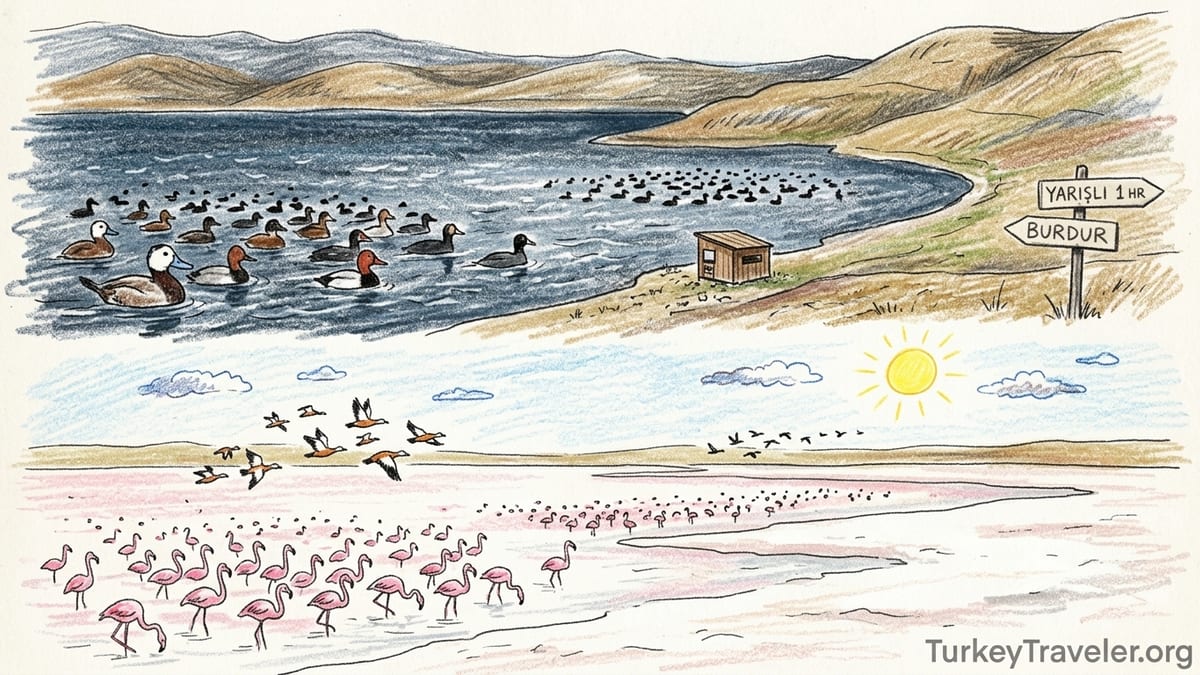
That salty, relatively stable open-water habitat is exactly what draws massive flocks of wintering ducks and other waterbirds. Official Turkish sources describe Burdur Lake as hosting around 100,000 waterbirds in winter in strong years, with mid-winter counts across the wider basin once surpassing 200,000 individuals. The mix typically includes large numbers of pochard, coot, tufted duck, ruddy shelduck and other diving and dabbling ducks, along with grebes and gulls. For visiting birders, the sense of scale is as impressive as any mountain view: in the right conditions, a single sweep of the binoculars can be filled with rafts of birds stretching across the choppy surface.
Lake Burdur’s international significance is tied especially to the white-headed duck, a globally threatened stiff-tailed duck of the western Palearctic. Historically, scientific counts suggested that around 60 to 70 percent of the global or Western Palearctic wintering population used Burdur. More recent research shows that numbers have fluctuated and in some years shifted toward other Turkish wetlands, but the lake still appears in international conservation plans as a key wintering site. When water levels and food availability are favourable, flocks of these compact, buoyant divers can be picked out among other ducks by their heavy heads and distinctive shape, particularly in late winter.
Recognising this value, Turkish authorities have designated Burdur Lake and its surroundings as a protected wildlife development area. Local promotion may still highlight lakeside promenades and evening tea gardens near Burdur city, but for birdwatchers the focus is firmly on the open water, the quieter agricultural margins and the viewpoints where you can observe without disturbing resting birds.
How Burdur Differs from Eğirdir and Beyşehir
At a glance on a map, Lake Burdur, Eğirdir and Beyşehir look like siblings in a chain of Anatolian lakes. On the ground, the experience for birders is very different. Eğirdir and Beyşehir are large, mostly freshwater systems with more developed lakeside tourism, marinas and summer recreation. Their shorelines include orchards, villages and beaches, and in high season they welcome swimmers, campers and boaters alongside birders. The birds here tend to favour reedbeds, deltas and fish-rich shallows, and the overall feel can be closer to a classic European lake holiday region.
Burdur, in contrast, is a working, semi-arid basin lake. Its water is distinctly saline and slightly alkaline, and there are no public swimming beaches or resorts on the level of Eğirdir’s lakeside pensions. Steep, often rocky shores drop fairly quickly into deep water in many sections, which limits broad reedbeds but creates an expansive, relatively undisturbed open-water zone in winter. This suits diving ducks and coot that prefer deep, plankton-rich water over vegetated shallows. It can also make birds appear more distant from the observer, which is why a spotting scope becomes particularly valuable here.
Another key difference is hydrology. Both Eğirdir and Beyşehir also face water management challenges, but Burdur is a closed basin with no outlet, so every litre pumped for irrigation or lost to climate-driven evaporation directly affects lake level and salinity. Scientific studies from the past decade document a drop of several metres in lake level and a clear increase in salinity over recent decades, linked to both water abstraction and regional warming. These shifts influence where in the basin birds choose to gather. Areas that once held gently shelving shorelines or shallow bays may now be exposed mudflats or receding coves, which can alter observation points from year to year.
For birders who have visited multiple Turkish lakes, Burdur often feels starker and more elemental. There are fewer lakeside cafes and more wind, fewer boats and more unbroken horizons of water and sky. It is less about idyllic reflections and more about the spectacle of movement as tens of thousands of birds raft, dive and lift off in dense groups, especially at first light in mid-winter.
Why Winter Can Be More Rewarding Than Summer
Most visitors pass through Burdur province in summer on their way to the Mediterranean coast or to popular freshwater resorts. For birdwatchers, however, the most rewarding months at Lake Burdur are often from late autumn through late winter, roughly November to February, sometimes stretching into early March depending on weather and ice conditions elsewhere in the region. This is when migratory waterfowl concentrate here to escape harsher conditions on northern breeding grounds and when overall bird numbers peak.
Mid-winter waterbird counts in the Lakes Region, coordinated with international census efforts, repeatedly show Burdur as a standout site for wintering ducks, coot and grebes. When other wetlands freeze or partially ice over, Burdur’s depth and salinity help keep large areas of open water available. This makes it a refuge not only for white-headed ducks, but also for black-necked grebes, ruddy shelduck, red-crested pochard and various Aythya ducks. Although exact numbers vary from year to year, the effect in the field is similar: dense flocks packed into visible areas that can be scanned methodically from established viewpoints.
Summer has its own interest, particularly early in the season when some waterfowl linger and waders, terns and gulls exploit exposed shorelines. Nearby Yarışlı Lake becomes a significant focus for flamingos and other species that feed in shallow alkaline waters, which we cover below. However, by high summer the combination of heat, haze, mirage and increased salinity can make birdwatching on Burdur itself a tougher proposition. Birds are more dispersed, midday temperatures climb into the high thirties Celsius in heatwaves, and the harsh overhead light flattens detail for photographers.
From a practical standpoint, winter birding also aligns well with local rhythms. Accommodation in Burdur city tends to be less busy and often more affordable outside the summer holiday period, roadside traffic to coastal resorts is lighter on weekdays, and you are more likely to share viewpoints with local enthusiasts and researchers than with tour buses. Prepare for cold, though. Mornings around the lake can feel significantly chillier than the city centre due to wind exposure, so packing a proper windproof layer, gloves and a warm hat is essential even on seemingly mild days in town.
Species Groups to Watch: From Rafting Ducks to Flamingos
The drama at Lake Burdur in winter revolves around waterfowl. While it is never advisable to promise specific species on a given day, several broad groups are especially worth studying here. The white-headed duck, as a conservation icon, is often a priority target. These chunky, stiff-tailed divers typically keep to deeper water, where they feed by diving repeatedly. Even when distant, their distinctive silhouette and behaviour can help separate them from other ducks in the scope. Conservation literature notes that Burdur’s share of the global wintering population has shifted over time, so treating any observation as a privilege rather than an expectation is part of ethical birding at the site.
Large flocks of diving ducks in the Aythya genus are another hallmark. Rafts of common pochard and tufted duck, sometimes mixed with red-crested pochard, bob in loose groups across the choppy water. Among them, grebes such as black-necked grebe and great crested grebe often sit slightly apart or dive in more scattered fashion. Coot form even denser black carpets against the grey-blue water, their numbers occasionally reaching six figures in strong years according to regional count reports. Scanning slowly across these flocks can reward careful observers with scarcer species or unusual plumages.
Ruddy shelduck is a character species of the wider Burdur basin, particularly visible at nearby wetlands like Yarışlı Lake and other shallow basins to the south and west. These large, orange-brown geese-like ducks are often seen flying between feeding and roosting sites, their calls carrying far across the open steppe. Raptors that take advantage of the winter abundance of waterbirds may include various buzzards, eagles and harriers passing overhead, especially near agricultural margins and wet fields on the lake’s outskirts.
Flamingos enter the story most strongly at Yarışlı Lake, around 45 to 60 minutes’ drive from Burdur city depending on route and roadworks. This shallow, alkaline, endorheic lake has become locally famous for flocks of greater flamingo feeding in its broad, pale shallows. Local and national media reports from 2026 again highlighted the spectacle of thousands of flamingos there in spring and summer, underlining the site’s importance within the migration network. While numbers fluctuate with water levels, the combination of pink birds, white salt flats and low islands makes Yarışlı a particularly photogenic complement to Burdur’s darker deep water.
Optics, Light and the Reality of Viewing Distances
One of the first surprises for many visitors to Lake Burdur is how far out the main rafts of birds often sit. Because the lake drops off relatively quickly and many birds favour open water away from disturbance, viewing distances of several hundred metres are normal. For this reason, a decent spotting scope transforms the experience. A portable scope in the 60 to 80 millimetre range on a stable but lightweight tripod allows you to resolve plumage details on distant ducks, pick out resting grebes and study subtle differences in head shape among diving ducks.
For binoculars, mid-range 8×42 or 10×42 models from well-known brands work well for general scanning. An 8× magnification offers a wider, more stable field of view, helpful in wind and when tracking flying birds. A 10× may suit birders most interested in detail and willing to brace against gusts. Entry-level models from manufacturers like Nikon, Celestron or Hawke can be sufficient if properly collimated and kept clean. Serious birders may bring premium optics, but the key is often steady technique rather than pure glass quality.
Light is another critical factor. The most rewarding times to be in position are around dawn and the last two hours before sunset. In early morning, birds are often actively feeding, and low, side-lit sunlight from the east picks out warm tones on plumage while the water remains relatively calm. In late afternoon, especially on clear winter days, the sun drops toward the low hills and paints the lake in gold and slate, with long shadows adding depth to photographs. Midday light in this high, dry basin can be harsh, with strong glare off the water and pronounced mirage effects on distant flocks, making both identification and photography more challenging.
Photography at Burdur benefits from focal lengths in the 400 to 600 millimetre range on a full-frame camera, or their equivalents on crop-sensor bodies. Even with such lenses, most images will be environmental birdscapes rather than tight portraits, which suits the conservation narrative: wide frames showing the relationship between the birds and the shrinking shoreline, the open steppe and the contours of the surrounding hills. A polarising filter can help manage glare, but care is needed to avoid uneven skies at very wide angles.
Access, Viewing Terraces and Shoreline Limitations
For planning, most birdwatchers base themselves in Burdur city, a compact provincial centre on the northeastern side of the lake. Budget and mid-range hotels cluster near the city centre and main highway. From here, several paved roads lead toward the lake margin. One of the most practical developments for visitors is a dedicated birdwatching house or hide constructed along the Burdur–Fethiye road on the eastern shore. This structure was built to give tourists and bird enthusiasts a sheltered vantage point over part of the lake without disturbing sensitive shoreline habitat. Local signage points the way, and the turning is straightforward for drivers using standard rental cars.
Another excellent overview point is Serenler Hill or Serenler Peak Natural Park, above the lake on the Burdur side. Official brochures describe an observation terrace here that looks west over the entire water body, with especially dramatic views at sunrise and sunset. From this elevation, you will not be identifying every duck, but you gain a powerful sense of scale and can watch large movements of birds in flight, including skeins of ducks commuting between feeding and roosting zones. The terrace is accessible by a winding paved road outside town; conditions vary seasonally, so checking locally for winter ice or maintenance issues is wise.
Despite these facilities, shoreline access around Lake Burdur is limited in many sections. Steep banks, private agricultural land, industrial facilities and conservation restrictions all reduce the number of spots where you can park safely and set up optics close to the water. In some places the receding shoreline has retreated hundreds of metres from the old road, leaving mudflats and exposed sediment between you and the waterline. These areas can be both hazardous to walk on and sensitive for roosting birds, so it is generally best to observe from firm ground near roads, designated viewpoints or existing tracks used by local farmers.
There is no continuous walking trail encircling the lake like you might find around smaller European wetlands. Short roadside stops and a few established platforms are the norm. Travelling birders should factor this into timing: covering several vantage points by car in a morning can give a good overview, but walking access alone will not reveal the whole basin. Having an offline map app with satellite imagery can help you match on-the-ground conditions to potential viewing spots, though you should still respect fences, crops and any posted signs.
Drought, Water Levels and What They Mean for Birders
Drought and water management are not abstract issues at Lake Burdur; they are visible in the landscape and directly affect birdwatching. Over recent decades, scientific studies and local agencies have recorded a marked fall in lake level, linked to increased groundwater extraction for irrigation and reduced inflows associated with climate variability. As the water recedes, new shoreline terraces, salt-encrusted plains and deeper nearshore drop-offs emerge. Salinity rises, which can alter aquatic food webs, including invertebrates and fish that waterbirds rely on.
For the visiting birder, these changes manifest in two main ways. First, traditional observation points that older guides or blogs might mention may now sit much farther from the water, with birds only just visible at the limit of binocular range. Second, some species that previously concentrated on Burdur in huge numbers may now distribute themselves more flexibly across other regional wetlands depending on food and disturbance. International conservation reports already describe a shift of part of Türkiye’s white-headed duck population to other lakes as Burdur’s conditions have changed, even though the site still appears in global action plans as historically vital.
This does not mean Burdur is no longer worth visiting. Rather, it underscores the importance of up-to-date local information and realistic expectations. When you arrive, it is worth asking at your hotel, local nature groups or the provincial tourism office about recent water levels, any current restrictions and which sections of shore have been most productive for observers. If you are using printed field guides or older trip reports, treat them as historical snapshots rather than exact directions.
There is also a broader conservation story that informed birders can share. By choosing local services in Burdur city, buying meals from family-run restaurants and voicing support for wetland protection when speaking with guides or officials, visitors can help reinforce the idea that a living, bird-rich lake has economic as well as ecological value. Some local organisations periodically run awareness events or exhibitions about drought and the lake’s future; if one coincides with your visit, attending can add context to the flocks you see through your scope.
Adding Yarışlı Lake: Flamingos and Shallow Soda Waters
Yarışlı Lake lies to the southwest of Burdur, near Yeşilova district, and makes an excellent supporting stop on a bird-focused itinerary. Like Burdur, it is an endorheic, or closed-basin, lake, but it is much shallower, more variable in surface area and more strongly soda-alkaline. Scientific and local sources describe its area shrinking significantly from winter to late summer as evaporation concentrates salts. In wetter seasons, the lake can extend as a broad shallow sheet of water ringed by pale, crystalline shorelines; in drier months, exposed salt flats and mudflats dominate, with remnant pools and channels.
Ecologically, these shallow alkaline conditions favour a different bird community to Burdur’s deep waters. Yarışlı is widely cited as a key site for greater flamingo, with thousands of birds feeding and resting here in years when water levels are favourable. Local tourism portals and recent media coverage in 2026 highlighted dramatic aerial images of dense flamingo flocks on the lake’s milky surface, reinforcing its national profile as a flamingo wetland. The same conditions also attract waders such as stilts and avocets, as well as ruddy shelduck and other waterfowl that forage in brackish shallows and muddy margins.
From a practical perspective, Yarışlı feels more remote and less formally developed than Burdur. Access tracks lead from small villages such as Yarışlı or Düğer toward the shore, often becoming unpaved near the water. Community-sourced accessibility descriptions note flat but unpaved ground, with no permanent facilities, cafes or visitor centres at the lakeside. The absence of infrastructure can be part of the attraction for birders and photographers seeking a quieter experience, but it also means you need to arrive self-sufficient with water, sun protection, snacks and a full fuel tank.
Driving times from Burdur city vary with route, but planning around one hour each way is reasonable. For example, a typical day might combine a dawn session on Lake Burdur’s eastern shore, a late-morning drive south and west to Yarışlı, several hours scanning flamingo flocks in the afternoon light, and a return to Burdur after sunset. Weather and road conditions can change, particularly in winter or after heavy rain, so checking with locals about the best current approach roads is prudent. Given the lack of shade around the lake, a broad-brimmed hat and high-factor sunscreen are also essential, even on cool spring days.
Half-Day and Full-Day Birding Routes from Burdur
A well-planned route helps make the most of changing light and bird activity. For a half-day itinerary focusing on Lake Burdur, consider starting before dawn in Burdur city. After a quick breakfast at your hotel or a local bakery near the main square, drive out toward the birdwatching house along the Burdur–Fethiye road. Aim to arrive at least 30 minutes before sunrise so you can set up your scope and allow your eyes to adjust. Spend the next 2 to 3 hours scanning the open water from the hide and nearby pull-offs, concentrating on identifying the main flocks of ducks, grebes and coot. Keep an ear open for calls overhead, as movements of geese, shelduck or cormorants can pass behind you.
By late morning, light and haze over the water often become harsher. This is a good time to move to Serenler Hill or other elevated viewpoints. From the observation terrace above the city, you can take a wide-angle look at bird movements, note any major concentrations along particular shore segments and capture panoramic photographs of the lake’s winter landscape. Allow an hour on the terrace, then either return to town for lunch or, if you have a scope adapter, experiment with digiscoping distant rafts under the midday sky.
For a full-day route that includes Yarışlı Lake, start similarly with dawn at Burdur, then depart mid-morning for the drive southwest. After checking your chosen route on an up-to-date navigation app or with your hotel, follow the main road toward Yeşilova, turning off toward Yarışlı village or another agreed access point. Plan to arrive by early afternoon, when the sun is high enough to illuminate the shallow water without being directly overhead. Park well back from the most fragile shorelines, using existing tracks, and walk cautiously to a firm vantage point. Spend several hours scanning flamingo flocks and other waders, watching for changes in density as birds move across feeding patches.
If you have the energy, time your return so that you reach a Burdur lakeside viewpoint again near sunset. In winter, the combination of sun dropping behind the hills and flocks of ducks commuting across the lake can be one of the day’s highlights. This three-stop arc Burdur hide at dawn, Yarışlı in mid-afternoon, Burdur overlook at sunset provides varied light, habitats and photographic opportunities within a single long day, without requiring specialised vehicles or long hikes.
Tips for Photographers vs Casual Birdwatchers
Photographers and casual birdwatchers often share the same viewpoints but may have slightly different priorities at Lake Burdur and Yarışlı. For photographers, the main challenge is distance. At Burdur’s deeper sections, most birds will remain well beyond the reach of short telephoto lenses. Bringing a 400 or 500 millimetre lens, or a high-quality bridge camera with an equivalent focal length, significantly improves your chances of usable images. Rather than chasing close-ups that may not be realistic, think in terms of layered compositions: flocks against textured water, silhouettes at dawn or sunset, or environmental scenes where a flock of ducks or a line of flamingos is just one element of a wider landscape.
Timing and position are also crucial for photographers. At Burdur, positioning yourself so that the low sun is behind or roughly to one side of you at sunrise and sunset helps avoid shooting directly into glare off the water. At Yarışlı, moving slightly along the shore to align parallel with feeding lines of flamingos can create pleasing side-lit images with repeated curves of necks and reflections in the shallow water. Tripods or monopods are valuable in the often breezy conditions, especially if you are working with heavy lenses. Dust and salt spray can be an issue near dried margins, so bringing a simple lens cloth and a bag or cover for equipment when not in use is wise.
Casual birdwatchers who are more interested in the overall spectacle than in photography can travel lighter. Quality 8×42 binoculars, a warm jacket and sturdy footwear may be all you need for a satisfying visit. Without the weight of long lenses and tripods, it is easier to shift rapidly between viewpoints or climb short slopes to terraces. Casual observers might also choose to spend longer simply watching behaviour: courtship displays among ducks in late winter, feeding strategies of flamingos at Yarışlı, or the interaction between raptors and dense flocks of waterbirds.
Regardless of your focus, ethical behaviour is essential. Both lakes are under stress from drought and human pressures, and birds rely on remaining quiet zones to rest and feed. Staying on existing tracks, avoiding sudden movements near roosting flocks and keeping noise to a minimum all help reduce disturbance. If you are working with local guides or joining a small group, discuss your priorities openly so that itineraries balance photographic opportunities with the birds’ needs and with the experience of others at the site.
The Takeaway
Lake Burdur is not a resort lake in the usual sense. Its value lies in its role as a winter refuge and migration hub for vast numbers of waterbirds, anchored by the story of the endangered white-headed duck and the wider network of wetlands in Türkiye’s Lakes Region. Its saline water, closed-basin hydrology and stark, often wind-ruffled surface make it distinct from more famous freshwater neighbours like Eğirdir and Beyşehir. For birders willing to embrace those differences, winter and early spring offer some of the most concentrated wildfowl watching in the country.
Pairing Burdur with Yarışlı Lake builds a rounded itinerary that contrasts deep open water with shallow alkaline flats and adds the possibility of watching flamingo flocks sweep across a pale soda lake. At the same time, visible signs of drought and changing shorelines make every visit a lesson in the fragility of these systems. Birdwatching here is as much about witnessing an evolving landscape as it is about ticking species lists.
With thoughtful planning, appropriate optics and a flexible approach that respects current water levels and access conditions, travellers can experience both the grandeur and the urgency of this landscape. Whether you are a photographer chasing long perspectives of birds against winter light, or a casual observer content to watch distant flocks pulse and shift across the water, Lake Burdur and Yarışlı reward slow looking and a sense of curiosity about how birds, people and climate are reshaping this corner of Anatolia.
FAQ
Q1. When is the best time of year to visit Lake Burdur for birdwatching?
The most rewarding period is usually from late autumn to late winter, roughly November to February, when waterbird numbers peak and deep water remains largely ice free.
Q2. Do I need a spotting scope, or are binoculars enough at Lake Burdur?
Binoculars are essential for general scanning, but a spotting scope makes a big difference at Burdur because many ducks and grebes stay several hundred metres offshore.
Q3. Can I rely on seeing white-headed ducks at Lake Burdur?
No specific species can be guaranteed. Historically the lake held very high numbers, but recent research shows that wintering flocks may shift between wetlands depending on conditions.
Q4. How far is Yarışlı Lake from Burdur city, and can I visit both in one day?
By road, Yarışlı is roughly 45 to 60 minutes from Burdur city. With an early start, it is realistic to spend dawn at Burdur and the afternoon at Yarışlı on a single day.
Q5. Are there formal birdwatching hides or terraces around Lake Burdur?
Yes. There is a birdwatching house along the Burdur–Fethiye road and an observation terrace at Serenler Hill above the city, plus various informal roadside pull-offs.
Q6. Is Yarışlı Lake suitable for families and casual visitors, or only for serious birders?
Yarışlı can be enjoyable for anyone interested in nature, but there are no lakeside facilities, so families should come prepared with water, snacks and sun protection.
Q7. What kind of vehicle and roads should I expect when visiting these lakes?
Main roads from Burdur to the lakes are paved and accessible with standard rental cars, but some tracks near Yarışlı’s shoreline are unpaved and can be rough after rain.
Q8. How do drought and water-level changes affect what I will see?
Lower water levels can push birds farther from the old shoreline and sometimes shift concentrations to other wetlands, so recent local information is important for choosing viewpoints.
Q9. Are there local guides or tours focused on birdwatching at Lake Burdur?
Availability changes from season to season, but provincial tourism offices and some local nature groups can often connect visitors with knowledgeable guides or small-scale tours.
Q10. What ethical guidelines should I follow while birdwatching at Burdur and Yarışlı?
Stay on existing tracks, avoid approaching roosting flocks too closely, keep noise low, respect private land and remember that conserving stressed wetlands is more important than any photograph.