

I arrived at Lake Salda on a breezy afternoon in late September, chasing a nickname as much as a destination. For years I had seen the same phrase repeated in guidebooks and social media captions: “Türkiye’s Maldives.” Turquoise water, blinding white shore, dramatic drone footage that made this inland crater lake in Burdur province look like a lost atoll in the Indian Ocean. I wanted to know what it felt like to stand on that white edge in person, to swim in the water, and to see whether the famous comparison helps travelers understand Salda or quietly sets them up for disappointment.
When I Went, How I Got There, and Exactly Where I Entered
My visit to Lake Salda took place in late September 2024, at the tail end of the high season, on a clear weekday that shifted between sun and passing clouds. I had based myself in Denizli the previous night and drove a small rental car along the D585 toward Yeşilova, then followed the brown “Salda Gölü” signs down to the lake. After skirting a pine-covered slope and catching first glimpses of turquoise through the trees, I headed for Yeşilova Belediye Halk Plajı, the main public beach on the southern shore that now concentrates much of the allowed swimming and camping.
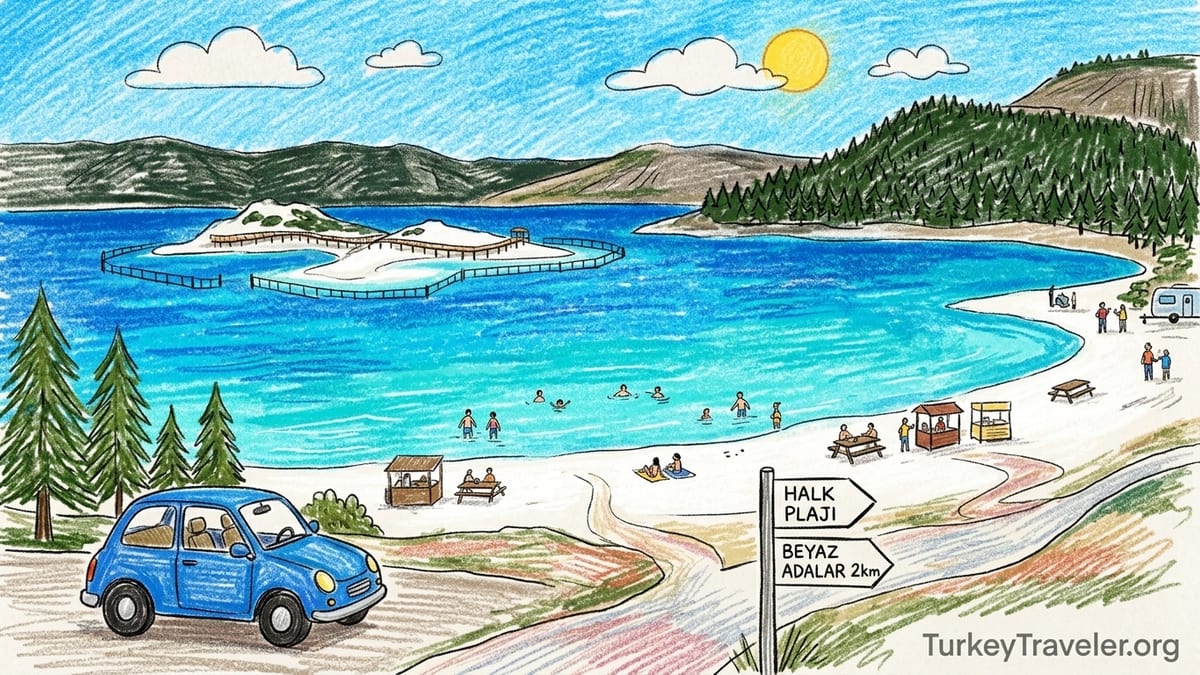
Google and some older blog posts still push visitors toward the famous Beyaz Adalar, or White Islands, on the north side of the lake. On arrival I quickly learned that this is no longer the simple drive-on beach it once was. Access for cars has been pulled back to a parking area roughly 2 kilometers away from the fragile white shoreline, and people are now shuttled in by electric minibuses to a viewing area with cafes, wooden walkways, and strict barriers that keep feet off the bright shore and out of the water in the most sensitive zone. Swimming there is prohibited, and the white band you see in many viral drone images is now mostly to be admired from behind railings.
Because I wanted to swim and feel the shore underfoot, I chose to begin at Yeşilova Halk Plajı. Practically, this meant turning off toward Yeşilova, then following signs to “Halk Plajı” down to a low-lying, flatter section of the lake’s southern rim. Here a simple entrance gate collected a modest car fee in Turkish lira, similar to the amounts reported locally for 2024. I parked on hard-packed ground behind the beach, a short walk from the water, with pines behind me and the wide, pale sweep of Salda opening out in front.
That was my main access point for walking the shore, swimming, observing facilities, and watching how visitors actually use the lake now that stricter protections are in place.
First Impressions: Does It Really Look Like the Maldives?
Standing at the edge of Yeşilova Halk Plajı, my first reaction was visual shock. The color palette at Salda is as startling as the photos suggest. The water closest to shore was a clear, pale aquamarine that deepened into saturated turquoise, then cobalt blue toward the basin’s center. The white fringe of hydromagnesite-rich sediment at the waterline glowed almost unnaturally against dark, pine-covered hills. If someone had teleported me there without context, I might have guessed a volcanic lake in Central America, not inland Anatolia.
From a purely aesthetic perspective, it is easy to see why tourism boards reached for the “Maldives” shorthand. At midday, with the sun high and the sky cloudless, the shallows became that milky tropical blue more often associated with shallow coral reefs. Small children played in ankle-deep water that looked almost too vivid to be real, while couples lined up for photos framed to suggest a seaside paradise rather than a high-altitude crater lake. More than once I heard Turkish visitors nearby refer to it affectionately as “bizim Maldivler,” our Maldives.
But there is a catch. The classic Maldives image nearly always includes palm trees, flat horizons, and a sense of sea-level languor. Salda is different. It sits at over 1,100 meters above sea level, with a ring of hills and, in some directions, bare slopes that remind you this is a mountain lake. Instead of coconut palms, there are pines and scrub. The wind can pick up and drive small chop across the surface, and the light has a harder, more continental quality. The resemblance works in photos cropped tight to the shore, less so when you stand back and take in the surrounding geography.
After just a few minutes on the ground, I realized the nickname is visually half-true but experientially misleading. Yes, the colors overlap, but the feel of the place is wilder, more fragile, and far more temperamental than any tropical beach resort.
Walking the White Shore: Beauty vs Barefoot Comfort
Those postcard images do not tell you what the shore actually feels like underfoot. At Yeşilova Halk Plajı, the surface is made of very pale, fine-grained material rich in magnesium compounds. Looking down, I saw a patchwork of dry, almost powdery white zones above the waterline, then damp, darker sections where tiny wavelets had saturated the sediment into a soft, clay-like paste. There were also scattered coarser grains and small pebbles further back from the water.
Walking barefoot along the dry parts, the sensation reminded me less of soft coral sand and more of compacted talc on top of a firm base. In places my heel would compress the upper layer slightly, then hit something harder beneath, yet without the coarseness of typical gravel. Closer to the water, particularly where families had been playing or people repeatedly entered the lake, the surface turned to a slick, almost soapy mud. Here I had to plant each step carefully, as the hydromagnesite-rich ooze clung to my feet and made it surprisingly easy to slip.
Comfort-wise, this is where comparisons with the Maldives fall apart. The white zones around Salda are both visually dramatic and, in many spots, not all that comfortable to walk on barefoot for long stretches. I saw several visitors abandon plans for a long shoreline stroll after a few minutes, washing off the sticky residue at rudimentary showers and switching to sandals. In the restricted Beyaz Adalar area, where I later walked on the wooden decks behind the barriers, information panels explicitly explain that the unusual shoreline formations are part of an active geobiochemical process. Those cloud-like underwater “islands” and stromatolite structures are one reason the area is now protected, and why people are kept from trampling the softest, whitest surfaces.
The most enjoyable walking I found was a narrow band where the shore was firm but not yet saturated, with only a thin film of dampness underfoot. Here the surface gave just enough to be comfortable, and the contrast between my footprints and the pristine white around them was striking. Yet the reality remained: this is more a place for short, mindful walks interspersed with sitting and swimming than for long, barefoot beach hikes.
Water Temperature, Swimming Conditions, and Wind
Late September at Lake Salda sits on the line between summer warmth and autumn chill. Daytime air temperatures during my visit hovered roughly in the low-to-mid 20s Celsius, warm enough for T-shirts in the sun but cool in the shade with a breeze. The lake itself, deep and fed by a high-altitude basin, retains cold longer than a shallow coastal lagoon. My first step into the water at Yeşilova Halk Plajı was a bracing surprise.
The shallows felt cool but tolerable, somewhere in the high teens Celsius by feel, refreshing after a short walk on the bright shore. Waist-deep, the temperature dropped more noticeably, and by the time the water reached my chest, it had entered what I would describe as invigorating rather than comfortable. Swimmers who are used to temperate lakes in Europe or North America will likely find it acceptable in late summer and early autumn, but anyone expecting bath-warm tropical water based on the Maldives comparison will be in for a shock.
The wind is another factor. Throughout the afternoon, irregular gusts blew across the lake, ruffling the surface into short, choppy waves. These broke gently on the shore but carried enough force to make floating or leisurely breaststroke swimming a bit of a workout. I noticed that when the wind picked up, families with young children tended to retreat to the shallows, while stronger swimmers ventured slightly further out before quickly returning. There were no lifeguards visible on the day I visited, but designated swimming zones were clearly implied by the concentration of people near the central part of the public beach and the way local visitors seemed to know where to enter.
Overall, swimming felt invigorating and clean, with no obvious pollution, litter, or strong smells. I stayed in the water in short bursts of 5 to 10 minutes, warming up in the sun on the shore between dips. For me, the experience was thoroughly refreshing, but not something I would associate with spending hours in the water as one might on a calm, warm tropical lagoon. Salda rewards quick, bracing swims and long periods of simply admiring the shifting colors from dry land.
Facilities, Food, Parking, and Practical Realities
At Yeşilova Halk Plajı, the setup is unglamorous but adequate. After parking on the compacted ground behind the beach, a few minutes’ walk brought me past simple kiosks selling gözleme, grilled şiş, toast, tea, and bottled drinks. Prices were in line with other inland tourist spots in southwestern Türkiye at the time, noticeably cheaper than coastal resorts, and cash proved more reliable than cards. Picnic tables under pines and small shade structures dotted the back of the beach where families had spread out plastic tablecloths and coolers, turning their day at Salda into a familiar Turkish lakeside picnic rather than a resort-style beach day.
Facilities included basic toilets, open-air showers for rinsing off the sticky white residue, and modest changing cabins. Informational boards explained some of the rules: no shampoo in the showers, no open fires on the shore, respect for marked-off areas, and reminders about Salda’s protected status. At the time of my visit, rubbish collection was clearly underway, with several large bins and municipal vehicles making rounds, although I still spotted plastic bottles and snack wrappers in less-trafficked corners, a reminder that even protected areas need constant care.
Parking itself felt controlled but not onerous. An entrance fee per vehicle helped limit random roadside stopping and nudged visitors toward using the designated public beach instead of pulling off on fragile lakeshore. In conversations with other visitors and based on posted boards, these fees have risen over recent years in parallel with the dramatic increase in visitor numbers, yet they remain within a level typical for Turkish nature parks rather than overtly exploitative. For independent travelers with a rental car, it is wise to bring enough cash in local currency to pay for both vehicle entry and any extras like tea, snacks, or a simple lunch at the lakeside eateries.
If you prefer a slightly more natural feel with more trees and shade, the Salda Gölü Tabiat Parkı area on the south and southwest side of the lake offers a blend of forest and shore, with its own parking and basic services. I drove through briefly late in the afternoon and saw caravans and tents clustered in designated clearings behind the frontal line of trees, clearly separated from the immediate lakeshore, in line with the evolving regulations that keep camping away from the most sensitive white-sand areas.
Protected Area Rules, Camping Limits, and Shoreline Restrictions
Salda is not just a pretty lake; it is a Special Environmental Protection Area under Turkish law, and the impact of that status is increasingly visible to visitors. Most striking is the treatment of Beyaz Adalar on the northern shore. Once the de facto postcard beach where many early social media images were taken, it is now behind a controlled access system. Visitors park away from the shore and take electric shuttles to a cluster of viewing platforms and cafes. From there, you can gaze across to the luminous white band and surreal shallow patterns, but physical contact with the softest part of the shore and entry into the water are blocked by wooden barriers and clear prohibition signs.
Information materials at the site explain that this is due to the area’s stromatolites and unique shoreline sediments, which are both scientifically valuable and extremely vulnerable to trampling. The white surface is not just sand but part of an active geological and biological process that researchers compare, in some respects, to environments studied by planetary scientists. That science-forward explanation helps visitors understand why rules that might appear restrictive at a normal beach are non-negotiable at Salda.
Camping regulations reflect the same balance between access and protection. Official materials and on-site notices confirm that camping directly on the delicate white shore is forbidden. Instead, camping is allowed only in designated public-beach zones such as Yeşilova Halk Plajı and Doğanbaba Public Beach, where facilities can be concentrated, and the pressure on the environment can be managed. In those areas, I saw tent clusters set back from the water behind the main shoreline strip, as well as caravans parked on firm ground under pines. The feel is closer to a basic lakeside campground than a wild, free-camping paradise.
These rules alter the experience in important ways. The protective measures mean you are less likely to find a solitary picnic spot on the lake’s whitest shore, but they also preserve the very qualities that draw people here in the first place. Compared with many unregulated beauty spots, Salda now feels managed, sometimes even over-managed, but not yet overwhelmed. As a visitor, I found that embracing the structure, rather than fighting it, made the experience more enjoyable. Understanding where you can and cannot walk, swim, and camp reduces frustration and lets you appreciate the view without worrying that you are damaging it.
Crowd Levels, Seasonality, and How Long I Actually Stayed
Late September turned out to be a sweet spot for visiting. At Yeşilova Halk Plajı around midday, there were perhaps a few hundred people spread along the shore: families cooking, couples taking photos, small groups of friends playing music quietly and wading in. It felt busy but not cramped. By mid-afternoon, day-trippers from Antalya and Denizli had filled more of the picnic tables, and the parking area felt close to capacity, but the long curvature of the beach still absorbed the numbers without a sense of crowding at the waterline.
The dynamic changed at Beyaz Adalar. There, even with access restrictions, the viewing decks collected a dense cluster of people during my late-afternoon visit. Many queued for the same iconic angles looking back along the white arc toward the hills, smartphones raised in almost identical compositions. I spent only around 45 minutes there, enough to walk the platforms, read the interpretive panels, and absorb the view, but never felt the urge to linger. The combination of barriers, shuttles, and selfie queues gave it more of a viewpoint-attraction feel than a place to relax.
In total, I spent a bit over five hours at Salda: roughly three and a half hours at Yeşilova Halk Plajı swimming, walking, and lingering over a simple lunch, followed by a short drive and under an hour at Beyaz Adalar, then a final scenic pause at a roadside pullout above the lake on my way back toward Burdur. For me, it fit comfortably as a substantial half-day to three-quarter-day stop within a wider Burdur and Lake District route that also included Sagalassos and nearby lavender fields on other days.
Talking with a local café owner and a pair of Istanbul visitors who had camped at the public beach, I heard a consistent message: July and August weekends are extremely busy, and midday can bring heavy crowds and queues at both entrances and shuttles. Winter, on the other hand, sees snow dusting the surrounding hills, near-freezing water, and a much quieter atmosphere. Anyone hoping to enjoy Salda with fewer people while still swimming would do well to aim for June, early July weekdays, or the September window I experienced, accepting that the lake will be cool rather than warm.
Birdwatching, Bike Rentals, and Sunset on the Lake
GoTürkiye’s official one-day route for Salda calls out birdwatching and cycling alongside swimming and picnicking, and both are genuinely present on the ground. At Yeşilova Halk Plajı, a small stand near the main path advertised bicycle rentals by the hour for those who want to cruise along the back roads and forest margins near the lake. I opted to explore on foot instead, but I did see several visitors riding simple mountain bikes between the public beach, nearby viewpoints, and shaded picnic spots in the pines. The terrain on this side is gently undulating, with a mix of compacted dirt tracks and paved sections, suitable for casual riders.
For birdwatchers, Salda’s appeal lies in its mix of open water, reed-fringed inlets, and surrounding farmland and forest. Even on a relatively busy afternoon at the public beach, I spotted herons and gulls working the shallows away from people, while overhead a pair of raptors circled in lazy spirals. Information boards and independent birding resources note that the lake supports dozens of species over the year, particularly during migration periods, making early morning and shoulder seasons especially rewarding for those willing to trade swimming time for binoculars.
I stayed long enough to experience the beginning of sunset from a pullout on the southern approach road, just beyond the Tabiat Parkı area. As the sun dropped behind the western ridges, the color of the lake shifted from bright turquoise to a softer, steelier blue, while the white fringes muted into pale beige. Thin clouds caught pastel oranges and pinks, reflected in subtle streaks on the water. The light leveled out, and the contrast that had made the lake feel almost unreal at noon vanished into a more subdued, mountain-lake mood. Cars paused at the same viewpoint, windows rolled down, passengers quiet as they watched the color fade.
It was not a dramatic, fiery sunset but a calm, contemplative one, better suited to lingering with a thermos of tea than a timed photo shoot. In that moment, more than at any other point in the day, Salda felt far removed from the Maldives imagery used in its promotion and much closer to the highland lakes I associate with long road trips and slow, reflective travel.
Maldives Metaphor: Helpful Hook or Misleading Comparison?
After spending hours walking, swimming, and watching people interact with Lake Salda, I kept returning to the central question that had brought me there: does the “Maldives of Türkiye” label help visitors, or does it distort their expectations? On the positive side, the nickname has clearly succeeded in putting a once-obscure inland lake onto both domestic and international travel maps. It signals that this is not just another reservoir or alpine pond but a place of rare color and beauty, worth detouring inland from the more famous coasts and ruins.
Yet that same label carries baggage. People arrive expecting a beach resort experience, perhaps unconsciously picturing overwater bungalows, endless soft sand, and warm, calm seas. Salda offers none of those. The shore in the most visually striking zones is fragile and often closed to direct access. Where you can walk, the white material can be sticky, slippery, or firm rather than uniformly soft. The water is clear but cold to cool for much of the season, the wind unpredictable, and the surrounding landscape very clearly a highland basin rather than a low-lying atoll. Facilities lean closer to municipal lakeside park than to curated island resort.
In conversation with fellow visitors, I heard both delight and mild disappointment. One Antalya-based couple told me they thought the water was colder and the shore harder to walk on than they expected from social media. Another group from Ankara said they loved Salda precisely because it did not feel like the Maldives, but rather like a uniquely Turkish mix of picnic culture, protected nature, and dramatic geology. Both reactions stemmed from the same comparison, which had primed them in different ways.
For me, the nickname works only if treated as a very rough visual shorthand, not a promise of experience. The water really does shift through shades that echo tropical lagoons, and the white margin can look surreal in the right light. But to appreciate Salda fully, you have to set aside the Maldives fantasy and meet it as what it is: a high-altitude crater lake with unusual mineral-rich shores, evolving protection rules, and a growing place in Türkiye’s nature tourism story.
The Takeaway
Looking back on my late-September visit, I am glad I went in person to test the Maldives metaphor. The drive in through pines, the first sight of the turquoise water, the shock of the cold on bare skin, and the feel of that peculiar, pale shore under my feet all added up to an experience that no overhead drone clip could fully convey. Salda is more complicated than its marketing: part geological laboratory, part family picnic ground, part Instagram backdrop, and increasingly part carefully managed protected area.
In practical terms, the lake is best suited to travelers who enjoy short, refreshing swims, striking landscapes, and an understanding that access and rules may change as protection efforts evolve. It is less ideal for those seeking a classic long, lazy beach day on soft sand with warm water and abundant amenities directly on the shore. I personally would not come to Salda to spend an entire multi-day beach holiday, but I would happily weave it into a broader Burdur and Lake District route that might also include Sagalassos, nearby lakes, and the lavender fields that color this part of southwestern Türkiye.
If I return, it will likely be again for a half or three-quarter day: a morning or afternoon at Yeşilova Halk Plajı or the Tabiat Parkı section, a couple of brisk swims, some unhurried shoreline wandering, a simple lunch under the pines, perhaps a short bike ride, and then a slow drive out timed to catch the soft light of sunset. Treated as a scenic, geologically fascinating stop within a wider route rather than a standalone beach destination, Lake Salda feels less like an imitation of the Maldives and more like what it truly is: one of Türkiye’s most visually striking highland lakes, deserving of its own name and story.
So would I recommend Salda for a full beach day or as a scenic stop? For most travelers, I would frame it primarily as the latter: a memorable, photogenic, and thought-provoking stop on a broader Burdur itinerary rather than the central, sun-and-sand anchor of a trip. Go prepared for cool water, regulated shores, and a mix of beauty and constraint, and you are far more likely to come away moved rather than misled by the famous nickname.
FAQ
Q1. Where is the best place to access Lake Salda for swimming now?
For practical swimming access, Yeşilova Belediye Halk Plajı on the southern shore is the most straightforward choice, with parking, basic facilities, and a clearly used swimming area.
Q2. Can you still walk and swim on the famous white shores at Beyaz Adalar?
You can visit Beyaz Adalar via an electric shuttle and view the bright white shoreline from platforms, but direct access to the softest areas and swimming there are currently prohibited to protect the fragile formations.
Q3. Is the shore at Lake Salda soft like tropical sand?
In many places the pale material is firm or sticky rather than powder-soft, and near the waterline it can turn into a slick, clay-like mud, so walking long distances barefoot is not always comfortable.
Q4. How cold is the water for swimming?
In late summer and early autumn the shallows feel refreshingly cool, while deeper water quickly turns bracing, closer to a highland lake than a warm sea, so most visitors swim in short bursts rather than for long sessions.
Q5. Are there places to eat at Lake Salda?
Yes, around Yeşilova Halk Plajı and other managed sections you will find small kiosks and simple eateries serving gözleme, grilled meats, toast, tea, and cold drinks at prices typical for inland tourist areas.
Q6. Is camping allowed right by the water?
No, camping directly on the delicate white shore is not allowed; tents and caravans are restricted to designated public-beach and park areas set back from the immediate lakeside.
Q7. How crowded does Lake Salda get?
On late-September weekdays it felt busy but not packed, but local reports indicate that July and August weekends can be very crowded, especially around midday at the main public beach and Beyaz Adalar viewpoint.
Q8. Is Lake Salda suitable for a full beach-day experience?
It can support a relaxed day of picnicking, short swims, and shoreline wandering, but the cool water, firm or sticky shore, and protection rules mean it does not offer the classic soft-sand, all-day-swimming beach experience many associate with coastal resorts.
Q9. What other activities are available besides swimming?
Visitors can rent bikes around Yeşilova Halk Plajı, enjoy birdwatching in quieter sections, walk forest paths in the Tabiat Parkı area, and watch soft sunsets from roadside viewpoints above the lake.
Q10. Should I plan my trip around Lake Salda or include it in a wider Burdur route?
For most travelers it works best as a scenic and geologically interesting stop within a broader Burdur and Lake District itinerary, rather than the sole centerpiece of a beach-focused holiday.