


I drove into Turkey’s Lakes District with a beach bag permanently packed in the trunk. A region called the Göller Bölgesi, literally the Lakes Region, sounded like an invitation to dive into clear water every day, to hop between shorelines the way you might in the Aegean or on the Mediterranean. Only after several days of circling Eğirdir, Salda, Burdur, Beyşehir and Kovada did I realise that expecting each lake to behave like a seaside resort was the wrong starting point. The region did not fail my swimming plans. My assumptions failed to notice what these lakes are actually for.
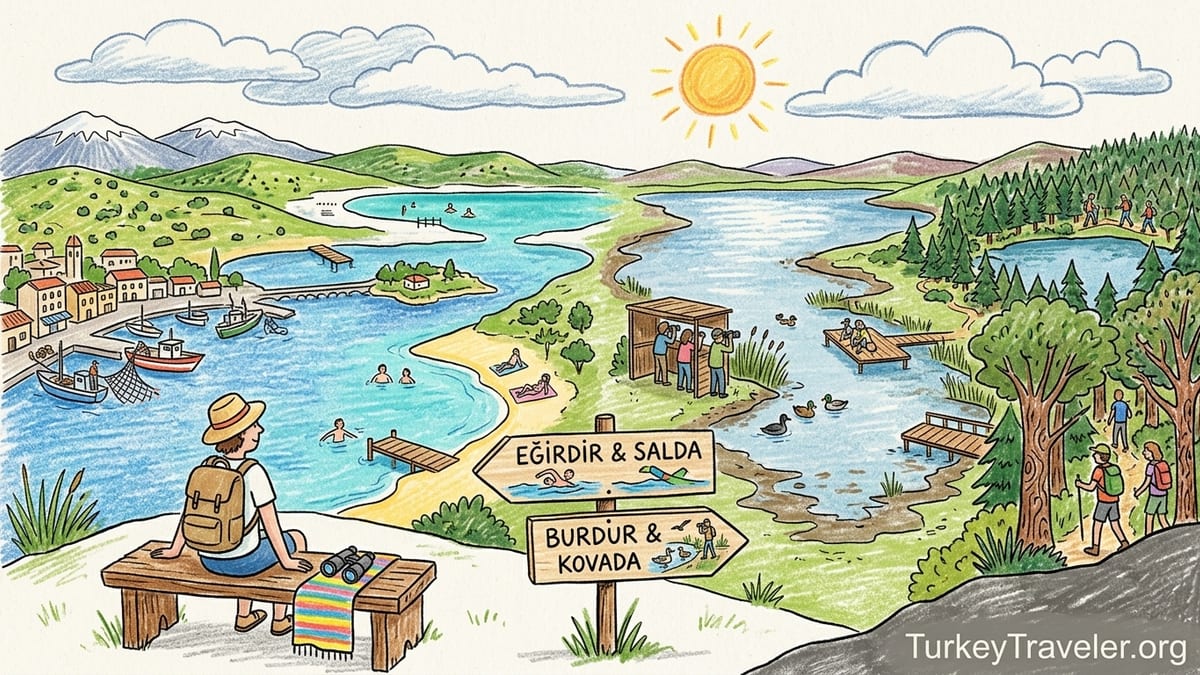
Arriving With a Beach Bag and Seaside Expectations
The logic felt airtight on the map. West and southwest of Konya and north of Antalya, the Lakes District looks like a scatter of deep blue ovals. Turkish tourism brochures describe Eğirdir as a summer town, Salda as a turquoise showpiece, Burdur as a Ramsar-listed wetland, Beyşehir as a national park and Kovada as a forest lake. I strung those descriptions together into a simple equation: lots of lakes plus hot Anatolian summers must equal endless swimming.
The reality unfolded more slowly. On my first afternoon in Eğirdir, the air temperature sat comfortably above 30 degrees Celsius, but the lake still held its spring chill. Locals stretched out on the grass near the municipal beach and children waded in, yet I saw almost as many anglers as swimmers. My idea of a lake holiday had been shaped by resort-style beaches with long, shallow entries, cafés every few meters and bathwater temperatures by July. Eğirdir was gentler and less curated, and it was my first hint that “lake” here often meant working landscape and fragile ecosystem as much as playground.
Over the following days I swam where conditions invited it, but I also stepped back from the shoreline in places where conservation rules, water chemistry or simple common sense signaled that the best way to experience a lake was to stay dry. At Burdur I traded my swimsuit for binoculars. At Kovada I learned that the most memorable views of water can be from a shaded forest trail rather than a sun lounger. By the time I left, I had quietly retired the idea that every stop in the Lakes District should deliver a new favorite swimming beach.
Eğirdir: The Everyday Swim I Actually Took
Of all the lakes I visited, Eğirdir felt the most like the place where a traveler could sensibly plan to swim several times during a trip. This is not a hidden cove fantasy. It is a lived-in Anatolian town with a working harbor, fishermen mending nets on the quay and a causeway running out to two small islands, Can Ada and Yeşilada. Official tourism materials call the stretch of shore below the old train station the best sandy spot for swimming, and on hot afternoons the municipal beach fills with families, teenagers and a few cyclists cooling off mid-ride.
The water in Eğirdir is freshwater and low in salinity compared with some neighboring lakes, which makes it comfortable on the skin and easy on the eyes. The shallows near the town beach shelve gradually enough that less confident swimmers can stay close to shore. I watched local kids leap off low concrete piers while grandparents sat on folding chairs in the shade, cotton candy in hand. There were basic changing cabins, showers and a snack kiosk selling gözleme and tea at prices similar to a simple café in a mid-sized Turkish town. It is not a resort, but it covers the practicalities that matter if you plan to be in and out of the water.
Conditions still vary. On windy days waves slap against the retaining walls, and the water can look murkier than any brochure photograph. In early season, usually late May or early June, snowmelt from surrounding mountains keeps temperatures on the brisk side, and a brisk north wind can convince even determined swimmers like me to stay on the jetty. Later in summer, when heat lingers into the evening and the lake has had time to warm, the water feels welcoming rather than punishing. On one July evening, I joined a local couple who swam short laps parallel to the shore while the last light washed the peaks of Davraz and Barla across the water. It felt domestic and unspectacular in the best possible way. If I had to name one place in the Lakes District where swimming slots naturally into everyday life, Eğirdir would be it.
It is also the point where I learned not to chase a perfect beach image. The town’s charm lies in its mix of practical and picturesque. After swimming, you can wander out onto Yeşilada, a once-separate island now joined by a causeway, and sit on a terrace above the water while plates of lake fish appear from tiny kitchens. Swimmers share space with small fishing boats, locals playing backgammon and visitors photographing the stone houses. The lake accepts swimming as one of many uses, not its defining purpose.
Salda: Turquoise Temptation With a Colder Truth
If Eğirdir is the lake you actually swim in, Salda is the lake you dream about before you arrive. From the road, it looks almost tropical. The water is a startling mix of deep blue and milky turquoise, framed by bright white shorelines made of magnesium-rich sediments that behave like sand underfoot. Turkish media has nicknamed it a cousin of an entirely different planet because of similarities between its shoreline minerals and rocks studied by space missions, and domestic tourists flock here every summer for that otherworldly color alone.
It is easy to understand why official tourism promotions highlight Salda as a destination for clear, cold water. Standing on the designated public beach on the Yeşilova side, you can see several meters down through the water, and the lake bed drops away more steeply than at Eğirdir. Even in high summer the first shock when you dive in is the temperature. Salda sits at altitude and is relatively deep, so the surface layer remains cool. On the hottest afternoon of my visit, when car dashboards read well above 30 degrees Celsius, I still inhaled sharply with the first plunge. It felt closer to a mountain tarn than a shallow resort bay.
The second surprise at Salda is how tightly regulated the swimming area is. In recent years local authorities have pulled car access back from the most fragile shoreline, fenced off white beach sections and concentrated visitors onto specific stretches where swimming is allowed. Signs ask people not to walk on the gleaming whitest parts of the shore or smear the soft sediment on their skin, practices that became popular through social media photographs but contribute to erosion. Floating buoys mark the limits of safe swimming, and staff on the shore occasionally whistle at people tempted to stray farther out or closer to closed sections.
Those restrictions initially frustrated my beach-hopping instinct. The water looked so inviting that I wanted to walk along the shore and pick my own entry point. Over time I came to appreciate the logic. The mineral-rich shallows are fragile, and the lake’s clarity depends on not treating the entire perimeter as a free-for-all. Facilities are concentrated too. On the permitted public beach I found paid sun loungers and umbrellas, basic cafés selling grilled köfte, corn on the cob and cold drinks, and public restrooms for a small fee. Away from those zones, the shoreline quiets, and swimming is no longer the main story. Salda was some of the most beautiful water I entered on the trip, but also the least casual. It is a lake you plan a focused swim at, not a place where you pop in and out anywhere as if it were a village pier.
Burdur: When Salty Water Belongs to the Birds
Burdur lies only a short drive from both Eğirdir and Salda, but any expectation of another swimming session evaporates as soon as you read the signs along the shore. The lake here is a protected wetland of international importance for migratory and resident birds, listed under the Ramsar Convention and further designated as a wildlife development and conservation area. Local information boards and brochures talk about white-headed ducks, coots and grebes, not swimmers or sunbeds. Instead of sun umbrellas, the shoreline features bird hides and low wooden platforms for binocular-toting visitors.
Water chemistry plays a role. Burdur is a saline and alkaline lake, significantly saltier than freshwater Eğirdir and noticeably different in feel. There are no municipal beaches advertising safe swimming, no jetties with ladders, no lifeguards and, crucially, clear prohibitions in many stretches against entering the water at all. Part of that reflects conservation priorities. Human presence, particularly near nesting or wintering areas, risks disturbing feeding and breeding patterns. Another part is simple practicality. The lake’s margins are often muddy or crusted with salt, and the depth can drop off quickly after deceptively shallow sections.
When I visited in winter, the idea of swimming would have been outlandish regardless of rules. The air over the lake carried a chill, and distant flocks of birds rippled like dark threads above the water. Even in warmer months, local conversations about the lake focus on its ecological concerns rather than recreation. Residents talk about declining water levels over recent decades, the impacts of water extraction on the shoreline and the importance of monitoring bird populations. Visitors arrive with camera lenses and spotting scopes instead of towels. On a clear January morning, I joined a small group of domestic birdwatchers who had driven from Antalya to scan the lake from a designated viewing point. We passed around a thermos of tea and took turns at a shared telescope. Not one of us wondered where the nearest changing cabin might be.
Burdur taught me that a lake can be all the more compelling precisely because it is not “for” us in the recreational sense. The most respectful way to experience it is to stay on shore, learn the names of the birds on the information boards and keep voices low. Expecting it to offer a swim would be like walking into a library and complaining there is no live music. The lake is doing exactly what it is supposed to do. The trick is adjusting expectations so that watching a raft of white-headed ducks through binoculars feels as complete a lake experience as any dive.
Beyşehir: National Park Scenery and Slow Sunsets
On paper, Beyşehir might look like another good swimming candidate. It is a large lake, fringed by villages, with a national park embracing wooded shores and islands. There are small beaches in places and locals do enter the water in summer, especially where the lake is shallow and reeds are sparse. Official descriptions, however, consistently highlight scenery, island-dotted views and sunsets rather than any long line of formal bathing beaches. Once I arrived, it was easy to see why.
The first impression of Beyşehir is width and distance. From the town’s lakeside promenade you look out not at a compact bowl of water but at a broad expanse stretching toward mountain silhouettes. Boat tours leave from the pier, threading between small islands and taking passengers close to historical mosques and village shorelines. Out on the water, the depth drops quickly away from the few narrow shallows, and the wind can raise a surprising chop in the afternoons. None of this rules out swimming altogether, but it discourages the kind of relaxed, unsupervised dips that a family with small children might expect from a holiday lake.
Reeds and conservation concerns also shape how people use the shore. Several stretches of Beyşehir are valuable breeding areas for fish and birds, and dense reed beds line the margins. In those sections, the water close to land can feel more like a marsh fringe than a clean-walled swimming pool. Entering there risks trampling fragile plants and disturbing wildlife. Local advice leans toward using modest designated beaches or, more commonly, treating the lake as a backdrop for walking, cycling and boat rides. As the day cools, the promenade fills with people strolling and eating ice cream while the sky performs over the water.
The most memorable moment I spent at Beyşehir did involve water, but not from within it. I took an early evening boat trip, the kind that departing guesthouses often help you arrange with a local operator. The skipper cut the engine near an island as the sun slid down, and the lake surface shifted from steely blue to burnt orange. A few teenagers did slip into the water from the low deck for a quick, shouted swim, but most of us stayed on board, wrapped in light jackets against the cooling air, watching the mountains silhouette against a slowly darkening sky. It felt fitting that my main sensory memory of Beyşehir is the sound of small waves against the hull rather than the feeling of water around my own shoulders.
Kovada: Walking the Forest Edge
Kovada sits downstream of Eğirdir as part of the same geological system, but in human terms it is worlds apart. Officially designated as a national park, the lake is wrapped in forest, with marked walking trails, picnic areas and bird observation points. The emphasis here is almost entirely on nature: plant diversity, quiet viewpoints and low-intensity recreation like hiking and photography. Information boards at the entrance describe the park in terms of endemic tree species and wildlife habitats. There is no suggestion that Kovada exists to meet visitors’ swimming expectations.
Part of the reason is geography. The shores of Kovada are irregular and often steep, with tree roots and rocks at the water’s edge. There are sections where reeds and aquatic plants dominate the shallows, creating excellent cover for birds and fish but making entry awkward and potentially damaging. The water itself is relatively calm, but visibility from the bank is often broken by vegetation, and there are no structured jetties or lifeguarded areas where someone could sensibly encourage a general audience to swim. During my visit I did not see a single person in the water, despite warm weather. Instead, families walked the lakeside loop trail, stopping to point out turtles and dragonflies.
Conservation rules reinforce that instinct. As a protected area, Kovada has clear signage about staying on marked paths, not lighting fires outside designated picnic zones and respecting wildlife. These are not the surroundings where you inflate a pool toy and set up a portable speaker. The reward for that restraint is a depth of quiet that feels increasingly rare. On one midweek morning, the loudest sound on the trail was not human conversation but the sudden clatter of a woodpecker working on a nearby trunk.
By the time I completed the main lakeside circuit, the desire to swim had faded into something else: the pleasure of arriving back at the car dusty and a little sun-hatted, with photos of patterned tree bark and glimpses of the lake through branches rather than beach selfies. If Eğirdir is the place where lake and town blend into an everyday swimming life, Kovada is where you remember that simply being near water, at walking pace, can be enough.
How Water, Salt, Depth and Rules Reshape Expectations
Moving between these lakes over a single trip made patterns in my own thinking uncomfortably visible. My first instinct at each shoreline had been to ask: Can I swim here, and if so, where is the best spot? Local answers layered practical and environmental factors that I had too often glossed over. At Eğirdir and certain zones of Salda, the combination of lower salinity, gradual or clearly marked entry points and basic facilities genuinely support swimming. At Burdur, higher salinity, soft or crusted shores and protected status converge into a quiet but firm “no.” Beyşehir and Kovada fall somewhere in between, with specific local uses that prioritize scenery, walking, boating or conservation over mass bathing.
Salinity matters because it changes not just how the water feels, but what lives in and around it. In saltier lakes like Burdur, unique ecosystems have evolved that can be sensitive to disturbances. Paddling into a seemingly empty stretch of water may mean pushing into critical habitat for invertebrates and fish that underpin entire food webs. Depth profiles also shape safety. Lakes that drop off quickly from shore, or conceal sudden underwater ledges, require more caution than long, shallow bays. Local authorities have responded by fencing off unstable mineral-rich shores at Salda, encouraging swimming only in surveyed zones, and by not creating any formal bathing infrastructure at Burdur or Kovada at all.
Human rules follow ecology. Ramsar listings, national park designations and wildlife development zones come with guidelines about what humans should and should not do. In practice, that means more signs and ranger presence in some places, but it also means subtler culture shifts. At Burdur, I noticed that even families with small children seemed to understand instinctively that the lake was something to look at, not rush into. Kids kicked footballs on the lakeside promenade rather than dragging parents toward the water. At Kovada, groups arrived carrying picnic baskets and binoculars, not inflatables.
Facilities tell a story too. An area with shower blocks, changing cabins, marked swimming boundaries and a kiosk selling cold drinks is usually somewhere that local authorities expect and accept swimming. A shore with bird hides, information boards about endemic plants and no obvious water access equipment is, almost by definition, not. Learning to read these signals allowed me to relax. Instead of asking every lake to be my next favorite swim, I began to ask what kind of relationship the surrounding communities had chosen with that water, and how I could step into it respectfully for the short time I was there.
The Takeaway
By the end of my circuit through Turkey’s Lakes District, I had swum less than I planned but understood far more about why that was a good thing. A region filled with lakes is not a region obliged to offer a beach at every turn. It is a mosaic of different waters, each with its own chemistry, depth, shoreline and set of rules, both written and unwritten. Treating them all as interchangeable swimming pools would flatten that richness into something both less interesting and less sustainable.
For travelers who arrive with the same beach bag expectations I carried, a simple reframe can unlock the region. Think of Eğirdir and the regulated swimming zones at Salda as places where you can enjoy being in the water when conditions allow. Go in knowing that Eğirdir’s municipal beach and island-fringed bays are where lake life blends most naturally with everyday swimming, and that Salda’s designated public beach offers some of the clearest, coldest water you will ever enter, within carefully drawn boundaries. Accept that Burdur is for birdwatching, not bathing, and that the most intimate encounter you will have with its surface is through a pair of binoculars or a camera lens.
At Kovada, lace up walking shoes rather than unrolling a towel, and follow the forested paths that dip in and out of lake views. Around Beyşehir, plan for sunsets and boat rides, not long days in the shallows. Once you sort the lakes into these more honest categories, the region becomes easier to love. It is no longer failing an imaginary test of “good” or “bad” swimming spots. Instead, it offers a spectrum of ways to be near water, from diving into it to simply watching its color change with the light.
My own revised map of the Lakes District is now unambiguous: swim at Eğirdir when the afternoon warms, and at the controlled beach at Salda if you are ready for a mountain-lake chill; bring binoculars and patience to Burdur’s bird hides; walk the circuits at Kovada under the trees; watch the sun sink behind the islands of Beyşehir from a boat or promenade. None of these lakes exist as props for a perfect holiday photograph. Each one has its own work to do and its own way of welcoming visitors who are willing to meet it on its own terms.
FAQ
Q1. Can you swim safely in Lake Eğirdir?
Yes, swimming is widely accepted at Lake Eğirdir, especially at the municipal beach near the town and around the causeway to Yeşilada and Can Ada, where there are gradual entries, basic facilities and a mix of locals and visitors in the water on warm summer days.
Q2. Is Lake Salda as good for swimming as the photos suggest?
Lake Salda offers very clear, beautiful water and a striking white shoreline, but swimming is limited to specific regulated zones, the water is noticeably cold even in summer and parts of the shore are fenced off to protect fragile mineral-rich sediments, so it is not a free-roaming beach destination.
Q3. Why is swimming not recommended in Lake Burdur?
Lake Burdur is a saline, alkaline lake that has been designated as a protected wetland and wildlife development site for its birdlife, with muddy or crusted shores and conservation-focused rules, so authorities promote birdwatching from the shore rather than swimming, and there are no formal bathing facilities.
Q4. Are there official beaches on Lake Beyşehir?
There are small local swimming spots and some modest beaches on Lake Beyşehir, but the main focus is on national park scenery, island views, boat trips and lakeside promenades, and most infrastructure supports walking and sunset watching rather than large-scale swimming.
Q5. Is swimming allowed in Kovada Lake National Park?
In practice visitors do not swim in Kovada Lake, which is managed as a national park with forest trails, picnic areas and bird observation points, and where the irregular, reed-fringed shoreline and conservation priorities make walking and wildlife watching the main activities rather than entering the water.
Q6. How cold is the water in these Turkish lakes during summer?
By mid to late summer, Lake Eğirdir usually feels comfortably swimmable on hot days, while Salda stays distinctly cold because of its altitude and depth, and lakes like Burdur, Beyşehir and Kovada are less associated with bathing, so water temperature is less of a focus than scenery and ecosystems.
Q7. Do I need special equipment for visiting these lakes?
For swimming at Eğirdir or in the permitted zones at Salda, simple water shoes can help on stony sections, while for Burdur, Beyşehir and Kovada it is more useful to bring walking shoes, sun protection and, if you enjoy wildlife, binoculars for birdwatching and long-lens photography.
Q8. Are there lifeguards at the swimming areas?
Presence of lifeguards varies by season and exact location, but at popular municipal beaches on Eğirdir and at the main regulated public beach on Salda there is usually at least some level of supervision or clearly marked boundaries, while more remote shores and conservation-focused lakes do not provide any lifeguard services.
Q9. What is the best way to experience Lake Burdur without swimming?
The most rewarding way to experience Lake Burdur is to visit designated viewpoints and bird hides along the shore, bring binoculars or a camera, read the information boards about its Ramsar status and seasonal bird species and spend unhurried time watching flocks on the open water from a respectful distance.
Q10. How should I divide my time between the Lakes District destinations?
If you have several days, you could plan one or two nights in Eğirdir for accessible swimming and town life, a focused day trip or overnight in Salda for a cold, clear swim within the permitted zone, a half day at Burdur with binoculars, a day for walking in Kovada’s forested national park and an evening at Beyşehir timed around a sunset boat trip or lakeside stroll.