


The first time I saw Lake Salda, it was not in person but on a phone screen in a humid Istanbul metro car. The image showed an impossible ring of electric turquoise wrapped around a chalk-white shore, with a caption that popped up again and again in my feed: “Turkey’s Maldives.” After weeks on the hot Mediterranean coast, that combination of tropical color and supposed soft white sand felt irresistible. I built a whole side-trip around that photograph. When I finally arrived on Salda’s shore, the lake was every bit as strange and beautiful as the pictures, but it was also something else entirely: a high, cold, protected crater lake that has very little in common with a beach resort in the Indian Ocean.
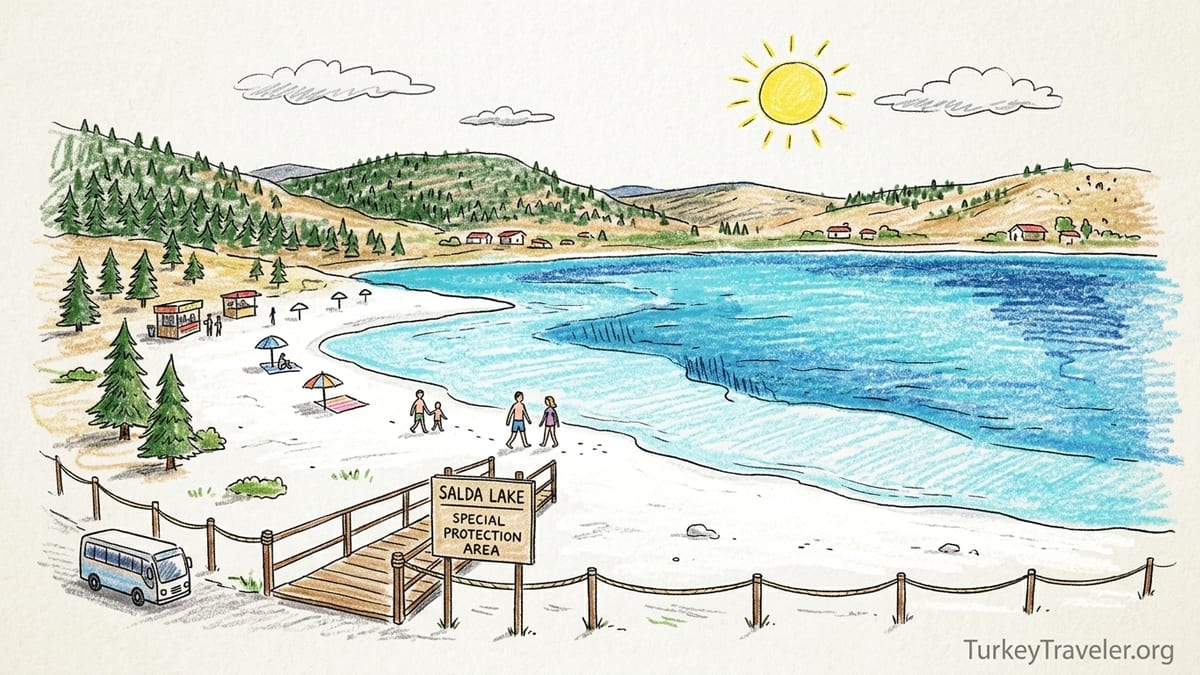
The Photos That Sold Me on the “Turkish Maldives”
My plan to visit Lake Salda started, like many trips do now, with a handful of viral images. On Instagram and in Turkish tour brochures, Salda appeared as a perfect oval of turquoise water framed by a blinding white shore, a place where people walked ankle-deep through glass-clear shallows that looked almost tropical. Several Antalya-based agencies marketed day trips with glossy posters labeled “Salda & Pamukkale – Turkish Maldives Tour,” often showing hammocks and palm silhouettes that, as I later discovered, do not exist anywhere near the lake.
Those images usually focus on the southeast shore, near Yeşilova’s public beach, where the color contrast is at its most dramatic. Photographers shoot from just above water level with a wide-angle lens, cropping out almost everything except the neon shallows and the white mineral band. Under certain summer light, especially on calm, sunny days, the resemblance to a small Maldivian lagoon is real enough that you do a double-take. The framing, however, is doing most of the work.
What the photos rarely show is the context. Lake Salda sits at roughly 1,190 meters above sea level in the highlands of Burdur province, bordered not by coconut palms and overwater villas but by pine-covered hills and dry, scrubby slopes. From the main beach you see low mountains, a scattering of village houses, and a few modest cafés instead of a polished resort strip. GoTürkiye itself describes Salda as a high-altitude crater lake with turquoise water, bright white mineral shore and very limited surrounding development because of protection rules, and when you stand on the gravel parking area looking down at the water, that description feels far more accurate than any comparison to the Maldives.
Still, on the bus from Denizli the day I visited, the marketing worked. The driver had taped a printed poster near the front, showing a woman in a wide-brimmed hat walking into water the color of a swimming pool. Half the passengers had flip-flops in their bags and spoke about Salda as if they were heading to a mountain version of a beach club. I was one of them. My expectations were primed for a soft-sand, warm-water, lounge-chair kind of day. That is not what Lake Salda delivers.
First Impressions: A High, Cold, Otherworldly Lake
Stepping out of the minibus at the main public area in Yeşilova, the first surprise was the air. In late August, I had left Pamukkale in 36-degree heat. At Salda, the midday temperature hovered several degrees lower, and there was a steady breeze off the lake that felt closer to a mountain town than a beach destination. Even before I saw the water up close, the highland setting was obvious: crisp air, the smell of pine from nearby slopes, and an almost total absence of the humidity you associate with the Mediterranean coast.
From the small parking lot, the view down to the lake was genuinely spectacular. The white shore formed an uneven arc, as if someone had spilled a vast bowl of powdered chalk around a deep, navy center. Closer in, the shallows glowed turquoise and apple blue, the color shifting sharply where the lake floor dropped away. Knowing that Salda reaches depths of around 180 meters adds to the drama; once the color turns from light to dark blue, you feel the abyss under that calm surface.
Walking down toward the water, though, the disconnect with the “Turkish Maldives” nickname grew with each step. The shoreline was open and exposed, with very little natural shade. Aside from a few scruffy pines set back from the designated beach zone and some young saplings protected by fences, there were no trees near the water to duck under. The land behind the shore felt raw and under-built by design, with conservation signage and roped-off sections reminding you that this is a protected Special Environmental Protection Area rather than a place where developers have been allowed to plant rows of sunbeds.
The atmosphere, too, felt different from a tropical resort. Families from Burdur and Denizli had driven in with picnic coolers; there were folding camp chairs instead of beach club loungers, and children running between the water and simple snack kiosks instead of infinity pools and cocktail bars. The lake did not feel like a luxury escape. It felt like a wild, high-altitude lake that locals were still getting used to sharing with the wider world, and that mismatch between image and reality turned out to be the main theme of my visit.
The Famous White Shore: Not Exactly Sand Underfoot
The second expectation I had carried with me was about the shore itself. Every brochure called it “white sand,” and almost every photo used some variation of that phrase. From a distance, it does look exactly like an overexposed tropical beach, an unbroken sweep of pristine white. Up close and underfoot, the experience is very different.
What looks like sand in pictures is primarily hydromagnesite and other magnesium-rich minerals, mixed with clay. In many places the surface feels more like packed, slightly sticky powder than granular sand. When dry, it is firm, almost like walking on compressed baking flour scattered over hard ground. Where the lake laps over it, the top layer often turns to a thin, yielding mud that clings to your toes in a way fine coral sand never does.
In the roped-off “Maldivler” section, where people used to crowd onto the brightest stretch of shore before stricter protections were introduced, you can see why authorities have limited access. The minerals form delicate, pitted textures similar to the microbialite formations that interest scientists studying Salda as an analogue for Martian lakebeds. Even light trampling leaves visible scars, and years of popularity have already compacted some sections into uneven, slightly greyed patches. Standing there, it is hard to begrudge the rules that keep visitors on wooden paths or confined to specific entry points. Without them, the white fringe would quickly lose the very quality that drew people here.
As for comfort, walking barefoot along the permitted shoreline was less pleasant than I had imagined. The dry sections were fine for short stretches, but in wetter areas the clay stuck in clumps, and the underlying ground sloped unevenly into the water. At one point I stepped into a soft patch that sucked at my heel like cold putty. Locals nearby casually rinsed their feet, laughing, clearly used to the weird texture. For someone arriving with postcard expectations of powdery sand between the toes, though, this aspect of Salda can feel underwhelming or at least surprising.
Water Color vs Water Temperature: A Chilly Reality Check
The water itself is the star of every Salda image, and in person the color does not disappoint. Standing in the shallows on a sunny day, you see your feet clearly even when the water reaches your thighs. The clarity is startling, with sunlight fracturing into bright, moving patterns on the pale lake bed. From certain angles, especially looking along the curve of the shore instead of straight out, the gradient from clear to turquoise to deep blue looks almost unreal.
What the “Turkish Maldives” nickname does not prepare you for is the temperature. This is a high-altitude lake fed by local catchments, not a shallow tropical lagoon. On my late summer visit, locals described the water as “refreshing,” and they were right. The first shock when you step in is similar to wading into the sea early in the Mediterranean season. Once you are waist-deep, the chill creeps upwards and settles into your core. Swimmers around me tended to take short, energetic dips rather than lingering for hours; very few people floated lazily as you often see in warm coastal waters.
I had expected to spend the better part of an afternoon in and out of the lake. In reality, two twenty-minute swims felt like plenty. The contrast between the intense sun on your shoulders and the cold around your legs is not unpleasant, but it belongs more to mountain lake culture than to the kind of bathtub-temperature sea associated with the Maldives. On windier days, the surface can chop up quickly, which adds to the sense that you are in a serious body of water rather than a safe, shallow lagoon.
Depth also affects the experience. Salda is among the deeper lakes in Turkey, and the drop-off from the bright shallows to darker water can come faster than many first-time visitors expect. The designated swimming zone near the main public beach stays relatively shallow for a comfortable distance, but if you walk along the shore away from the managed area, footing becomes more unpredictable. Combined with the cold, it is easy to understand why authorities and local guides emphasize staying within marked sections and avoiding attempts to swim far out into the lake.
Protected Shores and Restricted Access: Inconvenience with a Purpose
Another gap between expectation and reality at Lake Salda is the degree of regulation on where you can actually go. Many travel images show people scattered all along the brilliant white fringe, giving the impression that you can wander freely around the entire lakeshore. In practice, most casual visitors spend their time in a few designated zones where access is concentrated and managed, particularly on the Yeşilova side that bus tours favor.
On arrival, the first thing that greets you is not a beachfront bar but a cluster of information boards and ropes marking off sensitive areas. There are clear signs indicating where vehicles must stop, where walking is forbidden to protect the shore, and where swimming is either allowed or discouraged. Local staff circulate on busy days, reminding people not to venture onto closed sections, especially the brightest white “Maldives” band that appears so prominently in marketing photos.
For some visitors, especially those arriving on a quick tour from Antalya or Denizli with only an hour or two at the lake, these restrictions can feel frustrating. You can see surreal stretches of untouched white shore looming just beyond a rope, with no one on them, while your own designated area fills with families, umbrellas and inflatable rings. It is easy in that moment to forget that the very minerals and microbial structures that make the shore look so photogenic are fragile and slow to regenerate once damaged.
Spending a full afternoon at Salda, rather than rushing through, helped me reframe these rules. Watching the way visitors congregated in a few access points while the rest of the shoreline remained almost empty drove home how much heavier use the lake would endure without regulations. The Special Environmental Protection status that limits construction, motorized water sports and unrestricted shore access is precisely why, from a distance and in wide shots, Salda still looks nearly pristine. The inconvenience of walking a bit farther from the parking area, staying on wooden paths and respecting roped boundaries is a small price to pay for keeping that landscape intact.
Facilities, Crowds and Comfort: Not a Beach Resort
The practical experience of a day at Lake Salda diverges sharply from the resort-style expectations that the “Turkish Maldives” label encourages. On the Yeşilova side, which receives the bulk of visitors, there are basic facilities: public toilets for a small fee, simple changing cabins, a few modest cafés and gözleme stands, and tents or kiosks renting sun umbrellas and plastic loungers. You can buy tea, bottled water, simit and basic grilled foods, but there are no polished beach clubs, no cocktail menus, and no branded resort infrastructure hugging the shore.
During my visit, the main beach area felt busy but not chaotic. Families occupied shaded picnic shelters set back from the lake, while groups of friends clustered near the waterline. Tour buses that combine Pamukkale and Salda often arrive in waves, so the crowd can swell suddenly when a couple of coaches pull in from Denizli or Antalya. Tour descriptions commonly offer around one to two hours of free time at the lake, which means many people spend that entire window queuing for changing cabins, grabbing a quick swim, and lining up again for the toilets before departure. Travelers expecting the calm, nearly private atmosphere depicted in some photos may be surprised at how social and ordinary the beach scene feels in high season.
Compared with established coastal resorts, facilities at Salda are less developed and more utilitarian. There are rubbish bins, but they fill quickly on very busy days. The cafés serve practical food rather than curated “Instagram dishes,” and prices are generally moderate, more in line with small-town Turkey than major tourist hubs. What you will not find are beachfront hotels with direct, unrestricted access to the shore, nor rows of branded sun loungers laid out like a Mediterranean Riviera. The absence of that infrastructure is deliberate, a result of protection rules that limit permanent construction and keep development set back from the most sensitive parts of the lakeshore.
For comfort-focused travelers, this can be mildly disappointing. Shade is limited near the water, so many people bring their own small tents or sun shelters, or pay to rent an umbrella if available. The changing cabins are functional rather than pleasant, and on crowded weekends there can be a wait. If you arrive imagining the convenience of a full-service resort, with staff circulating to take orders and perfectly raked sand under every lounger, the reality of Salda will feel more like a scenic rural recreation area. Once you adjust that mental picture, however, the simplicity becomes part of the charm.
What Truly Impressed Me, and What Fell Short
Looking back on my visit, it is easy to separate what was genuinely spectacular from what felt over-sold by the “Turkish Maldives” narrative. The standout, without question, was the lake’s color and geological setting. Seeing that gradient of blues framed by highland hills, knowing that the same magnesium-rich minerals that whiten the shore also make Salda an analogue for Martian lakebeds, gave the place a quietly otherworldly character you do not get from a typical seaside destination. Late in the afternoon, when the crowd thinned and the wind dropped, the water turned into a vast, still mirror, the hills and clouds reflected in a way that made the lake look impossibly deep.
The relative lack of development, once I understood the context, also became a highlight. From certain vantage points, especially if you walk a little away from the busiest section, you can frame photographs where the only human traces are a wooden walkway or a distant swimmer, dwarfed by the vast bowl of the crater. There are no high-rise hotels intruding on the skyline, no jet skis carving up the surface, no loud music drowning out the sound of wind and water. For a place that has exploded in popularity over the past decade, that level of restraint is rare and precious.
On the underwhelming side, my biggest disappointment was the mismatch in “feel” compared with the tropical images that had lured me there. The white shore did not feel like sand beneath my feet, the water was far too cold for the lazy, hours-long floating I had imagined, and the facilities did not lend themselves to lingering in comfort all day without your own picnic setup. The designated beach areas, especially when a couple of buses disgorged their passengers at once, felt more like a busy municipal lakefront than a remote, hidden paradise.
None of this made Salda a bad destination. Instead, it taught me that the problem lies less with the lake and more with the nickname. By promising a Turkish version of a Maldivian resort, marketers guarantee a degree of disappointment for anyone who shows up expecting palm trees, warm sea and soft, endlessly walkable sand. Framed honestly as a protected high-altitude lake with striking colors, limited shade, cool water and modest facilities, Salda can set its own expectations and satisfy them.
Reframing Lake Salda: How to Enjoy It for What It Is
The most constructive way to think about Lake Salda is to drop the Maldives comparison entirely and reframe it as a geological and scenic destination, with swimming as a bonus rather than the main event. Approached this way, the very qualities that frustrate some visitors become part of the appeal. The altitude that keeps the water cool also provides relief from the coastal heat, especially if you are coming from Antalya or Fethiye in the peak of summer. The limited development means you can still find quiet stretches to sit and watch clouds move over the hills, even on days when the main beach is active.
For photography, Salda is a dream when the weather cooperates. Early or late in the day, the low sun picks out textures in the mineral shore, and the water shifts through a dozen shades depending on wind and cloud cover. Bringing a camera with a polarizing filter helps cut glare and reveal the lakebed in the shallows, something you notice immediately when you compare your own shots to the hyper-saturated images in brochures. From the shore near the village of Salda on the north side, you can capture wider, less crowded panoramas that include more of the surrounding hills and forest.
Spending time reading the informational boards and quietly observing the shoreline also changes the emotional tone of a visit. Signs from local authorities explain the Special Environmental Protection status, the fragility of the microbialite formations, and the role of the lake’s magnesium-rich water and sediments in scientific research. Once you understand that the bright white “sand” under your feet is part of a rare geological system, the desire to wander everywhere and claim the prettiest patch for yourself quickly gives way to an urge to tread lightly.
In practical terms, the best experiences I saw others having at Salda were those that treated the lake as a scenic highland outing: people who brought simple picnics, sat in the shade of the few available shelters or their own umbrellas, took a couple of brief but joyful swims, and then spent time walking along the allowed sections of shore, taking photos and simply enjoying the cooler air. Travelers who arrived in flip-flops with nothing but a beach towel, expecting all-day resort comfort, tended to be the ones hunting for shade and feeling irritable by mid-afternoon.
The Takeaway
Lake Salda is absolutely worth visiting, but not as a substitute for a Maldivian beach resort. It is a protected highland lake with unusual geology, intense water color, and a shoreline made of fragile white mineral deposits rather than traditional sand. The water can be strikingly cold even in summer, the shore underfoot feels more like clay and packed powder than a tropical beach, shade is limited, and most visitors are funneled into a few designated access points where facilities are basic and crowds ebb and flow with tour bus schedules.
Approached with realistic expectations, however, those same characteristics become strengths. The cool air and water offer a break from coastal heat, the lack of heavy construction keeps the views uncluttered, and the protection rules preserve both the delicate shore and the atmosphere of a wild, almost otherworldly crater lake. Salda is particularly rewarding for travelers interested in geology, landscape photography and quiet scenic time. It pairs naturally with nearby destinations like Pamukkale or Burdur, not as another place to work on a tan, but as a chance to stand on the edge of a deep Anatolian lake whose minerals link it, indirectly, to the study of ancient lakes on Mars.
If you arrive expecting hammocks among palm trees and warm, shallow sea, you will probably leave puzzled. If you come instead ready for a highland lake with bright water, cool swims, limited shade, and the need to respect roped-off areas, you are far more likely to appreciate what makes Lake Salda special. The problem is not with the lake. It is with the nickname. Once you set the “Turkish Maldives” label aside and meet Salda on its own terms, the place makes perfect sense.
FAQ
Q1. Is the white shore at Lake Salda really like sand?
The white shore looks like tropical sand from a distance, but up close it feels more like packed mineral powder and clay, sometimes turning to soft, sticky mud where it is wet.
Q2. How cold is the water at Lake Salda in summer?
In the main summer months the surface water can feel cool but swimmable, similar to an early-season Mediterranean swim, and most people prefer short, refreshing dips rather than very long swims.
Q3. Can you swim everywhere in Lake Salda?
No, swimming is generally limited to designated beach areas where access is managed; large sections of the shore and shallows are off limits to protect fragile mineral and microbial formations.
Q4. Are there many facilities and beach clubs around Lake Salda?
The main public area has basic facilities like toilets, changing cabins and simple cafés, but there are no full-scale beach clubs or large resort complexes directly on the shore.
Q5. Is there enough shade at Lake Salda for a full day visit?
Natural shade close to the water is limited, so most visitors rely on small picnic shelters set back from the shore or bring their own umbrellas and sun tents.
Q6. Why are some parts of the white shore fenced off?
Fenced and roped-off sections protect delicate mineral and microbial structures that give the shore its unusual white color; heavy foot traffic can damage them faster than they can recover.
Q7. Does Lake Salda really feel like the Maldives?
Visually, the turquoise water and white fringe can resemble tropical photos in certain lights, but the cool highland air, cold lake water and modest facilities feel very different from a Maldivian resort.
Q8. Is Lake Salda suitable for young children?
Families do visit with children and enjoy paddling in the shallows, but parents need to watch kids closely because the lake deepens in places and the shore can be uneven and slippery.
Q9. What kind of traveler will enjoy Lake Salda most?
Travelers who appreciate geology, scenery, cooler mountain air and photography, and who do not require resort-style comfort, tend to enjoy Lake Salda the most.
Q10. How should I mentally frame a visit to avoid disappointment?
Think of Lake Salda as a protected high-altitude crater lake with striking colors, simple amenities and some access restrictions, not as a tropical beach resort, and plan your day with that in mind.