


The eastern Mediterranean coast of Turkey offers a very different experience from the mass tourism hubs of Antalya and the Aegean. Stretching from the ancient fortified shorelines of Anamur and Silifke to the big cities of Mersin, Adana and Hatay, this region blends working ports, fertile plains, long sandy beaches and layers of history from Roman to Ottoman and beyond. For first-time visitors it can feel less polished yet more authentic, with lower prices, fewer foreign crowds and a strong local food culture. This guide focuses on practical planning for a first journey through Mersin province and onward to Adana and Hatay: where to go, how to move between cities, what to expect from the climate, and how to experience the coast, ancient sites and regional cuisine.
Understanding Turkey’s Eastern Mediterranean Coast
The eastern Mediterranean region of Turkey runs roughly from Anamur in western Mersin province east toward the Syrian border, taking in Mersin city, the Çukurova plain around Adana, and coastal Hatay. On the map you are looking at the stretch south of the Taurus Mountains where fertile citrus groves meet a warm sea. Culturally it is part of the broader Mediterranean Region of Turkey, with classic Mediterranean climate on the coast hot, dry summers and mild, wetter winters, and more continental conditions in the interior toward the mountains.
Compared with the well-known “Turkish Riviera” around Antalya and Muğla, this area has fewer all-inclusive resorts and large foreign tour groups. Mersin is a major port city first, holiday destination second, and Adana is a big industrial and university city famous for its food rather than its beaches. Hatay, whose capital Antakya was badly damaged in the February 2023 earthquakes, remains in a period of rebuilding but still offers important archaeological collections, coastal getaways such as Arsuz and Samandağ, and a celebrated culinary tradition. Travelers who come here usually want lower-key beaches, ancient Cilician and Roman sites, and contact with everyday Turkish life.
Distances are manageable but not tiny. From Mersin city to Adana is about 70 kilometers, usually around an hour by train or bus. From Mersin to Silifke is roughly 90 minutes by car, and from Silifke to Anamur another 2.5 to 3 hours on winding coastal roads. For a first visit it is realistic to focus on one or two bases such as Mersin or Kızkalesi for the coast, plus Adana for food and urban culture, with a side trip into Hatay if you have extra time and are comfortable with an evolving infrastructure situation.
Prices in this region tend to be lower than in Istanbul or the Aegean. In 2026, a midrange hotel in Mersin often starts around the equivalent of 40 to 70 US dollars per night for a double room, while local restaurant meals can still be found for under 10 dollars per person. Luxury options exist but are fewer than in Antalya, so the overall feel remains more local and budget friendly, especially outside the peak school holiday weeks in July and August.
Mersin Coast: Anamur, Silifke and Kızkalesi
The most attractive holiday coastline in this region lies within Mersin province between Anamur and Erdemli. Anamur, close to the border with Antalya province, is best known for Mamure Castle, a large seaside fortress set directly on the shore with stone ramparts and towers overlooking the waves. Beaches here are mostly long, open and comparatively quiet, with many local family-run pensions and small hotels. Expect simple but comfortable rooms, often with balconies and sea views, and prices slightly below more famous resort towns further west.
Continuing east, the Silifke area combines river valley farmland, a hilltop castle and some of the region’s most important archaeological remains. The hilltop Silifke Castle overlooks the town and the Göksu River, while nearby sites such as Uzuncaburç preserve the remains of ancient temples and colonnaded streets from the Roman and earlier periods. Short drives from Silifke take you to coastal villages including Taşucu and Narlıkuyu, where small coves, seafood restaurants and boat tours draw weekend visitors from Mersin and Adana.
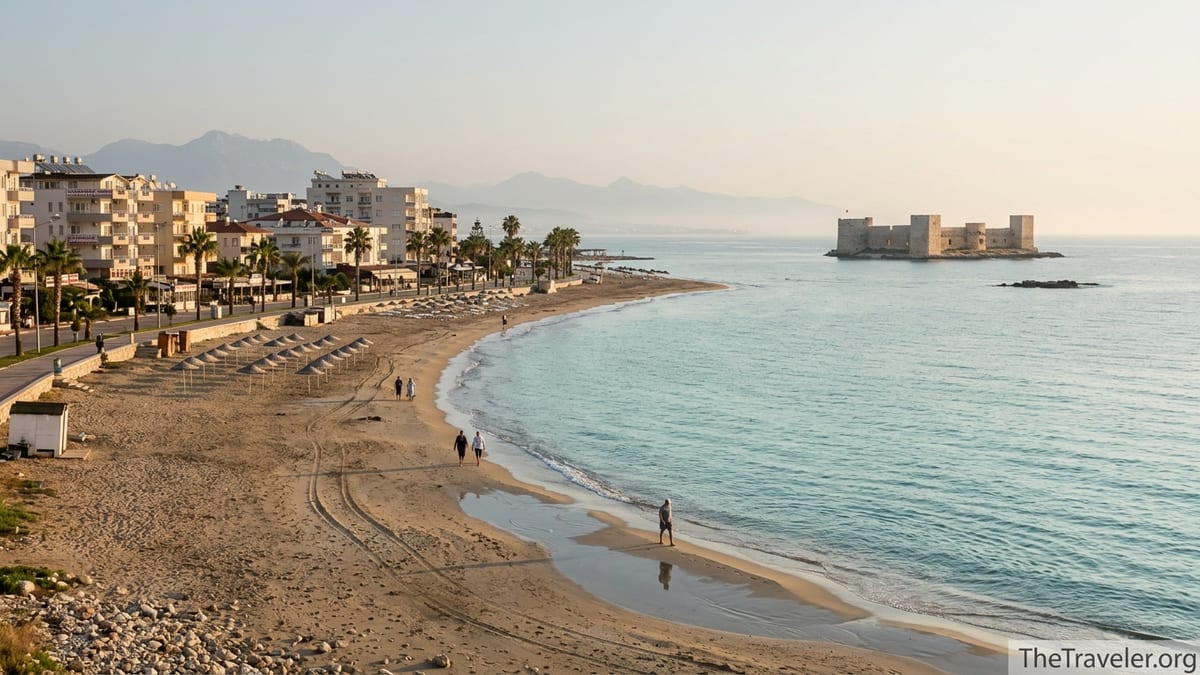
Kızkalesi, roughly midway between Silifke and Mersin, is the best known beach resort on this stretch of coast. The town’s sandy beach faces two castles: one on the shore itself and the other, Kızkalesi or Maiden’s Castle, on a small island a few hundred meters offshore. In summer you can take small boats from the beach to land on the castle islet or rent kayaks and paddle across when the sea is calm. The beachfront is lined with midrange hotels and apart-hotels, and prices are typically competitive: in high season it is often possible to find double rooms in clean three-star properties in the range of 50 to 90 US dollars per night, depending on proximity to the sea and facilities such as pools.
The coastline around Erdemli and west toward Silifke hides a number of quieter bays and coves that require a car to reach. Local guides and regional tourism offices highlight places such as secluded inlets near Ayaş and small unmarked beaches used mainly by locals. Infrastructure can be basic you might find a beachside tea house with umbrellas and simple showers rather than full resort services but the water is warm and usually clear from late May to early October. For a first-time visitor, booking accommodation in Kızkalesi or Silifke and then exploring outward by car or organized day tours is a practical approach.
Cities and Culture: Mersin, Adana and Hatay
Mersin city is a modern port with wide boulevards, a long palm-lined seafront promenade and a compact downtown full of cafes and shops. It is not a classic resort city but works well as a base if you prefer urban comforts while day-tripping to beaches and ruins. The waterfront offers public beaches, a marina area and coastal parks where local families gather in the evenings. Key historical sights include the remains of Soli Pompeiopolis to the west and day trips inland to sites like the early Christian complex associated with Aya Tekla near Silifke.
Adana, inland to the east, is one of Turkey’s largest cities and a center of the Çukurova agricultural plain. It is famous above all for its food, especially Adana kebab, a spicy minced meat kebab grilled on wide skewers and typically served with flatbread, grilled vegetables and salads. Eating at a traditional ocakbaşı grill house is an essential experience here: you sit close to the open fire, watch the skewers cooked in front of you and often pay per skewer, with full meals commonly in the range of 8 to 15 US dollars per person in 2026 for generous portions in local places. Adana also offers a riverside park along the Seyhan River, the historic Taşköprü stone bridge and several mosques and markets that showcase the city’s mix of old and new.
Hatay province, with its capital Antakya, has historically been one of Turkey’s richest cultural mosaics, home to Turkish, Arab, Armenian and other communities and a cuisine that blends Levantine and Anatolian influences. The 2023 earthquakes hit Hatay particularly hard, and while coastal districts like Arsuz and Samandağ as well as some inland towns are functioning and welcoming visitors again, the center of Antakya continues to rebuild. Travelers visiting Hatay now should be prepared for widespread construction, temporary housing areas and infrastructure still in progress. At the same time, key attractions such as the archaeological museums with their renowned mosaics and some historic churches and mosques are gradually reopening, and local guesthouses and restaurants are eager for responsible tourism that supports recovery.
For a first visit that combines cities and coast, a common pattern is to fly into Adana, spend one or two nights enjoying the food scene and riverside, then move on to Mersin city or Kızkalesi for several days by the sea. If you have a full week or more and are comfortable with a more complex itinerary, you can add a side trip down to Arsuz or Samandağ in Hatay for a look at the long sandy beaches and to sample Hatay-style dishes such as kağıt kebabı slow-cooked meat and vegetables baked on paper or the dessert künefe made with cheese and shredded pastry in syrup.
Beaches, Sea and Outdoor Activities
The Mediterranean here is warm and usually calm from late May through September, with sea temperatures often exceeding 25 degrees Celsius in midsummer. Beach infrastructure varies from wide public beaches with basic facilities to private hotel strands where loungers and umbrellas are included for guests and available for a small fee for day visitors. In Mersin province the coastline alternates between long sandy stretches and pebbly coves, so bringing water shoes can be helpful if you plan to explore beyond the well-known beach towns.
In Anamur and the surrounding coast, beaches are broad and relatively uncrowded, with a backdrop of banana plantations and low hills. It is common here to find simple beachside cafes serving grilled fish, salads, gözleme stuffed flatbreads and tea. A typical setup is to rent a sunbed and umbrella for the equivalent of 3 to 5 US dollars per day, then order food and drinks from the cafe while spending the day swimming and reading.
Kızkalesi’s main beach tends to be livelier, especially in July and August when domestic tourists fill the seafront hotels. The shallow, sandy bottom makes it popular with families. Boat operators along the beach advertise short trips out to the island castle and along the coast; prices are usually clearly posted and for 2026 you can expect small group trips of an hour or two to cost a modest amount, with discounts often available if you join with others. Always confirm the length of the tour and whether swimming stops are included before you board.
Beyond swimming, the region offers hiking in the foothills of the Taurus Mountains and visits to natural attractions such as canyons and waterfalls inland from Mersin and Silifke. Some of the rock-cut reliefs and valleys, like those near Adamkayalar in the Şeytan Deresi canyon, require a reasonable level of fitness and sturdy footwear. There is less of a developed adventure tourism industry here than in Antalya, so guided hikes and organized outdoor tours may need to be arranged through local agencies in Mersin or online with regional operators rather than relying on a dense network of tourist offices in each small town.
Ancient Sites and Historical Highlights
This stretch of coast forms part of ancient Cilicia, a region that saw Hellenistic kingdoms, Roman provincial towns, Byzantine fortifications and Armenian and Crusader castles. Archaeology-minded travelers can easily fill several days exploring scattered ruins that rarely feel crowded. Many are in rural settings with limited signage, so reading up in advance or hiring a local guide can deepen the experience.
Near Mersin city, the remains of Soli Pompeiopolis offer glimpses of a once-thriving Roman port, with columns and foundations still visible. Further west, the Uzuncaburç ruins above Silifke preserve a striking temple complex and sections of monumental gates and colonnades, set on a plateau with views over the surrounding hills. Visiting Uzuncaburç typically involves a winding drive up from Silifke, so combining it with other nearby sites in a half-day car hire or tour makes sense.
Kızkalesi itself is a highlight, with the island castle built on a small offshore islet and a corresponding fortress on the mainland. The sea-level location and surrounding beaches make it easy to combine history and relaxation in one stop. Boat rides to the island depart frequently in high season, and you can usually explore the walls and inner spaces independently once ashore. To the west near Anamur, Mamure Castle is another major fortress whose curtain walls, towers and inner courtyard stretch along the shoreline, delivering dramatic photo opportunities especially in the late afternoon light when the stones glow warm against the sea.
Inland, early Christian and later Byzantine sites dot the landscape. The complex associated with Saint Thecla near Silifke includes caves, church remains and cisterns, illustrating how early Christian communities adapted older sacred places. In Hatay, once conditions permit, the archaeological and mosaic collections in the regional museums offer an indoor counterpart to the open-air ruins along the coast, showcasing intricate floor mosaics and artifacts from Antioch and its surroundings. Always check locally for current opening hours and access, as restoration work can temporarily close parts of some sites.
Food, Markets and Everyday Life
One of the region’s great pleasures is its food, driven by the produce of the Çukurova plain and the fishing grounds of the Mediterranean. In Mersin and along the coast you will find abundant fresh fish, fried calamari, shrimp güveç casseroles and simple grilled sea bream or sea bass served with lemon, salad and bread. Prices vary by location, but neighborhood seafood restaurants away from the busiest promenades can offered grilled fish plates at reasonable prices in 2026, particularly at lunchtime.
Mersin has its own specialties, including tantuni thinly sliced beef or sometimes chicken sautéed with spices and wrapped in lavash or stuffed into small bread. It is a popular street food, and in central Mersin you will see neon signs advertising tantuni shops late into the evening. Ordering one or two portions along with ayran salted yogurt drink makes for a filling yet affordable meal. Another Mersin favorite is cezerye, a sweet made from carrot, sugar and nuts sold in colorful blocks at dessert shops and markets, often boxed for gifts.
Adana’s culinary fame centers on its namesake kebab, but the city also excels in meze spreads, offal dishes and hearty breakfasts. In traditional kebab restaurants you typically start with a table of salads, grilled peppers and soft bread, sometimes automatically included in the cover charge. Locals often order a mix of skewers to share, from classic Adana to liver or chicken wings, and finish with tea. Street-level prices remain competitive compared with Istanbul or major European cities, and visitors often comment that restaurant quality is high even in simple-looking neighborhood places.
Hatay’s cuisine, when you encounter it in functioning restaurants in the province or in Hatay-style eateries in Mersin and Adana, is rich in herbs, olive oil and dishes that reflect Levantine traditions. Mezze can include hummus, baba ghanoush, zahter wild thyme salad and various stuffed vegetables. Desserts such as künefe are cooked to order in small metal pans, with hot syrup poured over the crisp pastry and melted cheese just before serving. Many towns and cities host weekly street markets where you can see the agricultural side of the region up close stalls piled with citrus, pomegranates, peppers and fresh herbs at prices that remind you this is still a producing region rather than only a tourist showcase.
Practicalities: Accommodation, Transport and Weather
Accommodation along this coast ranges from basic pensions to modern business hotels in the larger cities and resort-style properties in Kızkalesi and along parts of the Mersin shoreline. In Mersin city, you will find well-known international and Turkish hotel chains near the waterfront and central districts, catering to business travelers as well as holidaymakers. These often offer reliable Wi-Fi, air conditioning and buffet breakfasts, with room rates generally lower than equivalent properties in Istanbul or Antalya. In smaller towns like Silifke or Anamur, family-run hotels and guesthouses dominate, sometimes with limited English spoken but warm hospitality.
Transport between major cities is straightforward. Adana and Mersin are linked by frequent trains and buses, with journey times usually around one hour. Both cities have modern intercity bus terminals with connections to Istanbul, Ankara and other parts of Turkey. Adana airport serves domestic flights from Istanbul, Ankara and other regional hubs, making it the typical arrival point for international visitors who connect via Istanbul. From Mersin to smaller coastal towns such as Kızkalesi, Silifke and Anamur, regular buses and minibuses operate during the day, although schedules may thin out in the late evening and outside summer, so planning arrival times to match public transport can save on taxi costs.
Weather is a key consideration for planning. Summers along the eastern Mediterranean are hot and humid, with daytime temperatures routinely above 30 degrees Celsius in July and August, and often higher in Adana and inland Hatay. Air conditioning in accommodation is essential in these months, and sightseeing is more comfortable in the mornings and evenings, leaving midday for the beach or rest. Spring April to early June and autumn late September through October offer more moderate temperatures and are often ideal for combining city visits and archaeological sites with time by the sea.
Costs for day-to-day travel remain relatively favorable for visitors using stronger foreign currencies, though they can change quickly with economic conditions and exchange rates. As of 2026, a city taxi ride within Mersin or Adana is often just a few US dollars, and intercity bus tickets between the two run at a modest cost. Carrying some cash in Turkish lira is still useful for small purchases, minibus fares and rural cafes, but credit and debit cards are widely accepted in hotels, larger restaurants and supermarkets.
First-Time Itinerary Ideas and Planning Tips
For a first-time visitor with one week, a simple and rewarding itinerary is to base yourself in two locations: Adana for two nights and the Mersin coast for four or five nights. Fly into Adana, spend your first evening settling in and sampling Adana kebab at a classic grill house, then use the next day to explore the riverside park, Taşköprü bridge and central markets. On day three, travel by train or bus to Mersin, check into a waterfront hotel, and stroll the promenade in the evening when families come out to enjoy the sea breeze.
From Mersin, plan at least one full-day excursion to Kızkalesi and the surrounding coastline. You can swim at the main beach, visit the mainland fortress, take a boat to the island castle and enjoy a long seafood lunch at one of the seafront restaurants. Another day can be dedicated to Silifke and nearby ruins such as Uzuncaburç or the Aya Tekla area, combining history and rural scenery. If you have the energy for a longer day and a rental car, driving west to Anamur to visit Mamure Castle offers a dramatic combination of fortress walls and crashing waves, though the road is winding and travel times can be longer than the distance suggests.
Travelers with 10 to 12 days might extend into Hatay, adding a few nights in a coastal town like Arsuz or Samandağ to experience long, less-developed beaches and Hatay cuisine. Because the region is still recovering from the 2023 earthquakes, it is wise to check recent reports, contact accommodation in advance and be prepared for visual signs of reconstruction and some ongoing disruptions. In return, you will be engaging with an area that deeply values respectful visitors and where your spending supports local recovery.
Regardless of trip length, planning around the climate is crucial. If your travel dates fall in peak summer and you are sensitive to heat, consider structuring days so that outdoor visits to sites like Mamure Castle or Uzuncaburç happen early or late, keeping the hottest hours for shaded cafes or air-conditioned museums. Booking accommodation with reliable air conditioning and, ideally, a pool can significantly affect comfort in July and August. Finally, remember that this is a working region as much as a tourist area: expect some industrial landscapes near ports and factories around Mersin and Adana, mixed in with farmland, historic ruins and quieter villages along the sea.
The Takeaway
Mediterranean Turkey east of Antalya offers a more understated experience than the heavily marketed resort coasts. From the banana groves and sea-washed castles of Anamur to the sandy beaches of Kızkalesi, the working port of Mersin, the food-focused streets of Adana and the culturally rich yet recovering landscapes of Hatay, this region rewards travelers willing to look beyond the usual itineraries. You will encounter fewer international crowds, more local families, and prices that still feel accessible for longer stays.
For first-time visitors, success lies in choosing realistic distances, respecting the summer heat, and embracing the mix of city life, rural coast and scattered ancient sites. Use Mersin or Kızkalesi as a base for beaches and ruins, dip into Adana for its legendary kebabs and urban energy, and consider Hatay with awareness of its ongoing rebuilding. With thoughtful planning, Turkey’s eastern Mediterranean can offer a memorable introduction to the country that feels both authentically local and richly layered with history.
FAQ
Q1. When is the best time to visit the eastern Mediterranean coast of Turkey?
For a balance of warm weather and manageable heat, late April to early June and late September to October work best. July and August are very hot and humid, especially in Adana and coastal Hatay, though they offer the warmest sea temperatures and the liveliest beach scene in places like Kızkalesi.
Q2. Is Mersin a good base for first-time visitors?
Yes, Mersin city is a practical base thanks to its transport links, range of hotels and urban amenities. You can make day trips to Kızkalesi, Silifke, Soli Pompeiopolis and other coastal and inland sites while returning to a city with plenty of dining options, supermarkets and evening promenades along the sea.
Q3. How many days should I plan for Mersin, Adana and Hatay?
For a first trip, plan at least six to seven days. Two nights in Adana give enough time for key sights and food, three or four nights on the Mersin coast allow for beaches and ruins, and one or two additional nights can be added in Hatay or Anamur if you want to explore more deeply.
Q4. Is it safe to visit Hatay after the 2023 earthquakes?
Many parts of Hatay, especially some coastal and outlying districts, are functioning and receive visitors, but Antakya city center and certain areas remain heavily affected and under reconstruction. Conditions can change, so check recent information, contact accommodation in advance and be prepared for visible rebuilding and occasional disruptions.
Q5. Do I need a car to explore the Mersin and Adana region?
You can travel between Adana, Mersin and main coastal towns like Kızkalesi and Silifke by bus or minibus, which is affordable and reasonably frequent. A car, however, gives more flexibility for reaching scattered ruins, small coves and rural viewpoints, especially around Anamur and the inland archaeological sites above Silifke.
Q6. What should I budget for daily expenses?
Budgets vary, but many visitors find that 70 to 120 US dollars per day per person, excluding flights, covers midrange accommodation, meals in local restaurants, local transport and entrance fees. Spending can be lower if you use public transport, choose simpler guesthouses and eat at inexpensive lokantas, or higher if you favor upscale hotels and frequent private taxis.
Q7. Are the beaches suitable for families with children?
Yes, several beaches are very family friendly, particularly the main sandy stretches in Kızkalesi and around some Mersin city beaches where the water is shallow near shore. In busier areas watch for crowds in peak season, and on more remote or pebbly coves be aware that facilities like lifeguards, toilets and snack stands may be limited or absent.
Q8. What local foods should I not miss?
Do not miss Adana kebab and meze spreads in Adana, tantuni wraps and cezerye sweets in Mersin, and whenever possible Hatay-style dishes such as hummus, zahter salad and künefe dessert. Along the coast, look for simply grilled fresh fish, village breakfasts with olives, tomatoes and local cheeses, and gözleme flatbreads cooked on griddles at roadside eateries.
Q9. How easy is it to get by in English?
In larger hotels, some restaurants and tourist-oriented businesses in Mersin and Adana, staff often speak at least basic English. In smaller towns, budget guesthouses and local eateries, English may be limited, so a translation app and a few phrases of Turkish are useful. Gestures, smiles and patience usually go a long way, and locals are generally helpful to visitors.
Q10. What should I pack for a trip to this region?
Light, breathable clothing for hot weather, a hat, sunscreen and comfortable walking shoes are essential, especially in summer. Swimwear and a quick-drying towel are useful for beaches, while a light sweater or jacket can be handy for cooler evenings in spring and autumn or in higher inland areas. If you plan to visit ruins and canyons, pack sturdy shoes and a refillable water bottle for long, sometimes unshaded walks.