


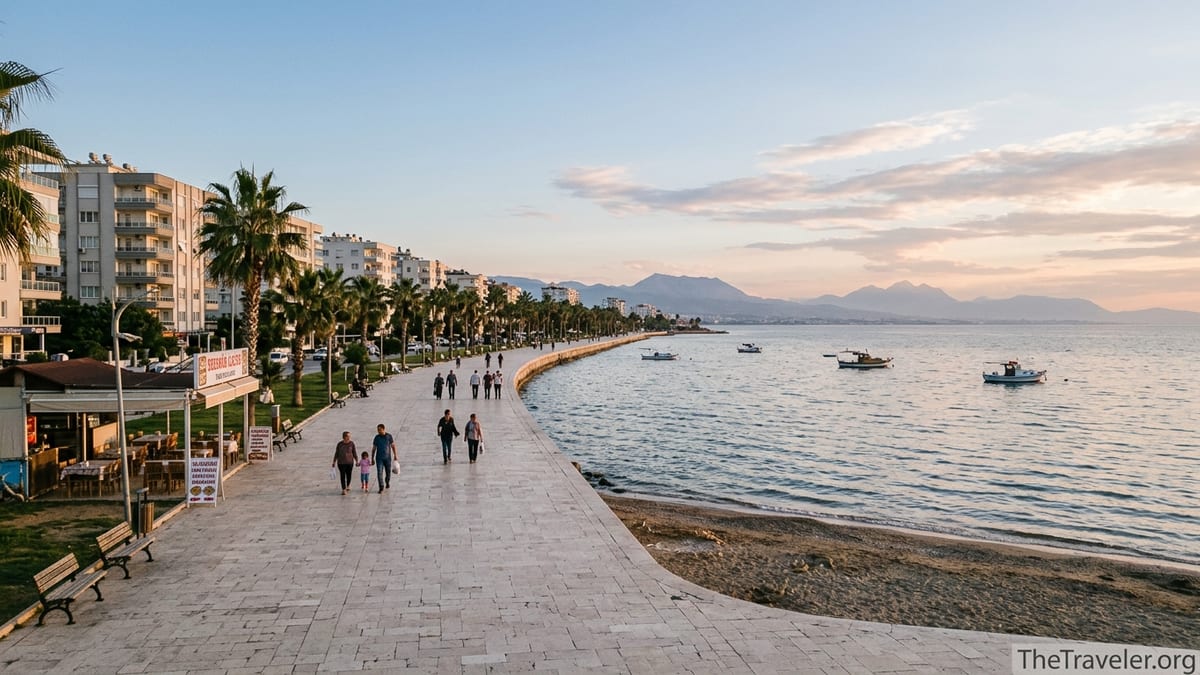
The Mediterranean arc between Mersin and Hatay is one of Turkey’s most rewarding yet least understood coastal journeys. Here, working ports back onto long city beaches, Christian and Islamic heritage sits above Roman roads, and family-run kebab houses share streets with contemporary cafes. This guide lays out realistic 5, 7, 10 and 14-day itineraries that string together Mersin, Tarsus, Adana and Hatay with archaeological sites, accessible beaches and atmospheric town centers, using real travel times and overnight bases that match what visitors actually experience on the ground.
How to Use This Mediterranean Turkey Itinerary Guide
Planning a Mediterranean Turkey trip between Mersin and Hatay is less about ticking off individual sights and more about choosing good bases, then layering day trips on top. Distances are short, but traffic through city centers can be slow, and many of the best ruins or beaches sit just outside town. This guide groups places by overnight base and then suggests logical daily loops you can realistically cover in a single day without feeling rushed.
All four cities in this arc are linked by frequent intercity buses and smaller dolmuş minibuses, and most journeys between major hubs take around one to two hours. For instance, Mersin to Adana by bus is typically around 1.5 hours depending on traffic, while Adana to Antakya, the main city of Hatay, tends to run about two and a half to three hours. Most visitors either use these public options or rent a car at Adana airport, which has the widest choice of rental desks and domestic flights.
Prices in this region remain lower on average than in Turkey’s heavily touristed Aegean or Istanbul. In practice, that means mid-range city hotels in Mersin, Adana or Antakya commonly price their standard doubles at a level that is noticeably below many western Mediterranean destinations, while simple local restaurants can still serve a full kebab meal with salad, bread and tea for the cost of a single drink in parts of Western Europe. Museum tickets are usually modestly priced by international standards, and some historic mosques and churches are free to enter.
The suggested 5, 7, 10 and 14-day routes below build on one another. The 5-day itinerary hits key highlights in each city with minimal backtracking. The 7-day version adds a dedicated beach day and more time in Tarsus. The 10 and 14-day itineraries open up less-visited stretches of coast near Anamur and Samandağ and allow for slower, more immersive days in old neighborhoods, bazaars and coastal promenades.
Overview of the Route: Mersin, Tarsus, Adana and Hatay
Mersin is the natural starting point for most itineraries along this section of coast, especially for travelers arriving from Antalya or from inland Cappadocia. It is a large port city with a long seafront, easy bus connections, and straightforward day-trip access to marquee coastal and archaeological sites such as Kızkalesi, the Cennet and Cehennem sinkholes near Silifke, and the extensive Roman remains at Soli Pompeiopolis and Uzuncaburç. Within Mersin itself, long coastal parks, an archaeological museum and a naval museum provide low-key urban sightseeing between beach walks and cafe stops.
Just inland, Tarsus feels remarkably different. This compact town is famous as the birthplace of the Apostle Paul and for the city gate known as Cleopatra’s Gate, the last standing gate of the ancient city. Visitors generally focus on a small, walkable cluster of sites: Saint Paul’s Church, now a museum; the nearby St Paul’s Well surrounded by a small garden; an excavated segment of Roman road; and the stone arch of Cleopatra’s Gate on the edge of the old town. Together they provide a dense, manageable half-day of exploration that suits both casual visitors and those traveling for religious or historical interest.
Adana, further east, is the liveliest big city on this route. Set on the Seyhan River, it is dominated by the six-minaret Sabancı Merkez Mosque and framed by parks, riverside promenades and the historic stone bridge known as Taşköprü. Travelers often use Adana as an urban break in their coastal trip: wandering the market streets, sampling local specialties such as Adana kebab and bici bici shaved ice desserts, and strolling through Merkez Park at sunset with views over the mosque and river.
Hatay province, with Antakya as its core city, forms the eastern anchor of the itinerary. The Hatay Archaeology Museum is renowned for its mosaics from ancient Antioch and nearby settlements, and Antakya’s narrow old streets preserve a mix of mosques, churches and traditional courtyard houses. While the region was affected by the 2023 earthquakes, visitors continuing to travel here report that key museums, religious sites and many businesses have reopened, though active reconstruction remains part of the city landscape. Coastal day trips from Antakya, especially to Samandağ, provide access to long, windswept beaches and the mouth of the Asi River.
5-Day Snapshot: Core Highlights on a Short Trip
A five-day window is enough to capture the essential flavor of this Mediterranean arc if you choose two main overnight bases and accept that some days will be full. One practical option is to spend your first two nights in Mersin, then one night in Adana, and the final two nights in Antakya. This pattern minimizes backtracking and keeps daily travel times under about three hours.
On Day 1, settle into Mersin and explore the seafront. Many visitors choose hotels along or near the coastal boulevard so they can walk directly to the palm-lined promenades and Atatürk Park. An afternoon circuit might take in the Mersin Archaeological Museum, with its focus on the region’s ancient settlements, followed by a coffee or tea in one of the seafront cafes. Evening temperatures in summer often stay warm well after dark, so locals tend to come out late to stroll, making this a good time to people-watch.
Day 2 can be devoted to a coastal and ruins loop from Mersin. Guided tours and self-organized trips typically combine stops at Kızkalesi, where an offshore castle sits romantically on a small islet, with a visit inland to the dramatic Cennet and Cehennem sinkholes and, time permitting, the upland site of Uzuncaburç with its scattered columns and theater remains. Travelers without a car often join small group day tours arranged through local agencies or their hotels, while drivers can follow the coastal road and branch inland on signed side roads.
On Day 3, check out of Mersin and ride an early bus or drive to Tarsus, which usually takes under an hour from central Mersin in normal traffic. Allocate about four to five hours to visit Saint Paul’s Church, the adjacent well, Cleopatra’s Gate and any additional small museums that interest you, then continue to Adana in the late afternoon. In Adana, most mid-range hotels concentrate near the city center, within reach of the river, parks and main mosque. An evening walk across Taşköprü, with views of Sabancı Merkez Mosque lit up after dark, makes a strong first impression.
Days 4 and 5 shift focus to Hatay. From Adana, mid-morning buses usually reach Antakya by mid-afternoon, providing time for an initial stroll through the old quarter and dinner in a traditional courtyard restaurant serving meze, local olive oil dishes and künefe dessert. Dedicate your final full day to the Hatay Archaeology Museum and a walk through Antakya’s historic streets, visiting a church or mosque that is open, then either remain a final night in Antakya or connect to onward buses in the evening.
7 Days: Adding Beaches and Extra Time in Tarsus
With a full week to work with, you can pace the journey more gently and include a dedicated beach day as well as more nuanced time in Tarsus. A logical pattern is two nights in Mersin, two in or near Kızkalesi on the coast, one in Tarsus and two split between Adana and Antakya. This arrangement reduces single-day road time and allows for slower mornings and extended evenings in each town.
After following the initial two days in Mersin described above, shift on Day 3 to a base near Kızkalesi or one of the neighboring beach towns between Mersin and Silifke. The coastal strip here includes stretches of sandy shoreline interspersed with small resort clusters, apartment hotels and family pensions. Many visitors look for places with direct beach access so they can swim in the early morning and again at sunset, avoiding the hottest hours. Simple beachfront restaurants along this strip often serve grilled fish, salads and regional meze, with prices that are lower than Turkey’s more famous southwest coast.
Day 4 becomes your unstructured beach and ruins day. Morning swims can be combined with a short boat trip out to the sea castle at Kızkalesi, while the mid-afternoon might be reserved for a brief drive or taxi ride inland to see nearby archaeological sites. Travelers who prefer to rely entirely on public transport can base in Kızkalesi and make use of dolmuş minibuses that run along the coast to reach neighboring coves and beach towns, hopping on and off at signed stops on the roadside.
On Day 5, travel inland to Tarsus and check into a small hotel or guesthouse near the historic center. Spending a night here rather than visiting as a simple day trip lets you experience the town in the evening and early morning, when day visitors have departed. After revisiting headline sites like Cleopatra’s Gate and the Roman road segment, you might wander quieter side streets, watch locals at the tea gardens, and sample regional specialties such as hummus and künefe that have strong followings in this part of Turkey.
Days 6 and 7 then focus on Adana and, time permitting, a first look at Hatay. One approach is to travel from Tarsus to Adana early on Day 6, devoting the day to Sabancı Merkez Mosque, Merkez Park, and the city’s bazaars, then traveling onward to Antakya on the evening of Day 6 or the morning of Day 7. If you prefer fewer hotel changes, you can instead base both nights in Adana and visit Antakya as a long day trip, though this adds more road time and reduces your flexibility in Hatay’s old quarter.
10 Days: Deepening the Coastal and Archaeological Experience
A ten-day itinerary unlocks quieter stretches of coast and allows you to explore inland ruins without watching the clock. This is the point at which it becomes particularly attractive to have a rental car, though it is still possible to navigate with buses and dolmuş connections if you accept some waiting time. A common pattern is three nights in Mersin, two on the coast near Kızkalesi or Anamur, one in Tarsus, one in Adana and three in Antakya.
With three nights in Mersin at the start, you can dedicate a full day to central Mersin and its immediate surroundings and another to the classic Kızkalesi and Cennet–Cehennem loop, then use the third day for a longer run further west along the coast. Options include Aydıncık, with its long, relatively unspoilt coastline and connections to the ancient port of Celenderis, or Anamur, known for the extensive remains of Anemurium and the well-preserved Mamure Castle. These western coastal stretches are less built up than some parts of the Turkish Riviera, so services are more spaced out, but many travelers find the combination of ruins and largely undeveloped sea views worth the extra effort.
Two nights on this quieter stretch of coast give you a base for both beach time and in-depth archaeological visits. For example, you might spend a morning exploring Anamurium’s necropolis and theater, where grass and wildflowers often grow among the stones, then retreat to a local fish restaurant for lunch before finding a low-key stretch of sand for a late-afternoon swim. Accommodation here tends towards small hotels and pensions rather than large resorts; most offer simple rooms, optional breakfasts and easy access to the main coastal road.
Returning eastwards, a night in Tarsus keeps the itinerary balanced and allows for unhurried visits not only to Saint Paul’s Church and the well but also to smaller sites such as the Makam-ı Danyal complex, believed by many to hold the tomb of the prophet Daniel, and local museums. Travelers with a particular interest in early Christianity or Islamic heritage may find that even a long afternoon is easily filled with site visits and conversations with local guides or caretakers.
The final stretch of a ten-day plan favors slow time in Antakya. After an overnight in Adana to break the journey and enjoy the city’s food and riverside walks, continue to Antakya for three nights. This gives you one day for the Hatay Archaeology Museum and the immediate old town, a second day for a coastal trip to Samandağ and the mouth of the Asi River, and a flexible third day for revisiting favorite streets, shopping for local olive oil, spices or soap, or adding an additional inland excursion to a nearby plateau or ruin, depending on current accessibility and road conditions.
14 Days: A Two-Week Immersion in Mediterranean Turkey
With a full two weeks, you can turn a linear route into a layered journey and respond to the unexpected: a market that invites lingering, a conversation that leads to a village restaurant, a beach that proves too peaceful to leave after one swim. A 14-day route might divide into four or five nights in and around Mersin, three to four nights along the western Mersin coast near Aydıncık or Anamur, one or two nights in Tarsus, two in Adana and three in Antakya, with flexibility to adjust within each cluster.
In the Mersin cluster, additional days can be used for side trips inland to sites such as Alahan Monastery above the Göksu Valley, whose terraced church structures stand on a steep hillside, or to caves like Gilindire, celebrated for its underground formations and proximity to the sea. These excursions tend to require more driving on mountain or coastal roads, so many visitors arrange them as private tours or shared minibus outings through local operators rather than relying solely on scheduled buses.
Extended time on the western Mersin coast lets you experience the sea in different moods and light, beyond the classic summer noon image. Early risers may swim at sunrise when the water is calm and the beaches are almost empty, then retreat to shaded hotel balconies or cafes during the midday heat before returning for a second swim near sunset. Over several days, you can combine this rhythm with visits to scattered archaeological sites, small fishing harbors and local weekly markets, where seasonal produce like figs, pomegranates or citrus fruits often appears depending on the time of year.
Allowing two nights in Tarsus in a longer itinerary gives travelers interested in religious and cultural history a rare chance to see how the town shifts from busy market hours to quieter evenings, and to attend services or community events if they are open to visitors. Meanwhile, extra time in Adana can be used to explore neighborhoods beyond the immediate riverfront, visit museums, or take a half-day out to nearby lakes or recreational areas popular with local families, especially on weekends.
In Antakya, three or more nights in a two-week itinerary make it possible to go beyond the highest-profile sites and include visits to hilltop viewpoints, further religious landmarks and nearby villages that specialize in particular crafts or foods. Because reconstruction and infrastructure work continues in parts of Hatay, conditions can change from season to season; many travelers find it helpful to ask their guesthouse hosts or local tourism offices for up-to-date advice on which roads and sites are currently accessible and where to focus their time.
Practical Tips: Transport, Seasons and Budgeting
Transport along this corridor relies on a mix of intercity buses, smaller dolmuş minibuses and, for some travelers, rental cars. Larger coach companies connect Mersin, Adana and Antakya with air-conditioned buses that include assigned seats and sometimes light refreshments, while dolmuş vehicles provide shorter, more frequent hops between smaller coastal towns or from city centers to nearby sites. Many visitors report that showing a destination name written on a phone screen or small card helps ensure they board the correct minibus, especially where English signage is limited.
Driving offers the greatest flexibility, particularly for reaching less accessible archaeological sites and beaches, but it also requires comfort with Turkish urban traffic and coastal roads. Most rental contracts include a daily kilometer allowance and basic insurance, with optional extras like full coverage or additional driver fees. Fuel costs can be a significant part of a driving budget, so factoring in the number of long coastal stretches you plan to cover helps avoid surprises at the pump.
Seasonally, the main consideration is heat and humidity. Summers along this part of the Mediterranean are typically hot, with daytime temperatures often climbing high in July and August, while shoulder seasons in late spring and early autumn tend to offer more comfortable conditions for combining ruins, walking and swimming. In practice, many travelers adjust by planning outdoor archaeological visits in the early morning, scheduling indoor museum visits or rest periods for the hottest midday hours, and timing beach time for mornings and late afternoons.
Budget-wise, the region can be adapted to a range of travel styles. Backpackers sometimes choose simple rooms in family-run pensions or older city hotels and rely on street food, bakery items and basic restaurant meals. Mid-range travelers seeking more comfort without luxury resort pricing often book newer city-center hotels in Mersin or Adana and smaller boutique-style accommodations in Tarsus and Antakya, looking for amenities such as breakfast buffets, reliable air conditioning and strong Wi-Fi. Those with more flexible budgets might consider hiring private drivers for longer day trips or booking rooms in properties that incorporate historic architecture, especially in Antakya’s old quarter.
The Takeaway
Spending between five and fourteen days along the Mediterranean arc from Mersin to Hatay offers a very different experience from Turkey’s crowded resort hubs. Here, long city beaches back onto working ports rather than rows of identical sun loungers, basilicas and mosques share blocks with everyday apartment buildings, and the rhythm of life follows local routines more than tourist timetables. The itineraries in this guide are designed to help you match your time frame with a realistic sequence of overnight bases and day trips so that ruins, beaches and urban exploration all have space in your journey.
Whether you have only a handful of days to sample Mersin’s seafront and Tarsus’s compact tangle of history, or a full two weeks to wander between western Mersin’s quieter coves and Hatay’s mosaic-rich museum halls, this stretch of coast rewards unhurried curiosity. By choosing a pace that reflects the region’s own laid-back energy, using local buses and dolmuş where they make sense and opting for occasional private transport when they do not, you can craft a Mediterranean Turkey itinerary that feels grounded, flexible and rich in lived detail rather than rushed from one famous site to the next.
FAQ
Q1. Is it better to start this itinerary in Mersin or Adana?
Both options work, but many travelers start in Mersin when arriving from the west or from Antalya, then move east to Adana and Hatay. If you are flying into the region, Adana’s airport usually has more frequent flights and rental car options, making it a practical starting point if you then loop to Mersin and onward to Hatay.
Q2. Do I need to rent a car to follow these 5, 7, 10 or 14-day routes?
You can complete the core 5 and 7-day itineraries using intercity buses and dolmuş minibuses, with taxis for some local journeys. For the 10 and 14-day versions, a rental car adds substantial flexibility for reaching quieter beaches and scattered archaeological sites, but it is not strictly necessary if you are comfortable with longer bus journeys and some waiting time for local connections.
Q3. Are the beaches between Mersin and Anamur suitable for families?
Many stretches of the Mersin coast, including parts of the Kızkalesi area and the longer beaches near Aydıncık and Anamur, are popular with local families in summer. Facilities vary, however, so it is sensible to look for areas with lifeguards, sunshade rentals, nearby cafes or restaurants and relatively gentle water entry if you are traveling with children.
Q4. How much time should I allocate to Tarsus within these itineraries?
Tarsus can be seen in a concentrated half-day if you focus on Saint Paul’s Church and Well, Cleopatra’s Gate and a walk through the old center. Travelers with a strong interest in religious or ancient history often appreciate a full day or even an overnight stay, which allows time for additional sites, museums and a more relaxed experience in the town’s streets and tea gardens.
Q5. Is Hatay currently suitable for tourists given recent earthquakes?
Conditions in Hatay continue to evolve as reconstruction progresses, but key cultural sites such as the Hatay Archaeology Museum and parts of Antakya’s historic center have reopened to visitors. Tourism services like hotels, guesthouses and restaurants operate in many areas, though travelers should expect to see ongoing rebuilding and may encounter occasional changes in access or routes. Checking recent local reports or contacting your accommodation before travel can provide the latest practical information.
Q6. What is the best season for combining ruins and beach time on this route?
Late spring and early autumn are widely regarded as the most comfortable periods for mixing archaeological sightseeing with swimming and coastal walks. During these shoulder seasons, sea temperatures are usually pleasant while daytime air temperatures are more moderate than in the peak of summer, making long walks through open archaeological sites more manageable.
Q7. Are there many organized tours, or should I plan to travel independently?
In cities like Mersin and Adana you will find some organized day tours, especially to popular sites such as Kızkalesi and nearby caves or sinkholes. However, this region does not rely on mass-package tourism to the same extent as some other parts of Turkey. Many visitors plan itineraries independently using buses, dolmuş and occasional private drivers, booking day trips locally through hotels or small agencies when they want local guidance.
Q8. How expensive are meals and accommodation compared with Istanbul or the Aegean coast?
In general, the Mersin–Adana–Hatay corridor is more affordable than Istanbul and many Aegean or Mediterranean resort towns. Simple local restaurants routinely offer filling meals for modest prices, and mid-range hotels in city centers often cost less than their counterparts in heavily touristed coastal hubs. Prices can still vary by location, time of year and current economic conditions, so checking up-to-date rates when booking is essential.
Q9. Is it easy to find English-speaking staff in hotels and at sites?
In larger hotels, national museums and some popular restaurants, you are likely to encounter English-speaking staff. In smaller family-run pensions, local eateries and dolmuş services, English may be limited, but travelers generally find that basic communication is still possible with the help of maps, translation apps and a few key Turkish phrases, especially for simple tasks like buying tickets or confirming destinations.
Q10. Can I combine this itinerary with Cappadocia or other parts of Turkey in a single trip?
Yes, many travelers connect this Mediterranean arc with inland regions such as Cappadocia or with Istanbul on the same journey. Common patterns include flying or taking a night bus between Cappadocia and Adana, then following the Mersin–Hatay route, or beginning in Istanbul, flying to Adana, exploring this coastal section and then continuing by bus or flight to other Turkish destinations. The relatively strong domestic transport network makes these combinations manageable in a two to three-week overall trip.