


I went to Türkiye’s Lakes District determined to prove that you do not need a rental car to enjoy one of the country’s most underrated regions. GoTürkiye’s own overview acknowledges that many lakes are remote and that collecting them in a single trip is easier with a car, yet it also hints that lake-hopping is possible where roads are good. I took that as a challenge and set out with a strict rule: rely on intercity buses, local minibuses (dolmuş), and the occasional taxi. What followed was a surprisingly intricate experiment in rural transport, full of smooth stretches, frustrating gaps, and one too many sunsets watched from a moving bus instead of a lakeshore.
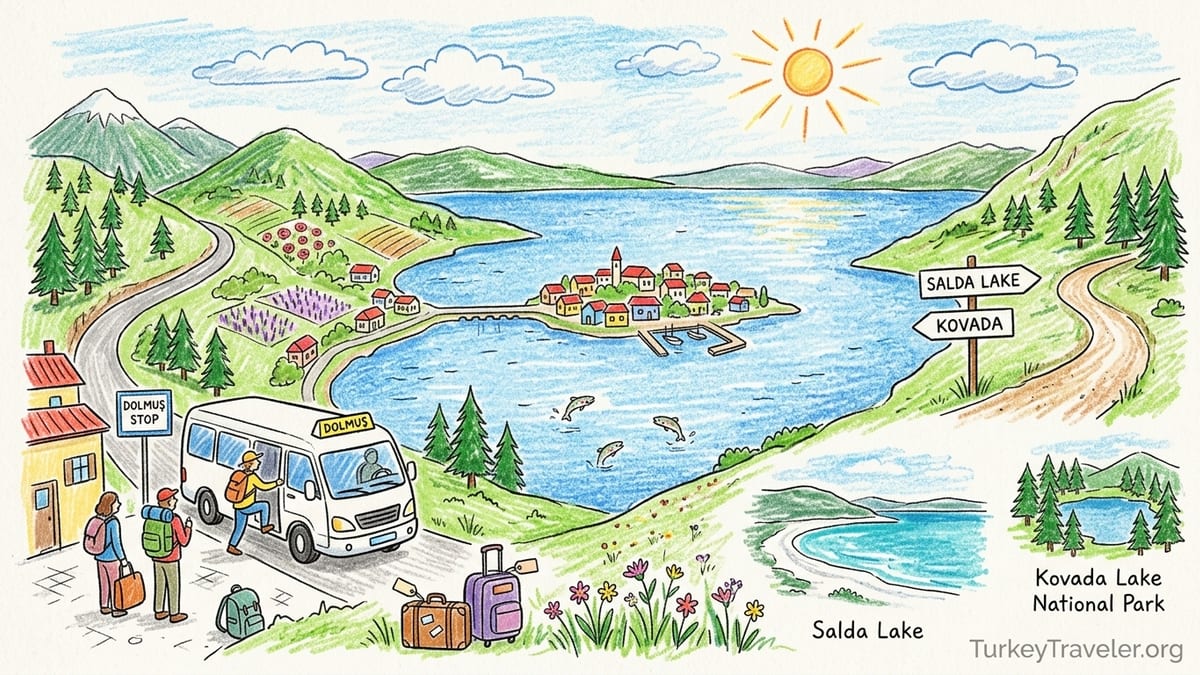
Why I Tried to Lake-Hop Without a Car
The Turkish Lakes District stretches across Isparta and Burdur provinces in southwestern Türkiye, a plateau of freshwater surrounded by the Taurus foothills. Maps tempt you with names: Eğirdir, Kovada, Burdur, Salda, and smaller basins like Karataş and Yarışlı. The marketing language talks about wildflowers, trout, and quiet villages. Hidden in the same official descriptions is a telling caveat that many lakes are remote and that renting a car in a nearby city is often the easiest way to visit them. I wanted to know what “often” really meant in practice.
My plan was simple on paper. I would base myself primarily in Eğirdir, the most visitor-friendly town on the shores of Lake Eğirdir, and use public transport to reach other lakes over four days. That meant getting into the region by bus, then relying on local dolmuş routes, regional coaches, and taxis only where absolutely necessary. No prearranged private driver, no multi-day car hire collected from the airport. It sounded perfectly reasonable sitting at my desk, tracing bus icons across online maps.
The region’s reputation encouraged that optimism. Isparta Province sits at a crossroads of major routes between Antalya, Denizli, Konya, and Afyon, and long-distance buses are abundant and relatively affordable. Around Salda, for instance, guides explain that you can reach Yeşilova by bus from Burdur or Denizli and then continue the last 5 kilometers to the lake by taxi or seasonal minibuses. From Burdur, information from local guides describes hourly minibuses to Yeşilova during the day. It all suggested a stitched-together network that, if timed right, could make up for the lack of a steering wheel.
What those same descriptions do not fully convey is how fragile that stitching can be once you factor in luggage, seasonal schedule changes, early-finishing rural services, and the simple desire to sit by a lake for sunset without worrying about whether your onward connection has already gone.
Getting In: Intercity Buses That Work Beautifully
My entry into the Lakes District could not have been easier. I started from Antalya, where bus travel remains one of the most efficient ways to move around Türkiye. Several operators run direct coaches from Antalya’s main otogar to Eğirdir or Isparta daily, with services from companies such as Isparta Petrol and others typically taking about 4 hours and costing the equivalent of roughly 8 to 10 US dollars depending on the season and exchange rate. By the time the bus began to climb away from the coast, I had already relaxed about the no-car decision.
On my afternoon departure, the schedule was clear: a 14:00 bus from Antalya, arriving in Eğirdir around 18:00, with a brief comfort stop outside Isparta. The coach was modern, with individual screens, tea and water service, and assigned seats. Larger luggage went under the bus; carry-ons fit easily in the overhead racks. This portion of the trip felt almost urban in its simplicity. I bought the ticket the day before using a national booking platform, walked into the terminal half an hour early, and rolled my suitcase onto the coach.
Arrival in Eğirdir was equally painless. The otogar sits just a short walk from the lakefront, and even with luggage I reached my guesthouse on the peninsula on foot in under 15 minutes. Taxis waiting at the station quoted around 150 to 200 Turkish lira for a short hop to the center in late 2026, reasonable for travelers who prefer not to walk. By the time I checked in and stepped back outside, the water had turned deep blue and the surrounding peaks glowed in the evening light. This was the first moment when I thought: yes, you can absolutely do this region without a car, at least if you choose your base carefully.
Key lesson from day one: getting into the Lakes District by bus is straightforward, as long as you anchor yourself in a town that sits on a major route like Eğirdir, Isparta, or Burdur. The real test only begins once you try to go sideways, from one rural corner to another, instead of simply along the spine of the highway network.
Eğirdir: Where Public Transport Shines
Eğirdir itself is the best argument against defaulting to car rental. The town lies on the eastern shore of Turkey’s fourth-largest lake, a long body of water framed by the Sultan and Karakuş mountains. It is both a district center and a lived-in community, which means there is regular transport in and out, along with services you actually need as a traveler: ATMs, supermarkets, bakeries, and small hotels clustered near the old peninsula.
From my base near the causeway that links the mainland to the peninsula, everything I wanted for slow days was walkable. The public beach, lakeside promenade, and small harbor were all within ten minutes on foot. Local dolmuş services trundled along the shore to nearby villages and beach areas during the day. Although not always clearly signed, they followed predictable routes and locals were quick to point out the right minibus if you mentioned the neighborhood or village name. Fares inside town and to nearby settlements ran to just a handful of lira, often coins handed directly to the driver.
One day I used the dolmuş to reach a cluster of lakeside picnic spots and swimming areas north of the center. I asked at my guesthouse about times, then walked to the main road where shared minibuses stopped in front of a bakery. Within fifteen minutes a white dolmuş with the correct sign appeared. The driver confirmed he was heading past my chosen stop, waved me aboard, and we threaded through apple orchards and small farms before being let out at a roadside tea house with steps leading down to the water. On the way back, I flagged down another dolmuş in the opposite direction and was dropped off near the peninsula.
This was public transport at its most satisfying: cheap, human, and reasonably frequent. For travelers happy to spend full days in and around Eğirdir, walking and using local minibuses works very well. The trouble begins when you try to fold in more ambitious plans, like adding Kovada Lake National Park as a day trip or combining multiple lakes in a single day.
The Kovada Detour: When the Last Mile Fights Back
Kovada Lake sits roughly 29 kilometers south of Eğirdir, a protected national park and a vital stop for anyone interested in the region’s geology and forests. On maps, the route looks trivial, essentially following the natural channel that connects Eğirdir to its smaller southern cousin. Guides describe Kovada as reachable from Eğirdir, and my assumption was that a dolmuş or two would link the district center to the park entrance throughout the day.
The reality was more complicated. The day I chose for Kovada was a shoulder-season weekday. At the otogar in Eğirdir, staff confirmed that there were minibuses heading toward the villages on the Kovada road in the morning and early afternoon, but they emphasized two points. First, the exact drop-off point might still be a few kilometers from the park entrance. Second, the last guaranteed return in the afternoon was earlier than I expected, leaving a narrow window for walking trails and lakeside time if I wanted to be certain of getting back before dark.
I boarded a mid-morning dolmuş that skirted the lake and then turned toward a village several kilometers from the park gate. The fare was modest, around what you might pay for a local trip in any Turkish town. Once we arrived, though, it became clear that continuing on foot would mean a long roadside walk with no shade and no certainty about when, or if, another passing vehicle might give me a ride. Waiting for another minibus was an option, but locals could only say that “one usually comes” around lunchtime, with no posted schedule.
After half an hour of watching trucks and the occasional car speed by, I compromised and flagged down a taxi from a nearby town that had just dropped off passengers. The driver quoted around 300 to 350 lira for the short run to the park entrance and the promise to pick me up again later in the afternoon at an agreed time. It was a fair price for his time and distance, but it also erased much of the cost savings I had imagined by avoiding a car. More importantly, I had to keep one eye on the clock during my hike, making sure I reached the rendezvous point so I would not be stranded after the last regular dolmuş.
In the end, Kovada was beautiful, but my time there felt compressed. I had about three hours to walk a lakeside loop, explore the viewpoints, and sit under pine trees before heading back to meet the taxi. Sunset at the lake was out of the question. The last reliable local transport in the direction of Eğirdir was too early to allow for that, and the taxi driver understandably did not want to be out on that road after dark for a single fare. This was my first real lesson in the Lakes District’s transportation reality: reaching a highlight on public transport is one thing, but having the freedom to linger, especially in the evening, is another.
Chasing Salda: Missed Connections and a Sunset Lost to the Road
The next test was Salda, arguably the region’s most famous lake thanks to its bright white shoreline and turquoise water. The lake lies near Yeşilova in Burdur province, about 60 kilometers from Burdur city along the road toward Denizli. Local information explains that travelers can get from Burdur to Yeşilova by minibus, then cover the last 5 kilometers to the lakeshore by taxi or seasonal dolmuş services when visitor numbers are high.
My plan required more steps. From Eğirdir, I first needed to reach Burdur, then connect to Yeşilova, and finally find a way to the lake itself. On paper, this looked manageable. Morning buses from Eğirdir to Isparta and then onward to Burdur are common, and from Burdur’s otogar, minibuses reportedly run to Yeşilova roughly once an hour during the day. To give myself a buffer, I left Eğirdir on an early coach, changed in Isparta, and arrived in Burdur around late morning.
That is where the first crack appeared. At the minibus area in Burdur’s station, I discovered that the timetable to Yeşilova had recently shifted for the off-season. The next dolmuş was in almost 90 minutes, not the hour I had counted on. I waited, shared a plastic chair with a backpack, and watched my planned lake time shorten. When the minibus finally arrived, the fare to Yeşilova cost the equivalent of only a few US dollars, but the real price was time. By the time we reached Yeşilova, early afternoon sun was already blazing over the white shores of Salda somewhere beyond the hills.
From Yeşilova’s small center, I asked around about onward transport. In peak summer, drivers explained, additional minibuses and shared taxis run from town to the designated public beach areas at Salda. On this shoulder-season day, however, there was no scheduled dolmuş to the lakeshore. The practical choice was a regular taxi to the main public beach area, with drivers quoting in the region of 250 to 350 lira one way depending on waiting time. I negotiated a price closer to the lower end with the understanding that the driver would drop me at the lake and return at a fixed time to bring me back to Yeşilova for the last minibus to Burdur.
We spent about fifteen minutes driving through fields and low hills until the first blue glimpse of Salda appeared. The lake’s main public beach has been reorganized in recent years, with controlled access to fragile white areas and focus on designated swimming beaches closer to Yeşilova and another popular spot near Doğanbaba. As I walked along the shore, it was hard not to resent the clock. Because the last regular Yeşilova to Burdur minibuses do not run late into the evening, I had barely three hours to swim, walk, and take in the views before I needed to meet my taxi.
Sunset was still hours away when I left. From the taxi back to Yeşilova and the dolmuş to Burdur, then an onward bus toward Isparta, I watched the sky deepen to orange through glass instead of from the water’s edge. In theory I could have stayed the night in a small hotel near Salda, which would have eased the transport pressure. In practice, I was traveling with a suitcase, and the thought of dragging luggage across three separate minibuses and a taxi just to reach a lakeside pension felt like too much friction for a short stay. Salda taught me that public transport can get you there, but only if you are willing to accept either a compressed daytime visit or an overnight stay that requires extra planning around luggage and limited services.
Rural Villages, Flower Fields and the Problem of Multi-Lake Days
One of the Lakes District’s quiet appeals lies away from the major shorelines. Around Isparta, rose-growing villages perfume the air in late spring, and highland communities cultivate lavender fields that have become minor attractions in their own right. Many travelers dream of stitching together an itinerary that combines, say, a morning at Lake Eğirdir, an afternoon among flowers, and perhaps an impromptu stop at a smaller lake along the route. Without a car, that sort of improvisation is significantly harder.
From Eğirdir, I tried to add a visit to a nearby plateau village known for its orchards on the same day as a lakeside hike. The dolmuş out of town left mid-morning, and the ride itself was delightful, passing fields and roadside stalls selling apples by the crate. Once in the village, however, I realized that the next minibus back was not for several hours. There was no posted timetable, just the driver’s assurance that he would “probably” leave in mid-afternoon. That eliminated any chance of combining the trip with another lake visit that day. Any attempt to move again by public transport would involve returning to Eğirdir first, waiting for an onward connection, and arriving at a second destination late in the day with no guarantee of a return service.
The rose and lavender areas near Isparta face similar challenges. During peak harvest and festival days, extra transport tends to appear, sometimes in the form of tour buses, sometimes as more frequent dolmuş runs organized informally between village and city. Outside those windows, the last-mile segment from main road to field or village can be awkward, especially if you want to carry luggage or camera gear and avoid walking long stretches along busy rural roads. Taxis can bridge the gap, but costs add up quickly when those rides involve significant waiting time.
Attempting multi-lake days without private transport proved unrealistic. To go from Eğirdir to Kovada and then on to another lake in the same day would have required perfect coordination around dolmuş departures that simply is not built into the system. Every missed connection pushed the next departure an hour or more away, which matters in a region where the most beautiful times of day are early morning and sunset. Instead of gliding from highlight to highlight, I found myself knitting together half-days anchored around whichever bus or minibus seemed most certain.
Luggage was another quiet constraint. On transfers between towns, carrying a roll-aboard or backpack is easy enough, with bus staff happy to store larger items. On small dolmuş routes, though, luggage quickly becomes a burden. Narrow aisles, lack of dedicated storage, and crowded services during local commuting hours make it uncomfortable to move with anything more than a daypack. That reality nudges no-car travelers toward single bases and out-and-back day trips rather than the one-night-per-lake fantasy that glossy images sometimes suggest.
Where Public Transport Truly Breaks Down
By the end of my week, patterns had emerged. Intercity buses between major towns such as Antalya, Isparta, Burdur, and Denizli were reliable, comfortable, and easy to book. Dolmuş services between district centers and nearby villages or beaches mostly ran as expected during the day, even if exact times were approximate. The real breakdowns happened in three situations: late evenings, shoulder seasons, and low-density last-mile segments to rural attractions.
Evening travel was the most obvious limit. Around Salda, local information warns that minibuses from Burdur to Yeşilova and back do not operate late into the night. Similar patterns appeared elsewhere. Dolmuş services that feel comfortably frequent at 10:00 in the morning can simply stop by early evening, leaving anyone still out at a remote village or lakeside restaurant with only two options: an expensive taxi or a long walk. That may not matter for day hikers who start early and finish mid-afternoon. For photographers, sunset chasers, or travelers who like to linger over dinner by the water, it matters a lot.
Shoulder seasons were the second weak point. In high summer, demand from domestic tourists often draws extra services. Minibuses that might run every hour in July can fall back to two or three key departures in May or October. When I traveled, some routes that online forums described as “frequent” were in fact operating on reduced schedules, and even locals could not always say precisely when the next vehicle would appear. I never found myself completely stranded, but I did spend more time than expected sitting on plastic chairs in bus yards, watching the sun slide toward the horizon while waiting for a driver to show up.
Finally, the last mile to specific attractions frequently required either a long walk or a taxi. At Salda, that meant budgeting extra money for the 5-kilometer ride between Yeşilova and the lakeshore if no seasonal dolmuş was running. Around Kovada, it turned into the taxi detour from the village where the dolmuş stopped to the park entrance itself. In rose and lavender country, it could mean hitching rides with locals or paying a driver to shuttle you between fields and villages. None of these are impossible, and the costs in lira are often modest compared with car rental. Yet they transform your day into an exercise in negotiation and contingency planning rather than relaxed lake-hopping.
On two separate evenings, early-ending services directly changed my plans. Once, I cut short a lakeside walk near Eğirdir to make sure I caught one of the last dolmuşes back to town, arriving just as the light turned golden. Another time, near Burdur, I chose to eat dinner in the city rather than at a village by the lake because the return dolmuş would have left before I finished my meal. In both cases, a private car would have let me stay out until after dark, but my self-imposed experiment required choosing the bus schedule over sunset.
The Hybrid Strategy I Would Use Next Time
My week without a car did not convince me that renting a vehicle is the only sensible way to see Türkiye’s Lakes District. It did, however, reshape how I would plan a return visit. Rather than treating car-free and car-based travel as an either-or choice, the region rewards a hybrid approach that plays to the strengths of both.
If I were starting again, I would still arrive by intercity bus. Coaches from Istanbul, Ankara, and Antalya to Isparta or Burdur remain efficient and comparatively low-stress ways to cover long distances. Tickets are easy to purchase a day or two in advance, luggage handling is straightforward, and arrival times put you in the heart of a city with plenty of accommodation and food options. From Isparta or Burdur, it is a short onward hop to Eğirdir by local bus or dolmuş, preserving that satisfying feeling of arriving at the lake by public transport.
The change would come once I started planning days that reach beyond the main lakeshore towns. Instead of trying to stitch together Kovada, Salda, flower villages, and small lakes purely on the back of dolmuş timetables, I would budget for a short-term car rental or local driver on specific days. Picking up a compact car in Isparta for two or three days, for example, would allow unhurried loops that combine Eğirdir, Kovada, rural plateaus, and evening stops for photographs without worrying about the last bus home. Similarly, arranging a local driver from Burdur or Yeşilova for a dedicated Salda day would protect you from missed minibuses and create room to stay through sunset.
That hybrid strategy does not mean abandoning public transport. On lake-centered days in Eğirdir, I would still leave the car parked and rely on my feet and dolmuş to get around. On transfer days between provinces, I would continue to use intercity buses rather than driving long highways myself. In practical terms, the biggest shift is psychological: accepting that a modest investment in a rental car or driver for two or three targeted days can unlock rural corners that otherwise require too many compromises around time, luggage, and early-finishing services.
Most importantly, experimenting without a car taught me to think in layers. The Lakes District has an excellent backbone of intercity buses, a patchier but workable web of dolmuşes, and a set of last-mile segments that still favor private transport. Building an itinerary means knowing which layer you are using on any given day, and being honest about when you want the freedom to wait for the stars to come out over the water instead of racing the clock back to the otogar.
FAQ
Q1. Is it realistically possible to visit Türkiye’s Lakes District without renting a car at all?
Yes, it is possible if you base yourself in a town like Eğirdir, Isparta or Burdur and are content with slower travel, daytime excursions, and accepting that some lakes and rural areas will be difficult or time-consuming to reach by public transport alone.
Q2. Which parts of the Lakes District are easiest to reach by public transport?
Intercity buses connect major cities such as Antalya, Istanbul, Ankara and Izmir to hubs like Isparta and Burdur, and there are regular onward buses and dolmuşes to Eğirdir. Within and around Eğirdir itself, local minibuses and walkable distances make it relatively straightforward to enjoy the lakeshore without a car.
Q3. Why is reaching Lake Salda challenging without private transport?
To reach Lake Salda, you typically travel to Burdur or Denizli by bus, then take a minibus to Yeşilova and finally a taxi or seasonal dolmuş the last 5 kilometers to the lakeshore. Limited evening services and off-season schedule reductions can compress your lake time and make it hard to stay for sunset unless you overnight nearby or arrange private transport.
Q4. How reliable are dolmuş (minibus) services around the Lakes District?
Dolmuş services are generally reliable during the middle of the day between main towns and nearby villages, but timetables can be approximate, evening departures taper off, and shoulder-season frequencies may be lower than in summer. It is common to wait longer than you expect, so building in extra time is important.
Q5. What kind of taxi costs should I expect for last-mile journeys?
Short taxi journeys from towns to nearby lakes or national parks often cost the equivalent of 10 to 15 US dollars one way, with higher fares if you ask the driver to wait and bring you back. Around Salda and Kovada, that can mean paying several hundred lira per segment, especially when travel involves rural roads and return pick-ups.
Q6. Can I do multi-lake day trips using only public transport?
In practice, combining several lakes in a single day purely by bus and dolmuş is very difficult. Each segment relies on connections that may run only a few times per day, and missed or delayed services quickly eat into your time. Most no-car travelers will find it more realistic to focus on one main area per day.
Q7. How does traveling without a car affect seeing sunrise or sunset at the lakes?
Because many rural services finish by early evening, relying only on public transport often means leaving scenic spots well before sunset to catch the last dolmuş or bus. Experiencing dawn or dusk by the water is much easier if you stay overnight lakeside or have access to a car or prearranged driver.
Q8. What are the main luggage challenges when using buses and dolmuşes?
Intercity buses handle luggage well with underfloor storage, but small minibuses can feel crowded and lack space for larger bags. Traveling with only a daypack on dolmuş routes makes life easier, while bigger suitcases tend to push you toward fewer accommodation bases and more out-and-back day trips.
Q9. When does it make sense to rent a car or hire a driver in the Lakes District?
Short-term car rental or hiring a local driver is most useful for reaching places like Kovada Lake National Park, Salda’s lakeshore, rural flower-growing villages, and smaller lakes that lack frequent public transport, especially if you want to stay for sunset or combine several stops in a single day.
Q10. What hybrid transport strategy works best for most visitors?
A practical approach is to use intercity buses to reach hubs like Isparta or Burdur, continue by bus or dolmuş to a base such as Eğirdir, and then rent a car or arrange a local driver for a few targeted rural days. On other days, walking and public transport are sufficient for enjoying the main lakeside towns.